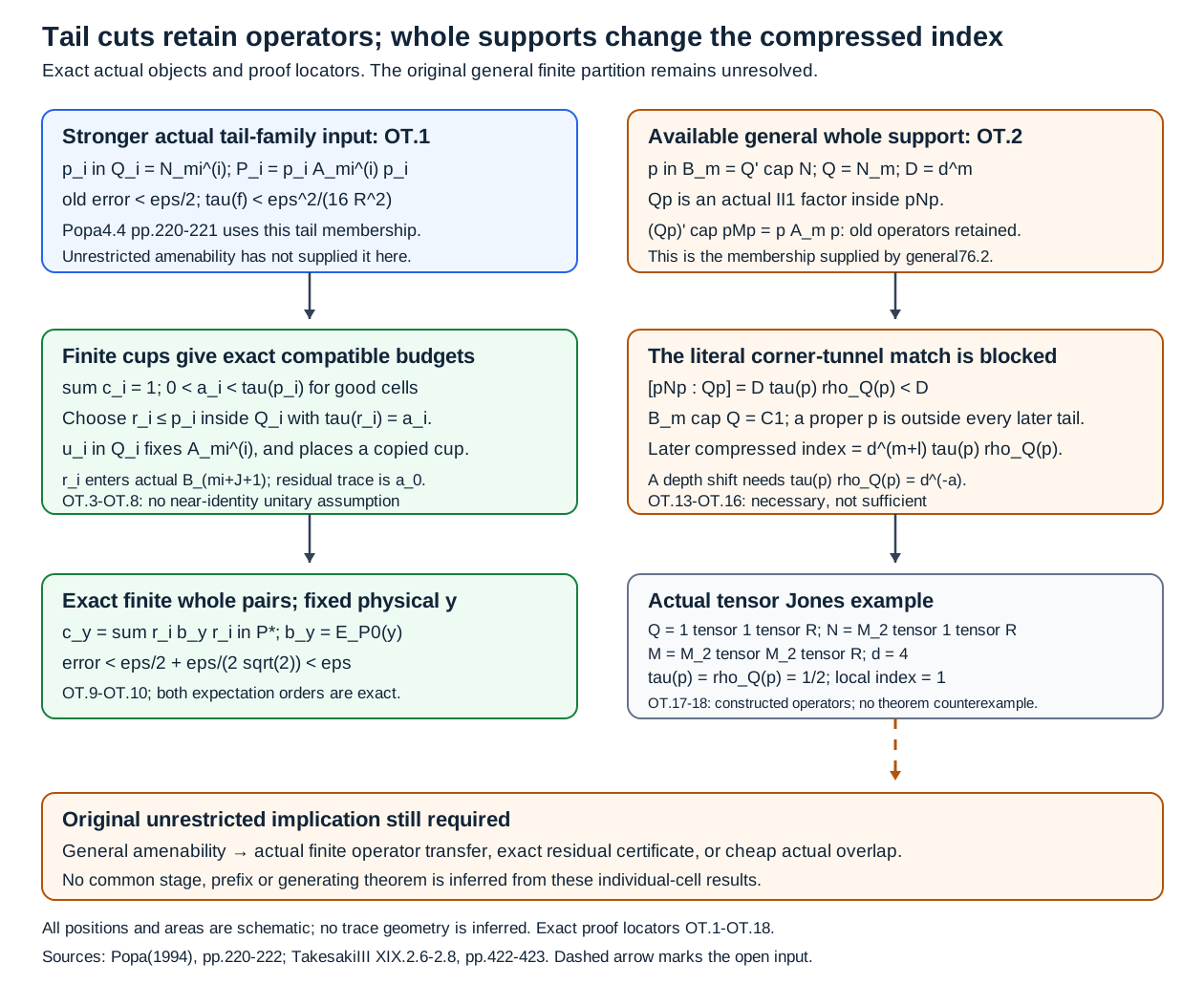
Tail supports, fixed operators and compressed tunnel depth
We continue the original unrestricted finite-partition problem, using the proved finite budget and operator-transfer criteria, UFP.2–UFP.5, and finite residual-cell criteria, FP.1–FP.5. Two new bounded results are proved here: an exact finite whole-cell conversion from an actual tail-supported near-cover, retaining the fixed physical target candidates, and the precise algebraic/index obstruction to applying that conversion to the whole-stage supports supplied by76.2. The unrestricted amenability implication is not proved.
The original endpoint and the source mechanism
The original statement is Popa4.4.1(1), printed p.222: for an amenable proper finite-index inclusion of II₁ factors and every finite , , find unital finite-dimensional , , with
and a finite orthogonal partition , each cell having its own actual finite whole-inclusion tunnel and
No finite depth, separability, extremality, ergodic core or unique norm trace is inserted. A common stage, preservation of an arbitrary ordinary prefix and generation remain separate endpoints.
Popa’s source argument on printed pages 220–222 uses two support memberships that must be distinguished. In4.4 the finite selected supports satisfy , a tail factor membership. Compressed tunnels can consequently be matched by corner-tunnel uniqueness. Whole-stage76.2 supports instead satisfy . These two memberships have different corner indices, as proved below.
Takesaki, Chapter XIX.2.6–2.8 gives the local-index formula with two distinct traces. The module dimension and local-index reading, Theorem 2.4, supplies the complete independently written proof used here. The finite-depth classification in Chapter XIX.§4 supplies no unrestricted amenability-to-operator transfer in this argument.
Exact conversion when the available supports really are in tail factors
Write , . All norms use the inherited normalized trace .
Theorem OT.1 — finite tail-supported conversion with fixed operators. Let be finite, , and . Suppose and a finite orthogonal family of nonzero projections has individual actual whole tunnels with
Then(OT.0)–(OT.1) hold with finitely many actual whole cells. In the construction, each good support is cut to , its old finite algebra is retained after compression, and the residual is one new whole cell. The physical are never conjugated. No near-identity placement unitary is assumed. This theorem assumes the actual tail-supported input(OT.2); it does not assert that unrestricted amenability supplies it.
Proof. Choose
In one faithful Markov cup factor, prescribe the probability vector
Apply the proved finite partition approximation argument of UFP.2 to the increasing finite cup algebras themselves. Its proof needs only a unital diffuse tracial closure and converging finite expectations, so it applies to this actual cup factor. It gives one finite cup stage, projections summing to one, and traces , with
The finite check is precisely , with the unchanged explicit constant of UFP.3. Thus, for every good cell,
The last bound follows from , (OT.2), and . The scalar residual trace is exactly , the trace of the finite cup projection .
Every is a II₁ factor. Prescribe inside with trace . These cuts remain physically orthogonal. Continue each actual tunnel, and copy the same finite cup projection into its future cup tail. In the exact convention51.1, and . A polynomial in the first tail cups
lies in and commutes with , by51.2. The generator-by-generator faithful Markov identification50.5/51.2 gives an actual projection there with the exact trace . This is a copy of a specified finite operator, not a scalar-array realization assumption.
Choose with , and rotate only that continuation. Because , it fixes every element of and . The new full supported late pair therefore contains
and its unit belongs exactly to the new finite smaller relative commutant. The support is not asserted to remain in the late tail factor. Earlier ordinary levels through are retained separately on this good cell.
Put . Its trace is the finite whole-stage trace certificate given by ; the canonical copy using lies in . Apply78.2 in to place in a separate actual whole finite smaller commutant. Take to be the direct sum of the full supported late pairs on all , and that full pair on . They have unit one and satisfy both expectation orders, by53.1 and trace pairing. Every summand contains its supported , so .
For fixed , let . It has norm at most . Each , , commutes with ; cross-cell products vanish. Thus every commutes with . The candidate
retains those actual operators exactly. Its missing part is , whence
This proves the strict target bound and the exact full finite structure. Only the controlled discarded physical mass remains in the error. No old matrix unit is retained on that discarded mass, and no target is moved by the placement unitaries.
This completes the finite whole-membership recovery from the actual tail-family part of Popa4.4. It supplies a concrete operator transfer without needing a general small- theorem at that stronger input. It is not a replacement for the original unrestricted hypothesis. Programme59.7 provides such tail families with a factorial larger core. Programme76.2 does not provide them in the unrestricted case.
What changes when the support belongs to a whole relative commutant
Theorem OT.2 — the actual compressed factor and its depth obstruction. Fix any actual ordinary tunnel, let , , and . Let be a projection in . On , set , the commutant of the actual left- action. The intrinsic dimension trace is a faithful finite normal trace with ; its normalized trace is . A physical projection denotes its left action when evaluated by either of these traces. Then the map
is a faithful normal unital *-isomorphism onto a II₁ factor (with unit ). It retains the exact old supported finite pair:
But its actual index in the physical smaller corner is
For every actual continuation ,
Consequently none of these compressed factors is a terminal factor of an actual corner tunnel of the same length . If one wants to reinterpret it as a terminal factor at some other finite length , a necessary numerical condition is
This condition is not asserted sufficient; the actual Jones projections, expectations and generation relations would also have to be constructed. No extremality or equality of the two traces is assumed.
Proof. Since commutes with , (OT.11) is a normal *-homomorphism. Its kernel is a weakly closed ideal of the factor , and it is nonzero on the unit; it is therefore faithful. The functional is normal tracial on , so equals . Hence the inherited normalized corner trace agrees with the original factor trace under(OT.11). For , commuting with all is exactly commuting with all , proving both identities(OT.12).
The complete local-index formula2.4, applied to and its relative-commutant projection , gives(OT.13). Faithfulness of and gives . The index is at least one; the strict upper bound is consequently a genuine finite index obstruction, not a hypothetical scalar assignment.
The -module is invariant. Restriction of scalars2.1 for gives
The same identity at1 gives total mass , hence normalized traces agree on . Apply2.4 again to obtain(OT.14). Every length- tunnel of the original physical corner inclusion has terminal smaller index : that inclusion has index , by algebra compression, and each actual predecessor step has index . Equality with(OT.14) forces(OT.15).
There is an even simpler exact membership obstruction. Since is a factor,
Thus this proper cannot belong to , or to any later tail factor , while that finite prefix is preserved. It cannot be turned into the support class required by OT.1 through a future-only rotation. This does not invalidate76.2’s retained-corner lift: that proof first retains its available physical residual in a tail factor, and constructs a whole-stage projection afterwards. The obstruction concerns reclassifying its final whole-stage support as a tail support while retaining that old prefix.
For comparison, if is an actual tail support, then has index . To check the normalization, right compression of by has left- dimension . Its left- dimension is by2.1. Algebra compression by the same divides by , giving dimension on . This is precisely why the tail-supported corner-tunnel matching in the.4 argument is valid. Replacing by the different factor in(OT.11) changes the depth calculation.
An actual Jones example of the depth shift
Take any II₁ factor , let , and set
This is an actual basic-construction triple . The projection is the maximally entangled rank-one projection on the two matrix factors. Direct multiplication gives for , , and
Thus the linear span is all of . More explicitly, the unitary , defined by , intertwines left matrices with the first matrix action. It sends the trace vector to . Tensoring with the identity on therefore fixes the specified left action and sends the actual Jones projection onto to the specified . Generation identifies its actual basic construction with this physical . Both adjacent indices are . Equivalently, each standard restriction is copies of the smaller standard module, so the dimension formula proves both indices directly. This explicitly constructs the Jones object; no scalar array is being called a Jones example.
Let . On , the commutant of left is . Left has rank in the -dimensional matrix Hilbert factor. Therefore , while
The visible compressed old stage has become depth zero, rather than depth one, in the physical corner. Here , so the necessary depth-shift resonance is exactly met. At , , both projection weights are and the compressed index is1. This example only illustrates the compression mechanism. It is not a counterexample to amenable finite partition, and no general amenability claim is inferred from its matrix coordinates.
Precise remaining implication
OT.1 proves actual finite whole-membership recovery and fixed-operator transfer from a finite near-cover whose supports belong to their tail factors. OT.2 proves both the factor construction and exact old relative-commutant retention for a whole-stage support, but also shows that its compressed factor has the wrong depth for the literal tail-corner amalgamation. Choosing a smaller-factor core, or silently applying corner-tunnel uniqueness at the old length, does not repair that difference.
General76.2 supplies whole-stage supports, not the tail-family input(OT.2). No unrestricted amenability-derived small actual , positive residual certificate, or sufficiently cheap actual overlap is obtained here. The original(OT.0)–(OT.1) remains open in this branch. The tail-family condition is a sufficient stronger input, not a necessary reformulation or a substituted theorem. Common-stage/prefix/generation and the separate singular-state/canonical-density branch remain outside this deliverable.
The editable figure and finite-check source reproduces the schematic and the exact rational operator checks. The complete arguments above establish the factor and index statements.
Human sources: S. Popa, Classification of amenable subfactors of type II, Acta Mathematica 172 (1994), 163–255, printed pp.220–222, DOI; M. Takesaki, Theory of Operator Algebras III, XIX.2.6–2.8, printed pp.422–423, Springer, 2003. The finite-index formula is used with larger factor , smaller factor , standard Hilbert space , inherited trace , and commutant trace . Immediate local proofs are 2.1–2.4/2.9, 4.1/4.5, 11.5, 50.5, 51.1–51.2, 53.1, 59.5–59.8 at their actual factorial larger-core scope, 76.2/76.4, 78.2, and UFP.2–UFP.4. Their existing prerequisite obligations remain explicit.
Solved learner checks
Exercise OT.1 — retain the physical targets with a strict numerical margin. Suppose the actual tail-supported input (OT.2) is available with two good cells, , , , , and . Set . Verify its admissibility, bound the discarded mass after finite cup approximation, and prove the strict target estimate. Explain which physical operators are retained and which hypothesis is still needed for the unrestricted theorem.
Solution. Both good traces exceed , and
The positive probability vector of (OT.4) sums exactly to one. The actual diffuse cup factor and its finite expectations provide a finite projection partition with total budget error less than , by UFP.2. Therefore each physical cut satisfies inside its actual , with . Its full supported late algebra contains the exact compressed old algebra in (OT.8). The new residual has the exact finite certificate , and
For each original physical , use and . They satisfy , , and . Hence
For the last strict inequality, square the positive comparison : its left square is . The old compressed candidates are retained exactly on the good cells; the controlled residual is discarded from those candidates and replaced by a full whole cell. The targets themselves are never conjugated. This computation is conditional on the actual tail-factor near-cover, including its old approximation bound. These scalar numbers alone do not construct that near-cover from general amenability.
Exercise OT.2 — a retained compressed factor with no possible finite tunnel depth. In the actual tensor Jones triple (OT.17), take and . Compute both projection traces, the two physical corner indices, and the index after actual continuation steps beyond . Can the retained compressed factor be the endpoint of any finite ordinary tunnel of the physical corner inclusion?
Solution. The actual standard-space unitary and matrix generation above establish the same Jones triple before compression. The inherited matrix trace gives . Left has rank on the nine-dimensional , so the normalized trace on the actual left- commutant gives . These two traces agree in this explicit model; that equality is not assumed in OT.2. The physical corners and embedded smaller factor are
The corner expectations are the normalized matrix partial traces. Module restriction, or the exact two-trace formula, gives
A length- ordinary tunnel of this fixed physical corner inclusion has terminal smaller index . Equality would require . Every integer power of , including negative powers, has zero 2-adic valuation, while has valuation two. Thus equality fails for all nonnegative integers , including . None of these retained compressed factors can be such an endpoint. This is a different compression of the same actual Jones realization used in (OT.18), illustrating an obstruction to this proposed transfer. It does not refute the unrestricted amenable finite-partition theorem or rule out another full-cell construction.
The transfer and the two corner normalizations
Figure OT.1. Actual tail cuts preserve fixed operators and permit exact full whole-cell conversion. The visible compressed factor for a whole-stage support retains the old pair but has a smaller corner index, blocking literal same-depth tail alignment. This does not contradict the original unrestricted theorem. No areas or positions denote traces. Editable source and exact finite checks. Human source context: Popa (1994), pages 220–222, and Takesaki (2003), XIX.2.6–2.8.
Original independently written exposition and figure: public domain, CC0 1.0.