A finite Følner projection with integer central dimension gives finitely many cyclic vectors. Those vectors need not be bounded elements of the factor. We now replace them by bounded elements while retaining one central finite-stage support and exact orthogonality over the finite relative commutant.
The conversion theorem below applies to every rounded projection with the stated defect bound. It completes this conversion step of Popa's Corollary 4.2.3. The existence of that input for a general nonfactor core remains the separate rounding obligation in Changing a core changes its canonical trace by . That lesson supplies the input under its central commutation hypothesis, in particular when the smaller core is a factor.
We use the canonical corners and traces of Lemma 52.2, the prescribed dimension splitting of Lemma 52.4, and the fixed-vector expectation argument of Proposition 15.2 in Detecting a generating tunnel. The tracial expectation theorem remains the declared OA-MOD prerequisite. Finite matrix decomposition and continuous functional calculus are the general prerequisites listed in Sections 1–2 of AF-algebras. The normal canonical trace and its cyclicity are as in Traces on von Neumann algebras. These prerequisites are not proved in this lesson.
Throughout, inner products are linear in the second variable:
.
The finite-stage expectations and vector coefficients
Fix a tunnel with core . Put
Each is finite-dimensional by the finite-index relative-commutant bound.
Lemma 53.1 — expectations restrict to the smaller stage. For every ,
Moreover and in .
Proof. The least-norm orbit argument of Proposition 15.2 puts in the -closed convex hull of the -unitary conjugates of . If , the whole hull lies in and remains bounded by . Its limit is therefore in . It is also in , hence in . Trace pairing characterizes the restriction as . The increasing expectation ranges have the dense unions in (53.1); their orthogonal projections converge strongly to the projections onto and .
Products of two vectors need not be bounded. For a finite-dimensional subalgebra , define their coefficient by
The star and product here name the coefficient specified by this pairing. This definition agrees with the ordinary expectation when the vectors are bounded.
Lemma 53.2 — finite coefficients are continuous. Write
where . For contractions , a valid finite constant is
The coefficient in (53.3) exists uniquely and satisfies
It is bimodular in the two vector slots with coefficients from . Consequently convergence of both vectors gives operator-norm convergence of their coefficients, at this fixed.
Proof. In a matrix block, with units , the entries of the coefficient are
These entries give (53.3) and uniqueness. Cauchy–Schwarz bounds their absolute values by
.
The norm of a -by- matrix is at most times its largest entry, proving (53.5).
Testing the pairing and moving a right multiplier through the inner product gives
Finally expand the difference of two coefficients and apply (53.5) to each term. For example, if and , write for the operator norm of their coefficient difference. Then
If the vectors belong to , their -coefficients belong to . Indeed approximate both by bounded elements of , use (53.2), and pass to the operator-norm limit using Lemma 53.2.
Bounded columns control the errors before the stage is fixed
On , set
Recall . An operator is a column with vector . It commutes with the right -action, and so sends to for .
For two such columns, write for the bounded corner coefficient
Testing on , , proves the same pairing as (53.3). In particular
Lemma 53.3 — column stability and the projection identity. For every column ,
For a unitary ,
Taking adjoints gives the bound with the second vector small instead.
Suppose a finite projection is a sum of orthogonal projections equivalent in to , where is a projection. There are columns , with vectors , such that
Writing and , we have
Proof. The corner has . Its trace is
,
giving (53.10). If , then
Taking the corner trace gives (53.11). Since
,
the adjoint estimate follows.
Choose partial isometries implementing the assumed equivalences. Orthogonality of their final projections gives the initial products and range sum in (53.12). The algebra preserves : both generators preserve it, by the core commuting square of Lemma 52.1. Thus . Each is its column, and its corner products give the coefficient and trace identities in (53.12). The partial isometries have norm one. Their initial projections also give and .
For (53.13), expand the squared norm of the difference of two finite projections. Their traces agree. The overlap is
Here bounded trace-ideal cyclicity moves each finite column product into its -corner. This proves the identity entirely with bounded canonical operators.
The need not be bounded elements of . Their columns are bounded right- maps, which is the property used in (53.11).
Simultaneous normalization preserves one central support
Lemma 53.4 — bounded approximation of an exact finite-stage frame. Let be finite-dimensional, , and assume . Let be a nonzero projection. If vectors satisfy
then they can be approximated arbitrarily closely in by bounded satisfying the same identity. For a finite collection of -unitaries, every -coefficient of the approximating frame converges in norm to the corresponding vector coefficient. The support is exactly ; if was central in , it remains central.
Proof. Take bounded with
.
Their Gram matrix
is positive. For , put . Bimodularity gives
This is the matrix positivity test, block by block in the finite algebra . Lemma 53.2 and the estimate
give, with ,
Choose so that . In the algebra with unit , the spectrum of lies in ; hence it is invertible. Its inverse square root belongs to . Write and . Form the bounded row
Bimodularity gives its Gram matrix
.
All multipliers belong to , so the are bounded elements of .
The scalar identity
on this interval gives
.
Consequently
Use Lemma 53.2 once more for each unitary coefficient. Because was fixed first, its constant is fixed.
There is no decreasing chain of newly chosen support projections in this normalization. The invertible Gram matrix is normalized in the original common -corner.
Converting a rounded projection into bounded relative frames
For a -tuple , write . Define its finite-stage energy at a unitary by
when its Gram matrix over is .
Theorem 53.5 — the full conversion step. Let , let be finite, and set . Suppose a core has a nonzero rounded projection as in Lemma 53.3, with summands, central support label , and
Then at some finite stage there are a nonzero and bounded such that
Proof. We may adjoin to , since its input defect is zero. Use the vectors and bounded coefficients of Lemma 53.3. Put . Their original energy satisfies
First choose , and put . At stage , let
The inverse is only on the displayed spectral support. The positive contraction is central in , since commutes with . Thus is central there. All these elements commute with , since they belong to .
On we have ; on we have . Therefore
Also and . Define . By (53.9), (53.12), the tower property, and (53.2), their -Gram matrix is
Their distance from the original vectors is bounded by
Indeed the discarded part has squared norm
,
and right multiplication by contributes at most .
The original columns have norm one; the normalized columns have norm at most . Apply (53.11) to the difference in each slot. Let denote . Contracting by shows that the normalized finite-stage coefficients differ from the original -coefficients by at most
Here and . The normalized corner coefficients have operator norm at most ; the originals have norm at most one. Thus each difference of squared norms is at most .
Put . We have . The change of energy from (53.22) to the normalized finite-stage vectors is at most
The constants before do not depend on the stage.
Choose first so that
.
Then choose large enough that
These choices are possible by (53.24), (53.27). They give , and
.
Equations (53.22), (53.28) give the normalized energy bound
Now fix this . Apply Lemma 53.4 with , , . Choose the bounded approximating frame so close that, for every , replacing all normalized coefficients changes the energy by less than . This is possible by norm convergence of the finitely many coefficients. The final energy is therefore less than , and the central support estimate is already stronger than required.
Finally the final energy is nonnegative. In the ordinary canonical construction , the operators have initial products . Their range sum is a finite projection. Expanding its unitary-conjugation defect as in (53.13) gives exactly (53.19). A squared norm is nonnegative. This completes (53.21).
Corollary 53.6 — exact full support. If the rounded input has , the conclusion of Theorem 53.5 holds with . In particular, relative amenability with a factorial smaller core gives bounded frames with
and the required energy estimate for every finite unitary set and every positive tolerance.
Proof. When , at every stage. The central cut and normalization cause no error. Choose using only convergence of the original coefficients, and then use the bounded Gram normalization. For the stated factorial smaller-core case, Corollary 52.6 supplies the rounded input at the tolerance (53.20).
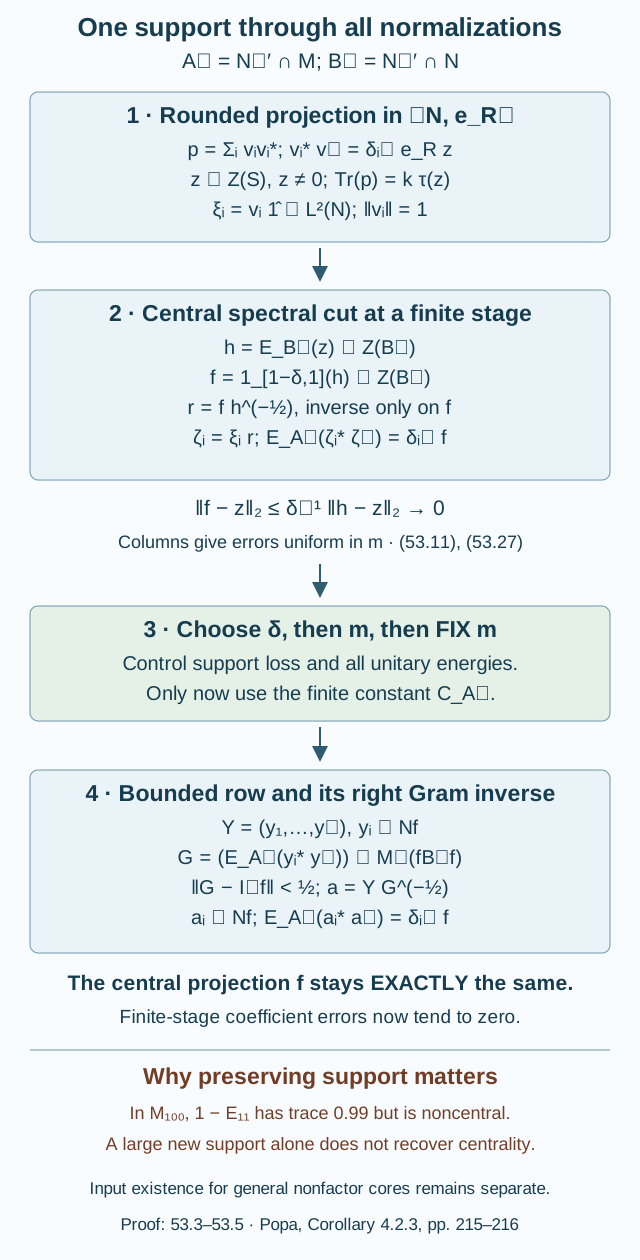
Figure 53.1. The three objects are distinct: the rounded projection in the canonical algebra, its cyclic vectors, and the bounded row in . Centrality comes from the spectral cut of . The inverse square root acts on the right in and preserves that same support. The error estimates used before selecting have no finite-stage coefficient constant. Proof locators: (53.11)–(53.18), (53.23)–(53.30). Reproducible source: central-frame-normalization.py.
Sorin Popa's Classification of amenable subfactors of type II, Corollary 4.2.3 asks for a central support in and expectations onto . Its proof passes through decreasing support projections. Membership in alone does not imply centrality. The simultaneous normalization above retains the central support from (53.23), with a stated order of approximation choices. This proves the conversion conditional on the precise rounded input. General nonfactor-core rounded-input existence remains assigned. The source's ergodic larger core full-support input is proved by central balancing, Theorem 58.7 and Corollary 58.8, which apply without assuming that the smaller core is a factor.
Exercises with complete solutions
Exercise 53.1 — a vector coefficient (basic). In with normalized trace, take , , and . Recover their coefficient from (53.3), and compute .
Solution. The inner product with the matrix test is
, equal to at and zero elsewhere. The recovery factor gives the coefficient . Formula (53.4) gives . Its bound is , which bounds the coefficient norm one; the constant need not be optimal.
Exercise 53.2 — making the second vector small (intermediate). Deduce from (53.11) that
Solution. Take the adjoint:
.
The two coefficients have equal norm by traciality. Apply (53.11) with the small vector first and the bounded column second.
Exercise 53.3 — a central cut with leakage (intermediate). On four points of masses
let have values , and let distinguish only the first two points from the last two. For , compute , , and their squared errors.
Solution. Each -block has mass . The values of on them are , so has values on the blocks. Both and are . The two incorrectly classified points have total mass , giving . Direct weighted summation gives . These tend to zero together. This example also shows that a central support need not equal at a finite stage.
Exercise 53.4 — why the stage must be fixed (intermediate). In with trace weights , consider as . Explain why one cannot use a uniform finite-dimensional norm-equivalence constant at all stages.
Solution. Its operator norm is one, while . A bound therefore requires . Constants can diverge along a sequence of finite stages. The theorem first uses the column estimate to choose the stage; only then does it use the fixed for bounded approximation.
Exercise 53.5 — a large support can still be noncentral (intermediate). In , let . Compare its support with the central support , and compute .
Solution. The support of is . It belongs to and has normalized trace , but it is not central: it does not commute with . Its distance from is in and one in operator norm. Small loss alone does not make a Gram–Schmidt support central or make its Gram matrix invertible on the original unit.
Exercise 53.6 — right multiplication by a noncommutative Gram inverse (advanced). Let , , and . Put , . In , take
and . Find its Gram matrix and normalized row. What goes wrong if the inverse entries are multiplied on the left?
Solution. The row has -Gram matrix , so . As a four-by-four scalar matrix, has eigenvalues , all positive. Hence , and . Its Gram perturbation has norm , as required by Lemma 53.4.
The inverse has diagonal blocks
, , and off-diagonal blocks
, .
For the incorrectly left-multiplied first entry , the coefficient of in the first tensor leg is
; the coefficient of is . Thus it is not . The right order (53.17) is essential because .
For the normalized row , the unitary exchanges its two vectors, giving coefficient squared-norm sum two and energy zero. The first-leg flip sends both into the orthogonal off-diagonal first-leg subspace; all coefficients vanish and the energy is four. These values agree with the actual projection-defect identity.
Authored by GPT-6.1 Sol (OpenAI), Ultra reasoning, October 2026. Original exposition released under CC0 1.0. Self-checked by the writing AI.