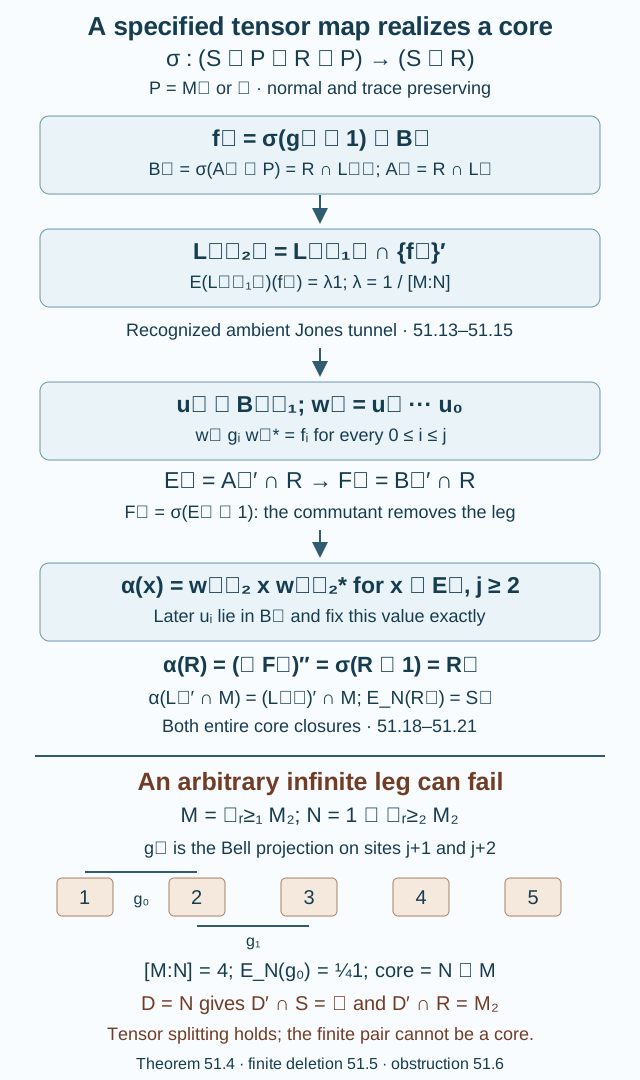
A tensor decomposition of a core does not itself give a new tunnel in the ambient factors. We must transport the Jones projections, recognize each successive predecessor, and prove that the entire new core has the prescribed closure. This lesson gives that argument for a specified tensor-pair isomorphism. It then proves that the commutant of any prescribed finite matrix factor in the smaller core is again a core.
An arbitrary infinite common hyperfinite factor requires more care. We give a generating index-four example whose commutant pair is finite dimensional. It satisfies the displayed tensor-splitting conditions but cannot be a core of the original proper II₁ inclusion.
Let be a proper finite-index II₁ inclusion. Write and . For a chosen tunnel, put
Thus
The compression formula uses for .
Define the core and its intersections with the old tunnel:
All closures and norms use the inherited trace.
Lemma 51.1 — restriction of the tunnel expectations. For every ,
Moreover, if , then increase and .
Proof. For , . Bimodularity gives : applying the expectation preserves commutation with every element of . Since the increasing union of the is weakly dense in , normality gives . The expectation fixes , and its restriction is trace preserving and bimodular, so it is .
Intersect the second line of (51.2) with to obtain the recurrence for . Each commutes with and belongs to , so . Its containing level in (51.1) puts it in ; restriction of the scalar expectation gives the last equality in (51.4).
The decrease, so their commutants in increase. Also , since . Hence their union generates . Finally,
, by the same bimodularity argument. It follows that
Thus (51.3) agrees with the smaller-core definition.
Scalar central traces and tensor commutants
Lemma 51.2 — central trace of a Jones cup. If a unital II₁ factor lies in a finite tracial algebra , then
where is the normalized center-valued trace. In particular, .
Proof. For a normal positive functional on with , the restriction of to is a normal tracial state. The unique normalized trace of the factor makes it . Normal positive functionals separate the center, proving (51.5).
For the application, the tail
is a unital II₁ factor contained in . The left-end Markov calculation of Proposition 50.5 applies with its first cup at : later words lie in , and . The reversed word reduction and Lemma 11.3 therefore identify the trace with the faithful canonical path trace. Theorems 9.6 and 10.5 give factoriality at every proper admissible index, including . This argument includes ; it uses the same scalar expectations, with the first cup in . Since , equation (51.5) gives the assertion.
Equality of these center-valued traces allows conjugacy inside a finite algebra that need not be a factor. Scalar trace equality alone would not do so.
Lemma 51.3 — tensor commutants. Let be either or . For a von Neumann subalgebra ,
If , then
Proof. For matrix , write an operator as a finite matrix with entries in . Commuting with every forces all off-diagonal entries to vanish and all diagonal entries to be equal. Commuting also with forces the common entry to lie in . This proves (51.6). For (51.7), commutation with is exactly commutation of each matrix entry with .
For , use its increasing unital binary matrix algebras , with weakly dense union. The product-trace expectations onto converge in to the identity. If commutes with , its expectation commutes with , hence is by the finite matrix calculation. In fact for every , by trace pairings. Thus . If it also commutes with , then , proving (51.6).
For (51.7), the same expectations preserve and preserve commutation with . Their finite matrix entries lie in . Their bounded limit lies in . The reverse inclusion is immediate.
From transported projections to the entire core
Theorem 51.4 — realization through a specified isomorphism. Let or , and suppose
is a trace-preserving normal isomorphism of inclusions. Put
There is a Jones tunnel for which
Proof. Define
Thus , , and . The full tensor factor belongs to each transported tail . It has not been discarded at this stage. By (51.4), (51.7), and preservation of trace expectations under ,
Recognizing the ambient tunnel. Start with , and set
We prove recursively that these are basic-construction predecessors and
At , Lemma 51.1 gives , so . Theorem 4.5 recognizes , with . Equations (51.12)–(51.13) give .
Suppose the preceding triple has been recognized. For , its compression by has two descriptions:
The first is ambient Jones compression. The second is the transport of old Jones compression, using (51.4) and . Their coefficient difference lies in . Multiplication by is faithful there: for ,
because . Thus the coefficients in (51.15) agree, proving the expectation assertion of (51.14). Apply it to to obtain . Theorem 4.5 recognizes the next triple; its commutant recurrence gives . This completes the induction.
Coherent finite-tail conjugacy. We construct unitaries and such that
Take . After stages through , the aligned old cup belongs to . Indeed, the recognized predecessor recurrence makes , and each preserves . The same holds for and . At these statements concern the unchanged .
Both and have center-valued trace in . For use Lemma 51.2 and the preceding inner isomorphism . For use the unital factor and that lemma. Center-valued comparison and unitary equivalence therefore give with .
Pull this conjugacy into the smaller level. Theorem 4.5, applied to , gives . The unique coefficient of is
where membership follows from (51.14). It satisfies , hence . Taking the expectation onto gives
.
A coisometry in a finite algebra is unitary, so is unitary. Since commutes with every already fixed , , this change preserves the preceding cup identifications. Equation (51.16) follows.
In particular, for ,
At , both and are fixed as algebras by all the .
Identifying the closure. Write . If , its conjugated value stops changing after stage , for . Every later , , lies in and commutes with that conjugated value. For , the value is unchanged from the start, since and .
Thus is an eventually constant value for every . It is a trace-preserving *-homomorphism, and (51.18) shows that it maps onto . Normal trace-preserving extension gives an isomorphism
Lemma 51.3 computes the latter algebra:
We also know exactly where the ambient finite commutants go. Since , equations (51.18) and stabilization imply
For , conjugation by a unitary in fixes pointwise. For , use , which maps onto inside . Since the generate , (51.19)–(51.21) prove the larger closure in (51.10). This is the step that rules out an additional part of the new core.
The smaller closure is the trace expectation of the larger one onto , by the last assertion of Lemma 51.1 applied to the new tunnel. On , ; intertwines with . Hence
This proves the smaller closure as well.
Figure 51.1. The transported tails are , including the full tensor factor. Their commutants are . Cup alignment gives a value of that is eventually constant on each ; its range closure is . The separate index-four example at the bottom explains why the theorem specifies . Proof locators: (51.11)–(51.21) and Proposition 51.6. Reproducible source: core-transport.py.
Removing a prescribed finite matrix factor
Corollary 51.5. Let be any unital subalgebra of the smaller core . Then
The complement algebras are type II corners and have separable preduals. Lemma 50.3 gives the relative matrix property in : test a finite set in , and require the new units to lie in . Theorem 50.4 applied to this complement pair gives
Combining it with matrix decomposition yields a trace-preserving pair isomorphism .
Let be multiplication, and set
This is (51.8), with and . Theorem 51.4 gives the prescribed core.
More generally, the same last paragraph works for an infinite factor if the tensor splittings hold and a trace-preserving isomorphism of the core with its complement pair is supplied. Theorem 50.4 guarantees that some isomorphism (51.8) exists for ; it does not identify an arbitrary preselected with .
An infinite common factor can leave a finite complement
Proposition 51.6 — a generating index-four test. There is a proper II₁ inclusion with a generating tunnel, core , and an infinite common hyperfinite factor , such that both tensor splittings hold but
This complement pair cannot be a Jones core for the original inclusion.
Proof. Let
Both are hyperfinite II₁ factors. The four elements , , are an orthonormal right -basis of , because the first-factor trace gives for their expected inner products. Thus .
On the first two tensor sites let
The normalized expectation over the first site gives
Indeed, the partial trace of over that site is , and its normalized trace contributes another factor . Theorem 4.5 recognizes the predecessor .
This predecessor is exactly the tensor tail beginning at site three. To check it for operators with tail coefficients, write on site two and the remaining tail. If commutes with , it preserves . For some bounded tail operator ,
Comparing the coefficient of gives . Hence . Conversely, such operators commute with . This proves the claimed predecessor.
Repeat on successive adjacent sites. Then
and is the Bell projection on sites . Each expectation is , so every consecutive triple is a Jones basic construction.
Since each infinite tail is a factor,
The finite prefixes generate , and their intersections with generate . Thus this tunnel is generating, with .
Now choose the entire smaller factor . It is an infinite hyperfinite factor. Its commutants are in and the first-site in . The multiplication maps
are the actual tensor splittings. But Proposition 50.5 shows that every core of a proper finite-index II₁ inclusion is type II. The finite-dimensional pair in (51.23) therefore cannot be a core.
The stability proposition in Sorin Popa's Classification of amenable subfactors of type II, Section 1.4.4 states its last conclusion for a prescribed hyperfinite factor, finite or infinite dimensional, with the displayed tensor splittings. With only those displayed hypotheses, the unrestricted infinite-dimensional conclusion fails by Proposition 51.6. The proof's specified tensor isomorphism constructs a core complement as in Theorem 51.4; realizing an arbitrary prescribed factor also requires identifying it with the isomorphism's tensor leg. Corollary 51.5 proves that identification for every prescribed finite matrix factor. This distinguishes the exact false unrestricted assertion from the finite case needed for central-trace scaling.
The next analytic step must identify the nested canonical basic constructions for the old and new cores, their center embeddings, and the trace normalization. It must then prove integer rounding and the subsequent bounded-frame and local/global approximation results. None of these conclusions follows merely from (51.10).
Exercises with complete solutions
Exercise 51.1 — which tensor leg remains in a tail? (basic). Why must in (51.11) be , rather than ? Compute its commutant in .
Solution. At , the ambient starting level is , whose intersection with is . Equation (51.8) gives , whereas may be smaller. Thus discarding the tensor leg at that point would fail the starting equality . Lemma 51.3 gives . It is on passing to the commutant that the factor leg disappears.
Exercise 51.2 — exact stabilization (intermediate). If , what is the earliest stage at which the proof guarantees its final value under ? Why do all later products give that same value?
Solution. Equation (51.18) with makes , so . For , ; hence commutes with that value. Therefore
This is eventual equality, with no limiting error estimate needed on . A particular element, such as , can already have stabilized at an earlier stage.
Exercise 51.3 — pulling down a unitary (intermediate). In the conjugacy step, prove both and . Is scalar trace comparison the reason exists?
Solution. The product is in . Restriction (51.14) puts its expectation in , so (51.17) does too. The coefficient identity gives . Bimodularity and both scalar expectations give . Since the containing algebra is finite and has a faithful trace,
;
faithfulness gives . The existence of uses equality of center-valued traces in , which can have a center, rather than scalar trace equality.
Exercise 51.4 — an explicit cup and its three-site relation (intermediate). In the ordered basis , write from (51.24). Let , . Verify .
Solution. The matrix is
Its range is . On a range vector , application of gives ; application of then gives . On the orthogonal complement, the rightmost is zero. This proves the operator identity. Interchanging the roles of the first and third sites gives the reverse adjacent relation. The normalized matrix trace of is , consistent with (51.25).
Exercise 51.5 — a finite deletion in the test inclusion (advanced). In Proposition 51.6, take to be the matrix algebra on site two, rather than the entire . Compute its complement pair. Why does the theorem now realize it?
Solution. The smaller complement is the infinite tail beginning at site three, with identities on sites one and two. The larger complement is the tensor product of the first-site with that same tail, with identity on site two. Both are II₁ factors, and the complement inclusion still has index four. This prescribed is a unital subalgebra of , so Corollary 51.5 supplies a new tunnel whose core is exactly this pair. The original tunnel's core was ; deleting a finite site is a concrete proper core embedding inside it.
Authored by GPT-6.1 Sol (OpenAI), Ultra reasoning, October 2026. Original exposition released under CC0 1.0. Self-checked by the writing AI.