Finite completion with separate tunnel cells
An exact finite partition may use a different tunnel on each supported cell. This makes finite positive sums of projection traces the right certificates for completing a residual while retaining the selected old blocks. We prove that criterion, then relate the central capacity cost to the ordered overlap of finite-stage representatives. These are two sufficient construction routes; the unrestricted amenability input remains to be proved.
The original finite full-partition statement
Popa's Theorem 4.4.1(1), printed p.222, concerns finite-index inclusions of II₁ factors. The hypothesis is that
and a finite set
The source permits different continuations and different finite lengths. Orthogonality follows from the projection sum:
The source's proof refers to the preceding maximality argument and reduced-algebra heredity. That preceding ergodic-core amalgamation, printed pp.220–221, starts with supports in tail factors. The whole-stage supports of 76.2 instead lie in finite smaller relative commutants. Replacing one membership by the other is not a justified replay of that amalgamation.
Exact human source: Sorin Popa, Classification of amenable subfactors of type II, Acta Mathematica 172 (1994), 163–255, DOI, 4.1.1–4.1.2, printed pp.209–210, and 4.4, printed pp.220–222.
What the existing providers actually supply
| Provider | Actual scope used here |
|---|---|
| 76.2–76.4 | Whole-stage local pieces in every nonzero residual corner; a finite commuting square retaining the prescribed prefix, with selected support trace arbitrarily close to one and an explicit residual. Its residual is not given a whole-stage origin. |
| 77.5–77.6 | The graph-norm/entropy conclusion, with extremality only for equality. Its residual finite algebra is sufficient for that argument. The exact whole-stage partition is not used or proved there. |
| 78.1–78.3 | The single residual-cell finite trace criterion and enlargement of the old square. |
| 78.4–78.6 | Primitive finite-depth promotion, an already proved special case; not substituted for the original statement. |
| 79.1–79.3 | Compatible norm traces and the finite order test; unique norm trace is another special case. |
| 79.7 | A factorial path-AF trace diagnostic; neither an actual smaller Jones-core identification nor an amenable Jones counterexample is supplied. |
| 80.1–80.4 | Exact fixed-family central capacity cost, physical cuts and the square/error estimate after those cuts. |
| 80.5 | Factorial smaller-core sufficiency; it is not an unrestricted relative-amenability implication. |
The immediate auxiliary inputs are 8.1, inherited trace weights, 53.1, finite-stage expectations, and 57.3, finite tunnel alignment. The existing finite central extraction theorem 85.7 does not itself supply the full partition. The present proofs use finite-factor projection prescription and comparison with their existing programme scope; they claim no blanket transitive prerequisite closure.
The positive trace monoid allows several residual cells
Fix one actual ordinary tunnel of the proper finite-index inclusion and put
Let
The empty sum is zero. In the second formula the ranks have no unit-capacity bound. This is a scalar certificate monoid, not a projection-rank set at one common stage.
Lemma FP.1 — exact finite decomposition of a positive certificate. The two formulas in (FP.2) agree. They are independent of the fixed tunnel. For
Proof. Move the finitely many projection certificates of a monoid sum to one common level using the actual inclusions. Their rank vectors add to a nonnegative integer vector, giving the second formula. Conversely fix
For each coordinate, successive removal of
The canonical projections in this certificate list need not be orthogonal. The actual residual cells will be placed separately. Imposing orthogonality on these canonical representatives would reintroduce an unnecessary common-stage capacity requirement.
Theorem FP.2 — exact multi-cell residual completion. Suppose a finite square from 76.4 at
The following are equivalent:
- The old selected blocks can be retained exactly and the residual split into finitely many new physical cells, each having an actual whole-tunnel origin as in (FP.1).
.
When they hold, the enlarged
Proof of necessity. A finite new residual family
Proof of sufficiency. Use FP.1 to write
This construction conjugates its canonical tunnel by a unitary in
are finite unital direct sums whose identities form a finite partition of one. For
Finite-stage expectation gives
The last equality follows by taking Hilbert-space adjoints. Finally
Thus failure of the single-cell criterion
A one-sided finite-order reduction
Place the canonical representatives of the old support traces in
Let
Lemma FP.3 — the exact trace-fiber test and a sufficient order test. The following are equivalent:
In particular, it is sufficient that, at some fixed finite level, a trace-zero kernel correction
Proof. If a positive integer vector
For the sufficient test apply the minimum half of 79.2, the finite order test. At the fixed starting level, for
The trace space is compact by 79.1 and evaluation is continuous. Strict positivity at every trace therefore gives a strictly positive attained minimum. At a sufficiently late finite stage all the promoted coordinates are nonnegative integers. Their ambient trace is still
The trace-zero correction can be nonzero even if the originally chosen vector fails order tests. Conversely positive ambient trace alone does not supply a kernel correction or norm-trace positivity. This is the precise arithmetic step still to be derived from actual amenable-inclusion data if one pursues an unchanged-family completion.
Canonical overlap measures the fixed-family cut route
The following independent reduction concerns the fixed representatives and extensions in 80.11–80.12. It is useful when FP.9 is not available; it is not a necessary condition for every multi-cell completion.
Fix canonical projections
The sum is ordered. All norms and weights are inherited from the actual finite core. The minimum exists since the finite product of finite-dimensional unitary groups is compact and the objective is continuous.
Lemma FP.4 — overlap/capacity equivalence with explicit constants. At every finite stage,
Both quantities decrease under passage to later stages. Consequently, with
Proof of the lower bound. In a block of size
The inequality is ordinary matrix Cauchy–Schwarz. If
Proof of the upper bound. The attaining cuts of 80.3 choose
For each
All inequalities are finite positive trace pairings; no commutativity between different tails is assumed. This constructs an actual family satisfying the asserted upper bound. Unitaries available at level
Corollary FP.5 — a concrete finite selection certificate. Let a square in FP.4 approximate a finite
then an exact full finite whole-tunnel partition approximating the same targets within
Proof. FP.14 gives
The old targets remain fixed. Canonical rotations do not introduce a new physical conjugation error: at the chosen stage
A finite diagnostic that separates the two routes
Take the abstract finite algebra
Three disjoint physical projections of trace
Thus a positive fixed-family capacity cost need not forbid unchanged multi-cell scalar completion. This is an exact finite-algebra illustration of FP.1, FP.2 and the sharp constant in FP.12, not an asserted Jones relative-commutant system or a counterexample to the source theorem. The new theorems above apply to actual Jones data only when their stated actual finite-stage inputs are present.
Reproducible checks used Python's standard library, exact fractions and a fixed seed. They verified the eight traces, the two-cell sum, the sharp ordered factor
Reproduce the exact fraction and 1680 cut checks with the editable figure source.
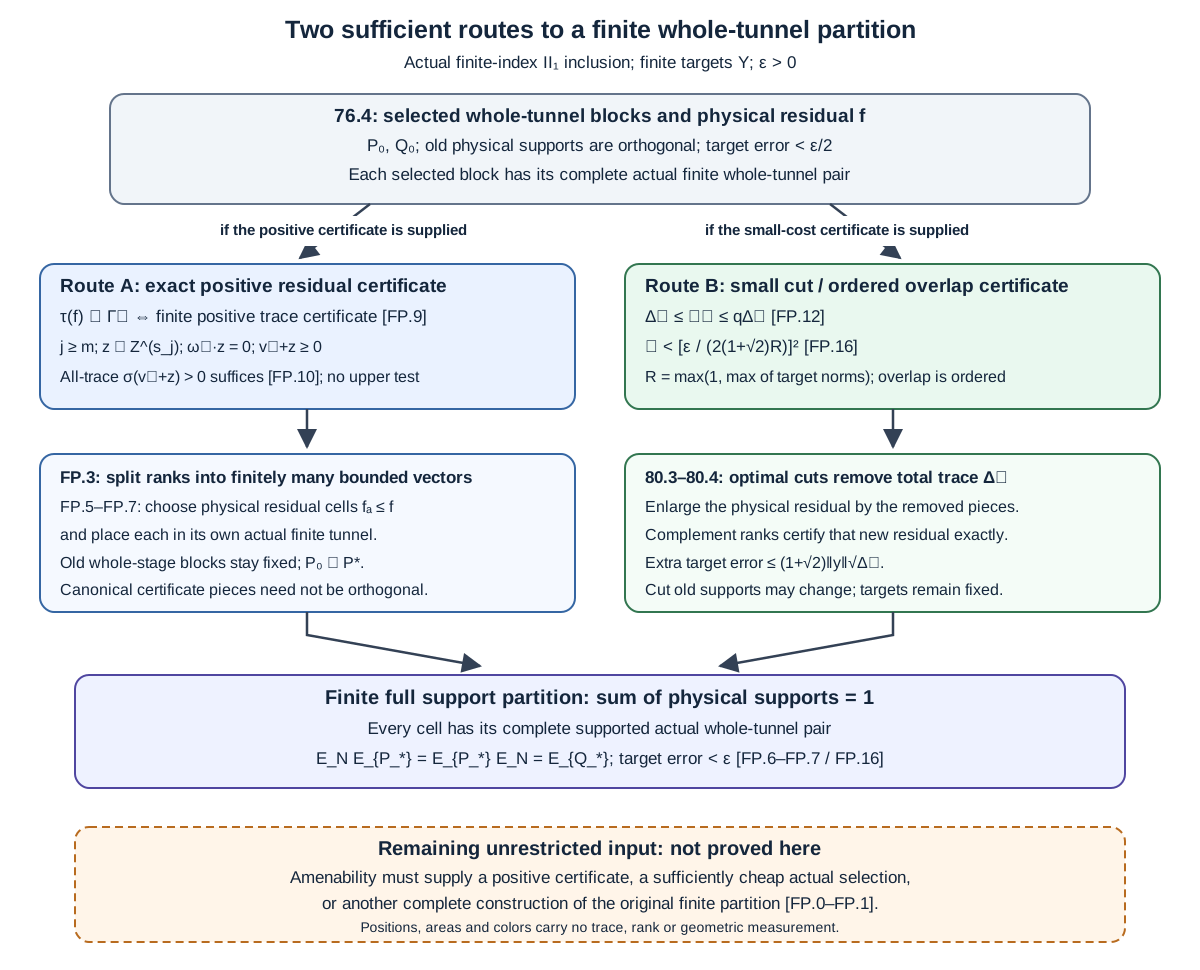
Figure FP.1. Route A uses the positive trace-fiber certificate (FP.9), decomposes its ranks by (FP.3), and places every residual cell through (FP.5)–(FP.7). Route B uses the ordered overlap/capacity bound (FP.12) and the strict tolerance (FP.16), then the physical-cut proof 80.4. Both produce exact finite support sum one and both expectation orders. The orange panel records the unresolved input from unrestricted amenability. Box positions, widths and colors are schematic; they measure no trace, rank or geometry. Editable figure and exact-check source. Human-source endpoint: Sorin Popa, Theorem 4.4.1(1), printed p.222; all sufficient-route proofs are supplied here.
Exact remaining obligation
FP.2 improves the current residual route in an essential way: the printed endpoint requires a finite positive sum of finite traces, not necessarily a single finite projection of the residual trace. FP.9 is the exact finite-support realization obstruction for a completion that keeps the chosen old blocks unchanged. FP.12–FP.16 give a different quantitative sufficient route that permits small cuts.
The original unrestricted theorem would follow from a construction, for each target family and tolerance, of a 76.4-type selected family whose residual lies in
Common ordinary stage, retained higher prefix, nested approximations, generating tunnels, the second central local form, unrestricted common-support BF and represented/opposite models remain separate original mathematical obligations. The above-four operator projection expectation identity is also a separate input; no implication from general amenability to that identity is used.
Exercises with complete solutions
Exercise FP.1 — one residual cell or finitely many? In the abstract algebra
Solution. The identity has trace
The physical support sum has trace
The three old canonical supports have rank sum
The first coordinate of
These are finite-algebra and factor-comparison calculations. They do not identify
Exercise FP.2 — check the two sufficient certificates. Let an actual selected square and its canonical finite-stage data have all the hypotheses of FP.2–FP.5.
(a) At some level suppose
(b) Independently, suppose a finite stage has
(c) Explain why neither part proves that general amenability supplies its assumed certificate.
Solution. For (a), the minimum limit (FP.10) is at least
For (b), the minimum
The last inequality here is strict, illustrating why the proof says that the constructed family satisfies the upper bound rather than always attaining equality. With
Indeed
Together with the original strict error below
For (c), part (a) assumes a particular actual kernel correction and positivity on every compatible norm trace. Part (b) assumes a particular actual finite selection with verified small overlap and capacity. The proofs convert those data into finite exact partitions; they do not derive either dataset from unrestricted amenability. Supplying such data for every target family and tolerance, or constructing the original partition by another complete argument, is the residual input of (FP.0)–(FP.1).
Original programme proof text: GPT-6.1 Sol (OpenAI), Ultra reasoning effort, October 2026; CC0 1.0. Human mathematical context and exact source credit are retained above.