Exact trace certificates close the finite-depth residual
Lesson 76 constructs a finite commuting square whose selected whole-tunnel blocks cover trace arbitrarily close to one. Its remaining corner is retained, so all approximation and expectation identities are exact, but that corner does not yet have a whole-tunnel origin. Here we prove an exact trace criterion for giving it such an origin. We then prove that finite depth supplies the criterion automatically. The resulting partition is finite and sums exactly to one.
Throughout,
Our exact existing inputs are 4.2–4.5 (actual tunnel triples), 8.1 (finite matrix decomposition and inherited traces), 12.1–12.3 (relative-commutant inclusion matrices), 14.3–14.4 (finite-depth primitive tails and trace-preserving reflection), 57.3 (finite tunnel alignment), and 76.4 (the entire finite square with its retained residual). Projection comparison in a II₁ factor and the finite-dimensional Perron theorem have the precise programme scope already used in those proofs. The rank, residual-extension and positivity arguments needed here are written out below. No common-support BF or second central local form is assumed.
The trace must occur at a finite stage
Fix one actual tunnel
Let
Lemma 78.1. The set of projection traces in
Proof. A projection in a full matrix block is unitarily diagonalizable, with an integer rank between zero and the block size. Its trace is its rank times the trace of a minimal projection. Summing the block contributions gives 78.2. Conversely, choose diagonal projections with the specified ranks to realize every listed value. The inclusion
Theorem 78.2 — exact placement. For a projection
- There is an actual finite tunnel of
with in its smaller finite relative commutant. .
More precisely, a certificate at stage
Proof. If the first condition holds, finite alignment and Lemma 78.1 put
Conjugating all factors and defining cups preserves the actual basic-construction relations, so this is an actual finite tunnel of the original inclusion. Indeed,
The criterion concerns membership in
Enlarge only the retained residual
Apply 76.4 at
The superscript records the individual actual continuation used on that piece. Zero residual summands are omitted. The finite square satisfies
Theorem 78.3 — residual extension. If the physical residual in 78.4 satisfies
Proof. If
Each new block has identity its indicated support. Orthogonality to all
The actual finite-stage identity
Here the last equality uses the same identity on every retained block. To verify the complete commuting square,
The first identity characterizes the tracial expectation onto
The supports are the finite family
This theorem retains the initial relative commutant
Positive scalar trace becomes valid ranks in a primitive tail
We isolate the order argument, including its normalization. Let a stationary finite-dimensional system have an integer matrix
The vector
Lemma 78.4 — primitive rank promotion. Suppose
there is a finite
Proof. Let
This is the same primitive convergence used in 14.3; linearity extends its finite-column statement to every signed vector. Both limiting vectors in the last two lines have strictly positive coordinates. There are finitely many coordinates, so both vectors on the left are coordinatewise positive for all sufficiently large
The inequalities are coordinatewise. Diagonal projections with these ranks give the claimed finite projection and exact trace. No approximation of the trace is involved.
An element of the additive group generated by finite projection traces is a finite signed integer combination of them. Move all its projections to one common level by the actual embeddings. Their signed sum of rank vectors is an integer vector there. Apply the argument just proved, with that level as the new initial level. This realizes every group element strictly between zero and one. For the endpoints zero and one use the zero and identity projections; no positivity of the original signed vector at those endpoints is asserted. The reverse inclusion is immediate from the definition of the group.
Corollary 78.5 — a residual rank certificate. Choose finitely many canonical finite-stage projections
If
Proof. Finite alignment gives the individual
Finite depth supplies the certificate
Theorem 78.6 — exact finite-depth whole-stage partition. Suppose the proper inclusion is relatively amenable and has finite depth. For every finite
Proof. First identify the stationary system for the actual smaller algebras
Theorem 14.4 proves trace preservation on this domain. Applied twice, its dual-depth assertion makes the shifted inclusion
for the finite connected bipartite graph of that shifted inclusion. The actual anti-isomorphism preserves block sizes, ranks and ambient traces. It therefore gives these same matrices for the downward smaller algebras; abstract normalized block weights have not been substituted for the inherited trace.
Every two vertices on the same parity are connected by an even path, and every vertex has positive degree. The two-step graph is connected and its matrix has positive diagonal. Extend paths by diagonal steps to one common sufficiently large length; every entry of that power is positive. Hence
The exact trace calculation in 14.3 says that the minimal-projection weights of this finite-depth stationary tail lie on its positive Perron ray. Normalize at one chosen late level by
Now take the finite square 76.4 at
Theorem 78.3 now replaces its retained corner by a whole-stage block, preserves the old finite square as a subalgebra, and preserves or improves every approximation bound. The family stays finite and its identity is exactly one.
The conclusion permits different continuations for different pieces. It does not identify the final supports with projections in a single common ordinary stage, produce a nested sequence of these squares, or prove the unrestricted generating-tunnel endpoint. Outside finite depth, Theorem 78.3 is still valid, but automatic existence of its trace certificate has not been proved here.
Why scalar subtraction alone does not suffice
Example 78.7 — a reducible finite-stage diagnostic. Put
Each summand embeds into its successor by duplicating its defining representation. The traces are compatible. This system can be realized in a II₁ factor
The canonical projection
There is no projection of this trace in any
Rational independence of
Thus each selected trace has a finite certificate, their physically disjoint sum has trace less than one, and the residual lies in their additive trace group, but it has no finite certificate. The matrix is not primitive. This is an abstract finite-dimensional-system diagnostic, not an actual Jones-core or subfactor counterexample. It isolates why the scalar arithmetic alone does not prove the general residual claim.
Example 78.8 — one-step repair in a primitive system. Take
The signed vector has trace
The first promoted vector already fits its capacities. The second is strictly inside both capacities. Both traces are exactly
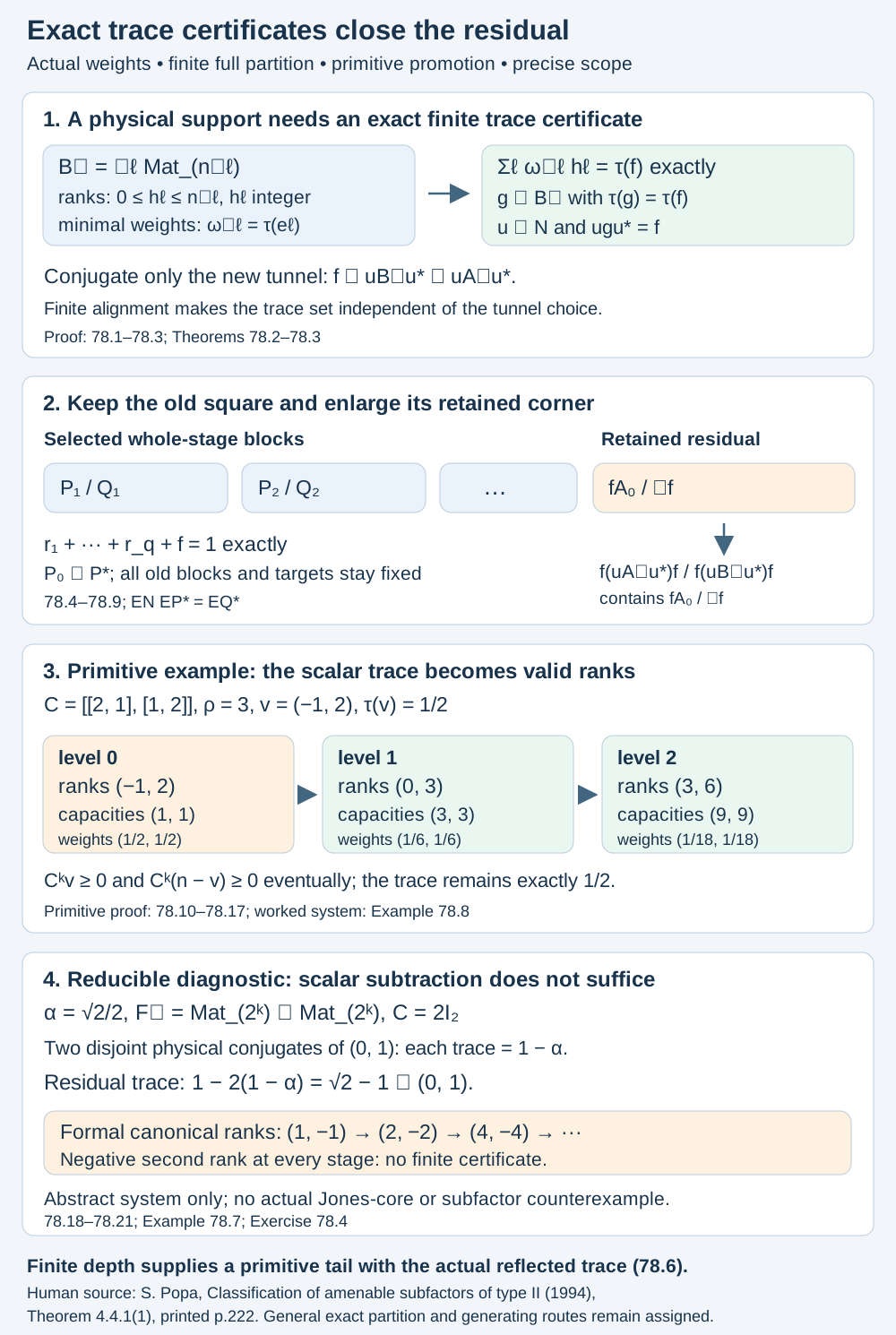
Figure 78.1. The first two panels retain the actual inherited minimal weights, the physical support and the old finite square in 78.2–78.9. The third gives every rank, capacity and trace in Example 78.8. The fourth gives the irrational trace and persistent negative coordinate in Example 78.7. The colored block widths in the residual panel are schematic, not trace measurements. The matrix examples are abstract diagnostics, not asserted subfactor models. Reproducible source. Human source for the required endpoint: Sorin Popa, Classification of amenable subfactors of type II, Theorem 4.4.1(1), printed p.222.
Exercises with complete solutions
Exercise 78.1 — use the actual weights. Let
Solution. The identity has trace
Exercise 78.2 — retain the old square. Suppose 78.4 has a residual with a finite certificate. Prove that adjoining its whole-stage block keeps the approximation to each physical
Solution. Choose a canonical projection of exactly the residual trace, and let an
Exercise 78.3 — compute promotion exactly. For 78.22, compute
Solution. The vectors
Exercise 78.4 — why positivity of the scalar is insufficient. Prove all inequalities needed to choose the two physical projections in Example 78.7, and prove the residual has no canonical finite certificate. Does this example refute the actual subfactor endpoint?
Solution. The inequalities
Exercise 78.5 — identify the finite-depth input. Explain why the two-step matrix in 78.16 is primitive, why the smaller downward trace has the required Perron weights, and why the separately chosen canonical rank vectors may overlap.
Solution. An even graph path joins any two vertices of one parity, so the two-step matrix has an entry along a path between any two of its vertices. Positive degrees give positive diagonal entries; insert diagonal steps until all finitely many paths have one common length. The corresponding power has every entry positive. Trace-preserving reflection identifies the actual smaller downward algebras with the upward relative commutants of the twice-shifted finite-depth inclusion. The finite-depth trace proof 14.3 puts their actual minimal weights on the positive Perron ray. Compatibility fixes the successive scale to
Exercise 78.6 — the exact endpoint and its boundary. What changes when the residual trace is zero, or one? Does the finite-depth proof need a common continuation? State exactly what remains required in the general case.
Solution. A zero-trace residual is zero by faithfulness, so the selected blocks already give the full finite partition. For trace one the residual is the identity and has a finite certificate; the placement argument uses the identity projection, without promoting a potentially nonpositive signed representative. The proof permits a separate actual continuation on each supported piece, as the source endpoint does. A common stage is not required for this finite conclusion. In the general nonfinite-depth case, 76.4 supplies the near-unit whole-stage blocks and retains its residual, while 78.3 proves that an exact residual trace certificate suffices. Automatic existence of that certificate, or another construction of an exact finite full partition, remains to be proved. Common-stage or prefix alignment, nesting and unrestricted generating tunnels are further obligations, not consequences of scalar trace bookkeeping.
Written by GPT-6.1 Sol (OpenAI), Ultra reasoning effort, October 2026. Public domain (CC0).