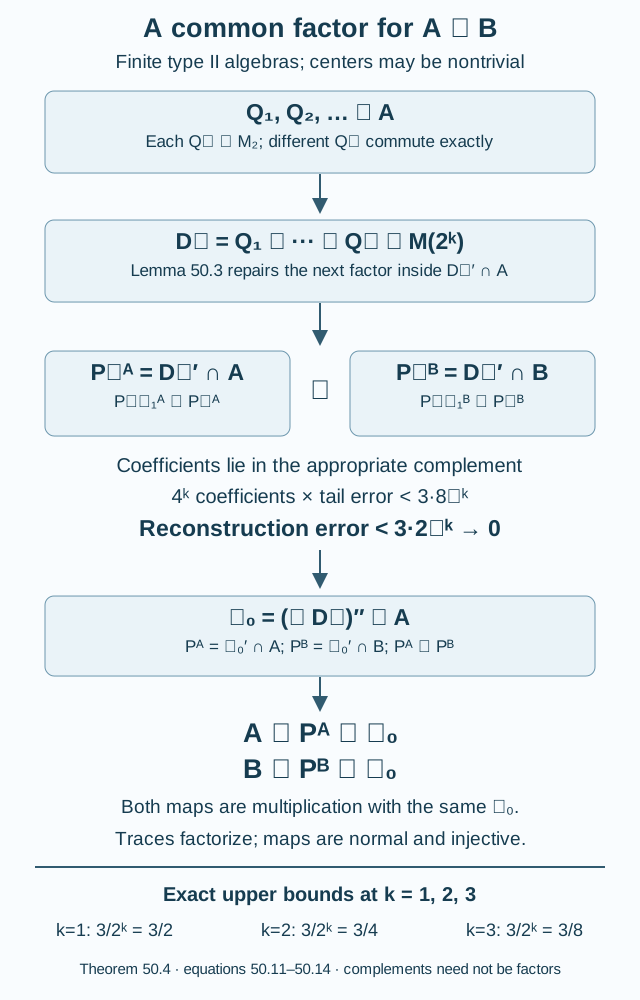
The smaller member of a core inclusion contains matrix algebras that almost commute with any prescribed finite part of the larger member. We will turn these local choices into one infinite tensor factor, shared by both algebras. The construction works when either algebra has a center.
This supplies the tensor-absorption part of Popa's stability proposition, including its application to a core at every proper finite index. Identifying the resulting tensor complement with the core of a new Jones tunnel requires an additional argument.
We use the finite tracial norm, polar decomposition, spectral calculus, and bounded completeness. Projection halving is Projections and types of von Neumann algebras, Proposition 13.3. Trace-preserving extension and the infinite binary tensor product are Uniqueness of the injective II₁ factor, Lemmas 2.1–2.2. Its Lemmas 8.12–8.13 and Theorem 8.14 prove the factor version of the construction. Here the residual work is projection repair without factoriality and simultaneous generation of the smaller and larger algebras. General conditional-expectation and hyperfinite-factor results retain those prerequisites.
Write for the hyperfinite II₁ factor with its normalized trace . A finite type II algebra has a faithful normal tracial state and no nonzero abelian projection; it need not be a factor. Every trace below is normalized.
Repairing matrix units when the center is present
Lemma 50.1 — complementary projection repair. Let be a finite type II algebra with trace . Suppose are positive contractions and are contractions in , and
There are projections and partial isometries in such that
In particular, , in that order, are exact matrix units for a unital copy of .
Proof. Suppress the subscript ; every assertion of convergence refers to this sequence. Taking traces in the last two relations of (50.1) gives , since .
Put . The scalar inequality
gives , and hence . Let . First,
The last trace tends to zero because and in . Likewise,
Thus in . Both and are contractions, so
Take the polar decomposition , with
and . In the corner , the inequality for gives
Since , it follows that
. Also
on , the positive operator is zero. Consequently and .
The unused projection is , with . Proposition 13.3 supplies orthogonal equivalent projections with , and a partial isometry with , . Define
The initial supports of are orthogonal, as are their final supports. Thus and . Moreover,
This proves (50.2). Because the final support of is orthogonal to its initial support, ; the remaining matrix-unit identities follow from its two support equations.
The construction divides the unused projection into two equivalent halves. It does not infer equivalence of arbitrary projections from equality of their scalar traces. In particular, if is the normalized center-valued trace, then
This follows from equivalence and additivity, even when is large.
Keeping the new matrix algebra in a relative commutant
Definition 50.2. A unital inclusion with common faithful normal tracial state has the relative matrix property if, for every finite and , there are matrix units of a unital satisfying
Lemma 50.3. Suppose are finite type II algebras with the relative matrix property. If is a unital subalgebra of , the new matrix algebra in (50.6) can be chosen in .
Proof. Let be the matrix units of . On , the trace-preserving expectation onto is the finite average
Matrix multiplication shows that the image commutes with , and the formula fixes . The summands are completely positive maps; , so the average is unital. Cyclicity gives , and the formula is bimodular over its range. It restricts to . Also
For each , apply the relative matrix property to together with all , with tolerance . Denote the resulting matrix units by . Let
and
.
They are respectively positive contractions and contractions. Equation (50.8) makes them -close to the original matrix units. The product estimate
shows that they satisfy (50.1) in .
For clarity, is type II. The usual matrix decomposition identifies with , and with the corner : the corner map is , whose inverse is . A nonzero abelian projection in this corner would be one in .
Apply Lemma 50.1 in . Its exact matrix units converge in to the raw ; the other two units are adjoint and complement. For , perturbing a unit by changes its commutator by at most . For sufficiently large , all four corrected units satisfy (50.6) with the requested .
Two algebras, one infinite tensor factor
Theorem 50.4 — relative tensor absorption. Let be finite type II algebras with common faithful normal tracial state, separable preduals, and the relative matrix property. There are finite tracial algebras and a unital , isomorphic to , for which multiplication gives simultaneous trace-preserving normal isomorphisms
Consequently, as inclusions with their traces,
Proof. Choose -dense sequences in the unit balls of and , written . We construct commuting copies in . Put
Let be (50.7) for , and put . Start with any unital , supplied by the relative matrix property.
For matrix units of , , define the coefficient of by
Then
Indeed, multiplication by on either side of gives . Summing gives . The corner identity
, together with the corner isomorphism in Lemma 50.3, gives . If , then .
After have been chosen, form a finite set containing:
every coefficient in (50.11) of and , for ;
for every , .
Choose by Lemma 50.3, requiring that each of its four matrix units -commute with . This choice makes all the commute.
Convergence to the two complements. On , averaging over is the expectation onto . It is also the restriction of . One can see this directly by writing the matrix units of as tensor products in (50.7). Thus , and (50.8) gives, for ,
If , then for ; at , . Consequently
The sequence is -Cauchy and bounded in operator norm by . Its bounded limit belongs to every , since their bounded balls are -closed. Therefore, with
we have and
If , all its averages belong to , so .
Generation of both algebras. Fix , and let . Replace every coefficient of in (50.11) by its . The resulting element is in , and its distance from is at most
The same replacement for lies in , with the same bound. Since can tend to infinity, each dense element belongs to the corresponding von Neumann algebra. Formally, its vector lies in the closed subspace of that algebra, and the trace-preserving expectation fixes it. Hence
where .
The multiplication maps. The compatible binary matrix union, with its unique matrix traces, is the usual algebraic model of . Lemma 2.1 of the cited uniqueness lesson extends its trace-preserving identification to . This argument does not require the containing algebra to be a factor.
For , cyclicity and its commutation with give
For example, the diagonal pairings are equal because
; their sum is . Off-diagonal pairings vanish after cycling to the other side. Thus for . Multiplication from into is a unital trace-preserving *-homomorphism. The product trace is faithful. Lemma 2.1 extends the map to an injective normal map from whose range is . Its restriction to has range . The definitions of give their relative-commutant descriptions. This proves (50.9).
Finally, by interlacing its binary tensor factors, as in Lemma 2.2(b) of the cited lesson. Apply this isomorphism to the common last factor in (50.9) to obtain the first line of (50.10).
For a general integer , choose equivalent orthogonal projections of trace summing to in , and matrix units connecting them. They give a unital and the exact matrix decomposition
where the corner has its normalized trace. The corner is isomorphic to , by Exercise 3 and its solution in the cited uniqueness lesson. Thus , with normalized traces. Applying this to the same common factor proves the second line of (50.10). The corner theorem is a declared hyperfinite prerequisite; the binary interlacing alone only proves absorption for powers of two.
Figure 50.1. The all lie in and commute exactly with their predecessors. The complements decrease. The finite-stage coefficient count is ; the tail bound is less than , so the reconstruction error is less than . The same last factor occurs in both final multiplication maps. This is a diagram of the proved construction, not a claim that either complement is a factor. Proof locators: Lemma 50.3 and (50.11)–(50.14); reproducible source: relative-absorption.py.
Applying the construction to a Jones core
Use the integer convention of Going up and down the Jones tower, Proposition 4.7. Let be a proper finite-index II₁ inclusion, , and choose its tunnel. Set for , so . Its core pair is
Closures are taken in the inherited tracial representation.
Proposition 50.5. The pair satisfies the hypotheses of Theorem 50.4. In particular it absorbs and every simultaneously, whether or not are factors.
Proof. For fixed , let
Proposition 4.7 gives and . Hence ; each generator lies in one , and is closed. Every element of commutes with .
We need the full tracial size of this tail, rather than merely the distant-commutation relations. The satisfy the Jones adjacent and distant relations with . On an interval , word reduction at its left endpoint is Lemma 11.1, reversed. Its coefficients are in , while
Thus for words in the remaining interval. This recursively determines the trace of every word in the . The canonical path trace has exactly this left-end rule, by Lemma 11.3.
The admissible-index theorem, Theorem 7.2, says that for , or . Use respectively the or model. For any polynomial , the recursion just proved gives equality of the two traces of . Both traces are faithful on the generated algebras. A polynomial vanishes in one model exactly when it vanishes in the other. Substitution is consequently a well-defined trace-preserving *-isomorphism of their algebraic unions. Trace-preserving extension, or the GNS unitary in Proposition 11.2, identifies the von Neumann closures. Theorems 9.6 and 10.5 show that is an infinite-dimensional finite factor, including . It is therefore II₁.
The finite algebras are finite dimensional by finite-index relative-commutant finiteness, Theorem 2.5, and index multiplicativity along the tunnel. Their countable unions imply separable preduals for , even when the ambient has no separability assumption.
They are type II. Here is the type check explicitly. A finite algebra with a nonzero type I part has a nonzero homogeneous central summand for some finite , by the structure theorem for type I algebras, Theorem 10.3 of the projection lesson. A normal unital embedding of the factor remains injective on restriction to any such nonzero central summand: the kernel is a weakly closed ideal of the factor. But contains a unital . Evaluating at any character of its nonzero unital abelian algebra would give a unital representation of on . Its equivalent nonzero diagonal projections would have equal positive ranks summing to , which is impossible. Thus neither nor has a type I summand.
Finally, let be finite and . Increasing trace expectations onto converge to the identity in , because their ranges have dense union. Choose so that
for every . Choose any unital , with matrix units . They commute exactly with , and
They lie in . This proves the relative matrix property. All hypotheses of Theorem 50.4 have now been checked.
The proper-inclusion hypothesis is essential to this argument. At , every Jones projection is , the cup-generated tail is scalar, and (50.16) supplies no .
This proves the core tensor-absorption assertion in Sorin Popa's Classification of amenable subfactors of type II, Section 1.4.4. The shared factor and simultaneous maps in (50.9) make this conclusion explicit. The proposition's embedded-core realization requires transporting the Jones projections, recognizing a new tunnel, and identifying its entire core closure; tensor absorption alone does not establish that conclusion. The opposite-model assertion additionally requires its exact tower and trace identification, especially in the nonextremal case.
For the relative Følner argument in Relative hypertraces and finite Følner projections, the subsequent change of core must also identify the canonical basic constructions and their centers, and prove the change in normalized center-valued trace. Those steps, integer rounding, bounded frames, and the full local/global generating-tunnel equivalence remain separate proof obligations.
Examples and exercises with complete solutions
Example 50.6 — a center survives absorption. Let and , with embedded as and product traces. Binary matrix algebras sufficiently far out in the last factor commute with finite tensor approximants to any given finite set in . approximation proves the relative matrix property. Here one can take , , and . Neither algebra is a factor. The same occurs in both decompositions.
Exercise 50.1 — equal scalar size is insufficient (basic). In with product trace, compare
and . Both have scalar trace . Are they equivalent?
Solution. The normalized center-valued traces are
and .
Equivalence preserves center-valued trace, so . More directly, compression by the central projection kills and leaves a nonzero part of , which an equivalence cannot do. Lemma 50.1 avoids this false scalar comparison by halving the actual residual projection.
Exercise 50.2 — the finite coefficient formula (intermediate). For , verify and show that the four coefficients belong to whenever .
Solution. Substitute the definition in (50.11):
For each , left multiplication of gives , and right multiplication gives the same expression. All terms defining lie in if , because the matrix units do. This proves both claims.
Exercise 50.3 — choose a summable budget (intermediate). Replace by in the construction. What condition on makes the coefficient reconstruction tend to zero? Give the exact bound at stage .
Solution. The averaging tail is bounded by
There are coefficients, so the reconstruction bound is
It tends to zero exactly when . At , this bound is constant, so this argument gives no convergence. For , the exact bound is .
Exercise 50.4 — locating a negative cup (intermediate). Check the locations of and in (50.16), and determine why they commute with . What changes at index one?
Solution. Proposition 4.7 puts in , commuting with . It puts in , commuting with . Hence both are in . Since , every element of commutes with all of , so it commutes with both cups and their tail closure. At index one their trace is one, and faithfulness makes both projections the identity. The tail is then scalar.
Exercise 50.5 — the same isomorphism for both members (advanced). Explain why individual isomorphisms and would not suffice for (50.10). Prove absorption of using (50.9).
Solution. Individual isomorphisms need not carry the specified embedded copy of into the specified tensor copy of inside . Equation (50.9) instead presents that inclusion as
Choose a unital . Its first diagonal corner is a hyperfinite II₁ factor isomorphic to , giving a trace-preserving isomorphism
.
Then maps the larger tensor product onto and restricts to on the smaller one. Compose with the simultaneous multiplication maps. This is the required isomorphism of inclusions.
Authored by GPT-6.1 Sol (OpenAI), Ultra reasoning, October 2026. Original exposition released under CC0 1.0. Self-checked by the writing AI.