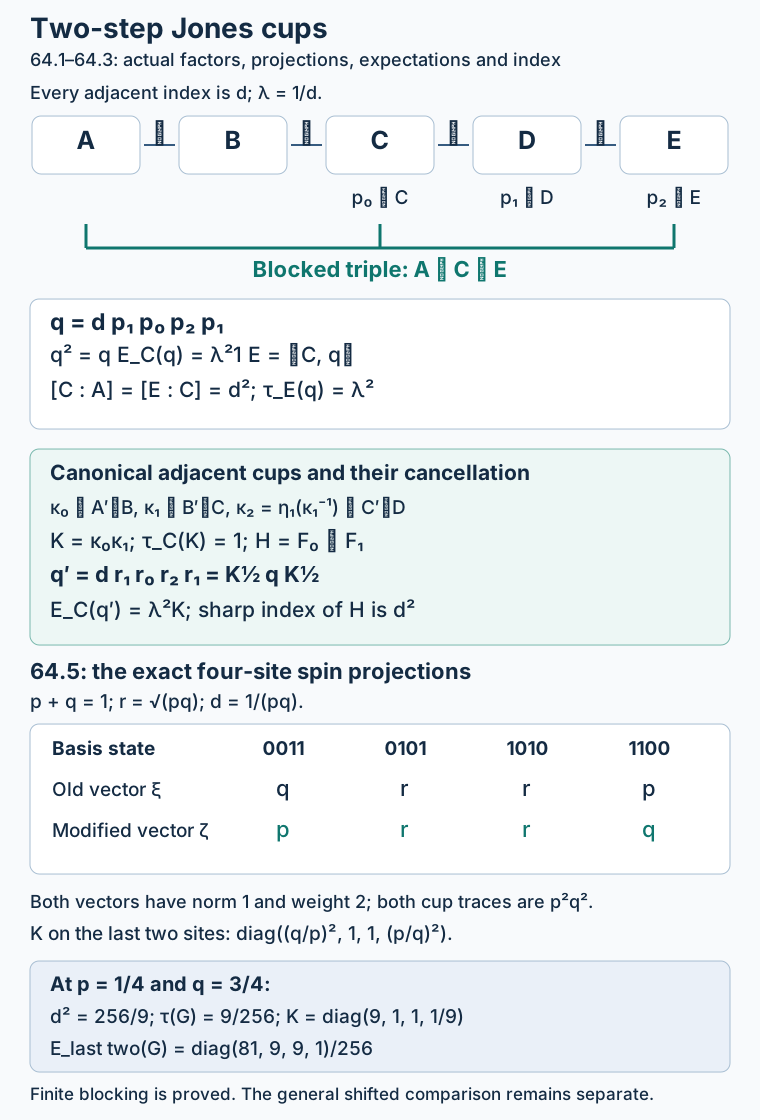
Taking every second factor of a Jones tower gives another Jones tower. Its cup is a normalized word of four original cups. For canonical modified cups, the same word implements the composition of two expectations, with a product density and sharp index equal to the square of the one-step index. We prove these assertions inside the prescribed factors and calculate the full weighted-spin example.
Write a consecutive portion of any tracial Jones tower or tunnel as
Every adjacent index is , and . Let , , be the Jones projections for , , , respectively. Thus
with the reverse adjacent relations as well.
Theorem 64.1. The operator
is the Jones projection for the blocked inclusion . In particular,
Here is the trace-preserving expectation.
Proof. Put , , . The two outside projections commute, and
Consequently ; multiplication by proves . It is self-adjoint since is self-adjoint. Each commutes with , so .
The tracial expectations onto and give
Multiplicativity gives both indices in (64.4). Downward recognition4.5, applied to the pair and this , identifies
, proves , and realizes as the basic construction of with its actual projection . Since and , multiplicativity gives , hence . All of (64.4), including generation and compression, follows from that recognition. No finite depth or extremality was used.
For the signed convention of Lesson4, a block with smallest algebra has middle , upper , and projection
Here is any integer. Consecutive blocks have , not . Theorem 64.1 identifies every consecutive blocked triple as an actual basic construction; therefore Lesson4.2 gives
Blocked projections with starting indices separated by at least four commute. These assertions concern the actual tower, including its designated projections.
The bare word instead satisfies
It is a projection exactly at . This distinction matters when comparing a source's unnormalized cup word.
Three canonical cups give one rescaled blocked cup
Let , , and be the canonical densities in 63.1 for the three adjacent inclusions. Let
Thus , , . The densities are normalized in their own containing factors. Proposition63.4 identifies the dual density of with :
This formula is transported through the actual finite identification ; it asserts no normal representation of the entire infinite tower on .
Theorem 64.2. Put
Then is positive invertible in , , and
The expectation is faithful and normal and has sharp positive index .
Proof of the density and composition. Since commutes with , it commutes with . Both densities commute with . Their product is thus positive, invertible and belongs to . The relative commutation gives , so
.
The -bimodularity of and give
Since commutes with , this equals its symmetric expression in (64.12), by the finite trace pairing as in 63.2. That expression proves complete positivity, normality and faithfulness; normalization proves it fixes .
Proof of the operator identity. Left multiplication by and right multiplication by agree on . Applying this on the range of , and taking adjoints, gives
The factors commute, because . Equation(64.10) therefore implies
Also commutes with , and commutes with . Expanding the four modified projections, moving only those commuting factors, and using (64.13), yields
This proves the second line of (64.12). Apply the general rescaling theorem63.2 to the blocked tracial inclusion , of index , and the normalized density . It supplies the actual projection, trace, compression and generation assertions. In particular , so generation refers to the same prescribed upper factor. The exact index proof follows next.
A finite composed basis and an actual sharp witness
Choose tracial common bases for and for , including both reconstruction identities and
,
.
The canonical bases of 63.3 are
Their index sums are again .
Proposition 64.3. The finite family
is a common basis for . It satisfies
If denotes the normalized finite-commutant trace on used in 63.1, then
The coefficient is optimal.
Proof. To prove the first reconstruction, use -bimodularity of to get
Taking adjoints gives the second identity. Since commutes with , (64.16) follows in its stated right order. The same composition argument for the trace expectations makes a tracial common basis of . Hence Theorem 64.1 and the basic-construction basis identity give
Their index sum also follows directly:
Applying the transfer formula63.3 to , with tracial index and density , identifies this sum with
. This proves the first equation(64.18). The same finite-basis Schwarz inequality in 63.3 proves its positive-operator bound.
For sharpness, downward construction4.4 supplies an actual triple with downward cup for the index- inclusion , and . The finite representation-independent cup functional62.2, as used for the witness in63.3, gives
Thus
is a nonzero actual projection in , and
.
If for every , compression at gives
, hence . This proves the optimal coefficient and completes Theorem 64.2's index assertion.
Let be the canonical density of the entire blocked inclusion, and let be its finite reflection. The general rescaling formulas give the exact two expectation targets:
The composed expectation is tracial exactly when . The upper relative cup expectation is scalar exactly when . The unchanged index alone does not establish that identification. Theorem66.3 and Corollary66.4 prove for every such inclusion by balancing the concrete duality closures. Hence the upper relative expectation of this composed cup is always scalar.
The finite comparison must respect normalized words
Proposition 64.4. Suppose a specified finite linear *-isomorphism or *-anti-isomorphism takes to tracial Jones projections with the same parameter , for . Then
The output is the normalized blocked projection, provided the have the corresponding consecutive tower endpoints. Its two-step index is . If also preserves the trace, it carries the trace of to the same trace on that output.
Proof. Linearity fixes the real scalar . An isomorphism preserves the word order, while an anti-isomorphism reverses it. Distant commutation interchanges , making the two resulting words equal. Theorem 64.1, with the stated output endpoints, proves the projection and index assertions. Trace preservation gives the final claim. No existence of is inferred.
This is a check on any future finite comparison. Popa1994 printed p.238 uses the word in the two-step argument and calls it the Jones projection for the upper pair . His upward projections start at , whereas Lesson4 starts at . To keep the notations distinct, call his projections . With normalized one-step projections and , the actual blocked projection is
Its actual basic-construction triple is , by(64.6) with . The upper pair named in the source has these same endpoints. The bare word is times that projection. The scalar-expectation argument on that page is unaffected by multiplying the word by ; the original page's word must nevertheless be normalized before calling it a projection. This is a bounded normalization clarification, not an endpoint objection or a proof or refutation of the separate noncanonical comparison cited there.
For Popa's main p.224 comparison one must still construct the actual finite anti-isomorphisms and check their two endpoints, inherited traces and cup images. Lesson65 proves the analytic bicommutant implication without coherence between finite maps or a normal comparison limit. Proposition 64.4 supplies the word calculation when its specified one-step maps exist; the blocked criterion65.14 can instead use the blocked cup images directly.
An exact two-step weighted-spin calculation
Use the actual weighted-spin tunnel of Lessons47 and62, with , , , . On the two-site basis , the old and modified cups have only the block nonzero:
Here each displayed matrix is its nonzero two-dimensional block. Put , , on four sites, and define likewise. The blocked operators are
They are rank-one projections onto the unit vectors
Their squared norms are . A direct calculation is short: apply to
.
The components vanish; the other two components give . Thus , proving the first assertion. Reversing gives the second.
The product density on the last two sites is
It sends to under : the last-two-site labels of and are and , respectively. Consequently , exactly as in 64.2.
Every vector in (64.26) has total weight two. In the actual four-site relative-commutant algebra, the inherited trace on each minimal projection of this weight block is . Hence both blocked cups have inherited trace . On the last two sites the inherited weights are , and the normalized opposite weights from62.6 are . Their ratio is precisely (64.27), so this example also proves .
Weighted partial trace over the first two sites gives
Weighted partial trace over the last two sites gives on the first two. Compressing the six matrix units of the last-two-site algebra
by gives the product expectation with reversed weights . The two-step index is .
At , the two-step index is , the inherited cup trace is , and . The middle-factor expectation of has coefficients ; its upper relative expectation is . At , , , and the index is . These explicit calculations do not establish the general comparison.
Exercises with complete solutions
Exercise 64.1 — the missing scalar (basic)
If the adjacent index is , determine the bare word's square and trace and the normalized blocked index and cup trace.
Solution. Here , so , . The projection is , with trace ; the blocked index is .
Exercise 64.2 — the integer labels (basic)
Which projection implements , and in which factor does it lie? Which blocked projection is next upward?
Solution. Formula(64.6) gives . The next is . Their adjacent relations have parameter . The middle level names the blocked inclusion's projection only after the full four-step endpoints are specified.
Exercise 64.3 — the basis order (intermediate)
Explain why the composed basis is , and compute its index sum.
Solution. The two modified bases multiply as
.
Since commute with , this is . No commutation of with a density is used. Summing the inner gives , then summing gives another ; the result is .
Exercise 64.4 — an actual optimal-bound test (advanced)
With as in(64.20), prove directly that is a projection and forces the optimal coefficient.
Solution. The already proved identity gives
.
It is self-adjoint and nonzero by invertibility of . Its symmetric expectation is . Compressing any proposed inequality by gives ; thus . 64.3 supplies the inequality at that coefficient.
Exercise 64.5 — the explicit spin numbers (intermediate)
In the spin model take . Compute , the blocked cup trace, , and its middle-factor expectation.
Solution., so , , and . Equation(64.28) gives . The upper relative expectation is .
Exercise 64.6 — the remaining comparison obligation (advanced)
Does the existence of , with the same upper factor and exact index , construct a trace-preserving comparison to an upward blocked tower?
Solution. No. 64.1–64.3 construct the actual lower blocked cup, composed expectation, basis and optimal bound. 64.4 calculates the image only if a specified finite anti-isomorphism already exists with the designated one-step cup images and output endpoints. The general bicommutant criterion65.14 still requires its finite maps, inherited traces and prescribed blocked cup image, or a vanishing image error. It needs no coherence between the maps or normal comparison limit. Corollary66.4 now identifies the general blocked density and makes the second expectation in(64.21) scalar. The unchanged index alone supplies no trace-preserving map.
Figure and comparison scope
Figure 64.1. The factor endpoints and cup containment are exact; the positions are schematic. 64.1 proves the normalized four-cup projection and its index. 64.2–64.3 prove the density product, inverse-dual cancellation, composed basis and sharp bound. The four-site vectors and weights are the exact full-parameter calculation in 64.5. The diagram records these proved mechanisms; it represents no new comparison map. Reproducible source.
The two-step basic construction, composed modified expectation and sharp index have now been established inside the actual factors. A general trace-preserving comparison still needs its finite maps, designated endpoints and cup images. Lesson65 proves that the bicommutant implication needs no coherence between these maps or normal comparison limit. The calculations here supply its exact blocked input and normalization.