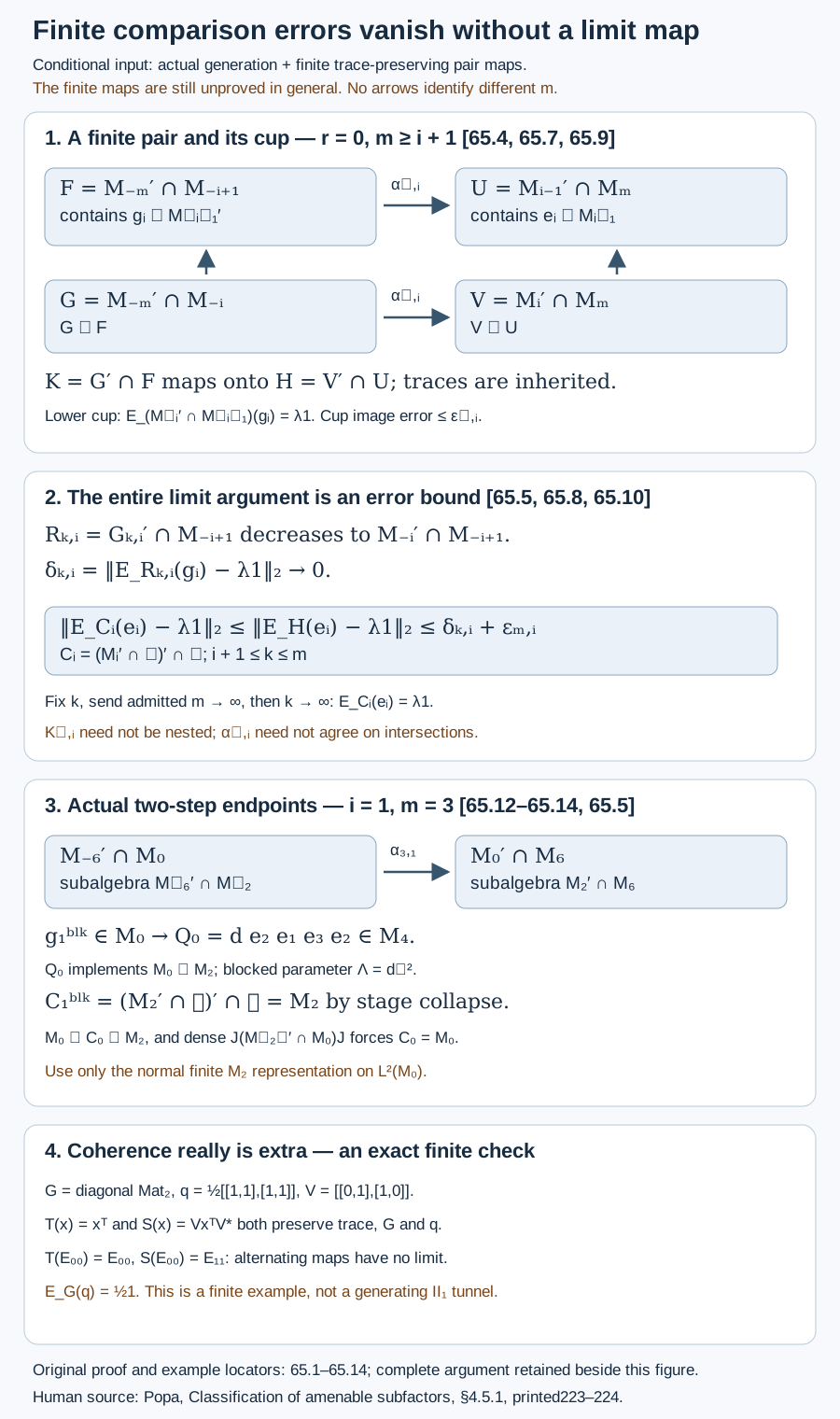
Finite comparisons suffice without a coherent limit map
Suitable finite comparisons and actual generation imply the tower bicommutant equality and the compatible smooth hypertrace. The finite maps may be independent and may have cup images with vanishing errors. We prove the complete analytic implication, including a fixed extra shift and the two-step blocked version. The general finite maps themselves remain an additional requirement.
The primary reference is Sorin Popa, Classification of amenable subfactors of type II, printed pp.223–224, the general nonextremal paragraph of 4.5.1. Printed223 has , so and . Uniformly, the source cup is our : in particular . Reindexing the source's by therefore gives exactly the unshifted course comparison (65.9) with . Its written upward endpoint does not constitute an extra shift after that reindexing. The earlier 62.4 unshifted endpoint criterion remains correct.
We use abstract blocking,14.8, which supplies the skipped basic-construction triple.64.1 identifies its normalized four-cup word, and 64.2–64.3 prove the modified composition, common basis and sharp squared index. None of these results supplies the finite trace comparison. We use scalar cup placement,63.5; finite normal tower representation,14.2; and stage collapse,61.4. The elementary expectation estimates needed below are proved here. Finite-dimensionality of relative commutants follows from 2.5.
Generation at every fixed lower endpoint
Let be a finite-index inclusion of II₁ factors, of index , with actual Jones tunnel . Put and
For , put . Then
Indeed , so bimodularity sends a commuting element to a commuting element. Every element of is already in and is fixed by the expectation, proving the range equality. Kaplansky density for the increasing finite-dimensional union in (65.1) supplies uniformly bounded approximants to every element of . Apply the normal expectation to these approximants. Their images have weak closure , proving (65.2). This step requires actual generation, without a separately imposed trace comparison.
A lower estimate for nonnested finite commutants
Fix , set , , and choose an actual projection satisfying
Such projections are supplied by 63.5 in every prescribed tunnel. For , write
The projection belongs to by its deeper commutation. Although the need not form a nested family, for one has . Consequently
All expectations and norms here use the inherited normalized trace of .
Proof of the limit. The algebras decrease, and (65.2) gives
. For a bounded , put . If , orthogonal projection in gives
The squared norms decrease to an infimum, so is -Cauchy. Its uniform bound supplies an ultraweak cluster in . Every cluster lies in each ; pairing with bounded elements identifies it with the limit. For , one has . These identities characterize the limit as . Apply this to and use (65.3).
For the inequality, nested expectations give
The last expectation is an contraction. This proves (65.5), including the nonnested case. No commutant-continuity assertion for the is needed.
Finite compression bounds an infinite expectation
Let be a finite tracial von Neumann algebra, a unital von Neumann subalgebra, and another such algebra. Suppose and . For and a scalar ,
Proof. Put and . Orthogonal projection, then trace adjointness and Cauchy–Schwarz, give
Divide when ; the other case is immediate. This proof covers arbitrary complex .
For the canonical tracial tower completion , fix an integer and put
The cup implements ; it belongs to for . For , the element belongs to by -bimodularity. It commutes with , by the same bimodularity and . Thus it lies in .
For , the expectation belongs to : and . Applying the preceding pairing proof with this , and with as the finite compression, therefore gives
One need not assert for arbitrary elements of : the proof only uses the element , whose finite compression was just checked.
Independent finite pair maps give scalar upper cups
For every , suppose there are arbitrarily large integers and unital trace-preserving linear *-anti-isomorphisms
The maps may be chosen independently for different . The exact cup image in the source is the special case . The norms on the last line use the inherited tower trace.
Then, for every admitted in (65.9) and every ,
Proof. Reversing products preserves the condition of commuting with a subalgebra, so . A trace-preserving *-anti-isomorphism is an isometry: . It carries the orthogonal projection onto to the projection onto . Hence it intertwines their expectations. Equation (65.5), triangle inequality and contraction give
Use (65.8). First fix , then take an unbounded admitted subsequence of with ; finally send . This proves the exact scalar identity. No common subsequence for all , no comparison between two finite maps, and no extension of any is used.
The same proof works for *-isomorphisms, but the source asks for anti-isomorphisms and (65.9) keeps that orientation explicit.
Collapse above the initial factor, then recover it
Under (65.1), (65.3) and (65.9),
Proof. Apply 61.4 to the tower starting at , with . Its successive tail commutants are exactly , , and (65.10) supplies every required cup condition. Thus .
Since , one has . For and , the finite reflected algebra belongs to , by 14.2. Therefore commutes with it. Transport this finite relation to the coherent faithful normal representation of on , where . Generation (65.1) makes the union of weakly dense in . Commutation with the fixed bounded operator is weakly closed. Hence . This proves (65.11). Only finite stages are represented normally; the whole tracial limit is not assumed to act normally on .
Generation also makes a weak closure of its increasing finite-dimensional algebras , by (65.2). The explicit construction 61.8 therefore gives the injective projections for and every finite tower factor;61.7 gives the projection onto . Combine this with (65.11) and 61.6. Every smooth nondegenerate expected representation has a UCP conditional expectation with and . The state is the compatible -hypertrace. These projections can be nonnormal. No extra separability hypothesis is added: the actual generating finite-dimensional sequence is the input.
Exact two-step application in the original tower
Keep an original index- tower , and block it by . Its adjacent index is , and its cup parameter is .64.1 gives
Use63 directly on this actual blocked tracial inclusion. For , let be its own canonical density, put , and set
This uses the canonical density of the blocked inclusion itself. It does not require identifying it with a product of adjacent densities.
The exact remaining finite comparison input is, for each , at arbitrarily large ,
with the inherited traces and anti-isomorphism orientation. A vanishing cup error also suffices by (65.9).
The even downward subsequence is cofinal, so (65.1) remains actual generation for the blocked tunnel. The even upward subsequence has the same tracial closure . Apply 65.1–65.5 to with and . Its collapse starts at , after which the finite normal representation of and the original generating union recover , exactly as in 65.5. This proves the original bicommutant (65.11). For a smooth expected representation of the original one-step inclusion , use the original tower and 61.6–61.8 to obtain its compatible hypertrace. Thus the blocked criterion suffices for the original inclusion without assuming one-step finite comparisons.
Exact examples and the limit-map distinction
An incoherent family. In with normalized trace, let be the diagonal algebra,
Both and are linear trace-preserving *-anti-automorphisms, preserve , and fix . Moreover . Alternate on a constant chain. Their values on alternate between , so they have no pointwise limit and do not define a common map on the union. This finite example demonstrates that coherence is genuinely extra. It is not asserted to be a generating II₁ tunnel.
A lower quantitative check. In , let and let be the rank-one projection onto . Then . At the preceding scalar stage, is the entire algebra and
; at the full -stage, . Any finite has , exactly as (65.5) requires. These are finite algebra checks, not a substitute for generation or (65.14).
Endpoint example. For , (65.14) has domain , subalgebra , range , and image subalgebra . It sends to . The target cup implements . The eventual scalar condition is onto , and the first collapse is at .
Exercises with complete solutions
Exercise 65.1 — source indices. Translate the source finite comparison with source into the original one-step course notation. Locate both cups.
Solution. Since , its domain is , and its subalgebra is . The range is , and the image subalgebra is . These are (65.9) with course . The source cup is the modified ; its image is , implementing . This calculation alone does not establish existence of that comparison.
Exercise 65.2 — nonnested expectations. In , set , . Let be the diagonal algebra and the algebra diagonal in the orthonormal basis . Compute . Explain why (65.5) uses the decreasing reference algebras.
Solution. For , the expectation fixes , giving squared norm . The two diagonal entries of in the second basis are both , so , giving zero. The three errors are , and are not monotone. Taking the containing reference algebra bounds all three errors by , but does not make them tend to zero. The limit in (65.5) instead uses increasing to the actual lower factor, which makes decrease to the relative commutant on which the cup expectation is scalar.
Exercise 65.3 — an approximate cup image. Suppose a finite family exists on an unbounded subsequence and has , with no prescribed rate for . Prove the exact upper scalar expectation without interchanging limits.
Solution. Let . Choose with . Then choose an admitted with . Equation (65.10) makes the fixed upper norm smaller than . Since was arbitrary, that norm is zero. Faithfulness of the finite trace gives . Each can use its own unbounded subsequence.
Exercise 65.4 — the inherited traces matter. On , put . Show that the block exchange is a unital linear *-anti-isomorphism but is not an isometry.
Solution. The algebra is commutative, so the *-isomorphism also reverses multiplication. For , its squared norm is , whereas its image has squared norm . Thus algebraic anti-isomorphism alone cannot justify the transfer in 65.4. The traces specified in (65.9) must actually agree through the map. This example supplies no generating tunnel.
Exercise 65.5 — where collapse starts. For the general theorem with , locate the first scalar cup and the factor at which 61.4 starts. Give the corresponding answer for (65.14).
Solution. The first index is , giving and . The tower starts at , so 61.4 gives . The finite representation of then recovers from generation. For (65.14), the blocked tower has , so its first cup is and collapse starts at . Its parameter is , rather than .
Exercise 65.6 — a density identity is not a completion gate. Does (65.13) require the product in 64.2 to be the general blocked canonical density? What remains to be proved after (65.13)?
Solution. Apply 63.1–63.5 directly to the actual tracial inclusion and its blocked basic construction supplied by 14.8/64.1. Its own central canonical density supplies (65.13) without a product identity. If one wants to identify that cup with the composed adjacent modified cups in 64.2, their densities must be compared separately; unchanged scalar index alone does not identify them. Theorem 66.3 and Corollary 66.4 now prove that separate general identity. For the bicommutant route proved here, the outstanding input is the finite inherited-trace pair comparison (65.14), with the stated cup image or a vanishing cup error. A coherent family and a normal comparison limit are not additional requirements.
Figure 65.1. The actual pairs and cup endpoints are (65.4), (65.7), (65.9) and (65.14). The error bound is (65.10); the decreasing reference error is (65.5). The endpoint example is . The last implication uses the finite representation in 65.5. Boxes denote algebras and maps, not spatial geometry. Reproducible figure source. Compare Popa 4.5.1.
The general finite pair maps (65.14) remain an additional requirement. This lesson proves the full analytic implication from the specified finite input to the bicommutant and compatible smooth hypertrace. The finite maps need neither a coherent family nor a normal comparison limit. Lesson 66 gives the separate general blocked density identity and identifies the lower cup explicitly.