Canonical rescaling of Jones cups
A Jones cup can be rescaled inside its actual basic construction so that its expectation onto the upper relative commutant becomes scalar. The resulting projection retains its deeper commutation and implements a faithful normal expectation with the original index. We prove the density formula, its inverse under finite duality, and all Jones relations for the modified cups throughout a prescribed tunnel. The general trace-preserving shifted comparison remains a separate requirement.
We use the local-index formula, Theorem2.4; finite common bases, Lesson3; the tracial basic construction and Markov expectation, Lesson4; normal finite expected constructions, Theorem61.2; and the cup functional and representation independence, Lemma62.2. Every representation used below is a faithful normal representation of a finite factor.
The two traces and their central density
Proposition 63.1. The normalized commutant trace has the central density (63.3)–(63.4), and the original cup has relative expectation (63.5).
Proof.
Let
We represent
This is a linear *-anti-isomorphism
It is the restriction to
Both
To construct it explicitly, on each matrix block choose a minimal projection
Equivalent minimal projections in a matrix block have the same two trace values, so this coefficient is independent of the choice. Formula (63.3) follows on every matrix unit. We may instead list all diagonal minimal projections in all blocks; this convention will be used for sums below.
The cup functional 62.2 gives
For example,
Rescaling inside the actual basic construction
More generally let
Theorem 63.2.
Its two inherited tracial expectations are
In particular
Proof. Since
The basic relation
For
For
Bimodularity of
The expectation
For each
Finally
A finite basis and the unchanged scalar index
Theorem 63.3. The rescaled expectation has the common basis (63.14) and exact positive index (63.15). The canonical choice retains the original index. The minimum within the stated rescaling family is (63.16).
Proof.
Choose a finite common basis
No orthogonality of this basis is required. For
The value
The second equality uses
Its scalar value is
Indeed
For the compression identity used here, if
Now put
For example the reconstruction sum equals
This is the scalar common-basis index. The same finite coefficient/Schwarz argument of 61.2 gives
is a nonzero projection in
For the canonical choice
Within this positive-invertible rescaling family, the smallest index is
Apply the finite tracial Cauchy–Schwarz inequality to
Adjacent densities are inverse under finite reflection
Proposition 63.4. The two adjacent densities satisfy (63.17).
Proof.
For the dual inclusion
The finite representation of
In particular this is a statement about each finite dual inclusion. It does not extend the infinite tracial tower normally to a fixed
Canonical modified cups throughout a prescribed tunnel
Theorem 63.5. Every prescribed Jones tunnel has the actual modified cups (63.18), with all properties (63.19) and every Jones relation (63.20).
Proof.
Let
Theorem 63.2 and (63.15) prove, without changing the tunnel factors,
They also satisfy the same adjacent and distant Jones relations:
Proof of (63.20). Represent the finite triple
The first equality is (63.10); the last uses the tracial Markov expectation for this finite triple.
The projection
For the reverse relation,
No actual generating hypothesis or extremality was used in 63.1–63.5. The placements and scalar relative expectations needed in the modified-cup criterion 62.4 are therefore available for every prescribed tunnel. Applying that criterion in the general nonextremal case still requires the normal trace-preserving comparison with every fixed endpoint and the stated cup images. Neither (63.19) nor the Jones relations alone supplies that map.
Exact worked examples
-
Weighted spin. In the lower relative commutant at the second site,
give , , and . On the basis , the second-site has coefficients . Conjugating the old cup with diagonal gives the modified cup with diagonal and the same off-diagonal . The first-site relative expectation is , while the second-site inherited expectation is . The implemented expectation has reversed weights , and its scalar index remains . -
Original versus canonical versus minimizing density. In the same inclusion,
gives the original trace expectation of index . The canonical also has index , now with scalar upper relative cup expectation. The minimizing density is , since ; (63.16) gives index . Its scalar relative cup condition fails: in the reflected order , (63.8) gives cup-expectation coefficients . Thus minimal index and scalar relative cup are distinct requirements. -
An extremal matrix example. For
, with a II₁ factor, , , and all diagonal minimal have . Formula (63.4) gives . Thus the canonical cup is the original cup, and both expectations are . Formula (63.16) also gives ; there is no smaller index within this rescaling family. -
Noncommutative rescaling inside an extremal block. In the preceding example take
, and let have eigenvalues in . Its normalized trace is one. Formula (63.15) gives . In the maximally entangled cup model the rescaled rank-one vector has coordinates proportional to ; the actual normalized cup trace stays . The upper relative expectation is , with eigenvalues . Positivity, finite index and the deeper commutation all survive, although neither expectation-preserved trace nor the scalar relative condition survives. Conjugating by any unitary of gives the same calculations, showing that need not be central.
Exercises with complete solutions
Exercise 63.1 — the two density columns (basic)
In the weighted-spin example, put
Solution. The two traces give
Exercise 63.2 — normalization makes a projection (basic)
Let
Solution.
Exercise 63.3 — three different expectations (intermediate)
For the same spin example, write
Solution. The normalization is
The original tracial choice is
Exercise 63.4 — a noncentral density and the sharp witness (advanced)
In
Use the actual inclusion
Solution.
Its eigenvalues are
Exercise 63.5 — inverse dual density and an adjacent cup (intermediate)
Take
Solution. Equation (63.17) gives
Exercise 63.6 — placement and comparison (advanced)
Explain which hypotheses of the modified-cup criterion62.4 are supplied by Theorem63.5, and which still require a separate proof for a general nonextremal generating tunnel.
Solution. For every
Sources and exact scope
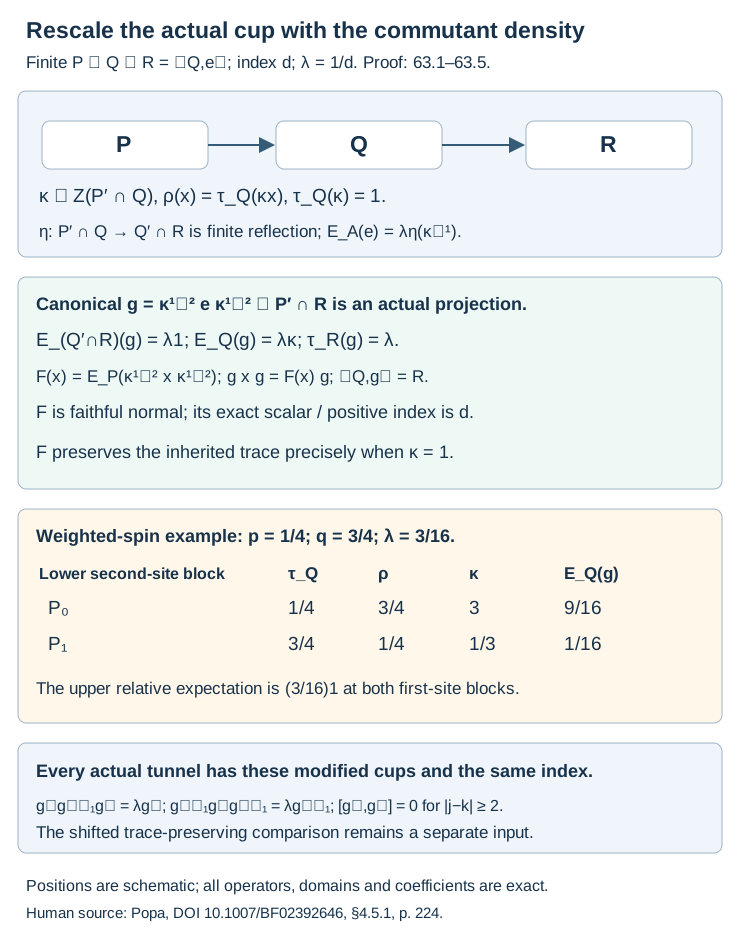
Figure 63.1. The triple and operator mechanisms are proved in 63.1–63.5; positions are schematic. The table uses the actual weighted-spin inclusion in the first worked example and identifies its lower relative commutant with the second site. Its inherited trace, normalized commutant trace and density are distinct columns. The upper first-site relative expectation of the modified cup is scalar, while its expectation onto
The human source for the modified-projection requirement is Sorin Popa, Classification of amenable subfactors of type II, Section4.5.1, printed p.224. The projection construction there is credited to Pimsner and Popa, Entropy and index for subfactors. Propositions63.1 and63.4 and Theorems63.2–63.3 and63.5 give the full finite rescaling proof using Lemma62.2. Popa cites a separate [Po12] comparison for the shifted trace-preserving maps; the cup construction does not supply those maps.
The modified cups now exist in every prescribed tunnel. To infer the general bicommutant conclusion from Theorem62.4, one still needs a normal trace-preserving comparison with every fixed endpoint and the required cup images. The Jones relations alone do not prove that comparison.