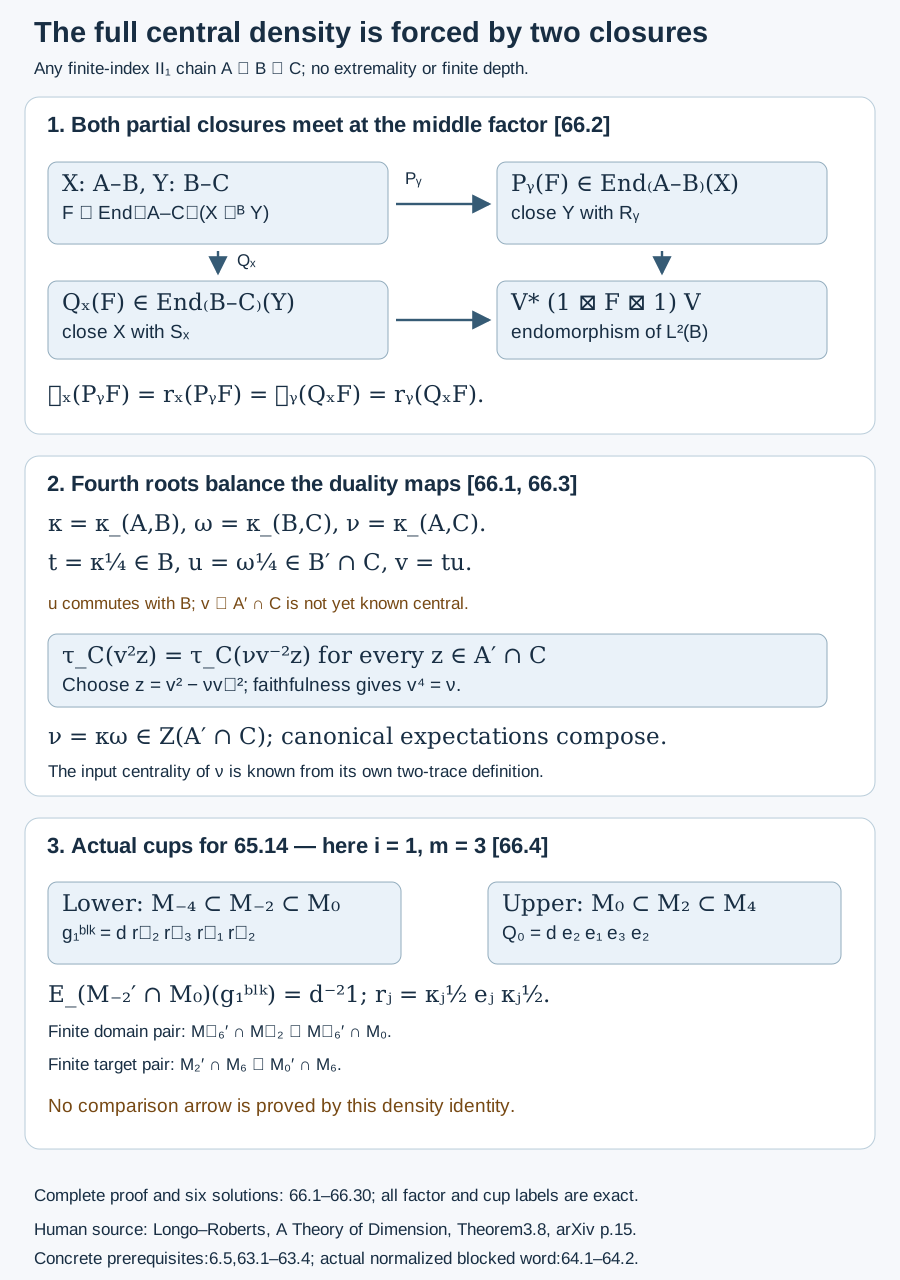
The two normalized traces on a relative commutant determine a positive central density. For any finite-index chain of II₁ factors, that density for the whole inclusion is the product of the adjacent densities. This proves the general identification left open after the two-step calculation in Lesson 64, including its centrality. The argument uses concrete finite bases and the previously proved duality maps; it does not assume a statistical-dimension theorem.
The density identity also identifies the lower blocked cup in the finite-comparison criterion,65.14. That criterion still requires the general finite pair anti-isomorphisms with their designated cup images.
The conjugate is identified by . A linear bimodule endomorphism of is left multiplication , with ; the corresponding endomorphism of is right multiplication . The map reverses products.
Choose any finite common tracial basis for . Let be inclusion, and let
By 6.4, . The maps of 6.5 are
Their two conjugate equations hold with the specified fusion units and associators. The endomorphisms of the standard - and - units are scalars.
For , define scalar closure functionals by
Let be the normalized trace of the commutant of left on , restricted to . Let be its density from 63.1:
Strict positivity here includes bounded invertibility.
Proposition 66.1. The closures in (66.3) are
For , the modified maps
still satisfy the conjugate equations, and their two closures agree:
Proof. The fusion unit identifies with . Thus the first closure is . Since commutes with , .
For the second closure, evaluate on a bounded vector . The formula for and gives
The transfer formula 63.13 makes . This proves (66.5) first on bounded vectors and then everywhere. No basis orthogonality was used.
The modification rule in (66.6) preserves duality. In the first conjugate equation, the factor acts on the output and the factor acts on the input . The composite is therefore
In the second equation the two inverse factors meet on the middle leg and cancel. Its remaining composite is the original identity on . This calculation uses ; bounded inverse and functoriality justify every displayed map.
The new closures are
Since is a central function of , both equal the value in (66.7). This proves equality on the entire endomorphism algebra, including all its matrix units. In particular both modified maps have squared norm .
The fourth root balances duality closures. The square root in the cup has a different role. We retain both normalizations.
Why balanced closures survive fusion
Here the module endpoints need not be the same. Let be an - correspondence and a - correspondence. Suppose they have bounded duality maps
Here , and similarly for . Define as in (66.3). Assume on and on . These equations compare scalar values even though their unit operators belong to different factors.
Lemma 66.2 — typed partial-closure interchange. For , with conjugate , put
These maps satisfy the conjugate equations. Their scalar closures agree on every .
Proof. For the first conjugate equation, interchange of the disjoint bounded maps rewrites the expanded composite as the product of
Both bracketed maps are the respective first conjugate identities. Thus . For the second equation the expanded composite similarly factors into
The second conjugate equations make both factors identity operators, giving . All bracket changes use the given associator and unit maps; no untyped algebraic tensor product is introduced.
For , define partial closures
For example has source and target . The -action at its output is the final right -action of . Every map in that composite intertwines the outer actions. The analogous check gives the claimed type of .
Expanding (66.10) gives
The two scalars and coincide. To see this without invoking a trace theorem, write
Interchange of bounded fusion maps also gives . Both scalar closures expand to precisely
The operator in (66.13) is a - endomorphism of , hence a scalar. This is the partial-closure interchange.
Now use the two assumed balanced identities, with the types in (66.11):
This proves the equality on the whole endomorphism algebra of , whether or not is irreducible.
Transitivity of the canonical density
Let be any finite-index chain of II₁ factors. Set
The densities are defined separately by their own commutant trace as in (66.4). The inclusion need not be a Jones tower, extremal or of finite depth.
Theorem 66.3 — canonical density transitivity. Inside the actual factor ,
Consequently the canonical expectations compose:
Proof. The two densities commute because commutes with and . Put
Then is positive invertible in ; its centrality there has not been assumed.
Take and . Their fusion is . On bounded coordinates, its unit map is . The conjugate fusion identifies with by . Both are the previously proved standard fusion unit maps.
Let be a common tracial basis for and one for . Their ordered products are a common tracial basis for . Indeed successive reconstruction gives
The left reconstruction follows by taking adjoints, and the index sum is
.
First use the unmodified maps (66.2) on . Under the two unit identifications, the product maps (66.10) are exactly the unmodified maps for . For , evaluate on : insertion of gives . This is the inclusion map with the normalization in (66.2). For , evaluating on a bounded gives
By (66.19) and 6.4 this is precisely . Density and boundedness extend both identifications to the full Hilbert spaces.
Next use the balanced maps (66.6), with on and on . Their product , on , becomes . Hence
For the other product map the bounded-coordinate expression is
Since commutes with , its second leg equals
. Therefore
This step does not move across ; such commutation has not been asserted.
Proposition 66.1 balances the closures of each input module. Lemma 66.2 therefore balances the closures of on every . Applying the original closure formulas (66.5) for to (66.21)–(66.22) yields
The positive element is central in , so it commutes with . Trace cyclicity changes (66.23) into
The coefficient is self-adjoint and belongs to . Choose . Faithfulness gives , hence . Multiply by to obtain . In particular the product is central. Thus centrality was a consequence of the full closure calculation, rather than an inference from the adjacent commutation alone.
Finally, , and . Bimodularity of gives
These are the faithful normal expectations already constructed in 63.2.
The same proof also gives the identity
For a direct check, by (66.16), and . This is an identity for the explicitly balanced closure masses. No classification of all expectations is inferred.
The general two-step density and its actual cup
Now take the actual consecutive basic-construction chain of 64.1:
Let be its adjacent canonical densities. The finite dual identification 63.4 gives
, with
on .
Corollary 66.4. The product in 64.2 is the canonical blocked density:
It belongs to , and the projection in 64.2 is exactly the canonical scalar-relative-expectation cup for :
Proof. Apply Theorem 66.3 to . The finite right-multiplication identification gives the second expression in (66.26). The operator equality and projection assertion in (66.27) are already proved in 64.2. With , the general relative-expectation formula 64.21, or 63.8 for the blocked inclusion, becomes . All these statements concern the same prescribed factors and actual projections.
For the signed course convention, write and . The cup for the blocked inclusion is therefore
In 65.14 take . Its fixed lower scalar cup can now be written explicitly as
The upper target remains the tracial . We have identified the lower cup, not constructed a finite map carrying it to that target.
Corollary 66.5 — arbitrary finite chains. For of finite-index II₁ factors,
Proof. A newer density commutes with every earlier containing factor, so the factors in the product commute pairwise and are positive invertible. Inductively apply Theorem 66.3 to ; its base case is the definition for one step. The same induction proves the expectation identity. Every equality is at a finite endpoint.
Figure 66.1. The two partial closures of an - endomorphism meet in the - unit and yield the same scalar (66.11–66.14). For an actual finite inclusion chain, the fourth roots give ; equality of the full closures forces (66.23–66.24). The last panel records the exact signed lower and upper cups in 65.14. The density proof supplies no arrow between their finite algebras. Human source for interchange: Longo–Roberts, Theorem 3.8; concrete duality and densities:6.5,63.1–63.4; actual blocked word:64.1–64.2. Reproducible figure source.
Examples
Example 66.6 — three diagonal corners. Suppose three successive inclusions have local corner indices one and diagonal trace weights , each summing to one. For the first inclusion,
and the canonical coefficient on corner is , by 63.4. Write and . On a nonzero simultaneous diagonal corner , (66.30) gives coefficient
The inherited joint weight is under the stated factor hypotheses. To see this, write the chain as , with successive diagonal projections , and . Expectation bimodularity puts in , and trace preservation makes it . Likewise . Therefore
Thus the left dimension weight of this joint projection is , using its displayed canonical-density coefficient. This calculation does not require an independent tensor-product construction. The joint projection need not be minimal in the full outer relative commutant; its trace and density coefficient are still the values just computed.
Example 66.7 — unequal weights do not disappear in a block. In the weighted two-spin family of 64.4, , , and on the two adjacent sectors has values . Its dual has reciprocal right-multiplication values. On the four joint sectors the blocked density is
in the ordering used there. At , its values are . The mixed sectors have value one, while the two unmixed sectors retain the distortion. The general proof 66.4 now identifies this product with the canonical blocked density outside that particular family as well.
Example 66.8 — trivial and extremal steps. If , then ; the maps in (66.2) are the fusion units and (66.7) is the ordinary trace. If both and are extremal, their two densities are one, so 66.3 proves is extremal. Conversely, if is extremal, then . Thus lies in both and , hence in . Normalization forces , and then . Induction proves that a finite chain is extremal at its full endpoints exactly when every adjacent inclusion is extremal. The intersection argument is essential to this converse.
Six exercises with complete solutions
Exercise 66.1. Starting from the basis formula for , compute its closure on a minimal projection , where and . Then compute the balanced value at .
Solution. The local formula 2.4 gives . Equation (66.5) yields , while . The coefficient of on its matrix block is . Multiplying the first closure by its square root gives
.
The second balanced closure is
.
Thus the two coincide exactly, including at a nonextremal corner.
Exercise 66.2. In (66.11), give the source and target of , and explain why belongs to . Identify the middle unit in (66.13).
Solution. The source is , identified with . The target is , a - module. The middle map respects those outer actions, and maps back to with the same actions. Hence the composite is a bounded - bimodule endomorphism. Both expansions in (66.13) are endomorphisms of commuting with its left and right actions. Since is a factor, they are scalar operators on that precise middle unit.
Exercise 66.3. Explain why the step from (66.23) to (66.16) does not assume is central. Supply the separating test element explicitly.
Solution. Only , the already defined central density for , is known central. It commutes with , so is self-adjoint in the same finite algebra. Trace cyclicity gives for every there. Taking gives ; faithfulness implies . Thus , and multiplication by the invertible gives . Since commute and , . Centrality of this product follows from its equality to .
Exercise 66.4. Verify the order of the second leg in the modified product . Which commutation justifies moving , and which further movement would be unjustified?
Solution. Insert in on a bounded . The resulting second leg is
.
Because and , it equals
.
The same commutation makes commute, so . There is no hypothesis that commutes with ; moving it through would be unjustified. The resulting expression is exactly (66.22), with the inverse acting on the leg.
Exercise 66.5. Specialize (66.29) to , and list the lower inclusion, containing factor, deeper commutation, scalar expectation algebra and upper target.
Solution. Here . The lower blocked inclusion is , with upper containing factor . Its canonical cup is
.
Its scalar relative expectation is
.
For the finite pair in 65.14, , the domain is with subalgebra . Its prescribed upper target is
, inside with subalgebra . The general finite pair anti-isomorphism with that cup image remains an additional unproved input.
Exercise 66.6. Derive (66.25) by conditional expectation and iterate it over . State exactly what numerical quantity has been proved multiplicative.
Solution. Since commutes with , is central in . Its trace is , so it equals that scalar times . Equation (66.16), commutation of the adjacent densities and bimodularity give
Multiply by . For the three-step chain, induction with (66.30) gives
The quantity is the common scalar closure of the two explicitly balanced duality maps on the identity endomorphism. The exercise establishes that quantity and its product formula. It does not by itself classify all conditional expectations or supply any of the finite comparison maps in 65.14.
What this closes
66.1–66.5 prove the general finite-chain canonical density identity, its centrality, composition of canonical expectations and the scalar relative expectation of the actual modified blocked word. They close the general identification separated from 64.2–64.3. The analytic criterion 65.1–65.6 remains valid and now has the concrete lower cup (66.29). General inherited-trace finite pair anti-isomorphisms, the unconditional bicommutant assertion, general nonfactor J.18/G and every other residual original assignment remain open where previously recorded.