Reflected traces and a uniform bound along a tunnel
A tunnel puts each downward relative commutant inside the original factor. Reflection compares it with an upward relative commutant, but two traces enter that comparison. Finite depth makes the relevant inductive-limit trace unique. This supplies the trace agreement, proves that the dual inclusion also has finite depth, and gives one positive-operator bound valid at every tunnel level.
Let have finite index , put , and choose a Jones tunnel
For every integer , the projection implements . Throughout this lesson, finite depth is the full-support condition of Definition (12.7).
A basic construction survives passage to commutants
Lemma 14.1. Suppose is the basic construction of a finite-index inclusion of II₁ factors. In any faithful normal representation of with finite commutant, the reversed inclusion
is a basic construction with Jones projection . Its consecutive indices equal .
Proof. First use the defining representation on . The basic-construction formula gives , whence
The projection onto commutes with , since . Thus the reversed triple is the opposite of the original basic construction, with the same projection. Its normalized trace still gives weight .
The defining -module has positive finite dimension . Any other -module with finite commutant has positive finite dimension. Finite-module classification realizes it as the range of a projection in the commutant of a finite amplification of the defining module: choose an amplification with sufficiently large dimension, then a projection of the required dimension trace. In that realization the reversed commutants are the common corners
Here lies in the smallest algebra and commutes with . Amplification and a common corner by a projection in the smaller factor preserve a basic construction. To verify the corner assertion, compress the identity . The compressed expectation preserves the normalized corner trace, and the compressed projection has trace , since . The span of middle-algebra multiples of that projection fills the larger corner: matrix partial isometries in the smaller factor with initial projections under and final projections covering one reduce the original spanning assertion to its corner. These are precisely the basic-construction identities. The trace normalization, or the index formula for the common corner, gives the same index. Transport back to the given representation.
One coherent representation for every finite level
Let on . Define, for ,
Proposition 14.2. The sequence , together with , is a representation of the Jones tower. Each is a finite factor. Its first Jones projection is the ordinary projection onto ; for its Jones projections are .
Proof. The first basic-construction formula is . For every , apply Lemma 14.1 to
Conjugating its reversed commutants by gives the basic-construction triple with projection . The commutants are finite because . The basic-construction uniqueness at each step identifies these inclusions with the canonical upward tower, fixing all earlier levels.
We henceforth write for in this representation. This represents every finite level on . It does not assert that the tracial von Neumann limit acts normally on .
The linear map
reverses products and preserves adjoints. For , (14.2) gives the exact reflection rule
The domain and range are finite-dimensional algebras. This assertion concerns the algebraic anti-isomorphism; trace preservation will follow below.
Finite depth makes the trace unique
Set and , as in (12.1).
Theorem 14.3. If has finite depth, the norm closure of has exactly one tracial state, namely the compatible tower trace. Its tracial von Neumann closure is a factor, and is II₁ when .
Proof. After the last new vertex appears, the inclusion matrices alternate between and , where is the bipartite matrix of the finite connected principal graph. Both and are primitive. Indeed, any two vertices on one parity are joined by a path of even length; their two-step graph is connected. Every vertex has positive degree, so the two-step matrix has positive diagonal. One sufficiently large power therefore has all entries positive.
For any tracial state, let be its nonnegative vector of minimal-projection weights at level . Trace restriction gives . At a fixed late parity this becomes
Primitive Perron convergence says that all nonzero rays in converge uniformly to the positive Perron ray. Uniformity follows by normalizing input vectors in the compact unit simplex and first applying a power with strictly positive entries. Thus the ray of , which lies in every such cone, must be the Perron ray. Normalization by the level's block-size vector fixes its scale. This determines the trace at every late level and, by restriction, at every earlier level. The existing tower trace supplies existence.
If its tracial von Neumann closure had a nontrivial central projection , the two normalized traces obtained by multiplying by and would restrict to the same unique tracial state. It follows that on the dense union and then on the closure. Faithfulness gives , a contradiction. The closure is therefore a factor. When , the Perron eigenvalue of a two-step matrix is . Walk counts, hence some matrix block sizes, are unbounded. These blocks cannot embed in a fixed finite matrix factor, so the closure is II₁. For it is scalar.
Dual depth and the two traces
Write for the normalized trace on the finite factor in (14.2). Its restriction to the norm closure of the is a tracial state. Theorem 14.3 therefore gives
In particular, the normalized commutant trace and the original trace agree on . This property is called extremality of the inclusion.
Theorem 14.4. Finite depth of implies finite depth of . The norm closure of also has a unique tracial state. In (14.3), with or , reflection preserves the compatible traces.
Proof. The trace-preserving expectation is the conjugate by of . The positive-operator bound gives for .
It maps onto . To check this in the correct ambient algebras, conjugate by . The resulting element lies in . Since , equivariance of puts its image in . Conjugate back. The image is in , and fixes every element of . Equation (14.5) makes this restriction the tower-trace expectation. Hence
We need a finite-dimensional consequence. If has an expectation with , then at most central blocks of can meet any one block of . Suppose such central projections meet a block. Choose one unit vector in each of their orthogonal ranges inside that block. Let be the rank-one projection onto , zero on other blocks. Bimodularity removes its off-diagonal pieces. Since , positivity gives . Evaluating on its defining unit vector gives . Every block of meets some block of , so
Finite depth bounds the number of blocks of all . Equations (14.6)–(14.7) bound those of all . In the dual principal graph, old vertices persist at every subsequent level of the same parity. Infinitely many new vertices would make the block counts unbounded on at least one parity. Thus the dual graph is finite, which is dual finite depth. Apply Theorem 14.3 to the dual inclusion to obtain uniqueness of its inductive-limit trace.
The normalized trace on restricts to a tracial state on the union, so it equals their tower trace. For , uniqueness of the trace on gives . Since , this is precisely trace preservation in (14.3) with . The domain is a subalgebra of the domain, so the same equality applies there.
Trace uniqueness also explains representation independence here. In any finite tracial normal representation of either inductive-limit algebra, the ambient normalized trace must restrict to its unique trace. The resulting faithful tracial representation extends the same GNS completion to the same von Neumann closure. This determines the individual closures. Determining the index of the pair of closures requires the inclusion structure as well.
The exact reflected pair of a generating tunnel
Put
The tunnel is generating if and . Each finite union stage is finite dimensional, so a generating tunnel exhibits both factors as approximately finite dimensional.
Corollary 14.5. At finite depth, reflection extends to a normal trace-preserving anti-isomorphism of pairs
Consequently a generating tunnel reconstructs from this reflected pair. The pair is determined by the standard invariant, since
Proof. Formula (14.3) sends the first union defining to , and the union defining to . Theorem 14.4 gives trace preservation on each finite stage. Thus reflection gives an isometry of the corresponding tracial Hilbert completions, reversing the represented products; it extends normally to their von Neumann closures. Trace-preserving expectations onto approximate any element of in , and preserve commutation with or . Therefore the upward closures are exactly the relative commutants displayed in (14.8). Finally , so commuting with means commuting with both generators, proving (14.9).
Both fixed starting levels in (14.8) matter: reflecting gives the starting commutant , whereas reflecting gives . A reconstruction statement must retain these indices.
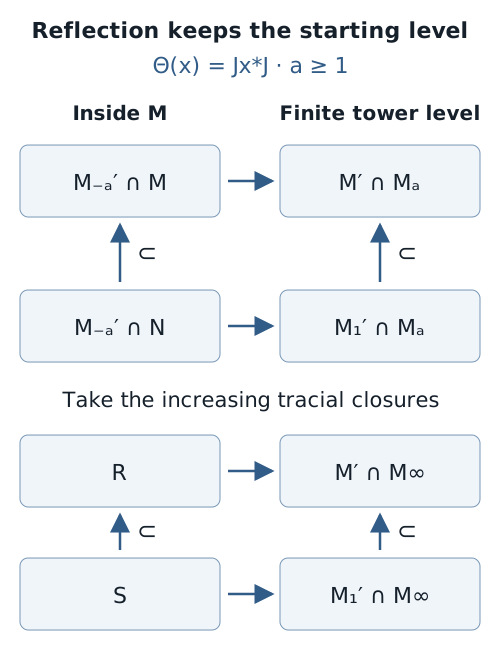
Figure 14.1. The upper downward row has endpoint ; the lower has endpoint . The same linear anti-isomorphism sends them to and , respectively. The bottom line shows their tracial closures. The arrows represent the algebra maps (14.3) and (14.8), not a normal representation of the whole infinite tower on . Editable figure source.
Minimal corners have uniformly bounded index
Set and . For a minimal projection , let .
Proposition 14.6. Suppose has finite depth. There is a finite constant , depending on the inclusion, such that every tunnel and every such satisfy
Proof. Reflection identifies with , preserving its trace. The normalized trace on the full commutant corresponds under to that on . On , Theorem 14.4 consequently identifies this trace with . The local-index formula of Theorem 2.4, applied to , now gives the equality in (14.10).
After dual depth, there is no new part. The minimal-projection trace vectors at successive full basic constructions satisfy , under the old-block identification. Hence the numbers are constant along each late parity and vertex. There are finitely many earlier levels and finitely many vertices in the two late levels. Take to be the maximum of those finitely many numbers. The reflected trace vectors and inclusion matrices come from the canonical tower, so this constant does not depend on the choices in the tunnel.
A positive-operator bound for the commuting join
Theorem 14.7. Suppose has finite depth. There is , depending only on , such that for every tunnel level,
One may take , where is from Proposition 14.6 and bounds the number of blocks of .
Proof. For an orthogonal partition , pinching has the bound
Indeed, for any Hilbert-space vector , Cauchy–Schwarz gives
Let be the minimal central projections of . In each block choose a minimal projection and matrix units for . These matrix units give
The maps are faithful because is a factor and commutes with the matrix units. The corner inclusion has index , by tensor-product invariance of index. Its trace-preserving expectation therefore dominates times the identity map on positive operators. The global expectation first pinches by the , then applies these corner expectations. Equation (14.12) yields
The finite dual graph bounds uniformly. This proves (14.11).
The uniform constant controls a commuting join at every level. Turning this estimate into a generating tunnel still requires an approximation argument that respects the already chosen finite tunnel.
Skipping an equal number of levels
Proposition 14.8. For any integer and positive integer , the triple
is a basic construction, with consecutive index . If its Jones projection is , then
Proof. Repeat Proposition 14.2 with center , using tracial conjugation on . It represents the level as . This is exactly the basic construction of , by Theorem 1.2. Index multiplicativity gives . The basic-construction projection commutes with its smaller algebra and has expectation . Transporting back through the tower identifications proves (14.13)–(14.14).
Every integer rectangle and its reflection
The finite statements below need only finite index. Their trace is the inherited tower trace, before any assertion about its infinite closure.
Proposition 14.9. For integers , put . These algebras are finite dimensional. For integers and nonnegative integers with , set
Then , , and, as expectations on ,
For every integer center , choose the coherent finite-window representation on from Proposition 14.2. Its tracial conjugation gives the compatible linear, adjoint-preserving anti-isomorphisms
Proof. Multiplicativity gives . The arbitrary-index bound in Theorem 2.5 makes finite dimensional. Since , the displayed inclusions and intersection follow directly.
The expectation from onto is bimodular over . It therefore preserves commutation with , and its restriction to is . It also preserves commutation with , so . On , the self-adjoint projection leaves invariant; hence it leaves its orthogonal complement invariant and commutes with the projection . The product is the projection onto . For the last equality, both ranges consist of vectors in the finite-dimensional algebra , so their Hilbert-space intersection is their algebraic intersection. This proves (14.16).
In each finite window, the representation satisfies
, for every represented integer . Equivalently . Conjugation carries commutants to commutants, and taking adjoints does not change a star-closed algebra. Thus
The same gives all these maps within a window, and coherent enlargement preserves their restrictions. Multiplication is reversed because ; anti-linearity of both 's makes linear. It preserves adjoints and all algebra inclusions.
Increasing the second coordinate enlarges ; increasing the first coordinate shrinks it. Thus the bottom row of (14.15) is contained in the top row. The two coordinates are exchanged and subtracted from under reflection. These finite algebra maps do not by themselves identify inherited traces or give a normal map between infinite closures. Theorem 14.4 supplies the needed trace equality at finite depth for the two reconstruction rows. The precise general extension criteria are in Trace-compatible reflection, and the weighted-spin generating tunnel shows why a generating hypothesis alone cannot replace them.
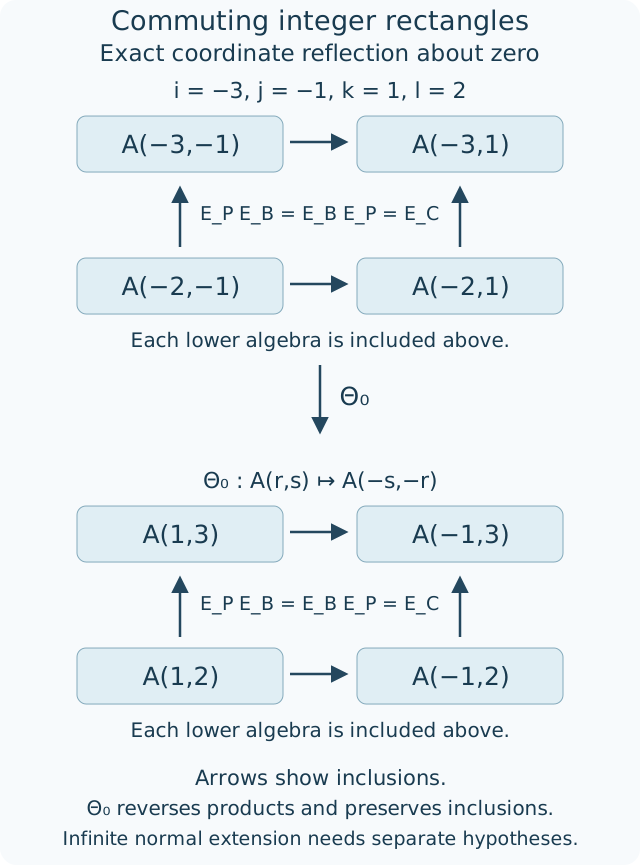
Figure 14.2. The example has , and center . Arrows within each square show inclusions, with each lower algebra included in the algebra above it. Reflection preserves these inclusions and sends each labeled corner in the first square to its corresponding corner in the second by (14.17). Each square commutes for its inherited trace by (14.16); the arrow between the squares denotes an algebra anti-isomorphism, without asserting trace preservation. Editable figure source. Compare Takesaki, Chapter XIX, equations (16′)–(18′).
An arbitrary finite partition of corner subfactors
Proposition 14.10. Let be nonzero orthogonal projections with sum one in a II₁ factor . In each normalized corner , let be a unital II₁ subfactor of finite index . Put and . Then the inherited-trace expectation satisfies
Proof. Pinching is the expectation onto . Applying the normalized corner expectations after pinching preserves the trace of , since each corner trace is multiplied by . The composite is therefore . In each corner the positive-operator index inequality gives
.
Sum and apply (14.12) to obtain (14.18).
This includes the corner step in Theorem 14.7, but makes no finite-depth assumption. In Takesaki's Lemma 4.20(iii), the preceding corner-index bound and the block-count bound give . The printed choice on page 483 does not follow from its displayed inequality (22); the existence of a positive uniform constant still follows, as proved in Theorem 14.7.
Exercises
Exercise 14.1 — introductory. In (14.3), find the reflected algebras for and . Explain why their starting levels differ.
Solution. They are and , respectively. The first domain is ; the second is . Formula (14.2) identifies and , so their ambient downward endpoints give different fixed starting commutants.
Exercise 14.2 — intermediate. For diagonal matrices , prove that the optimal constant in is .
Solution. Pinching by the coordinate projections proves the bound . For the rank-one projection onto , its diagonal expectation is . Evaluation on that unit vector shows . This is the single-block case of the counting argument in Theorem 14.4.
Exercise 14.3 — intermediate. Suppose the two late trace vectors of a tunnel have minimal-projection weights and at levels and . Give the late contribution to the constant .
Solution. It is
Every two-level extension multiplies the weights by and the prefactor by , leaving these products unchanged. Earlier levels must also be included in the final maximum.
Exercise 14.4 — advanced. Let two finite-index, finite-depth II₁ inclusions each admit a generating tunnel. Show that an isomorphism of their full standard invariants, including their Jones projections and traces, yields an isomorphism of the original inclusions.
Solution. The full invariant isomorphism carries the ambient ladder to the other ambient ladder, its subalgebras to their counterparts, and to its counterpart. It therefore carries the commuting-with- subalgebras as well. Trace preservation extends these maps normally to the reflected pairs in (14.8)–(14.9). Finite depth permits Corollary 14.5 for both inclusions. Compose with its two anti-isomorphisms, whose domains are the original factors because both tunnels generate. Reversing products twice gives an ordinary isomorphism carrying onto the other smaller factor.
Exercise 14.5 — introductory. Reflect about center , and apply the same coordinate reflection again. What happens to a horizontal inclusion?
Solution. Formula (14.17) gives , since and . Applying it again gives . More generally each coordinate returns to itself after two subtractions from . The inclusion becomes
: decreasing the first coordinate enlarges the reflected algebra. No trace assertion is needed.
Exercise 14.6 — intermediate. In (14.15), why is needed? Verify the rectangle with and list its reflected corners at center zero.
Solution. This inequality ensures that the lower-left corner is a relative commutant of a smaller factor inside a larger one, and that , as used in the expectation proof. In the example the top row is , and the bottom row is , included in the top row. Reflection gives the top row and the bottom row . These are the exact four labels in Figure 14.2.
Exercise 14.7 — advanced. Construct an actual three-corner example with all corner indices four in Proposition 14.10, and prove that its constant is sharp.
Solution. Let be a II₁ factor, , and , all with their product traces. Put and . The normalized corner inclusion is , of index four. Choose unital matrix units in and put
Matrix multiplication gives and . Partial trace gives , exactly as in Exercise 4.2. Pinching gives . Consequently is a nonzero projection of trace , and . Proposition 14.10 proves the lower bound ; compressing any inequality by forces . This proves sharpness. The expression cannot be a positive-operator lower bound, even at . This is a test of the general corner calculation; no particular principal graph is asserted for this example.
References
Masamichi Takesaki, Theory of Operator Algebras III, Springer, 2003, Chapter XIX, equations (16′)–(18′) and Lemma 4.20, printed pages 479 and 482–483.
Vaughan F. R. Jones, Index for subfactors, Inventiones Mathematicae 72 (1983), 1–25.