Finite cup densities and a positive-cost Følner criterion
The ambient inclusion and its core use the same finite basis. They nevertheless have different relative commutants, and their canonical dual densities must be compared on those actual algebras. We compute both densities in finite matrix representations, construct the canonically rescaled expectation of the possibly nonfactor core, and reduce the remaining joint-center discrepancy to a finite-dimensional cup density.
The weighted discrepancy in Lesson 81 is the value of one fixed positive central operator in a finite-projection state. We prove that it can be made arbitrarily small together with all prescribed Følner commutator errors exactly when a central state annihilates that operator. This gives a precise state criterion. General relative amenability alone has not yet been shown to provide an annihilating state.
We use the finite basis and matrix-module proofs of Lessons 2–3; the actual common basis and full corners of 52.1–52.2; the finite canonical density and rescaling proof of 63.1–63.3; the bounds and marginals of 68.1–68.2; the complete branch identity of 72.2–72.3; and the norm theorem and actual branch means of 81.2–81.6. Normal trace duality, the tracial – pairing, projection comparison and conditional expectations retain their declared prerequisite scope. We prove the square-root inequality and spectral extraction needed here rather than importing a Følner extraction theorem.
Human-source context for the cup warning is Sorin Popa, W-representations of subfactors and restrictions on the Jones index, L'Enseignement Mathématique 69 (2023), 149–215, DOI 10.4171/LEM/1055, printed p.189: cup-tail inclusions above index four can be locally trivial and nonextremal. That identification is context, not a prerequisite of the calculations below. The original amenability target is Popa, Classification of amenable subfactors of type II, Theorem 4.2.2, printed pp.213–214.
Compare the actual commutants
Let be II₁ factors of finite index , with actual core . Its common cup factors satisfy
Use the unit-containing partial orthonormal common basis of 68.1. Write , , and . Thus , , , and . Every finite trace and conditional expectation below is inherited from .
Lemma 82.1 — commutants and finite matrix trace. One has and . The three positive operators
are the central, boundedly invertible densities of the respective normalized dual traces. All lie between and , and have trace one. In particular need not be finite dimensional.
Proof. The initial relative commutant belongs to and commutes with , hence is contained in . Every member of commutes with ; it also commutes with . Both centers themselves belong to . This proves the stated central containment.
For the core, use the right -module coordinate map
Orthogonality and the basis expansion show that these are inverse isometries on bounded coordinates, hence inverse unitaries. The commutant of right in this representation is , , acting by left matrix multiplication. This follows directly from the standard -module commutant on each coordinate; the corner selects the prescribed ranges. Its finite matrix trace is , of mass on .
For , right multiplication commutes with right . Its matrix is
Indeed permits the coefficient to move to the right of the expectation. The supports put that coefficient in . Right multiplication reverses products, preserves the adjoint, and is faithful; its restriction therefore pulls the normalized matrix trace back to a faithful normal tracial state on . Adjointness of identifies its density as . A density representing a trace commutes with its whole algebra: trace pairings with and , followed by faithfulness of the pairing, prove this. Thus .
The identical matrix argument over , using the same , proves on . Over it proves the analogous assertion on . These are exactly the normalized finite dual traces used in 63.1, now also constructed for the nonfactor core. Positivity and the bounds on give all bounds and bounded inverses. Trace preservation gives the three normalizations.
Proposition 82.2 — restriction and transfer. The ambient dual trace is the restriction of the core dual trace to . Moreover,
Proof. Both scalar dual trace formulas on are . The first identity follows by testing every . For the transfer, expand for . Since commutes with every coefficient in , moving it across the coefficients and using the adjoint basis expansion gives , exactly as in 63.12. Thus the transfer is central. Cyclicity, and the fact that commutes with the , give . Since , (82.4) gives the last line.
The identity does not imply . Conditional expectation restricts the trace to a smaller commutant; it need not preserve its density as a physical operator.
Rescale the nonfactor core with its own density
Theorem 82.3 — actual canonical core expectation. The core density satisfies , and
is a normal unital completely positive -bimodular expectation onto . It has the finite basis and scalar index bound
Here the last line is a bound. We do not claim a new witness proving its optimality for every nonfactor core.
Proof. Since commutes with , its -expectation is central. The smaller-center marginal in 68.2 gives for every ; testing this identity shows . Alternatively that marginal follows from the common basis supports in the factor , as proved there.
In (82.5) put . Its central transfer has pairings with every , so it is . Sandwiching and the trace-preserving expectation are normal completely positive maps. Commutation with makes their composite -bimodular; makes it unital and the identity on .
For reconstruction, the sum in (82.7) is
.
Moving across the -valued coefficients is legitimate; it is not moved across or . The row sum is (82.6).
For completeness put . The row norm bound gives
.
Applying to the adjoint reconstruction identity times , using bimodularity, identifies the sum as . Taking proves the positive-operator bound.
The original tracial expectation and this modified expectation need not agree. In fact
Corollary 82.4 — exact compatibility of modified expectations. The ambient canonical expectation of 63.3, restricted to , is
.
It equals on all of exactly when .
Proof. The restriction formula uses and . Equality follows immediately if the densities agree. Conversely equality of the expectations implies, after applying , that for every . Take to conclude equality.
Compatibility of these modified expectations is consequently stronger than the joint-center equality in 81.15. The tracial commuting square by itself does not identify the two canonical rescalings.
Reduce to a finite cup density
Write the distinct spectral values and projections of the finite-dimensional density as
Theorem 82.5 — finite cup reduction. For every von Neumann subalgebra ,
In particular , , and , with the cup density viewed as a physical element of .
Proof. Apply 81.2 inside the finite-index factor inclusion . Finite -unitary averages of converge in norm to . For , trace cyclicity and show that every such conjugate has the same trace pairing with as . Equivalently for each . The expectation is norm contractive; passing to the norm limit proves (82.10). The three particular algebras commute with , so the asserted identities follow.
This theorem does not identify with or . The latter can contain diffuse , whereas is finite dimensional.
The weighted gap is one positive central cost
Use the complete smaller-center branches and from 81.12. Define
where , , have the canonical trace normalized by . The hat is the full-corner central lift of 52.2, not physical left multiplication in .
Proposition 82.6 — exact weighted cost. For every positive ,
The second identity holds for every finite-trace projection ; denotes the density of its restriction to , as in 70–72. It does not require .
Proof. The complete branch norm identity applied to gives
.
Apply it instead to , where . Its branch coordinates are . The bounded central multiplier commutes with , so its absolute value is . Monotone convergence gives the first identity for . Adjointness of gives the second expression . Finally the definition of the central density , tested on , gives .
Also exactly when : take the trace of the positive operator . Thus 81.15 is precisely the assertion that this fixed positive cost vanishes as an operator.
The finite spectral formula is
It supplies finitely many physical cup projections. It does not assert that either expectation of each individual is scalar.
A state criterion with one positive test
The next theorem applies to a von Neumann algebra with a faithful normal semifinite trace , a unital expected subalgebra , and a unital von Neumann subalgebra . Assume is semifinite and the normal expectation preserves . There is no requirement that , or any finite-index hypothesis. A state is -central if for every , . It may be singular.
Theorem 82.7 — positive-cost Følner criterion in the expected algebra. For a fixed , the following are equivalent:
There is no assertion that a given arbitrary bounded selfadjoint test can have any prescribed projection-state value.
Normal density approximation. Normal states are weak-* dense in all states of . Otherwise real Hahn–Banach separation gives a selfadjoint whose supremum over all states exceeds its supremum over normal states. The latter already equals the top of the spectrum: a nonzero spectral projection sufficiently near the top has a normal vector state supported on it. This is a contradiction.
Approximate by normal states on , with positive densities , , and extend each state through . Trace adjointness identifies the extension with on . The equality makes these extensions converge weak-* to on the whole of . For , centrality and imply weak convergence to zero of
, together with the real coordinate . This is weak convergence in , whose dual coordinates are bounded operators and scalars. Hahn–Banach separation of a convex set shows that its weak and norm closures agree. Finite convex combinations therefore give, for any , a positive with
The cost is nonnegative, which is essential in extracting one projection.
Square-root estimate. For positive ,
Here is a proof retaining noncommutation. Put , , . Products of two operators are in . Cyclicity and give
.
Since , . Since , . The traces of the positive products are nonnegative, justified by sandwiching or approximation. Adding gives
.
The trace duality bound proves (82.16).
Spectral extraction. Let , , and . Every has finite trace . Layer cake gives
To prove the commutator bound first suppose is a finite spectral step operator supported on a finite-trace projection. Include , . Expansion of the squared projection difference and integration gives
.
The term is omitted; every remaining term is finite and nonnegative. Cauchy–Schwarz, using
, bounds this sum by
.
The second factor is at most . This proves the first bound; (82.16) proves the second.
For a general positive , approximate it by nonnegative finite spectral step functions , supported where is bounded away from zero, with . Because commute, the integrated squared distance of their spectral projections is exactly . A subsequence thus converges in for almost every threshold, as do its unitary conjugates. Fatou's lemma, (82.16), and convergence of pass the bound to . Monotone spectral integration, or positive trace duality after truncation, gives the two layer-cake identities. This proves every assertion of (82.17).
Apply it to the normalized from (82.15). Its spectral projections lie in . The total integrated sum of the squared commutator errors and positive cost is at most
.
Choose so small that this is below . Since , some threshold with positive trace has
Otherwise integration would contradict the strict bound. Each term is nonnegative; thus this one projection satisfies (82.14). The argument also applies with .
Converse. Direct the projections in (82.14) by finite unitary sets and tolerances tending to zero. The states satisfy , by trace adjointness and . They have a weak-* cluster state. For ,
Indeed is supported on the join of two projections of trace , whose trace is at most . Trace-class Cauchy–Schwarz bounds its norm by times its norm, which equals . The cluster state is central, remains -invariant, and has value zero on . This proves the converse and the theorem.
Apply the criterion without assuming normal density matching
Corollary 82.8 — exact remaining state alternative. Apply 82.7 to the actual expected algebra , the ambient , and from (82.11). Arbitrarily accurate finite-projection Følner tests with and weighted gap tending to zero exist exactly when has an -central, -invariant state annihilating .
If a compatible hypertrace expectation is available and , its state supplies this criterion. Since , compatibility gives , and -bimodularity puts it in . Thus this extra condition is exactly .
Proof. Proposition 82.6 identifies the positive cost with the normalized weighted gap. The theorem therefore gives the equivalence. The state is -central by bimodularity and traciality. Compatibility and trace preservation also give . For the final assertion use on , then commute with all .
Choose the common norm average of 81.6 first and include its finitely many -unitaries among the -tests. Include all finitely many unitary components of the basis and other prescribed tests. If the annihilating state is supplied, (81.18) then has a controlled final term. This conclusion does not by itself give near-one cyclic integer rounding, a common-support basis, exact full partition or an unrestricted generating tunnel. The source hypotheses must still justify the remaining steps.
The normal identity makes the cost vanish for every projection. An annihilating singular state is a weaker sufficient route: it only supplies selected projection states with small cost. We have proved the alternative criterion, not that general relative amenability forces either route.
A locally trivial density calculation
Suppose a II₁ factor has a projection of trace , , and a normal isomorphism . The diagonal inclusion is locally trivial. Its relative commutant is . The diagonal commutant scalars follow because both corners are factors. A nonzero off-diagonal intertwiner, by its polar decomposition, would have initial and final supports and : its support projections commute with the two full corner factors. These supports would be equivalent in , contradicting their unequal traces.
Both local corner indices are one. Splitting by the two commuting left projections and applying the corner module-dimension calculation of Lesson 2 gives finite left -dimensions and . Thus the inclusion has finite index, equal to their sum. The finite relative-commutant module trace calculation of 63.1 then gives
For clarity, each corner's dual mass is its local index divided by the product of and its physical trace; summing the two masses to one verifies the displayed , and dividing each mass by the physical trace gives the density. The two normalized traces agree only at ; the case has index strictly above four. This is an actual conditional construction when the stipulated corner isomorphism exists. It is not a claim that these specific physical operators are cup factors of a separately specified tunnel.
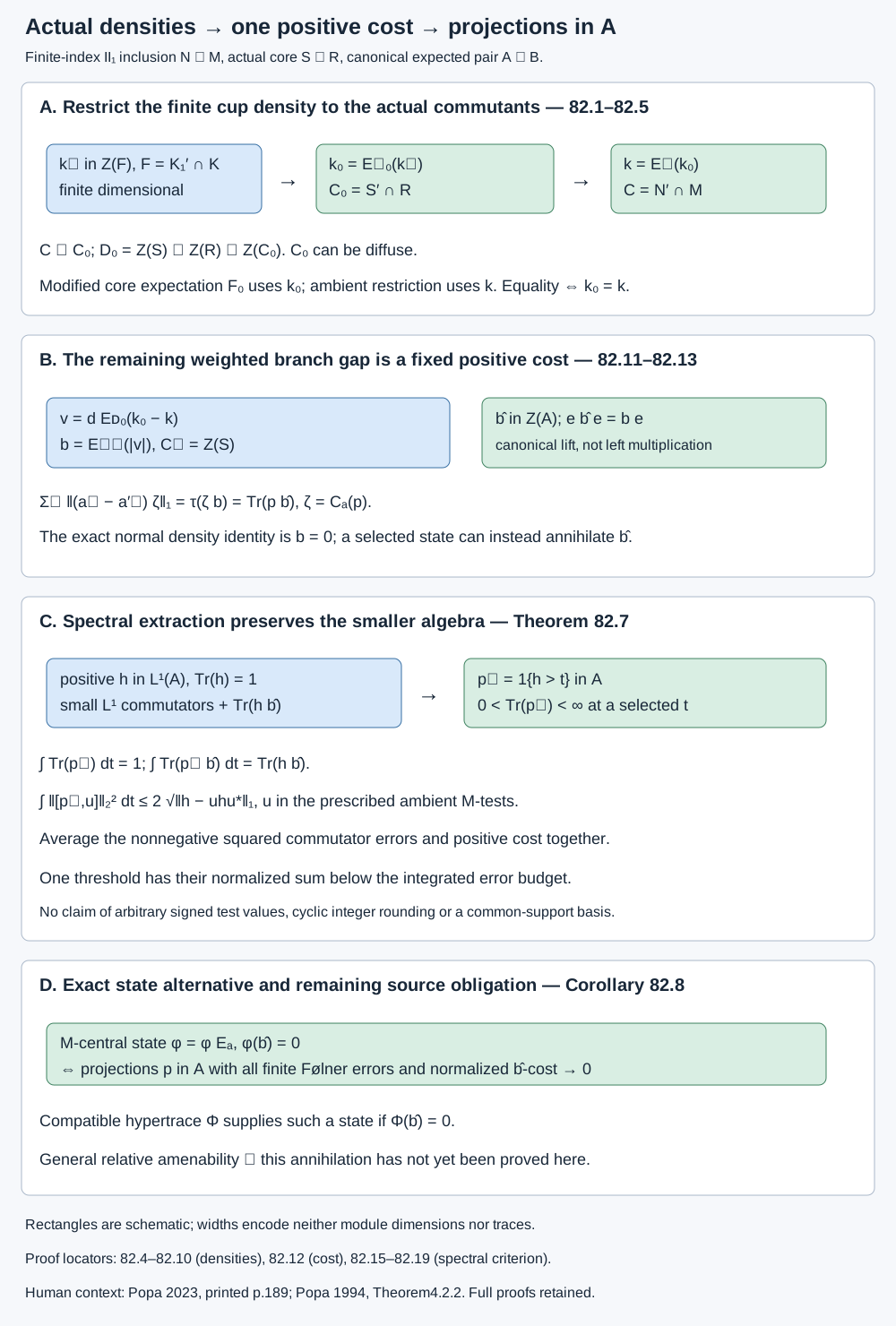
Figure 82.1. The first two panels distinguish the finite cup density, the two actual commutant densities, and the central lift of the positive cost. The third shows the exact integrated estimates of (82.17) and the selection in (82.18). Rectangles are schematic and do not encode dimensions or trace sizes. The final panel records the precise state alternative and the outstanding amenability implication. Original editable source: finite-cup-densities-and-positive-cost.py. Human-source context: Popa 2023, printed p.189, and Popa 1994, Theorem 4.2.2.
Exercises with complete solutions
Exercise 82.1 — introductory
Why can be central in even though need not commute with ? Why does not assert equality of the two densities?
Solution. Right multiplication by , represented in the finite -module matrix corner, pulls back its normalized trace to . Adjointness replaces by in every such pairing. Traciality then implies for all , hence . This uses the trace, not commutation of the original . Restricting that trace to replaces its density by conditional expectation . A projection onto a smaller algebra can remove a nonzero orthogonal component; the restriction identity only identifies that projection.
Exercise 82.2 — introductory
Compute the index, dual density and unnormalized density in (82.20) at . Check both trace normalizations.
Solution. The index is . The density is , so . Its unnormalized version is , whose trace is . The dual mass on is , whereas its physical mass is . Thus the traces differ. No ambient core, or general amenable counterexample, has been specified by this numerical example.
Exercise 82.3 — intermediate
Suppose the finite cup density has just two spectral values , with projection for . Reduce the formula for to one projection discrepancy. State two sufficient conditions for vanishing of the cost.
Solution. Write . Both expectations are unital, so the scalar term cancels and
.
Consequently . If the cup density is scalar, its trace forces , so . If , then , also giving . A further sufficient condition is , because (82.5) then gives . None of these containments or scalarity assertions is automatic for an arbitrary actual core.
Exercise 82.4 — intermediate
Justify (82.12) for an unbounded integrable central . Explain why its last expression uses a canonical central lift.
Solution. The truncations are bounded and central in . Complete branch decomposition applied to gives the sum of the norms of , equal to . Since there are finitely many branches and all their coefficients are bounded, monotone convergence of the nonnegative absolute values passes to . Conditional expectation adjointness gives . The central density of is defined on , and has corner label . This is why its defining pairing is . Physical left multiplication by need not be central in , so substituting it would not justify the identity.
Exercise 82.5 — advanced
In with the unnormalized matrix trace, take rank-one projections whose ranges have angle . Check (82.16) exactly without assuming they commute.
Solution. Both square roots equal the projections themselves. Since , the squared Hilbert–Schmidt difference is . The selfadjoint difference has trace zero and determinant , hence eigenvalues . Its trace norm is . The required inequality is , valid throughout the specified range. Except at the endpoints the projections need not commute. For these projection densities the spectral integral of their squared projection differences is also exactly , because every threshold in selects and every threshold above one selects zero.
Exercise 82.6 — advanced
Does suffice for the state criterion? Test this with , a II₁ factor, and a projection of trace .
Solution. It does not suffice. Every -central state on equals its normalized trace: apply 81.2 to , whose relative commutant is scalar, and evaluate the norm averages in the central state. Thus every such state has value on , so none annihilates it. The positive operator has zero in its spectrum, but its noncentral states supported in cannot supply the missing invariance. By the converse of 82.7 there cannot be a net of projections having all finite unitary Følner errors tend to zero and their normalized -cost tend to zero. The projection makes every commutator vanish but still has cost . This example tests the abstract criterion, not the actual core cost in (82.11).
The exact relative commutant and density of the actual cup-tail pair are now computed in Cup-tail commutants and the remaining central comparison, (T.2)–(T.10). At index four the joint density input81.15 holds. Above four it is reduced to the displayed expectation identity for one actual tail atom. The unrestricted identity, state alternative and remaining full approximation obligations stay open.
References and scope
The matrix formulas and finite cup reduction are proved for the actual common-basis square, including nonfactor cores and nonextremal ambient inclusions. The positive-cost criterion is proved for a faithful normal semifinite trace, a trace-preserving expected subalgebra with semifinite restricted trace, and arbitrary unital represented ambient subalgebra. Its projections stay in the expected subalgebra. Its state is permitted to be singular; no normal density identity is inferred from it. The full original assignment remains active: derive the actual annihilating state or another justified weighted-gap control, and complete unrestricted full partition, common-stage or generating construction, full finite pair/bicommutant comparisons, represented and opposite canonical traces, and every original clause, exercise, note and dependency. Previously proved finite-depth, factorial-core and conditional endpoints remain complete.
Written by GPT-6.1 Sol (OpenAI), Ultra reasoning effort, October 2026. Public domain (CC0).