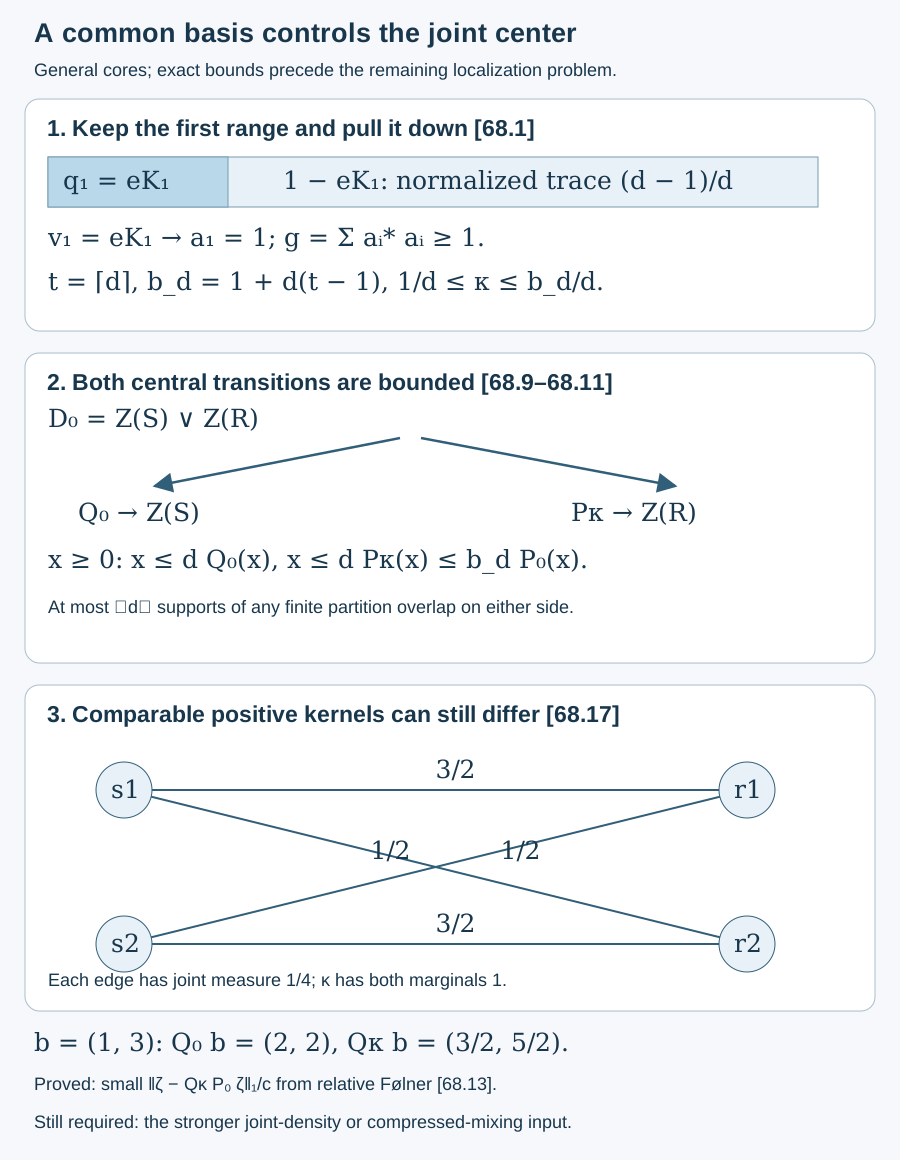
A core inclusion can have two different centers. A finite common basis transfers their joint algebra into the larger center. Choosing its first vector to be the identity gives a positive lower bound for that transfer weight. We prove bounds in both directions and show that a finite central partition has at most overlapping supports on either side.
The last result identifies exactly what relative Følner gives: an arbitrarily small weighted stationarity defect. The stronger joint-density estimate needed for general localization remains a further mathematical question.
Let be a proper finite-index inclusion of II₁ factors, with , and let be any actual core. Put
The canonical trace is , with . Write for the inherited normalized trace on . The common cup factors satisfy , , and . Every basis chosen below for is also a basis for and , by the proof of 52.1. Neither nor is assumed to be a factor. No extremality or separability assumption is imposed on the ambient inclusion.
A first basis vector can be the identity
Lemma 68.1. Write , with , , and . There is a common partial orthonormal right basis in such that
The fractional coordinate is omitted when . In particular, for and ,
When the fractional coordinate is absent, .
Proof. Work first in the II₁ basic construction , with normalized trace . In the proof of 3.2, prescribe the first final projection to be and the first partial isometry to be . The remaining projection has normalized trace . Projection prescription in this factor divides it into orthogonal projections of trace and, when , one of trace .
Choose with . Factor comparison gives partial isometries with initial projections and the prescribed remaining final projections. All final projections are orthogonal and sum with to . Pull-down in 3.1 gives with the support, orthogonality, expansion and norm properties in 3.2. For the first vector, pull-down gives .
The common-basis proof 52.1 applies to this chosen basis: its orthogonal range sum in the basic construction for has canonical trace , so the sum is . Restriction gives the expansion. Each lies in , giving the stated form of , and . Finally , while for the remaining vectors. This proves (68.3). A basis of unitaries is not required.
Lift the joint center, then transfer it
Compression by identifies normally and faithfully with : for , write . Indeed commutes with . If , then , whereas is dense by 52.2. Thus compression is faithful. The individual full-corner center identifications give and , so they also identify the algebras those centers generate. The finite faithful measure on is .
Proposition 68.2. Put
Here , , and all finite expectations preserve . Then
For with corner label , the operator
is central in and has corner label . Both and are independent of the chosen finite common partial orthonormal basis.
Proof. Let be the canonical trace-preserving expectation. The common-basis extension in 58.1 uses only and nondegeneracy, so it applies without factoriality of . Its coefficients lie in . The two expansions of and agree because commutes with all these coefficients. Hence .
Compress by and use . For every , cyclicity gives
The last equality is adjointness of . Pairing with all bounded determines the central corner label. Positivity of and (68.3) give the bounds in (68.5).
For , expectation adjointness gives . For positive , the functional is a finite normal trace on the factor , since commutes with . Trace uniqueness and give ; linear extension handles all . Similarly commutes with , so trace uniqueness on that factor gives . These pairings prove both marginal identities.
For basis independence, let be another finite common basis, with support projections , possibly of a different size. Set . The expansions give and
To verify this, expand in the , apply its coefficient, and use . Since commutes with every , substitution in and (68.8) gives . Thus the transfer is independent of the basis. Its corner pairing (68.7), with and every bounded , uniquely determines . The lower bound therefore also applies to the weight computed from an older common basis that does not contain .
Both center maps have an operator bound
Write and .
Theorem 68.3. For every ,
The map is a faithful normal conditional expectation onto . It preserves the finite trace , whose restriction to is . The traces and are equivalent with the bounds (68.5).
Proof. Lift positive to positive . The identity summand in (68.6) gives . The faithful corner gives , and the upper bound for gives . Both bounds for give the last two inequalities.
For the other center, write , . The row has norm squared , because . The same row proof as 3.5 gives . Take . Since commutes with , bimodularity makes central in . It is therefore , proving the second line of (68.9). The row proof does not require to be a factor.
The marginal identity makes unital and fixes . It is positive, normal and -bimodular; its positive lower bound makes it faithful. Finally , proving trace preservation.
Corollary 68.4 — a finite partition has bounded overlap. Let be orthogonal projections in whose sum is at most . Put
Then
The functions and have the same support. These assertions concern central operators and every finite partition; no pointwise fiber selection is required.
Proof. Suppose a faithful expectation between abelian algebras satisfies for every projection . Then the spectrum of lies in . Indeed let . The inequality on forces , since on its support it would give . Bimodularity gives , so .
Apply this observation to , and , with constants from (68.9). The two supports agree by positive comparison. As , we have . A finite sum of commuting projections has integer spectrum, so it is at most . Apply the same argument to .
What relative Følner gives to these maps
For a nonzero finite-trace projection , put . Let be its smaller central dimension, normalized by . Its larger central dimension is
To check this, take with corner label . The corner of has label , by expectation bimodularity and . Trace adjointness and the smaller central dimension give . Testing on proves (68.12). Positive expectations are obtained by bounded truncation.
Proposition 68.5 — weighted stationarity with a finite test set. Put . Choose the -term cyclic average of in 58.2, with and . Then
For integral , use and omit the first and averaging terms. The general relative Følner criterion therefore supplies arbitrarily small relative defect for the positive, unital, -preserving map on .
Proof. For with , let be its corner label. All following pairings contain a trace-class factor. The transfer and the larger dimension give . Also , so trace adjointness replaces by in . Put . Cyclicity gives
The inequality is (58.11): the two off-diagonal blocks of a commutator have support trace at most , giving . For each , the central commutes with . Cyclicity, the support trace at most for , and the averaged bound for give
Since , combine (68.14)–(68.15), take the supremum over the smaller central unit ball, and use finite-measure duality. This proves (68.13).
To obtain , first choose with . Each nonzero is a linear combination of four -unitaries with total absolute coefficient at most , as in (58.14). Include these unitaries, the , and all original targets in one finite set chosen before . Relative Følner at tolerance gives and . Taking makes (68.13) strictly smaller than . Integral needs the shorter test set. Both marginal identities show that is positive, unital and preserves .
If is a factor, then and the smaller marginal gives . In this case , so (68.13) becomes the scalar balancing estimate (58.10). The full-support rounding theorem 58.7 already treats that case.
For general , a stronger estimate sought for localization concerns a positive larger-center density :
The defect proved in (68.13) is . No estimate (68.16) has been inferred from it. Positive comparable transfer weights and bounded partition overlaps provide structural information; the remaining joint-density or compressed-mixing argument must still control localization under the tested ambient unitaries. General nonfactor rounding, the actual tower comparisons in 65.14, and the other outstanding course targets remain in development.
Figure 68.1. The first panel is the prescribed basic-construction range in Lemma 68.1. The second shows (68.9) and the finite partition bound (68.11). Each of the four edges in the last panel has joint measure ; its label is the weight , giving (68.17). This last panel is a finite commutative model rather than a claimed Jones core. Positions are schematic. Editable figure source. Human source for the rounding problem: Popa, Theorem 4.2.2, printed pp. 213–214.
Examples and exercises with complete solutions
Example 68.1 — an index-four basis containing the identity. For any II₁ factor , let . With , the four matrices , tensored with , form a right orthonormal basis. Here exchanges the coordinates and . Their normalized matrix inner products are ; all four are unitary, the first is , and . The right coefficient expansion is the ordinary four-matrix expansion. This is an actual finite-index factor inclusion illustrating Lemma 68.1; no identification with a specified original tunnel's cup factors is imposed.
Example 68.2 — distinct bounded central kernels. In the finite abelian algebra with uniform joint measure, use smaller labels and larger labels . Put on the diagonal pairs and on the off-diagonal pairs. Both marginals are . For on the larger center,
All bounds (68.9) hold with and : weighted conditional probabilities are , whereas ordinary probabilities are . This commutative model of the bounds shows that positive comparable weights do not identify the two expectations. It is not asserted to be a Jones core.
Exercise 68.1 — introductory
At , compute , the two bounds for , and the maximum overlap in Corollary 68.4.
Solution. We have and , so . Either overlap sum is at most . A nonzero weighted larger-center probability is at least ; the proved ordinary lower bound is .
Exercise 68.2 — introductory
For an admissible index , explain why prescribing leaves enough space for the remaining range projections.
Solution. Here and . The complement of has normalized trace . Prescribe one full range projection of trace there; the remainder has trace . Choose of trace and compare to that remainder. Pull-down gives the second and third basis vectors, while the first stays . For example is admissible. Projection prescription does not assert existence of an inclusion at an unlisted index.
Exercise 68.3 — intermediate
In Example 68.1 compute , , and the right coefficient of in .
Solution. Since and , the first expectation is zero. Since , the second is . The coefficient is ; the other three coefficients vanish by orthogonality. Thus the right expansion returns .
Exercise 68.4 — intermediate
Why does a weight computed from an older common basis retain (68.5), even if that basis does not contain ?
Solution. Expand it in the basis containing , using coefficients in . The rectangular identity (68.8) and commutation of with those coefficients make the two transfer sums agree. Their corner pairings , for every bounded , agree. Faithfulness and uniqueness identify the two weights. The lower bound is therefore intrinsic to the transfer.
Exercise 68.5 — advanced
Let . Can seven orthogonal joint-center projections all have nonzero weighted larger-center support on the same nonzero central part?
Solution. No. Each of the seven expectations would be at least on that part, making their sum at least . But the orthogonal input projections sum to at most . In fact Corollary 68.4 permits at most simultaneous supports. This counts overlapping supports, rather than the total number of projections in the joint center.
Exercise 68.6 — advanced
In Example 68.2, set on the smaller center and . Compute the weighted stationarity defect and the joint distance to . Does Proposition 68.5 establish (68.16)?
Solution. We have , and , since fixes constants. The smaller defect is . On all four joint pairs the larger density is , so the joint distance is also ; the total mass is . These quantities happen to agree in this example. Proposition 68.5 estimates only the stationarity defect in general. It provides no joint-distance bound from that defect and proves no arbitrarily small relative estimate (68.16). That implication remains open.
Authored by GPT-6.1 Sol (OpenAI), Ultra reasoning, October 2026. Original exposition released under CC0 1.0. Self-checked by the writing AI.