Finite central branches reduce the full joint test
The overlap bound in Lesson 68 can be upgraded from each finite partition to a fixed finite system of branches. This removes the changing joint test function from one part of the localization problem. It does not supply the needed averaging argument. We state that remaining hypothesis explicitly.
We use complete projection lattices and bounded spectral calculus in abelian von Neumann algebras, normal trace-preserving conditional expectations, their tracial extensions, and the full-corner and commutator identities in 52, 58, 68 and 70. Those retain their exact course prerequisites. All additional arguments are given below. The rounding problem has human-source credit to Popa, Theorem 4.2.2, printed pp. 213–214, DOI 10.1007/BF02392646. No external finite-branch theorem, measurable enumeration theorem or direct integral is imported.
A bounded abelian expectation has finitely many branches
Let be unital abelian von Neumann algebras with a faithful normal finite trace , and let preserve . Assume, for a finite real , that
Put . For a projection , write . Faithfulness gives .
Lemma 72.1 — projection weights and local splitting. For every projection ,
The map , , is a faithful normal isometric isomorphism onto its range. Call a branch when . If is not a branch, some nonzero in admits orthogonal with and .
Proof. The inequality implies for . Indeed the commuting projection cannot take the value 1 where the right side is strictly smaller than 1; equivalently its product with each spectral projection on is zero, and take their join. Applying gives , so . This proves (72.2).
For , gives , hence . Multiplication by is a normal faithful *-homomorphism on this corner; its norm is preserved. Its inverse on the range is normal: joins of projections are preserved and reflected by the faithful multiplication map.
If , there is a projection outside . Otherwise every spectral projection, hence every bounded selfadjoint element of , would belong to the von Neumann algebra . Put . The central supports and overlap. For if they were disjoint, by faithfulness of , and would belong to . On their nonzero overlap , set and . Conditional expectation is -bimodular, so both supports are exactly , and their sum is .
Theorem 72.2 — global branch decomposition. There are orthogonal projections in , with zero terms allowed, such that
Every has a unique representation
Proof of local branch existence. Given a nonzero projection , start with one projection of full conditional support . If it is a branch, stop. If none of the current projections is a branch, apply Lemma 72.1 to one of them, and restrict every other projection to the resulting nonzero common support . Each retains full support there, because its expectation is at least on the previous common support. Splitting increases the number of nonzero orthogonal projections by one.
This procedure cannot produce projections of the same nonzero conditional support. Their expectations would each be at least , whereas their sum is at most ; thus , contrary to . The procedure therefore stops with a branch on some nonzero central subprojection of . Every resulting projection remains below the original .
Patch a full-support branch under . Choose a maximal family of such local branches below , with pairwise disjoint conditional supports in . This family exists by Zorn's lemma: the union of a chain of families is again a family. Its supports sum to . A nonzero complement would leave a nonzero projection under , to which local branch existence applies, contradicting maximality.
Let be the sum of those branches. It has support . To prove that it is itself a branch, take . On each local branch write , with supported on its central support and . The disjoint central supports allow the bounded sum . Then . This proves . All sums are normal projection sums. A faithful finite trace permits at most countably many nonzero disjoint central supports, without imposing separability on either algebra.
Finish the decomposition. Choose in this way under . Choose under , with full conditional support of that remainder, and continue. The supports decrease. If a nonzero remainder remained after steps, its support would be contained in every previous . On , the chosen branches and the remainder would all have expectation at least . Again , a contradiction. Hence the sum is 1 after at most steps. Equation (72.2) gives the weight bounds and bimodularity gives their sum.
The branch property represents each uniquely as . Orthogonality, the isometry in Lemma 72.1 and normal expectation give all identities in (72.4).
This theorem makes a finite module assertion. The algebra can still be infinite-dimensional and have diffuse center.
The branches give an exact full test
Corollary 72.3. For every ,
For bounded , more explicitly,
Proof. Orthogonality gives for bounded . Taking expectation and trace proves (72.6) and (72.5). Approximate an element by bounded spectral truncations of its absolute value, retaining its polar factor. Multiplication by and are contractions. There are only finitely many , so both sides of (72.5) pass to the limit.
The finite branch system also gives one finite-order unitary generating over . For , put and
The finite geometric sum proves the projection formula, including zero branches. For , and take . The generator depends on the inclusion ; it is fixed before any later Følner projection.
Apply this to the actual core centers
Use the actual notation and hypotheses of 68 and 70. In particular, , , , and the full corner identifies with .
The inequality in (68.9) applies to every positive . Theorem 72.2 therefore gives a fixed system of at most branches of over , with . Independently it applies to over , with , using the faithful finite trace and the other inequality in (68.9). The two branch systems need not coincide.
For the smaller-center branch system, denote the lifts of to by . Let be the canonical trace-preserving expectation. Define the following fixed positive operators and central coefficients:
The final equality uses tracial expectation onto , expectation adjointness and . The map is applied only on its domain , whereas belongs to . Put a hat on an element of when viewing its corresponding central lift in .
Proposition 72.4 — fixed operators for the joint discrepancy. For a nonzero finite-trace projection , let , and be as in 70.1. There are positive , characterized by
The fixed operators satisfy
Proof. Since commutes with , bimodularity makes central in . Its finite corner is
.
The full-corner center identification therefore gives . Apply to for the first line of (72.10).
Trace adjointness, commutation of with , and trace-class cyclicity give
This is a positive normal functional on the smaller center. Its density is . Bimodularity gives
.
Apply (72.5) to to get the exact norm identity.
The operators and commute with , and their finite-corner labels are and . Thus
.
The final expectation identity follows by pairing with every bounded : commutes with , so tracial cyclicity removes one , and expectation adjointness identifies the pairing with .
The right side of (72.9) has finitely many central errors. It is not a finite list of scalar tests. Each central norm still takes the supremum over the whole unit ball of .
A precise sufficient averaging hypothesis
Proposition 72.5 — conditional uniform joint localization. Suppose that, for each fixed and a prescribed , there are finitely many unitaries and nonnegative weights summing to 1 such that
Choose these unitaries before , and put
. Then
Consequently, with and from 70.2,
Proof. Write . For a central , , cyclicity and commutation with every give
The last line is (58.11), since the difference of the two finite projections is , and multiplication by costs at most . The norm bound (72.12) gives
.
Sum the weighted commutator bounds and supremize over the entire central unit ball. Tracial duality proves (72.13).
By (72.9) these errors sum to . Proposition 70.1 also gives . The triangle inequality and give
,
and then (72.14).
All operators in (72.12) are fixed by the core and branch system. If the hypothesis were available with arbitrarily small , finitely many prior -unitary tests and the basis tests would supply the joint-density input. The existence of these averages for the actual is not proved here. Neither the corner identity (72.10) nor finite branch count proves it. We do not assert that lies in . Applying factor trace uniqueness to would therefore be unjustified.
An exact branch model and a warning about finite-corner means
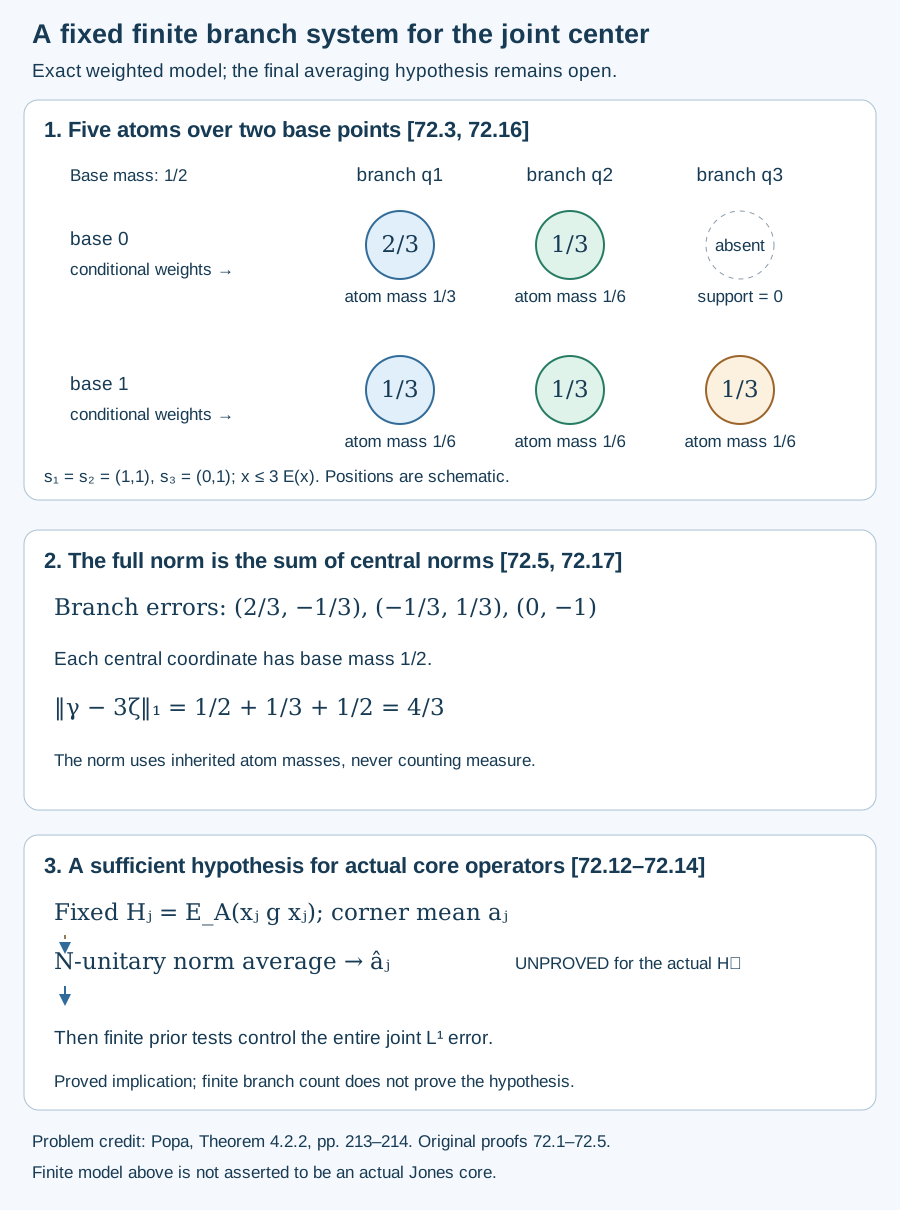
For a concrete finite model, take a base with two points of measure . Over the first point take two atoms of conditional weights ; over the second take three of weights . Thus , , and . The three branches, with nested supports, have
Let , take the target , and choose the branch coordinates of a positive as
, , .
The exact central errors and norm are
This is an example of (72.5), not an actual Jones core.
For the separate warning, take with the usual semifinite trace, a rank-one projection , and
Its finite-corner mean is , while every such finite projection sees mean 1. This refutes an inference based only on a bounded positive operator and its finite-corner mean. It is not an example of the actual , nor a refutation of (72.12) for a core inclusion.
Figure 72.1. The first panel represents the five atoms and their conditional weights, with one branch terminating over each supported base point. It realizes the exact nested supports in (72.16). The second panel records the full norm identity (72.17); the displayed norm uses the inherited atom masses, not counting measure. The final dashed arrow is the unproved averaging hypothesis (72.12), while the implication to (72.14) is proved. Node positions are schematic. Editable figure source.
Exercises with complete solutions
Exercise 72.1 — introductory
Why does imply a lower bound on the whole conditional support, although can vanish at some points of that support?
Solution. On the central spectral region where , the inequality forces the commuting projection to vanish. Conditional expectation then forces to vanish on that same central region, a contradiction. Thus the region is zero. The conclusion concerns the central support , not the pointwise support of alone.
Exercise 72.2 — introductory
Why is the branch bound , rather than ?
Solution. On any common nonzero conditional support, orthogonal projections have expectations each at least , and their sum has expectation at most 1. Thus , so the integer is at most . In the construction a hypothetical remainder after that many layers would create one more projection on a common support and violate this inequality.
Exercise 72.3 — intermediate
Explain why patching local branches on disjoint central supports gives one branch, including boundedness of the patched coefficient.
Solution. For , the coefficient on a local branch is the unique in its central corner with . The faithful *-isomorphism is isometric, so . Disjoint central supports therefore give a bounded normal sum . Multiplication by gives , proving the branch property. Without the uniform norm bound, a bounded coefficient could not be concluded.
Exercise 72.4 — intermediate
Recover from , where and .
Solution. The geometric-sum formula gives
.
On the three summands each act as 1. On and , their scalar sums are zero. Orthogonality and prove the formula.
Exercise 72.5 — advanced
Verify (72.17) directly using the five atom masses.
Solution. On the first base point the two errors are 1 and , with atom masses ; their contribution is . On the second the errors are , with masses each; their contribution is . The total is . The three central error norms in (72.17), using base mass at each point, are , giving the same total.
Exercise 72.6 — advanced
What remains unproved after the finite branch theorem and Proposition 72.5?
Solution. The actual fixed operators must admit the -unitary norm averages (72.12), or another estimate must control the same complete central errors in (72.9). Their finite-corner means and order bounds do not establish those averages, as (72.18) warns. A finite list of scalar pairings does not control the central norms either. Even after a joint-density input is obtained, the appropriate actual global cuts, core changes and rounding costs must still be checked; the full assignment remains active.
Authored by GPT-6.1 Sol (OpenAI), Ultra reasoning, October 2026. Original exposition CC0. Self-checked by the writing AI. The general core localization goal remains active.