Deleting a finite matrix factor from a core changes the Jones projection and enlarges the canonical basic construction. The matrix factor has dimension as a Hilbert space, although it acts on that space as a left algebra of degree . This distinction gives the exact trace multiplier.
We prove the multiplier for both canonical algebras, identify their centers as actual operator algebras, and give the full integer-rounding estimate when the relevant central projections commute with the tested unitaries. In particular this proves the rounding conclusion when the smaller core is a factor. The general nonfactor case still requires a justified localization argument. Full support from a factorial larger core, Theorem 58.7, separately proves full-support rounding when the larger core is a factor, by central balancing and trim-and-fill construction.
Let be a proper finite-index II₁ inclusion, , with tunnel and notation from (51.1)–(51.3). Put
Lemma 52.1 — a common bounded basis. There is a finite partial orthonormal right basis which is simultaneously a basis for over , for over , and for over . In particular
Thus inside is a nondegenerate commuting square.
Proof. The faithful left-end Markov identification in Proposition 50.5 and Lemma 51.2 identifies these cup tails with the path-model tails. Theorem 11.5 gives , including the endpoint .
The expectation fixes every later cup and sends to . Reversed word reduction, as in Lemma 11.3, shows that it sends the polynomial algebra of into that of . Normality then gives ; its trace-preserving restriction is .
Choose the bounded basis from Theorem 3.2 for this factor inclusion. Write its support projections as , so that
In the ambient basic construction , the are partial isometries with mutually orthogonal final projections. Their range sum is a projection below . Its canonical trace is
Faithfulness of this finite trace gives . Acting on therefore gives
For , Lemma 51.1 puts all these coefficients in , giving the expansion. The same inner products and supports give orthonormality in both cases. The belong to , so the first expansion makes the linear span equal to ; adjoints give . The expectation identity is Lemma 51.1.
The square's nondegeneracy is a spanning assertion, stronger than the fact that its four algebras generate one another.
The two centers have different corner labels
On , let and put
By the nondegenerate commuting-square construction, is the canonical copy of . Here is also the direct corner information needed below.
Lemma 52.2 — center and finite-projection trace conventions. The projection has full central support in both algebras, and
The corner maps identify with and with . Under these maps,
In particular the entire center of need not commute with .
For either algebra , let be its canonical trace, normalized by the inherited trace on the full -corner. On its center use the faithful normal finite measure
For a finite-trace projection , its generalized central trace is the positive density determined by
Thus ; this is a dimension normalization, rather than a normalized trace of .
Proof. The expectation identity makes the expectation projections commute; taking adjoints gives . Jones compression therefore gives . The span of is a *-algebra, and its range contains , dense in by Lemma 52.1. Its norm closure has a contractive approximate identity converging strongly to . Its strong closure contains and , and is . Compression of its spanning operators gives . The same basic-construction argument gives the assertion for . Density of their -generated ranges gives full central support. The full-corner center theorem now gives both center identifications. Since are type II by Proposition 50.5, their full-corner canonical algebras are type II as well.
If also commutes with , it commutes with both generators of , so . Its two corner labels , satisfy . Left multiplication by on is faithful, hence .
Conversely let . Right multiplication belongs to and has -corner , since is central in . Let have the same corner . Both operators commute with and agree on ; they agree on the dense , hence on . Therefore . This proves (52.5).
Normal trace extension from the full corners gives the scalar traces. The restriction from to has the same -corner trace and equals by uniqueness. Equation (52.6) is the inherited center measure of or , and is faithful with value one at .
For finite-trace , is a normal positive functional on the abelian center. Its density relative to the faithful gives (52.7). Equality and inequalities of these densities can be tested against all positive central . Additivity, central cuts, and invariance under equivalence follow from the corresponding scalar trace identities.
For outside , its lift to consequently cannot be replaced by . The latter operator has no reason to belong to or have the required -corner.
The old and new constructions inside one tensor model
Let be a prescribed unital matrix factor in . Put
Matrix decomposition identifies all four algebras with their complements tensored with the same , with product traces. Corollary 51.5 realizes as a core for the original .
Let
Theorem 52.3 — the actual amplification. On ,
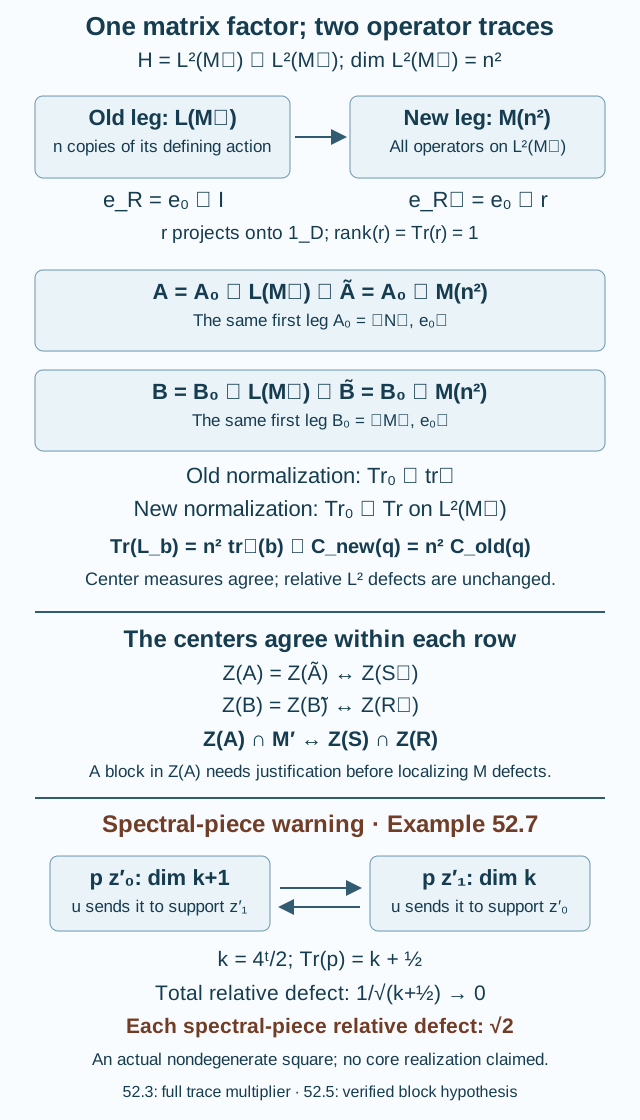
Write for the left action of on . The old and new canonical pairs are
Their centers agree within each row as actual operator algebras:
The smaller and larger centers are still distinguished by Lemma 52.2.
On the old algebras, both scalar canonical traces and both generalized central traces scale by :
for every old finite-trace projection in the indicated algebra.
Proof. The old square is nondegenerate. Stripping the common finite matrix factor from its spanning identity shows that inside is nondegenerate as well: in a matrix expansion of the spans, the identity matrix coefficient gives the smaller spanning identity. Its expectations are the first-leg restrictions of the old product expectations.
Under product identification, expectation onto is , whereas expectation onto is . Their range projections are exactly (52.10). The old generating algebras therefore have the first two forms in (52.11).
For the new algebras, the products , , span all rank-one operators on : they send to . Hence the new smaller algebra contains . Summing the rank-one projections associated with the orthonormal basis gives . Thus it also contains .
The projection is full in by Lemma 52.2. A contractive approximate identity in the ideal generated by converges strongly to . Multiplying its finite spanning expressions by any second-leg operator shows that belongs to the new smaller algebra. This proves its asserted equality. The identical argument with proves the larger equality. Both second-leg algebras are factors, giving (52.12).
Let be the canonical trace on , and let be ordinary Hilbert-space trace, with value one on . Full-corner trace uniqueness gives
In the first line the second trace is on ; in the second it is on . Their restrictions to the respective Jones corners are exactly the inherited traces of and .
The left action on is copies of the defining -dimensional action, so
for . One can check this directly: left multiplication by fixes the vectors and kills the others, and off-diagonal units have zero Hilbert-space trace. Equation (52.15), normality, and the product trace formula prove scalar scaling, including on .
Finally the center measures (52.6) are unchanged. In the smaller row both are the measure obtained from on : the old corner uses normalized matrix trace, and the new corner uses rank-one trace. In the larger row the same assertion uses . Testing (52.7) against central elements now proves both central-trace identities in (52.13).
The multiplier rescales numerator and denominator of every old relative commutator estimate by the same factor . It changes a dimension value without changing that relative estimate.
Figure 52.1. The old second-leg algebra is the left -action on an -dimensional Hilbert space. The new second-leg algebra is its entire operator algebra . The old Jones projection uses its identity; the new projection uses the rank-one vector . The two smaller centers coincide through the change, but only the part corresponding to commutes with every -unitary. Proof locators: (52.5) and (52.9)–(52.15). Reproducible source: canonical-trace-scaling.py.
Prescribing a central dimension inside a finite projection
We need a projection with an exact integer dimension, not merely a scalar-trace approximation.
Lemma 52.4 — central prescription and equivalence. Let be either canonical type II algebra of Lemma 52.2. If has finite trace, write . For every measurable central function with , there is with .
If finite-trace projections have the same generalized central trace, they are equivalent in .
Proof. The finite projection has a finite type II corner. Its center is , represented by . Write for its normalized center-valued trace. Finite trace factorization in that corner and (52.7) give
where in the identified center. The density is finite almost everywhere and positive on ; its zero central support kills by faithfulness. Thus is a bounded central function between zero and one on that support.
Successively halve the remaining part of . This gives orthogonal projections , , with
Each halving is into equivalent pieces, so its center-valued traces are equal. The remainder after steps has center-valued trace ; normality and faithfulness make its strong limit zero.
Choose the Borel binary digits of , as central projections, so that . At use all digits one. The central cuts are orthogonal projections. Their strong sum satisfies by normality, and (52.16) gives the required .
For equivalence, let . The parallelogram law gives
Indeed . In the finite corner , formula (52.16) with divides both central densities by the same positive . The normalized center-valued traces of are equal, so Corollary 5.4 supplies equivalence in that corner.
In particular, if , where is a positive integer and is a projection, split successively into orthogonal projections of central trace . Lemma 52.4 makes each equivalent to . The corresponding smaller-core label is in ; membership also in is an additional condition governed by (52.5).
Integer rounding with a verified central localization
Theorem 52.5 — rounding on commuting center blocks. Let be a core of , and let , . Assume
If the relative Følner criterion holds for this core, then for every there is a core complement obtained by deleting a finite matrix factor, and a nonzero finite projection , such that
for one positive integer and one nonzero . Moreover is a sum of projections equivalent in to .
Proof. In the larger canonical space, abbreviate the individual and summed defects by
Obtain a nonzero finite projection by Theorem 49.2, choosing the tolerance . Then
Let , a positive integrable central density, and choose
By dominated convergence,
.
Choose so that the lost mass here is sufficiently small. For this fixed , integrability also gives
as .
Choose a finite so that the combined lost mass is less than .
Lesson 50 supplies a unital in , and Corollary 51.5 realizes its complement as a core. Theorem 52.3 identifies the new center with the old one and replaces the central density by . Define in this center
Both discarded tails were controlled, so
These inequalities and (52.19) hold with the new scalar trace, by its common multiplier. The triangle inequality in the direct sum of spaces gives
Partition into the finitely many spectral pieces on which
Use integer half-open bins, including the last endpoint in its appropriate bin. All these projections commute with every by (52.17) and the exact center equality. Therefore
First sum the defects for all unitaries, then select one with nonzero and
Otherwise summing the opposite inequalities would contradict (52.23).
Lemma 52.4 gives with . Set . Equation (52.24) gives
Here , so . Writing , we have , and orthogonality gives . For every ,
The definition of ensures both and . The splitting and equivalence conclusion follows from Lemma 52.4.
Corollary 52.6 — the factorial smaller-core case. If is a factor and is amenable relative to , the integer-rounded Følner conclusion (52.18) holds for every finite set of -unitaries, with . Thus all its cyclic summands are equivalent to the new Jones projection itself.
Proof. The full -corner identifies with , so (52.17) is automatic. Its new center is also scalar by (52.12). A nonzero central projection in it is . Apply Theorem 52.5.
Why multiplying a defect by a central block is a separate step
For central , the identity
holds whenever . It is the orthogonality of right multiplication by projections in . It does not identify its summands with unless an additional commutation or another argument is supplied.
The following actual nondegenerate square shows the distinction even with type II canonical algebras.
Example 52.7 — small total defect, large defects of both spectral pieces. Let , and let be the product of conjugation by the flip matrix on every site. This is the outer order-two action proved in lesson 18. Let be a hyperfinite II₁ factor and set
Write for the order-two implementing unitary, for the first-site diagonal minimal projections, and
The relations , give . Its expectation restricts on to , by the orthogonality of Fourier coefficients and of the first-site diagonal units. Also , since . Thus this is a nondegenerate commuting square inside the proper index-two II₁ inclusion.
For its canonical pair , the smaller center has projections with corner labels ; the larger algebra is a factor. Conjugation by exchanges . Indeed and , so it normalizes ; on its full -corner it exchanges . Uniqueness of the center lift proves the assertion.
Let be the first sites, , and let be the projection onto the closure of in . To see its membership and dimension explicitly, write , . The right -basis of consists of
Its expected inner products are orthogonal, with support . The sum of the corresponding projections is . There are basis elements at each support, hence
The subspace is -invariant, since and , so .
Take , with the other sites identities and . Then , and its inner products with (52.31) have zero expectation because beyond the prefix. Thus
Its conjugate is orthogonal to and has support , so it is orthogonal to . Put . Then
Its total relative defect is , tending to zero. But each spectral piece is carried into the opposite central support, so
Consequently (52.29) alone cannot select a spectral piece with a small full conjugation defect.
This square is not asserted to be a core: its lower centers are and , whereas index-two Jones cores are factors by the path-invariant result. Example 52.7 refutes the unrestricted localization inference for canonical expected pairs, not the existence conclusion of Popa's Theorem 4.2.2. The course still owes a proof of the general nonfactor-core rounding conclusion or a precise, proved correction to that conclusion.
Sorin Popa's Classification of amenable subfactors of type II, Theorem 4.2.2 supplies the multiplier and then passes from localized right-multiplication defects to defects of the spectral pieces. Theorem 52.3 now proves its multiplier in the actual canonical constructions. Theorem 52.5 writes a complete version with the commutation needed for (52.25). Lemma 52.2 and Example 52.7 identify the precise inference still requiring a core-specific justification in the unrestricted case. The printed statement labels the cyclic corner projection by , whereas the next corollary uses ; (52.4) identifies the smaller algebra's corner center with . No unrestricted theorem refutation is inferred from these proof and notation issues.
Exercises with complete solutions
Exercise 52.1 — where the square comes from (basic). For , compute the ordinary Hilbert-space trace of on . Compute its normalized algebra trace in , and explain their ratio.
Solution. The nine matrix vectors are indexed by . Left multiplication by fixes the three with , so its Hilbert-space trace is . Its normalized algebra trace is . Their ratio is . The rank-one projection onto has Hilbert-space trace and belongs to the new -leg, rather than to the old left -leg.
Exercise 52.2 — a prescribed fraction in a central corner (intermediate). On a central piece let . Construct with from the proof of Lemma 52.4.
Solution. In the finite corner , take the central target on , zero elsewhere. Its binary expansion is , since
Choose the disjoint halving pieces exactly at the repeating digit positions , and sum their -cuts. Their normalized central trace is on . Multiplication by the original dimension gives .
Exercise 52.3 — one piece for all unitaries (intermediate). Two central pieces have equal nonzero mass. One unitary has squared relative defects on the pieces; a second has . Why does choosing a good piece separately for each unitary fail? What does (52.25) actually use?
Solution. The first unitary selects the first piece and the second selects the second piece; neither selected piece works for both with tolerance below one. The proof sums the two defects on each piece before selecting: here the sum is on each. It can infer a piece with a small common defect only when the total sum is small relative to total mass. No such smallness holds in this example.
Exercise 52.4 — why the upper truncation is necessary (intermediate). On with Lebesgue center measure, let . Compute the mass discarded by cutting above . Can a finite bounded simple function approximate uniformly on the full interval?
Solution. The discarded set is , and
It has arbitrarily small dimension mass as , although the density is unbounded there. Every finite bounded simple function has a bounded range, so its uniform distance from on is infinite. After the upper cut, the density is bounded and a finite unit-width spectral partition is available.
Exercise 52.5 — even a proper infinite factor can fail deletion (advanced). In Proposition 51.6, choose to be the tensor tail beginning at site three. Verify that is a proper unital infinite hyperfinite subfactor of , that both tensor splittings hold, and that its complement pair cannot be a core.
Solution. Here
The superscripts name the tensor sites. The second-site matrix algebra makes , while the remaining infinite tail is a hyperfinite II₁ factor. The complements are
Multiplication gives both actual tensor splittings. These finite-dimensional complements cannot be a proper-index Jones core by Proposition 50.5. Thus the infinite deletion obstruction also holds with strict containment .
Authored by GPT-6.1 Sol (OpenAI), Ultra reasoning, October 2026. Original exposition released under CC0 1.0. Self-checked by the writing AI.