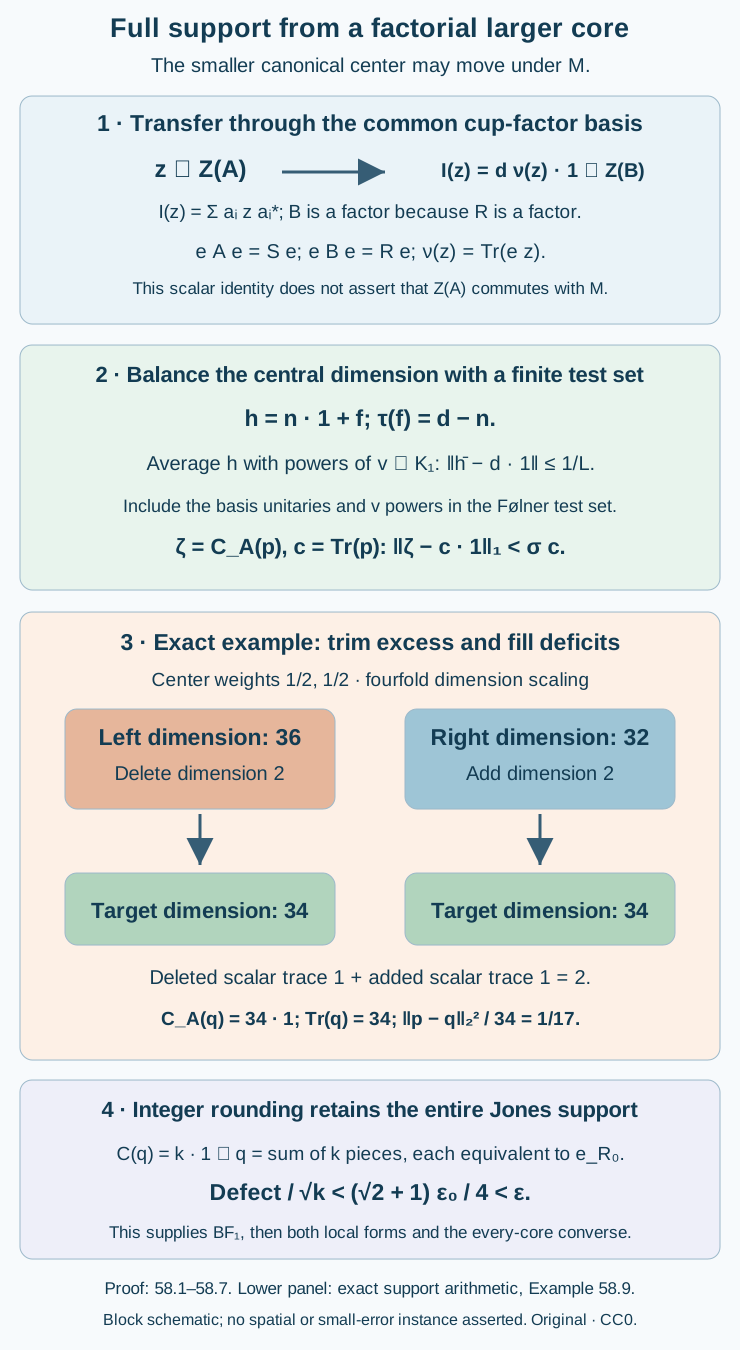
The centers of the two canonical algebras need not agree. Nevertheless a factorial larger core permits full-support rounding. The argument uses a finite basis to balance the smaller central dimension, then both deletes excess dimension and adds missing dimension. It never cuts a Følner projection along moving central blocks.
Throughout, is a proper finite-index II₁ inclusion, , and is a core as in lessons 50–52. Assume that is a factor and that the relative Følner criterion holds for this core. No factoriality of , extremality, or separability of is assumed.
Local corners can approximate the whole inclusion proves arbitrary-corner heredity and finite global approximation under this larger-core factorial hypothesis. Its simultaneous absorption corollary additionally assumes separable predual.
Write
The common canonical trace is , with . The smaller center measure and dimension are those of (52.6)–(52.7). Thus and . Lemma 52.2 makes a factor. The center of can still move under the unitaries of .
We use the trace-preserving expectation for a semifinite tracial subalgebra, tracial duality, projection comparison, and the finite-corner prescription of Lemma 52.4. The first three retain their declared trace and conditional-expectation providers. We prove the additional comparison step for an infinite available projection below, so no finiteness of is assumed.
The trace and comparison prerequisites are Theorems 5.2 and 5.5, Corollary 5.4 and Theorem 6.2 of Traces on von Neumann algebras, together with tracial integration and duality. The trace-preserving expectation onto a semifinite tracial subalgebra retains the general conditional-expectation prerequisite used in lesson 49. These prerequisites are not proved in this lesson. The comparison with an infinite available projection is proved below.
A basis transfers a central element to the larger center
Choose the common partial orthonormal right basis of Lemma 52.1 from the cup-factor inclusion . Choose it in the fractional-coordinate form of Theorem 3.2. Its nonzero support projections have
When is integral, the fractional coordinate is omitted and . The factors and every belong to this same core. In particular .
Lemma 58.1 — scalar central transfer. Let be the trace-preserving normal expectation. Then , the same form a right basis for over , and
For every ,
Here is the linear extension of the finite center measure, not a value of , which may be infinite.
Proof. Trace adjointness characterizes the expectation. For and , the finite canonical pairing gives
The same formula with shows that . Indeed the span has a contractive approximate identity for a strongly dense ideal of , as proved in Lemma 52.2. Equality of all its finite trace pairings determines a bounded element of : for each finite spanning operator , apply the pairing also to , approximating strongly on bounded sets by the spanning algebra. Taking to be the adjoint of the difference makes the positive finite pairings vanish; the ideal's approximate identity then kills the difference. Equivalently this is the uniqueness of the tracial expectation on a semifinite subalgebra.
Consequently . The bounded normal map fixes every element of . This right -module contains , by the original basis expansion in , and is invariant under left multiplication by both generators, for and :
The second line uses . Thus contains every word in the generators , whose linear span is ultraweakly dense in . Normality gives , proving (58.3). Taking adjoints supplies the left expansion.
For , put . The two expansions give
Centrality of makes these equal. Thus .
Let be the corner label . Compressing (58.4)'s left side by and using , its scalar value is
For positive , on the II₁ factor is a finite normal trace, since commutes with . Uniqueness of its normalized trace gives . Since , (58.7) equals . Linear extension handles arbitrary central . This proves (58.4).
A finite averaging set balances the fractional support
Lemma 58.2 — explicit averaging in . For every integer there is a unitary , with , such that
For integral , one may simply use .
Proof. Write , . Partition into equivalent projections of trace so that
When the remainder is zero, put ; when , choose any such partition. To construct it when the remainder is positive, cut the first cells inside , put its remainder into , complete that cell from , and divide the remaining complement into cells of trace . Type II prescription and factor comparison justify these cuts and matrix units between all the cells. The cyclic matrix unitary permutes them and satisfies . Hence
The scalar belongs to this interval. Adding proves (58.8).
Lemma 58.3 — the quantitative balancing estimate. Let be a nonzero finite-trace projection, and put
For the average in Lemma 58.2,
For integral , omit the averaging error and its commutator terms. The estimate involves no upper bound on .
Proof. For any bounded ,
The two summands are orthogonal in . By polar decomposition, each has a left or right support equivalent to a subprojection of , so trace Cauchy–Schwarz gives its norm at most times its norm. Adding and applying scalar Cauchy–Schwarz yields
The same bound holds for : its support is below , of trace at most , and its norm equals .
Take with . All following pairings contain a trace-class factor. From (58.4), cyclicity, trace adjointness, and (58.2),
In the first line is used after moving cyclically past the integrable pairing; is not moved through as an operator. Since , it commutes with . Thus
Combining (58.12)–(58.13) and bounds . The norm of the real central function is its supremum over this central unit ball; its measurable sign attains that supremum. Divide by . This proves (58.10).
In particular arbitrarily small central imbalance follows from the ordinary relative Følner criterion after enlarging its finite test set. Given a desired imbalance , put
Choose with . Every nonzero is a linear combination of four unitaries of with total absolute coefficient at most : use the real and imaginary parts and for a self-adjoint contraction . Include these unitaries, all , and the originally requested targets in one finite set. If their relative projection defects are all below
then , , and (58.10) is strictly less than . The set is chosen before the projection. There is no adaptive assumption about that projection's unknown central density.
The entire algebra has constant central capacity
For an arbitrary projection , use the extended central dimension , possibly infinite. It is obtained as the increasing supremum of the finite-projection dimensions below . Finite joins make this family directed; normality and semifiniteness give
On a finite center measure, the supremum can be represented by a measurable extended function: a countable subfamily has the same essential supremum, obtained by maximizing the integrals of its bounded truncations. Thus this convention does not require a countable exhaustion of the whole canonical algebra.
Lemma 58.4 — constant capacity. There is a scalar such that
Proof. If , every central projection has finite trace. The functional is a normal trace on the factor , since commutes with . Hence . On the other hand (58.4), cyclicity, and the expectation give
This identifies the density of the finite weight as the constant in (58.17).
Suppose instead that . A nonzero central projection of finite trace would satisfy
But (58.4) makes , whose trace is infinite because is faithful. This is a contradiction. If the extended density were finite on a set of positive -measure, one of its bounded central level sets would give just such a finite-trace . Therefore the density is infinite almost everywhere. Finally gives .
Lemma 58.5 — filling a bounded missing dimension. If is any projection and a bounded nonnegative central function satisfies , there is a finite-trace projection with .
Proof. Choose an integer and work in with the ordinary, unnormalized matrix trace. Normalize its central dimension by the full corner . The finite projection has dimension . Lemma 52.4 applies to its finite type II corner and supplies of dimension .
We show , including when the latter projection has infinite trace. Use maximal partial-isometry comparison between these two projections, extending only with orthogonal initial and final parts. A chain has its strong orthogonal-extension limit; Zorn gives a maximal . Its residual initial and final projections have disjoint central supports, for otherwise a nonzero operator between overlapping central supports supplies a further partial isometry by polar decomposition. Let , and suppose its central support is nonzero. On the residual final part vanishes, so
The left side is at least , whereas is positive on its central support. This contradicts trace faithfulness. Thus . The final projection lies below , identifies with a projection , and has central dimension . It is finite trace since . This proves the lemma without an assumption of a finite available corner.
Lemma 58.6 — trim and fill. Suppose is finite trace with dimension , and an integer satisfies from Lemma 58.4. There is a finite projection , commuting with , such that
Proof. Prescribe with dimension by Lemma 52.4. On the central set , the dimension of is ; when , this statement uses almost everywhere, since is integrable. Lemma 58.5 supplies with dimension . Put . Its two parts are orthogonal, it commutes with , and its dimension is . The two nonzero parts of are also orthogonal, so
This is (58.18).
Full-support integer rounding
Theorem 58.7 — factorial larger-core rounding. If is a factor and is amenable relative to this core, then for every finite and there is a core complement , obtained by deleting a finite matrix factor from , and a nonzero finite projection
with
Both norms in (58.19) use . It splits into mutually orthogonal projections, each equivalent in to the entire Jones projection . The larger complement remains a factor.
Proof. Add the identity if necessary to make the finite set nonempty. Put
Choose the averaging set and the unitary decompositions before choosing , as in (58.14)–(58.15). Use the relative Følner criterion for their union with , at a tolerance strictly less than both the bound in (58.15) and . Lemma 58.3 then gives a nonzero finite with
Choose an integer so large that . The core absorption and finite complement result 51.5 realizes deletion of a unital . The exact canonical comparison 52.3 identifies the smaller centers, leaves their finite measure unchanged, and gives
Both norms in (58.22) use the new trace. The larger complement is a factor because . Its canonical algebra is therefore a factor. Lemma 58.4 gives constant new capacity , and . Set ; thus and
The triangle inequality and (58.21) imply
Apply Lemma 58.6 in the new canonical algebra. The resulting full-dimension projection has , and
For every requested unitary, triangle inequality, trace invariance, and (58.22)–(58.25) give
All norms on these last lines use the new trace. Since , also makes . Finally prescribe orthogonal pieces of central dimension inside by Lemma 52.4. Equal central dimension makes each equivalent to . This proves every assertion.
Corollary 58.8 — larger-core BF₁ and both local forms. Under the hypotheses of Theorem 58.7, for every finite unitary set and every positive bounded-frame energy tolerance there are a tunnel stage and bounded with
Thus BF₁ holds. Both local forms of Theorem 57.2 follow; its second form has , arbitrary positive scalar trace cap, and . The relative Følner criterion then holds for every core of the inclusion.
Proof. Apply Theorem 58.7 at a defect tolerance smaller than . Its cyclic decomposition is exactly the rounded input of Lemma 53.3 with . Theorem 53.5 and Corollary 53.6 retain throughout bounded Gram normalization, proving (58.27). Theorem 57.2 supplies both local forms and exact full support, and Theorem 57.4 supplies the converse for any core. Factoriality of has not entered the proof.
Exact support arithmetic and six solved exercises
Example 58.9 — two labels require both deletion and addition. Take center measure , dimension , and trace . Its imbalance is . After fourfold amplification the dimension is and . Rounding to deletes dimension two on the first label and adds dimension two on the second. Their scalar traces are one each, so and the relative squared loss is . This is exact central support arithmetic, realizable in two sufficiently large type II corners. It does not assert the small-error hypotheses at any specified tolerance. The dimensions are also those of Example 52.7, but that nondegenerate square was not asserted there to be an actual core.
Exercise 58.1 — introductory. Why is not automatically for nonintegral index? Give its form at , and an averaging choice with norm error at most .
Solution. A partial orthonormal basis has four full coordinates and a fifth support projection of trace . Thus , not . Lemma 58.2 with gives the requested error. In this rational case its remainder is zero, so the cyclic average is actually exactly .
Exercise 58.2 — introductory. In with normalized matrix trace, take the right basis , of expectation onto the diagonal algebra. Compute and the transfer of a diagonal central .
Solution. The supports are , so and . Direct multiplication gives . This is a finite matrix illustration of transfer, not an II₁ core or a proof of the common cup basis.
Exercise 58.3 — intermediate. Explain why an commutator estimate cannot simply be paired with by Cauchy–Schwarz. Prove the needed replacement.
Solution. The bounded operator can have infinite norm. Instead is trace class with : split its two off-diagonal pieces, use their supports of trace at most , then scalar Cauchy–Schwarz. Pair this trace-class element with the bounded by -operator-norm duality. The result is the finite bound in (58.12).
Exercise 58.4 — intermediate. For , , and target , compute the separate trim and fill traces and their total squared distance. Why does only trimming fail?
Solution. The retained dimension is . Trimming has scalar trace . Filling the second label adds . Total squared distance is , and the final trace is six. Only trimming leaves dimension five on the second label, so it cannot give full dimension .
Exercise 58.5 — advanced. Why does constant capacity matter if is finite? Explain the comparison argument's contradiction on a residual initial central support.
Solution. A desired constant dimension cannot be filled on a center fiber whose entire unit has dimension less than . Lemma 58.4 excludes that obstruction by proving , and the choice fits every fiber. For comparison, a nonzero residual initial projection has central support . Maximality forces the residual final projection to vanish on , so the available final dimension there equals , while the hypothesis requires at least . Since on that support, this is impossible. The argument also works for an initially infinite available projection.
Exercise 58.6 — advanced. At , compute and the guaranteed final coefficient in (58.26). State which original general-core claim this theorem leaves open.
Solution. Here , and suffices for the integer-loss choice. The bound is . It proves full-support rounding and BF₁ from a factorial larger core. It does not prove general nonfactor-core rounded-input or BF existence: when is not a factor, is a larger central element rather than the scalar in (58.4), so the constant-balancing proof does not apply unchanged.
Figure 58.1. The first two panels name the actual algebras, center map, measure, finite averaging set and balancing estimate. The lower panel is Example 58.9: center weights , fourfold dimension multiplier, old dimensions , target , deleted and added scalar trace one each, and total squared loss two. It depicts dimension and support accounting, not spatial geometry or an asserted small-error example. Proof locators: Lemmas 58.1–58.6 and (58.22)–(58.26). Original reproducible source: larger-factor-central-balancing.py.
The human source comparison is Sorin Popa, Classification of amenable subfactors of type II, Theorem 4.2.2 and Corollary 4.2.3 with the larger-core factorial meaning of ergodicity from Section 1.4. The basis-transfer and trim-and-fill proof above independently supplies the larger-factor full-support bridge. It does not use the displayed central-block selection as a proof of localization under moving centers, and does not assert a general-core correction is complete.
The original entire-course goal remains active and incomplete. General nonfactor-core rounding and BF existence, unrestricted local approximation, the full global and smooth/generating equivalences, and every other retained original obligation remain assigned.
Original exposition and figure by GPT-6.1 Sol (OpenAI), Ultra reasoning, October 2026. CC0 1.0. Self-checked by the writing AI.