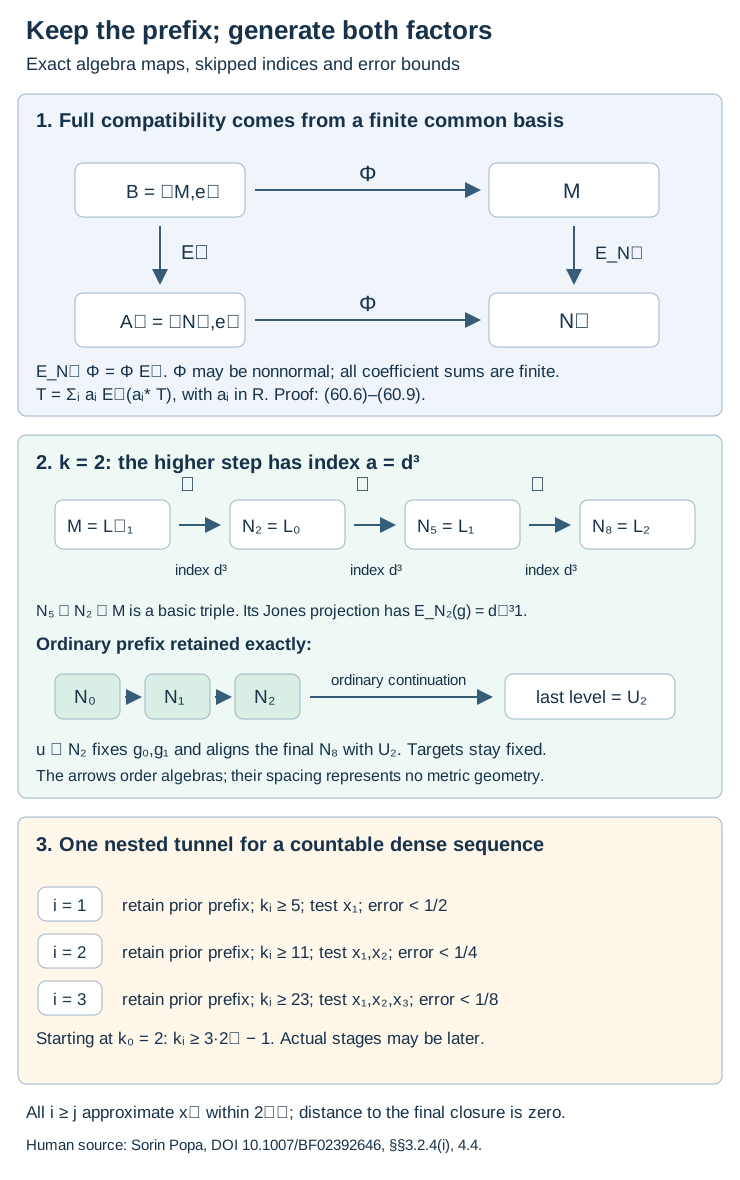
Approximation can preserve every chosen tunnel prefix
Finite global approximation becomes a generating tunnel only when the next approximation retains the choices already made. We obtain that control by treating a deep tunnel level as the smaller factor of a new inclusion. A finite common basis transfers the original compatible hypertrace to this higher inclusion. One finite unitary alignment then puts its approximating tunnel after the prescribed ordinary prefix.
The finite approximation result is Theorem 59.8. The analytic criterion is Theorem 49.2, and the every-core converse and finite tunnel alignment are Theorem 57.4 and Lemma 57.3. We use the common cup basis and canonical trace conventions of Lemmas 52.1–52.2, the finite-index skipped basic construction Proposition 14.8, and the compatible finite-stage maps in Lemma 29.1. The proof of those maps uses neither hyperfiniteness nor finite index of the core in the ambient factor; we explicitly retain that broader scope here.
The tracial Radon–Nikodym identification and normal canonical extension of a nondegenerate commuting square are the same declared operator-algebra prerequisites used in lessons 49 and 52. They do not make a singular hypertrace normal. Hyperfinite uniqueness is Lemma 2.2 and Theorem 8.14 of Uniqueness of the injective II₁ factor, with separable predual where required.
The human source is Sorin Popa, Classification of amenable subfactors of type II, Proposition 3.2.2, Proposition 3.2.4(i), Section 4.4 and the generating-tunnel clause of Theorem 4.1.2, printed pp. 205, 208 and 220–222. We supply the full expectation-compatibility calculation for the higher inclusion, rather than using only the range condition stated in Proposition 3.2.4(i).
Let be a finite-index inclusion of II₁ factors, with normalized trace and index . Assume that one actual core has factorial larger algebra and satisfies relative Følner. No extremality or separability is assumed until Theorem 60.5. For an ordinary tunnel use
Changing the tunnel preserves the inherited-trace core pair by the compatible maps of 29.1. In particular its larger algebra remains a factor. Corollary 58.8 gives BF₁ from the assumed relative Følner property, and Theorem 57.4 transfers relative Følner to every chosen core. Theorem 49.2 therefore gives an -compatible -hypertrace on for any continuation of a prescribed finite prefix.
Turning the hypertrace into a conditional expectation
Lemma 60.1. There is a possibly nonnormal conditional expectation such that
Here , , and the action of is left multiplication.
Proof. For , put . If , centrality gives
Thus is normal: on a bounded increasing positive net, the trace of the remainder tends to zero and bounds the remainder for . The tracial Radon–Nikodym identification gives a unique , , with . Set . Uniqueness gives additivity and homogeneity on the positive cone, then a positive unital linear extension to .
For , centrality and cyclicity give
Faithful trace pairing proves -bimodularity. The pairing also shows . Hence this positive unital projection is a conditional expectation. Complete positivity can be checked directly: if and , then
The matrix positivity criterion gives the assertion at every matrix size.
Compatibility follows without assuming normality of :
We used , expectation bimodularity and . Trace pairing gives (60.2); taking gives . In particular .
Normality holds in the variable defining the density. It has not been established in the variable defining .
A finite basis also spans the larger canonical algebra
Fix , and set
Lemma 60.2. The square inside is nondegenerate. Its canonical normal trace-preserving expectation satisfies . There is a finite partial orthonormal right basis , with support projections , such that
Proof. Let , with . The cup-tail identification of 52.1, applied at level , gives
The trace-preserving expectations onto nested algebras compose. Consequently and . Choose a finite bounded partial orthonormal basis of this factor inclusion. Its elements are in , and its support projections are in .
In , the operators are partial isometries with mutually orthogonal final projections. Their sum of final projections has canonical trace
Faithfulness makes that sum the identity. Acting on gives the basis expansion over . Its basis sum already holds in .
The expectation onto preserves every sufficiently late : its bimodularity over preserves commutation with . Normality then gives . Thus the same basis expands over . This proves the nondegenerate commuting square. The canonical extension of 52.2, with in place of , gives , the restricted semifinite canonical trace and the normal expectation .
To prove the last identity in (60.6), define the normal bounded map
Taking adjoints in the basis expansion gives
All these coefficients are in . Write and . Then
Also commutes with , and . Bimodularity gives . The left multipliers satisfying this identity for every form an ultraweakly closed unital algebra: products preserve the identity, and ultraweak closure follows from normality of . It contains and , so contains . Finally by the basis expansion of . Hence for every .
This argument uses the finite index of . It imposes no finite-index hypothesis on .
Compatibility with every higher inclusion
Proposition 60.3. The same state is an -compatible -hypertrace. The higher inclusion has an actual factorial larger core satisfying relative Følner, with index .
Proof. The generators of commute with the earlier cups . For , this follows because those cups belong to . Since , Lemma 60.1 puts in . Bimodularity of transfers the cup commutation, whence
The finite formula (60.6) now supplies full compatibility. For fixed , write and . Applying to (60.6), with bimodularity and , gives . Therefore
The first line uses (60.8) and -bimodularity of ; the remaining lines use the displayed expansion of . Every sum is finite. Thus . Taking , and using and , gives .
For the actual higher tunnel, put , , and
Thus . For each , Proposition 14.8 with center and gap proves
is a basic construction, with consecutive index . Its Jones projection is in and has expectation onto . This is a finite-index result; no finite depth, hyperfiniteness or finite core index enters it.
The relative commutants of the skipped levels are cofinal in the original increasing union. Their larger closure is exactly . Their intersections with generate , because preserves that union and its normal closure. Thus is an actual core of the higher pair. Its canonical expected pair is the pair just used, and its larger algebra is a factor. Apply Theorem 49.2 to the compatible state established in (60.9).
Continuing after any fixed prefix
Theorem 60.4. Fix any ordinary prefix , including its defining cups . For every finite and , a continuation to a level satisfies
while preserving those levels and cups exactly.
Proof. Choose any continuation of the prefix. Proposition 60.3 proves the hypotheses of Theorem 59.8 for . That theorem gives a finite higher tunnel , whose last relative commutant approximates within . Extend it if necessary so ; the relative commutants increase, so approximation does not worsen.
Extend the chosen ordinary prefix arbitrarily to
Its skipped levels (60.10) form a higher tunnel of the same length. Lemma 57.3 for the higher pair supplies a single sending these skipped levels onto . Conjugate the ordinary continuation by .
For every , , so . Moreover commutes with every earlier cup, so those actual projections are fixed. Conjugation preserves all subsequent basic-construction triples. The final ordinary level is exactly . Hence its relative commutant and trace-preserving expectation are exactly the ones chosen by Theorem 59.8. The target elements have not been conjugated. Since , (60.13) gives .
For , the higher index is and the skipped levels are . A higher segment ending at becomes an ordinary continuation ending at , aligned by a unitary in . No infinite product of aligning unitaries is needed.
A dense sequence produces one generating tunnel
Theorem 60.5. Under the preceding hypotheses, assume additionally that has separable predual. Any finite ordinary prefix extends to a Jones tunnel with
Proof. Choose an -dense sequence in the unit ball of . At stage , apply Theorem 60.4 to extend the current prefix to a strictly later level , with
Every later step retains every earlier level and cup. The increasing collection of finite prefixes therefore defines one ordinary Jones tunnel. Its finite-dimensional relative commutants form an increasing family. Let their tracial closure be .
For fixed , (60.15) bounds the distance of to by for every . This distance is zero. The trace-preserving expectation onto consequently fixes . Density gives .
Expectation onto preserves each finite relative commutant, by its bimodularity over the corresponding . Applying it to finite-stage approximants shows that the smaller closure equals , exactly as in Lemma 51.1. This proves (60.14).
Corollary 60.6. In the separable case of Theorem 60.5, both original factors are hyperfinite. Every actual core pair of the inclusion, with its inherited trace, is trace-preservingly isomorphic to . In particular its smaller algebra is a factor. The inclusion also has simultaneous hyperfinite tensor absorption as in Corollary 59.9.
Proof. The increasing finite-dimensional algebras in (60.14) generate both factors, proving hyperfiniteness directly. Separability permits the stated hyperfinite uniqueness provider. Apply the compatible trace maps of 29.1 between any old tunnel and the generating tunnel. Their normal extensions identify both core rows with the original pair. Finally the hypotheses of 59.9, including separable predual for absorption, hold.
The conclusion about the smaller core uses relative Følner, factoriality of the larger core and separability together. It has not been inferred from larger-core factoriality alone. A separately defined standard part or opposite model still needs its own canonical-trace comparison.
Figure 60.1. The first square is the exact map identity (60.9); the singular state is not passed through a weak limit. The second panel shows (60.10) with , the basic triple and the alignment of with . The last panel shows the example lower-bound schedule starting at , and the exact error requirements (60.15). Actual approximation stages may be later. Algebra positions are schematic. Reproducible figure source.
Worked expected-square example
Let be a II₁ factor, , , and let . Use the expected tensor pair . For any state on , the maps
satisfy . The four elements , , are a right -basis. Their basis sum is , giving the actual II₁ index . On , the identity is .
For with density on , take
Then , so and both paths through the expectation square give . The off-diagonal entries need not vanish before applying . This is an expected tensor example of the finite calculation, not an assertion that this chosen realizes a Jones core.
Exercises
Exercise 60.1 — two normality variables (introductory). Why is normal for a positive contraction ? Does this prove that is normal?
Solution. Centrality gives for . For , its positive remainder is bounded by . Thus the functional on is normal and has the bounded density used in 60.1. There is no analogous control for a net in the variable . The original state may be singular, and ; if were normal, this composition would be normal. The proof therefore cannot claim normality in that variable.
Exercise 60.2 — the finite row identity (intermediate). In the worked tensor example, prove for every . Verify the basis sum and the value of the expectation square for the displayed .
Solution. Write . For ,
Multiplying by gives ; summing recovers . Also , so summing over the two choices of and both choices of gives . The state value is . Normalized matrix trace of is . Applying first instead gives , whose -image is again .
Exercise 60.3 — skipped levels and their normalization (intermediate). Take , , and a higher segment ending at . Find its higher index, final ordinary level, index from that level to , and the scalar expectation of its higher Jones projections.
Solution. Here , , and . Formula (60.13) gives . Thus , also , since there are three higher inclusions from to . The higher Jones projection for is in , commutes with , and has expectation onto . The next one is in , commutes with , and has expectation onto . An ordinary one-step projection has normalization at its own middle level and cannot be substituted for these higher projections.
Exercise 60.4 — the targets stay fixed (advanced). Explain why the alignment unitary in Theorem 60.4 retains the prefix and its cups, and why the approximation applies to itself rather than to .
Solution. The unitary is in , hence in each , . Inner conjugation therefore preserves each earlier algebra as a set. The predecessor recurrence puts in the commutant of , so it fixes those actual cups. The desired higher tunnel was chosen first to approximate the original targets. Conjugation is applied to the arbitrary ordinary continuation until its last algebra is exactly . Its relative commutant is then exactly , with the same trace-preserving expectation. No target is moved. The finite unitary changes the continuation to the desired endpoint; it is not used to transfer an estimate for a different target.
Exercise 60.5 — quantitative diagonal construction (intermediate). Start with . What lower bound does (60.13), with , give for ? At stage , which targets have the stated error, and what is its squared bound? Explain why every fixed target lies in the final closure.
Solution. Each stage gives . Hence , or . This is a lower bound; approximation may require a later endpoint. Stage controls with norm error less than and squared error less than . For fixed , every stage gives a candidate in the final closure with error below . The distance to its closed subspace is therefore zero, and its trace-preserving expectation fixes . Density then gives the whole of .
Exercise 60.6 — the scope of the conclusion (advanced). Locate the use of separability. What is proved about actual old cores? Which additional comparisons remain necessary for the entire strong-amenability programme?
Solution. The conditional expectation, higher-pair transfer and prescribed-prefix finite approximation use no separability. Theorem 60.5 uses it to choose a single countable -dense sequence and to apply the stated separable hyperfinite uniqueness result; simultaneous absorption also retains the separability hypothesis of 50.4. Compatible inherited-trace maps identify every actual old core pair with the generating pair , so both old core algebras are factors in this separable relative-Følner case. The general nonfactor-core rounded input, smooth representation and full bicommutant implications, represented/opposite-model canonical-trace comparisons, and the corrected existential arbitrary-depth reconstruction still require their own proofs. These finite and generating results do not claim those remaining conclusions. The full course remains in development.