A finite-depth inclusion has a tunnel whose relative commutants generate a factor of finite index. The generating-tunnel argument can start from that conclusion itself. It does not need a finite principal graph. Two points require additional proofs: changing the tunnel must preserve factoriality of its closure, and finite matrix corners must still approximate a late relative commutant when the number of its blocks is unbounded.
Let be separable hyperfinite II₁ factors of finite index . Fix a Jones tunnel, and write
The hypothesis of this lesson is that is a II₁ factor and . Index here means index of an inclusion of factors. A finite positive-operator bound for an arbitrary algebra with a center is a different hypothesis. We impose no finite-depth assumption. Expectations and closures use the actual trace of .
Changing a tunnel preserves its tracial closure
Lemma 29.1. For any other Jones tunnel of the same inclusion, there is a compatible trace-preserving isomorphism
It extends normally to their tracial closures, and maps their intersections with onto one another. In particular, the new closure is a II₁ factor.
Proof. Both tunnels have ; put . Suppose matches the two finite prefixes through level . One-step tunnel uniqueness supplies a correction such that matches them through level . The correction fixes the earlier algebras and earlier Jones projections. Thus
The second assertion holds because commutes with . These maps therefore define (29.2), rather than just separate finite-stage isomorphisms. Each preserves the trace and the operator norm. Their inverse maps are compatible as well. They induce a unitary between the tracial Hilbert completions that intertwines left multiplication, so conjugation by this unitary gives the asserted normal extension. Each belongs to , and therefore maps onto .
Finally, the expectation onto preserves every : averaging over the -unitaries commutes with its Hilbert-space projection. Consequently the closure of is . The same applies to the other tunnel, proving the assertion about intersections.
No convergence of the unitaries in is claimed. Compatibility on the increasing relative commutants is sufficient. This lemma compares the closures with their inherited traces; it does not assert that a separately chosen trace on an abstract upward tower equals this trace.
Odd levels have factor intersections
Set . The expectation argument just used also gives
These are the invariant-projection statements of Proposition 15.2; their proofs do not use finite depth.
Lemma 29.2. If , , then is a II₁ factor. At every such level,
A partial orthonormal basis in over is also a basis in over .
Proof. Use the skipped basic construction
Its Jones projection commutes with , so . Write . The full-corner and normalized expectation formulas give
If , write using the first formula. Then
because preserves , by (29.4) at the middle level. Conversely every commutes with , giving
The map is faithful on the factor , by the basic-construction corner identification. Thus . Since is a II₁ factor and , this proves factoriality and type II₁.
Fix this odd , and put . The commuting expectations in (29.4) and their positive bounds imply
A second skipped construction, , has Jones projection and . Hence . Testing the optimal positive-operator bound for on this nonzero projection gives . Multiplicativity now forces
Computing the same index through gives (29.5).
For a partial orthonormal basis , with supports , (29.4) gives . The basis identity in is . Thus the mutually orthogonal projections in the basic construction of have total normalized trace one. Faithfulness makes their sum the identity, and pull-down gives
The finite-basis theorem permits entries with , including a zero final entry when necessary. These bounds are independent of the odd level.
The two skipped projections in this proof have different jobs. The first gives the corner proving factoriality; the second tests the index. Formula (29.8) uses the expectation onto the middle algebra , not a false compression identity for every element of the upper algebra.
Small blocks lose all their trace
Fix an odd , and let , . Its block sizes are , and its minimal-projection trace weights are . Thus . The number of blocks may tend to infinity.
Lemma 29.3. These weights satisfy
Proof. For any integer , let be the central projection of formed by its blocks of size less than . Under a unital inclusion of finite-dimensional algebras, a new block of size less than cannot receive a representation of an old block of size at least . Therefore
Their strong limit commutes with every . By (29.4) and Lemma 29.2, their closure is the factor , so is zero or one. We rule out one by an explicit matrix polynomial.
Put and . Consider the alternating polynomial
It vanishes on any matrix algebra of dimension at most : the matrices are linearly dependent, and multilinearity and alternation imply the claim. Hence it vanishes in every direct sum of blocks of size less than .
It does not vanish in . Choose distinct matrix units , possible because . Set
For a product in (29.13) to survive, its matrix unit at position must have both row and column . The units are distinct, so only the identity permutation survives. Its product is .
If , monotonicity forces for every , so (29.13) vanishes on every . Expectations onto the increasing approximate each bounded element of in , with a uniform operator-norm bound. Every finite product consequently converges in , by telescoping and the inequality . The polynomial would vanish on . But that II₁ factor contains a unital , contradicting (29.14). Thus , and normality of the trace gives .
Separate the small blocks from the others:
For each fixed , the limit superior is at most . Letting tend to infinity proves (29.12).
This estimate replaces the bounded block count and geometric decay used at finite depth. A bound only on the largest minimal-projection weight would not suffice when there are many blocks.
Prefix approximation at odd levels
Proposition 29.4. Fix an odd . For every finite and , there are an odd and such that
Rotating the continuation by preserves the entire prefix through .
Proof. All downward factors are finite corners of amplifications of the preceding factor's opposite; hence they are separable hyperfinite II₁ factors. Expand the finite set in matrix units of the finite-dimensional . Its finitely many coefficients belong to . Approximate them in by one full matrix subfactor , taking conditional expectations to keep their norms bounded by a constant .
Apply Lemma 16.1 to and . It gives and a unitary with
Lemma 29.3 lets us make the right side arbitrarily small, even with restricted to odd integers. Put . Then , and fixes pointwise. Replacing each coefficient by its approximant , then by , costs at most
Sum over the finite expansion and use the best-approximation property of the expectation to obtain (29.16). Conjugation by preserves all earlier tunnel algebras and Jones projections, just as in Theorem 16.3.
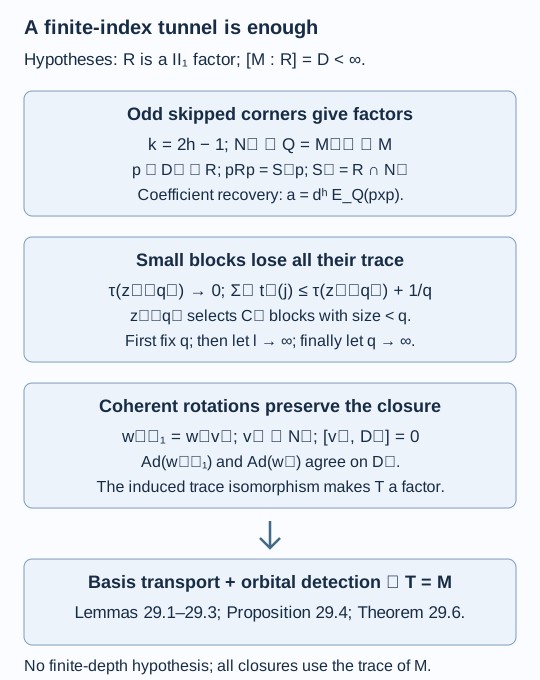
Figure 29.1. The skipped corner uses , , and the projection of (29.6). The middle estimate is (29.15), with fixed before tends to infinity. The compatible rotations (29.3) preserve factoriality of any new closure. Together these statements supply prefix approximation, basis transport and the factor hypothesis needed for the orbital argument. Lemmas 29.1–29.3 and Proposition 29.4. Editable figure source.
Orbital saturation with no depth bound
Proposition 29.5. There are and such that for every odd and every with , , some satisfies
Proof. Suppose this fails. Choose increasing odd and such with the supremum in (29.17) at most . In the tracial ultrapower put
The relative-commutant equality is Lemma 15.6. All unitaries of lift to coordinate unitaries by Lemma 17.1. The coordinate bounds therefore give , with .
Proposition 29.4, applied separately to a bounded coordinate , approximates it within by a unitary conjugate of an element of . The approximants are uniformly bounded because they are expectations of . The proof of Lemma 17.2 thus gives .
Lemma 17.3 applies verbatim. Its hypotheses are precisely that is a II₁ factor, , is invariant under -unitary conjugation and contains . Its corner refinement estimate has constant and uses no finite-depth statement. Thus every bounded vector of is stable under left and right multiplication by , and trace cyclicity gives
Lemma 29.2 supplies a basis , with uniformly bounded entries. For every bounded sequence , (29.11) gives
The first factors belong to ; the second belong to . Hence is orthogonal to every bounded element of , including itself. This contradicts its unit norm.
Theorem 29.6. A finite-index inclusion of separable hyperfinite II₁ factors that has a Jones tunnel satisfying (29.1) with a factor of finite index admits a generating Jones tunnel. Finite depth is not required.
Proof. If , then ; commuting expectations in (29.4) give , so the original tunnel generates both endpoints.
For , use the induction of Theorem 15.5, choosing every detection level odd. Proposition 29.5 provides the orbital bound on this cofinal set of levels. We spell out the consequences that previously required a finite-depth closure theorem.
Choose countable -dense sequences in the sphere , and in the positive unit ball. Match the current finite prefix to the original tunnel by . At a sufficiently late odd level , increasing-limit convergence and the positive-vector index inequality give
Apply (29.17) to , choosing . At a later finite level , the expectation onto detects this vector by more than . Rotate the continuation by . This preserves the old prefix, the previous detections and the displayed positive-vector bounds, since fixes . Repeat.
Let be the relative-commutant closure of the resulting tunnel. Lemma 29.1 makes a II₁ factor. Passing to limits and using density gives
The positive-vector variational theorem gives , including the exclusion of infinite index. If , Lemma 15.4 gives a bounded vector with expectation zero, -norm one and operator norm at most . This contradicts detection. Therefore . Commuting expectations onto then show that the smaller-endpoint relative commutants generate as well.
This theorem supplies a criterion for generating tunnels. It does not assert that finite index of alone produces the extra finite-index closure in (29.1). Finite depth supplied that step in Theorem 16.4. At infinite depth the existence of such a closure is a substantive additional question.
Exercises
Exercise 29.1 — introductory. At , identify the triple used to prove factoriality of , and the distinct triple used to compute its index.
Solution. Here . The first triple is , equivalently . Its projection gives , and the coefficient formula is . The index test instead uses ; its projection has .
Exercise 29.2 — intermediate. Verify the polynomial contradiction for using , , , .
Solution. The identity term is . The transposed term begins . Thus . In a commutative one-dimensional block the two terms are equal, so their difference vanishes. Uniformly bounded approximation preserves this polynomial identity, which separates a II₁ factor from a closure consisting solely of scalar blocks.
Exercise 29.3 — intermediate. Why does by itself not prove the estimate needed for matrix divisibility?
Solution. In with uniform weights, the maximum is , while the sum of minimal weights is one. Lemma 16.1 bounds the removed trace by , so it is the sum that must vanish. The small-block projection and the factor hypothesis rule out this persistent scalar-block example.
Exercise 29.4 — advanced. Suppose finite prefixes are matched by unitaries , but no compatibility between their restrictions is given. Which step in Lemma 29.1 would fail, and how does tunnel uniqueness repair it?
Solution. Separate maps on would not define a map on their union: the image of an element of might change at the next stage. Sequential matching chooses , with . This correction commutes with , so the restrictions agree exactly. Trace preservation then extends a single map to the tracial completion, preserving factoriality of the new tunnel closure.
References
Vaughan F. R. Jones, Index for subfactors, Inventiones Mathematicae 72 (1983), 1–25.