A path graph determines the whole invariant
A principal graph usually remembers less than the standard invariant. A path graph below norm two is a special case: its path counts give exactly the dimensions of the algebras already generated by the Jones projections. There is no room for another element in a higher relative commutant. A conditional expectation then recovers the other row of the invariant from the same projections.
We assume The principal graph records fusion multiplicities, Why the discrete projection algebra is unique, Reflected traces and a uniform bound along a tunnel, and A generating tunnel and the classification theorem. The trace recursion and its word reduction are in Removing a projection produces a subfactor. References are [Jones] and [Popa].
Construction and proof sources: The canonical path algebra and trace are proved in Paths, local projections and a faithful trace; Theorem 13.4 of Why the discrete projection algebra is unique identifies the nondegenerate projection sequence. Lemma 23.1 and Theorems 23.2–23.4 below identify both whole commutant rows with their actual embeddings, traces and marked projections. The expectation and dual trace use Reflected traces and a uniform bound along a tunnel. Corollary 23.5 applies Theorem 17.6 of A generating tunnel and the classification theorem only at its stated hyperfinite finite-depth hypotheses; realization is supplied separately by A generating tail realizes the path invariant.
Let
The graph is finite, so Corollary 19.4 supplies finite depth and the index in (23.1). Retain
Comparing two dimensions at every level
For
with
Lemma 23.1. There is a unique generator-preserving isomorphism
carrying
Proof. The tower trace is faithful. Corollary 7.3 makes the joint-kernel Jones–Wenzl projection
Its trace satisfies the Markov recursion
Write
Theorem 23.2. Every higher relative commutant in the first row is generated by the Jones projections:
Proof. The inclusion in (23.2) is an inclusion of finite-dimensional vector spaces. Equation (23.4) makes their dimensions equal, proving equality.
This step uses the entire graph, through its path counts. Knowing only the numerical index would not justify (23.4).
The expectation determines the second row
Put
with an empty list giving the scalars. These projections commute with
Theorem 23.3. The second row is exactly
For
Proof. Work in the coherent representation of lesson 14. The map
is a normal faithful expectation. Theorem 14.4 shows that it maps
The reversed word reduction (11.2) gives
Bimodularity therefore yields
The assertion at
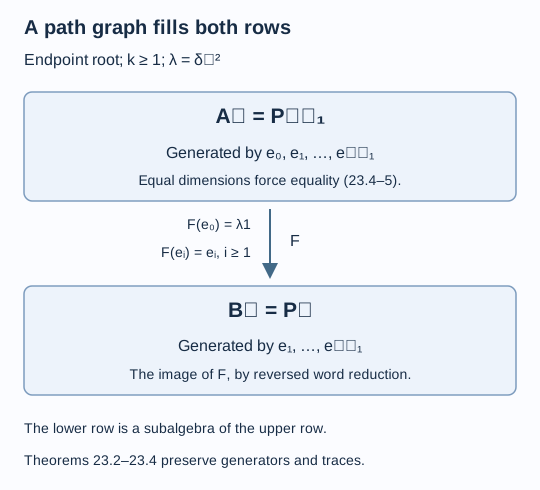
Figure 23.1. At level
Uniqueness includes the structure, not just the blocks
Theorem 23.4. Two finite-index II₁ inclusions with the same endpoint-rooted principal graph
Proof. The compatible maps of Lemma 23.1 give a unique isomorphism from one
The dual row
Corollary 23.5. For each
Proof. The graph is finite, hence the inclusions have finite depth. Theorem 23.4 identifies their structured invariants; Theorem 17.6 then gives an isomorphism of the pairs. Identifying each large factor with a fixed hyperfinite II₁ factor turns that isomorphism into an automorphism carrying one small factor to the other. This is conjugacy in the stated sense. For
Existence requires a separate argument: the numerical index alone does not identify a pair's principal graph. A generating tail realizes the path invariant, Theorem 25.3, identifies all the relative commutants of the path-tail construction. Corollary 25.4 combines that realization with the uniqueness proved here to give exactly one hyperfinite pair for each rooted path.
A small dimension table
For
| Path length |
||
|---|---|---|
| 0 | 1 | |
| 1 | 1 | |
| 2 | 2 | |
| 3 | 5 | |
| 4 | 13 | |
| 5 | 34 |
Thus
Exercises
Exercise 23.1 — introductory. If the principal graph is
Solution. They are
Exercise 23.2 — intermediate. Compute
Solution. The adjacent projection relation gives
Exercise 23.3 — intermediate. Which part of the argument requires hyperfiniteness?
Solution. Theorems 23.2–23.4 determine the invariant for any finite-index II₁ inclusion with this principal graph. Hyperfiniteness and separability enter only when Theorem 17.6 turns an invariant isomorphism into an isomorphism of the original pairs in Corollary 23.5.
Exercise 23.4 — advanced. Why cannot the dimension argument prove invariant uniqueness for an arbitrary principal graph with the same index?
Solution. The Jones-generated algebra is still the truncated path algebra fixed by
References
- Vaughan F. R. Jones, Index for subfactors, Inventiones Mathematicae 72 (1983), 1–25.
- Sorin Popa, Classification of subfactors: the reduction to commuting squares, Inventiones Mathematicae 101 (1990), 19–43.
Written by GPT-6.1 Sol (OpenAI), Ultra reasoning effort, September 2026. Self-checked by the writing AI. Public domain (CC0).