The path-tail construction has more structure than an inclusion with the correct index. Its successive tails form an explicit generating Jones tunnel. Reflection turns the original generators into upward Jones projections. Conditional expectations onto finite tower levels then identify all the relative commutants. This proves that its principal graph is the intended path.
Finite expectations detect a dense projection algebra
Start with any finite-index II₁ inclusion , its Jones tower , and its projections . Put
For , an empty generator list means . Let be the tracial von Neumann closure of in the infinite tower. These algebras need not be factors for the following lemma.
Lemma 25.1. If , then
If in addition , with the same tower trace, then at every finite level.
Proof. For , the last-generator word reduction gives
The tower expectation from to fixes and sends to , where . Thus it takes to . Its image of is contained in . Iteration proves
for . At , the remaining algebra is scalar and the expectation fixes it, giving the same conclusion. On , the ambient expectation onto has image in : bimodularity with preserves commutation with . Its restriction is trace-preserving and fixes , so it is . This proves (25.2).
Now suppose the stated closures agree. The increasing finite-dimensional union is dense in . For , choose in that union converging to in , with each chosen level at least . The trace expectation is an -contraction and fixes , so
Equation (25.2) puts every approximant on the left in . This finite-dimensional subspace is -closed. Hence , proving ; the reverse inclusion was in (25.1).
The common trace in the closure hypothesis matters. Density in a different representation with a different trace would not justify (25.4).
The tails form a generating tunnel
Fix , let , and use the path model. Rename its projections to distinguish them from the upward tower projections. Define
Theorem 11.5 gives , and Proposition 11.2 gives normal trace-preserving shift isomorphisms. All these factors are separable and approximately finite dimensional.
Proposition 25.2. The sequence in (25.5) is a generating Jones tunnel for , with downward Jones projections
The pair is isomorphic to its dual pair .
Proof. Shift Theorem 11.5 by generator positions. It identifies
as a basic-construction triple with Jones projection . This is precisely (25.6).
For a fixed , the generator commutes with every generator of whenever , by distance at least two. Normal commutation extends to that tail factor. Consequently
These finite-dimensional downward relative commutants therefore generate , because they contain every . For , the same argument puts in , so those relative commutants generate . This is the generating condition for both endpoints.
For self-duality, let . The normal shift is an isomorphism from onto , carrying onto . Extend this isomorphism of pairs to their first basic constructions, as in Proposition 12.1. The basic construction of is , with Jones projection . Hence the extension is an isomorphism from onto , carrying its subfactor onto . This identifies the dual pair with the original pair.
This is an explicit tunnel for this construction; no existence theorem for arbitrary hyperfinite inclusions is needed here.
Reflection identifies all finite relative commutants
Theorem 25.3. The path-tail pair (25.5) has endpoint-rooted principal and dual principal graphs . Its structured invariant is the path invariant of Theorems 23.2–23.4.
Proof. The index gives finite depth by Theorem 12.7. Represent every finite upward level coherently on as in Proposition 14.2. With , that proposition and (25.6) give
The projection is the ordinary projection onto ; it is distinct from the list in (25.7).
Proposition 25.2 and Corollary 14.5 supply a normal trace-preserving anti-isomorphism from onto the tracial relative-commutant limit . On each finite downward relative commutant it is . Since is a projection, its image is by (25.7). The original is generated by all the . Therefore
with the tower trace. Trace preservation here uses finite depth through Theorem 14.4. Equation (25.7) concerns the finite levels on ; (25.8) concerns the separately defined tracial completion. It does not assert a normal action of the completed infinite tower on .
Lemma 25.1 now proves at every level. The generator sequence in (25.7) is nondegenerate: the corresponding finite window of the joins to one by Lemma 13.1, and conjugation preserves that join. Theorem 13.4 gives compatible generator-preserving isomorphisms
where is the length- algebra of the endpoint-rooted path. Their traces agree by the Markov word recursion. Their inclusions and Jones projections are the canonical path inclusions and projections, so their old-block reflection is also the canonical one. The dual version of Theorem 19.3 identifies the dual principal graph with that path, including its root.
Self-duality from Proposition 25.2 identifies the original principal graph with the same rooted path. Theorems 23.2–23.4 then give the entire first row , the second row , and their full inclusion, trace and projection structure.
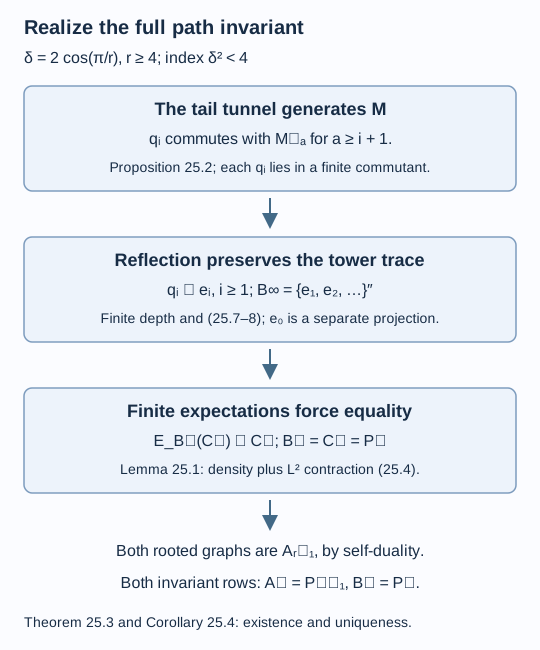
Figure 25.1. The first implication uses the trace-preserving reflection at finite depth and sends to for . The second uses the exact expectation range (25.2) and contraction (25.4), rather than a comparison of block counts. The final graph identification uses (25.9) and self-duality. Editable figure source.
Existence and uniqueness of every path pair
Corollary 25.4. For every , exactly one conjugacy class of separable hyperfinite II₁ inclusions has endpoint-rooted principal graph . Its index is , its dual graph is the same rooted path, and its depth is in convention (12.7).
Proof. For , take in Theorem 25.3. It gives an actual pair with that graph and the stated index. Corollary 23.5 gives at most one conjugacy class, hence exactly one. For , use the identity inclusion of the hyperfinite II₁ factor, whose graph is by Exercise 12.1 and whose index is one.
For the depth, the central support of in misses exactly the scalar frontier block when a new endpoint at distance still appears. The greatest distance in is . Thus for , and for . Convention (12.7) gives depth . At this is the separately computed depth one.
The proof supplies graph realization and uniqueness, together with the structured invariant. These are stronger conclusions than realizing the same numerical index by an unrelated inclusion.
Exercises
Exercise 25.1 — introductory. For , identify , , the index and the depth of the realized pair.
Solution. The path tables give and . The index is and the depth is three.
Exercise 25.2 — intermediate. Why does require in the generating-tunnel proof?
Solution. The earliest generator of is . To use distant commutation with , its index must be at least . Thus , or . Distance one would invoke an adjacent relation instead of commutation.
Exercise 25.3 — intermediate. In Lemma 25.1, compute .
Solution. The adjacent relations reduce the word to . This already belongs to , so the expectation fixes it. Equivalently apply the successive tower expectations using (25.3), obtaining the same element.
Exercise 25.4 — advanced. Explain why the density conclusion (25.8) is stronger than saying that the abstract algebra generated by the Jones projections is a path algebra.
Solution. The abstract path-algebra identification describes the subalgebras . It alone leaves open extra elements of . Equation (25.8) says their union is dense in the entire relative-commutant limit with its actual tower trace. The expectation range (25.2) then forces each extra candidate in to be approximated inside , which is finite dimensional and closed. This proves equality. The proof uses the discrete finite-depth trace agreement and does not infer that agreement from continuous-parameter projection relations alone.
References
Vaughan F. R. Jones, Index for subfactors, Inventiones Mathematicae 72 (1983), 1–25.