A generating tunnel and the classification theorem
The finite-index tunnel constructed in the preceding lesson need not yet generate the ambient factor. Its finite basis supplies the missing argument. A vector missed by every late rotation would remain orthogonal after multiplication on either side by the late factor. The same basis then makes it orthogonal to every vector, which is impossible.
Throughout the main argument, are separable hyperfinite II₁ factors of finite index and finite depth. By Theorem 16.4 choose a Jones tunnel with
All expectations preserve normalized traces.
Coordinate expectations and unitary representatives
Fix a free ultrafilter . For any increasing sequence , put
The last equality is Lemma 15.6. The inclusions of these ultraproducts into are trace-preserving normal embeddings: their trace norms are inherited coordinatewise, and a trace-preserving embedding of finite tracial von Neumann algebras is normal. Also is a II₁ factor. The cited factor theorem gives factoriality, and projections of trace in every coordinate show that it is not a matrix factor.
Coordinate expectations define
They are well defined because they contract and operator norm. Trace pairings identify them with the expectations onto the indicated normal subalgebras.
Lemma 17.1. Every unitary of has a representing sequence of unitaries .
Proof. Choose any bounded representing sequence . Its being unitary in the quotient implies
In the finite factor , extend the partial isometry of the polar decomposition of to a unitary . This is possible because its initial and final projections have the same trace, as do their complements. Then , and scalar functional calculus gives
Thus represents the given unitary.
Rotations contain the commuting join
Let be the closed linear subspace of spanned by
It is invariant under conjugation by every unitary of .
Lemma 17.2. There is inclusion .
Proof. First let be a bounded element of . At coordinate , Theorem 16.3 gives and such that
Set . These elements belong to and are uniformly bounded by . Consequently
It follows that this whole ultraproduct subalgebra is contained in . It contains , , and their products. Because and commute, their algebraic products generate . Bounded strong approximation gives -density of these products in its tracial completion. Closedness of proves the claim.
The continuation at coordinate is a rotation of the original tunnel after level . Thus the element in (17.5) lies in the fixed algebra , despite the separate choices of and .
A bounded orthogonal vector survives corner multiplication
Write . Its invariance under conjugation does not by itself imply invariance under left and right multiplication. We prove precisely that implication for its bounded vectors.
Lemma 17.3. If , then for all .
Proof. For any finite partition in , conjugation by the diagonal unitaries , with on the unit circle, preserves . Integrating its distinct characters gives
The diagonal character gives the sum of diagonal corners, rather than each corner separately. The latter require an additional argument.
Fix a nonzero projection . The full-corner relative-commutant calculation in Lemma 15.1 gives
For completeness, an element commuting with extends to an element commuting with by summing its conjugates by finitely many partial isometries of whose initial projections lie under and whose orthogonal final projections cover one. Include the identity partial isometry , and choose all other final projections under . The resulting extension compresses back to the original element. Since is a factor, has full central support, so compression is also faithful. This proves (17.7), including when has a center.
By Lemma 17.2, is orthogonal to . In particular, for ,
Thus has expectation zero onto . The norm-closed convex hull of its -unitary conjugates has least-norm vector zero: the least-norm argument of Proposition 15.2 identifies that vector with this expectation.
Here is the resulting quantitative corner estimate. For a nonzero bounded of expectation zero onto , some satisfies
Otherwise every convex average would have pairing greater than with , contrary to convergence of such averages to zero. Approximate in operator norm by a finite-spectrum unitary in the same corner so that the pairing is at most . Put . Orthogonality of its matrix blocks gives
Therefore
Every subcorner , with , also has expectation zero onto , by the same trace pairing. Repeatedly refine each nonzero diagonal corner by (17.8). The squared norms add across orthogonal corners. Starting with the partition , after finitely many refinements we obtain a finite partition refining it with
Zero corners need no refinement. This argument uses the finite trace on ; it imposes no separability assumption on the ultraproduct.
Within the corner , all off-diagonal terms , , belong to by (17.6). Equation (17.9) therefore approximates by elements of , with error at most . Hence . We have proved this for every projection .
For a finite-spectrum self-adjoint , expand into its corners. Both its diagonal and off-diagonal terms lie in . Operator-norm approximation of a general self-adjoint then gives . If , its polar decomposition can be written , with and unitary, by finite-factor comparison. Apply the preceding assertion to to get .
Finally the polarization identity
gives for arbitrary , and replacement of by proves the stated assertion. All vectors used remain bounded elements of . No density of bounded vectors in an arbitrary invariant subspace was assumed.
The finite basis rules out a missed vector
Theorem 17.4. The tunnel (17.1) satisfies the uniform orbital test (15.9).
Proof. If the test fails, choose increasing and elements with
The class has . For , lift it by Lemma 17.1 to unitaries . For a bounded sequence , trace pairings give
Thus for every , so . Lemma 17.3 and trace cyclicity imply
At coordinate , Theorem 15.3 transports a partial orthonormal basis for to a basis for . Choose it in the form of Theorem 3.2, with entries and . If the final support is zero, retain its zero entry. In particular the number and norm bound are independent of .
For any bounded representing sequence , its exact basis expansion is
Both sequences on the right are bounded. Taking their classes gives
Thus every bounded element of belongs to the finite sum . Equation (17.12) makes orthogonal to all of , including itself. This contradicts its norm of one. The test therefore holds with some and , as claimed.
Theorem 17.5 — generating tunnel. Every proper finite-index, finite-depth inclusion of separable hyperfinite II₁ factors admits a generating Jones tunnel.
Proof. Theorem 16.4 supplies (17.1). Theorem 17.4 supplies its uniform orbital test. Theorem 15.5 constructs a tunnel whose downward relative commutants generate , and whose corresponding smaller-endpoint commutants generate .
The existence of a finite-index factor closure in (17.1) also suffices without finite depth. A finite-index tunnel is enough, Theorem 29.6, proves this extension: compatible inner maps preserve the closure's factoriality, odd skipped corners give basis transport, and a small-block estimate replaces the finite graph in prefix approximation.
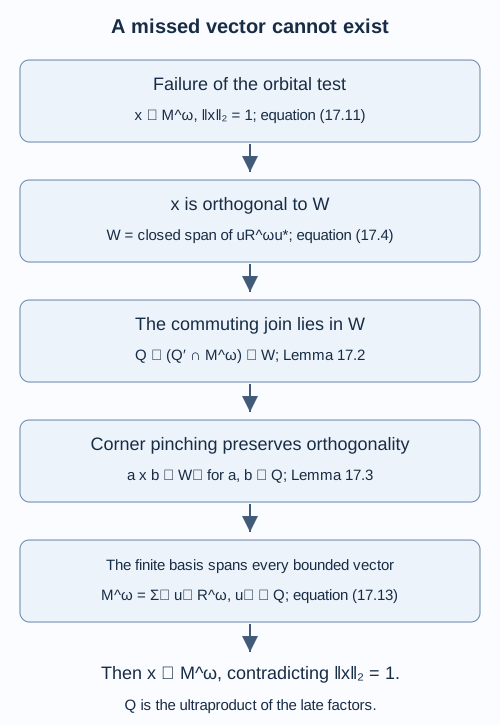
Figure 17.1. Here , is the space (17.4), and all orthogonality is in tracial . The five boxes record the exact implications in Lemmas 17.2–17.3 and Theorem 17.4. The finite sum at the last step has uniformly bounded basis sequences. The contradiction yields the uniform orbital test, and Theorem 15.5 then constructs a generating tunnel. Editable figure source.
The standard invariant determines the inclusion
Theorem 17.6 — finite-depth classification. Two finite-index, finite-depth inclusions of separable hyperfinite II₁ factors are isomorphic as inclusions if and only if their structured standard invariants are isomorphic, including their inclusions, normalized traces and Jones projections.
Proof. An inclusion isomorphism extends up the Jones tower and gives the invariant isomorphism, by Proposition 12.1.
Conversely, first suppose the common index is greater than one. By Theorem 17.5 choose generating tunnels for both inclusions. Corollary 14.5 supplies trace-preserving anti-isomorphisms to their reflected pairs
The invariant isomorphism maps each and to its counterpart, preserves the compatible traces and maps to . Its isometry on the tracial completion of the union extends normally to its von Neumann closure. This extension restricts to an isomorphism of the closures and carries their subalgebras commuting with these projections to one another. Equation (14.9) therefore makes it an isomorphism of the pairs in (17.14). Using the ambient ladder matters here: does not generally belong to .
Compose with the anti-isomorphism from the first generating tunnel and the inverse anti-isomorphism from the second. Products are reversed twice, giving an ordinary normal isomorphism carrying onto .
At index one, the inclusion is the identity inclusion by the dimension theorem. The separable hyperfinite II₁ factor is unique up to isomorphism, so the identity inclusions are isomorphic. Their Jones tunnels are constant and do not satisfy the proper-inclusion generating-tunnel assertion; this endpoint is handled directly. The index itself is part of the invariant, since . This also separates the identity case from the proper case.
The invariant used in the theorem is the structured ladder of finite-dimensional algebras. A principal graph records dimensions and multiplicities; it need not determine the ladder's embeddings and commuting-square data. Graph realization and the number of inclusions for a given graph require further arguments.
The index of the canonical pair
The following conclusion holds for any finite-depth II₁ inclusion, even when the original factors are not hyperfinite. Form the tracial closures
inside the tracial completion of the tower. They agree with and , respectively: expectations onto preserve the indicated commutation relations and approximate every element in .
Proposition 17.7. If and the inclusion has finite depth, then are separable hyperfinite II₁ factors and
Proof. Theorems 14.3–14.4 give factoriality, the unique compatible traces and II₁ type. Each closure is generated by an increasing sequence of finite-dimensional algebras, giving hyperfiniteness and separability.
The compatible expectations satisfy , by (14.6). Theorem 12.2 implies that the expectation onto , restricted to , is precisely : its Hilbert projection commutes with the projection onto , and their common range is . Thus approximation by the positive elements , for , gives
These approximants are uniformly bounded and converge in , hence strongly in the tracial standard representation. Positivity is preserved in the limit.
The projection tests sharpness. In the defining representation on , it is invariant under the tracial conjugation . The expectation used in Theorem 14.4 consequently gives
Therefore . If a larger constant satisfied (17.17) with in place of , evaluation on a nonzero vector in the range of would give . The positive-operator characterization of index in Theorem 7.5 now proves (17.16).
When the original inclusion is hyperfinite, the generating tunnel identifies this canonical pair with the dual inclusion, reversing products. Indeed its downward relative commutants with endpoint contain those with endpoint , which generate , and contain , which commutes with every negative tunnel level. Their closure therefore contains and equals it. Reflection sends the endpoints and to the fixed starting commutants and . Trace preservation follows from uniqueness of the -union trace, exactly as in Corollary 14.5. Thus
The reflected pair (17.14) reconstructs the original inclusion; the canonical pair (17.15) reconstructs its dual. Both have index , but their fixed starting levels carry different information.
There is also a numerical distinction between the index and its reciprocal . At finite depth the Perron eigenvalue of the two-step inclusion matrix is , by Corollary 8.5 and the stabilized basic constructions. Takesaki's Proposition 4.19(iii) correctly states that the canonical pair has the original index, but its proof on printed page 482 calls the inverse index the Perron eigenvalue. The direct expectation proof in Proposition 17.7 fixes this normalization: the sharp positive-operator constant is , while the pair index and the Perron eigenvalue are .
Exercises
Exercise 17.1 — introductory. Why is a uniform operator-norm bound on the vectors in (17.11) necessary?
Solution. A sequence of -unit vectors alone need not represent an element of the von Neumann ultrapower, which is the quotient of bounded operator sequences. The bound puts in , permits coordinate trace estimates against bounded sequences, and allows the corner argument to stay within bounded operators.
Exercise 17.2 — intermediate. For the two-projection partition , identify which terms of are isolated by conjugation by .
Solution. Its characters and isolate and . The constant character gives . It does not separate those two diagonal terms. This is why the small-pinching argument is needed before one may multiply an orthogonal vector on both sides by a projection.
Exercise 17.3 — intermediate. Suppose . How many uniformly bounded basis sequences suffice in (17.13), and what is the trace of the fractional support at each coordinate?
Solution. There are four full entries and one fractional entry, for a total of five. The final support has normalized trace in . Every basis entry has operator norm at most . The support projections may vary with , but their traces and the common number of entries suffice for the ultraproduct expansion. The chosen value is admissible by Theorem 7.2 and the realization in Theorem 11.5.
Exercise 17.4 — advanced. Show that a classification argument based only on an isomorphism of the towers still needs their compatibility with in the ambient ladder.
Solution. The large reflected endpoint is the closure of . The small endpoint is its subalgebra commuting with , by (14.9). The projection belongs to and need not belong to , so a map of the towers alone has no specified action on it. Extending the full ladder map and preserving identifies the small endpoint, making the final composition an isomorphism of inclusions.
Exercise 17.5 — intermediate. For the index-six crossed-product inclusion in Theorem 41.4 and its star graph in Lemma 41.3, compute the Perron eigenvalue, the index of the canonical pair, and the expectation of its distinguished projection . Can the inverse index be its Perron eigenvalue?
Solution. For the crossed-product pair the principal graph is the six-leaf star. Its incidence column has six entries equal to one, so and its Perron eigenvalue is six. Proposition 17.7 gives canonical pair index six and . The inverse index is , the projection normalization. It is different from the eigenvalue six; confusing them would contradict both the explicit incidence calculation and sharpness of the index bound.