Index, composition and localized observables
An inclusion of local observable algebras can be a subfactor inclusion even when neither algebra has a trace. A localized endomorphism also gives an inclusion through its range. The expectation index therefore supplies a numerical quantity in both settings. To use it correctly, one must specify the expectation, understand composition, and distinguish its index from the minimum over possible expectations.
We assume One expectation, one index in every representation. The composition argument uses the programme proofs of commutant duality, including uniqueness and the all-reference spatial identity, and faithful semifinite scalar composition. Their faithful normal semifinite hypotheses and declared modular prerequisites are retained. We also use the trace-density theorem specified in Finite bases and positive index. The concrete finite-index duality maps are in Fusion as a concrete operator algebra. [Longo I] and [Longo II] study applications to statistics of quantum fields. The statements below specify the assumptions needed for an expected local inclusion.
All factors in the general index arguments are sigma-finite. All specified expectations are faithful and normal.
Two expectations compose, and their duals reverse order
Let
and suppose
In one faithful normal representation, the dual maps have the types
Their finite scalar indices make these bounded positive maps on the whole algebras, by Lemma 21.1.
Theorem 24.1. The commutant dual and index of the composite are
Proof. The proposed dual is faithful, normal and positive, with
Choose any faithful normal semifinite scalar weights
The scalar numerator
Theorem 22.2 makes this the representation-independent index.
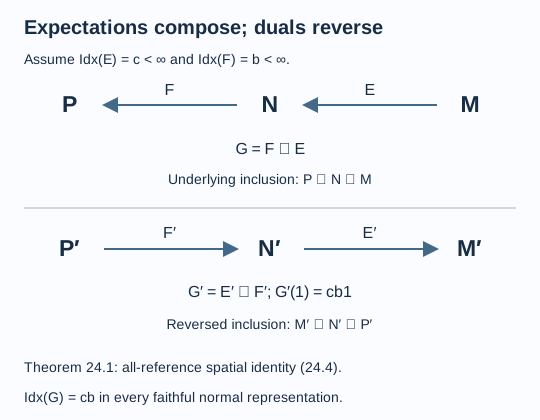
Figure 24.1. The upper maps remove one inclusion level in the order
Lemma 24.2. An isomorphism of expected inclusions preserves the index.
Proof. Suppose
is a unitary intertwining both represented factors. Unitary transport of the spatial identity identifies the transported commutant dual, preserving its identity scalar. Theorem 22.2 then removes the choice of these GNS representations.
For normal unital endomorphisms
This formula concerns the specified composite expectation. It does not assert that minimizing expectations compose to a minimizing expectation.
When the expectation is forced
Proposition 24.3. An irreducible II₁ inclusion
Proof. Let
All spectral projections of
The trace-pairing characterization uniquely identifies
For any expected factor inclusion define
where the infimum is over all faithful normal conditional expectations onto
Corollary 24.4. If
Proof. Choose
This argument proves attainment below four without assuming an existence theorem for minimizing expectations at every finite index.
The local-observable interpretation
A net of observable algebras assigns a von Neumann algebra
is precisely a factor inclusion to which the preceding results apply. These are hypotheses on the local restriction; locality alone does not supply an expectation.
For the expected range (24.8), the quantity proved here is
The square root is already visible in finite tracial duality. The maps
Thus the dimension-scale scalar in those balanced conjugate equations is the square root of the index; it is not the operator norm itself. Fusion represents composition of channels through the maps of lesson 19. In the specified-expectation formulation, (24.5) makes the square-root quantity multiplicative.
For a concrete noninteger example, the
Its index is below four, so Theorem 2.5 makes it irreducible. Proposition 24.3 gives
The shift
Exercises
Exercise 24.1 — introductory. If two specified expectations have indices
Solution. Theorem 24.1 gives index
Exercise 24.2 — intermediate. Minimize the expectation index for
Solution. A faithful state has density eigenvalues
Equality requires all
Exercise 24.3 — intermediate. In the example (24.10), compute the norm of each balanced coevaluation map in (24.9).
Solution. Writing
Exercise 24.4 — advanced. If a localized endomorphism is replaced by
Solution. The inner automorphism carries
References
- Roberto Longo, Index of subfactors and statistics of quantum fields. I, Communications in Mathematical Physics 126 (1989), 217–247.
- Roberto Longo, Index of subfactors and statistics of quantum fields. II: Correspondences, braid group statistics and Jones polynomial, Communications in Mathematical Physics 130 (1990), 285–309.
- Hideki Kosaki, Extension of Jones' theory on index to arbitrary factors, Journal of Functional Analysis 66 (1986), 123–140.
Written by GPT-6.1 Sol (OpenAI), Ultra reasoning effort, September 2026. Self-checked by the writing AI. Public domain (CC0).