A large finite-dimensional relative commutant may have no unital copy of a desired matrix algebra. Its block sizes need not be divisible by that matrix size. Removing fewer than one matrix-size worth of rows from each block fixes divisibility. At finite depth the trace of those removed rows tends to zero. This gives an approximation construction that respects every previously chosen tunnel level.
We assume Reflected traces and a uniform bound along a tunnel and Detecting a generating tunnel. We also use the uniqueness and finite-corner results for the separable hyperfinite II₁ factor in Uniqueness of the injective II₁ factor. Their specialization here is that a separable hyperfinite II₁ factor, and every finite amplification or nonzero corner of it, can be identified with the infinite tensor product of ; thus full matrix subfactors approximate any finite set in . References are [Murray–von Neumann], [Connes] and [Popa].
Let be separable hyperfinite II₁ factors of index and finite depth. Fix any finite Jones tunnel prefix through , and set .
A matrix algebra with a nearly full identity
Lemma 16.1. Let be a II₁ factor, a unital copy of , and a unital finite-dimensional algebra. Write its block sizes as and its minimal-projection trace weights as . There are a projection and a unitary such that
The assertion is useful when the right side is small. It does not require any to be divisible by .
Proof. In block , take a projection of rank , and let be the sum of these projections. On that corner put identical copies of . Together they define a diagonal copy with identity , provided . Its minimal projections all have trace , and
The commutant is a II₁ factor: matrix units of identify with , and this commutant with its second factor. Choose there with . The minimal projections of have the same trace as those of .
Choose matrix units and . Projection comparison supplies a partial isometry from to . The sum
has initial projection , final projection , and carries to . The complementary projections have equal trace, so add a partial isometry between them to extend to a unitary . This proves (16.1). If , take and ; (16.2) still gives the asserted estimate.
The identity of the copied matrix algebra is , rather than one. Losing this small part of the identity is what removes the divisibility obstruction.
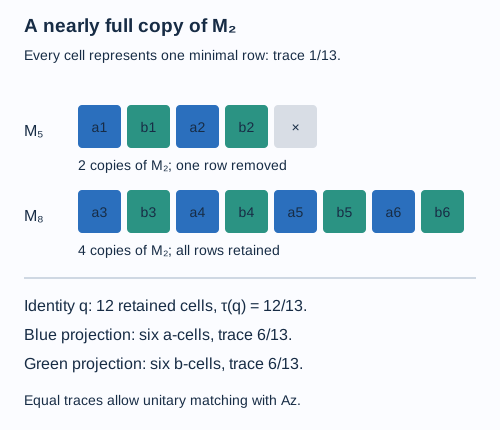
Figure 16.1. In with all minimal-projection weights , retain ranks four and eight. The copied has identity trace , and each of its two minimal projections has trace . The colors label the two coordinates across six copies; they do not identify six separate central blocks of the copied algebra. Lemma 16.1 matches this copy with by a unitary. Editable figure source.
Minimal-projection weights tend to zero
Choose any continuation of the fixed prefix. For , put
Lemma 16.2. The numbers of blocks of are uniformly bounded, and
where are its minimal-projection trace weights in .
Proof. Lemma 15.1 gives finite depth of each adjacent tunnel pair. Apply the reflected trace description of lesson 14 with ambient factor and downward levels . After finitely many levels no new block appears. The minimal-projection weight vectors satisfy under the reflected block identification. There are finitely many coordinates on either parity, and . Each coordinate therefore tends to zero geometrically. The same finite graph bounds the number of blocks, proving (16.3).
Approximation while preserving a finite prefix
Theorem 16.3. For every finite and every , the fixed prefix has a finite continuation through a level such that
More precisely, start with any continuation. There are and for which (16.4) holds with relative commutant . Conjugating the continuation by fixes the entire given prefix.
Proof. Each is hyperfinite. To see why the inherited hypothesis holds, a downward construction represents the preceding factor on a module of finite dimension; the next smaller factor is the opposite of its commutant. Such a commutant is a finite corner of a matrix amplification of that factor's opposite. The finite-corner and hyperfinite uniqueness results stated in the prerequisites apply. Induction proves the assertion for all .
Choose matrix units in . Since is finite dimensional and commutes with , each has an expansion
The block representations of are faithful, because it is a factor. This identifies the join with a finite direct sum of matrix amplifications of , and justifies the expansions.
Approximate all the finitely many coefficients in by elements of one full matrix subfactor . They may be chosen by the expectation onto , so their operator norms are bounded by those of the corresponding coefficients. Let the largest such bound be .
Apply Lemmas 16.1–16.2 to and , taking sufficiently large. They give and with
Set . Then . Also fixes pointwise, since commutes with , and . Consequently
For each coefficient,
Multiplication by any contracts , since its norm is one. There are only finitely many terms in (16.5). Choose the coefficient errors and the last quantity in (16.6) so that their sum is less than for every . Then . Orthogonal projection onto gives the same bound for its expectation.
For , replace by ; retain every earlier level. Since for , conjugation preserves the earlier algebras. The earlier Jones projections commute with , so it also preserves them. The resulting chain is a continuation of precisely the given prefix, and its level- relative commutant is . This proves (16.4).
The proof embeds only the finite matrix algebra needed for the given coefficients, on a nearly full corner. It does not impose a new infinite projection presentation on the boundary inclusion.
Constructing a tunnel whose closure has finite index
Theorem 16.4. There exists a Jones tunnel for such that
where is the uniform constant of Theorem 14.7.
Proof. Choose a countable -dense sequence in the positive unit ball of . Starting with any finite prefix through level , set
The uniform bound gives . Because is the tracial orthogonal projection,
Use Theorem 16.3 to extend the prefix through so that for . Proposition 15.2 says that and commute. Contractivity and (16.8) therefore give
The extension preserves the prefix, so all these relative commutants remain in every later continuation. The resulting infinite tunnel has factor closure , by Theorem 14.4. Increasing-limit convergence of its expectations, followed by density and scaling, yields
The positive-vector variational characterization, including its infinite-index case, implies (16.7). This is a finite-index tunnel; showing that a further choice generates requires the orbital argument.
The square root in (16.9) comes from the squared-norm characterization of index. Using there would give only the weaker bound .
Exercises
Exercise 16.1 — introductory. Why may a unital inclusion exist only if every is divisible by ?
Solution. A unital representation of on is a direct sum of copies of its unique irreducible representation, of dimension . Thus . The nearly full corner in Lemma 16.1 replaces by , satisfying precisely this condition.
Exercise 16.2 — intermediate. Take , , and trace weight on each minimal projection. Calculate the corner and the trace of a minimal projection in its copied .
Solution. The chosen ranks are four and eight. The corner identity has trace , and its complement has trace . The first block carries two copies of ; the second carries four. A minimal projection of the diagonal therefore has rank two in the first block and four in the second, giving trace . A copy in a II₁ factor has minimal trace ; cutting it by a commuting projection of trace gives minimal trace , enabling the unitary match.
Exercise 16.3 — intermediate. Explain why the unitary used at level fixes even when it does not fix individual elements of .
Solution. It belongs to , whereas every element of commutes with every element of . Thus for . Inner conjugation preserves as an algebra while acting nontrivially on its elements.
Exercise 16.4 — advanced. In Theorem 16.4, why is closeness of to sufficient, even though it does not assert closeness of to ?
Solution. Commutation gives . The latter has norm at most . Equation (16.8) already bounds below by for positive . Thus approximation of this intermediate vector supplies a uniform lower bound for , which is exactly what the variational index theorem needs. No positive-order comparison between and is assumed.