A finite-dimensional inclusion can be described by an integer matrix. That matrix records multiplicities. A trace contributes a second vector: its value on a minimal projection of each matrix block. The basic construction exchanges the two sides of the inclusion matrix, while the Markov condition becomes an eigenvector equation.
We assume finite-dimensional matrix algebra and Finite traces and Jones projections, Sections M1–M8, which prove the expectation, compression, density and finite matrix commutant statements used here. Lemma 10.3 of AF algebras and Theorem 11.2 of AF algebras supply trace restriction by the multiplicity matrix and the commutant transpose rule. We spell out their trace-coordinate specialization to obtain the Jones projection's rank and coefficients. For the spectral assertion we use Theorem 4.4 of Numerical ranges, positive matrices and co-Souslin sets: a primitive nonnegative matrix has a simple largest eigenvalue, a strictly positive eigenvector, and convergent normalized powers. For further reading, see [Anantharaman–Popa] and [Jones].
Multiplicity and trace vectors
Let
be a unital faithful inclusion. Its inclusion matrix is , where the representation of on the defining space of the -th block is
No row or column of is zero. In particular,
Let be a faithful tracial state. Use ordinary, unnormalized matrix traces and write
Thus is the trace of a rank-one projection in the -th block. The trace of that block's identity is , a different number.
Proposition 8.1. The restricted trace has minimal-projection weight vector
Proof. In the -th block, a matrix occurs as . Its ordinary trace is . Summing with weights gives the formula. The normalization follows from .
The expectation in matrix coordinates
Index a basis of by triples , with and . Denote matrix units in by , and matrix units of by .
Proposition 8.2. The trace-preserving expectation is given by
Proof. Characterize the expectation by
for all . Testing with each matrix unit of makes the right side zero unless the two matrix indices have the same -block and multiplicity index. In the nonzero case, the trace pairing of with its matching adjoint is , whereas the trace pairing in is . This gives the displayed coefficient. These tests span , proving the formula.
The expectation averages the multiplicity coordinate with weights prescribed by the trace. It is not an unweighted partial trace unless the weights happen to give one.
Why the inclusion matrix is transposed
The equality of the generated basic construction with the right-module commutant, used next, is proved by the full matrix-unit calculation in Section M8 of Finite traces and Jones projections.
Let . Put
Theorem 8.3. There is an isomorphism
The inclusion matrix of is . In the -th block of , the Jones projection has rank .
Proof. Apply the commutant transpose rule to the right representations of on . This is a faithful unital finite-dimensional representation. Its -multiplicity vector is , its inclusion multiplicities are , and its two commutants are left and . The cited theorem gives the sizes and the transpose matrix for left .
To locate the Jones projection in these blocks, use the orthonormal vectors
The indices enumerate the multiplicity coordinates, while carries the irreducible right action.
For fixed and , let have coefficient at the index
and zero at the other indices. The identity makes these vectors orthonormal. Proposition 8.2 shows that the -th block of the projection onto is
Its rank is therefore .
The matrix units of act by replacing one multiplicity label with another and leaving fixed. This gives an explicit operator model, including the trace-dependent normalization of its Hilbert-space coordinates.
More explicitly, denote the matrix unit in the -th basic block by
. Its action on a raw matrix vector is
All unmatched right-block or multiplicity labels give zero. This follows by substituting
in the normalized matrix-unit action. Thus the path replacement has coefficient one on the orthonormal coordinates, and the displayed square-root coefficient on the raw coordinates. This distinction matters whenever an operator joins different large blocks.
Example 8.9 — the Jones projection joins different blocks. Take
, with
, where and .
Here , , and the orthonormal coordinates are
. The vector for is
, so
This is a rank-one orthogonal projection. In raw coordinates the same expectation has
matrix : it sends both output entries to
.
At , the Jones matrix is one half of the all-ones matrix.
Deleting the entries between different -blocks instead gives
, whose square is ; it is not a projection.
This gives a precise correction to the displayed expression for after (17′)
in Takesaki, Chapter XIX, printed page 447: summing only pairs of edges ending at the
same larger block omits these mixed entries. The rank-one formula above retains all
block pairs. The abstract path tower remains valid; its weighted operator realization
must use the stated orthonormal coordinates.
Paths and matrix units
The same description has a useful graph interpretation. Draw one vertex for each summand of , one for each summand of , and edges from to . Attach distinguished starting labels to vertex . A basis of is indexed by a starting label followed by an edge ending at . A basis of the -th block of is indexed by one more edge, traversed in the reverse direction, ending at .
For paths with the same endpoint, write for their matrix unit. Then
The embedding of one level into the next is
where ranges over edges leaving the common endpoint. This is a unital *-homomorphism: the multiplication rule gives its multiplicativity, and summing all diagonal matrix units gives the next identity. Counting paths gives exactly the sizes and in Theorem 8.3.
Diagonal path projections also give compatible diagonal maximal abelian subalgebras at these finite levels. This is a statement about the full diagonal matrix algebra in each block. It does not concern the different algebra generated by every other Jones projection.
The Markov condition is an eigenvector equation
A faithful tracial state on , extending , is a Markov trace of modulus if
where preserves . Equivalently,
The same definition applies to an inclusion of finite von Neumann algebras whenever its basic construction has a faithful normal tracial state extending the given one. The expectation is then the normal trace-preserving expectation onto the larger algebra of the original inclusion. The equivalence follows from its trace-pairing characterization. The matrix criterion below concerns the finite-dimensional case.
Definition 8.10 — a prescribed subalgebra. In this general setting, let be any unital von Neumann subalgebra, with the restricted trace . For , the extension is a -trace when its trace-preserving expectation satisfies
Indeed expectation adjointness proves the forward implication. Conversely it pairs to zero against every ; take , which is selfadjoint, and use trace faithfulness. No containment between and is part of this definition. The ordinary Markov condition is the case .
Pairing with the unit gives , so . If , faithfulness forces ; projection onto is then the identity on , and for every , so . Conversely the identity inclusion has and is a -trace for every such . If , the equation says that the nonzero projection itself is scalar, so only this identity endpoint is possible.
This supplies the prescribed-subalgebra interface of Takesaki, Chapter XIX, Definition 2.23. The printed Lemma 2.24 tests specifically on the smaller algebra ; the following lemma gives that statement and its contained-subalgebra extension. An arbitrary prescribed test algebra need not imply the ordinary Markov condition.
Lemma 8.7 — testing on the smaller algebra. In this general finite-algebra setting, if , then . More generally it suffices to test on a subalgebra containing : implies the same conclusion.
Proof. For , trace cyclicity and the compression identity give
This is exactly the trace-pairing criterion for . If , composition of the trace-preserving expectations first gives .
Containment of matters. For the diagonal algebra of , its basic construction is three copies of . Give their minimal projections weights with . This trace extends the normalized trace of . The Jones projection has rank one in each block, so its scalar expectation is always . In contrast,
as follows by pairing against . It is scalar only when all . Thus testing on , which does not contain this , would be insufficient.
Let be the trace of a minimal projection of the -th block of .
Theorem 8.4. Such a trace exists precisely when
When it exists its weight vector is uniquely determined:
Proof. Trace restriction along the transposed inclusion gives
For , the rank description of gives
. The Markov identity tested on thus forces . Combining these identities proves necessity.
Conversely, suppose the eigenvector identity holds, and define . The weights are strictly positive. Their restriction to is , so the resulting trace extends , and is normalized because the inclusion is unital. The rank description gives for . For arbitrary , cyclicity and compression give
The expectation characterization therefore gives . The formula for proves uniqueness.
The matrix side is fixed by the vector's type: has one entry for each
-block, so acts on it. The matrix instead
acts on the -weights , with the same positive eigenvalue. The statement of
Takesaki's Proposition XIX.3.5 prints the latter matrix on the larger weight vector;
its proof on printed page 449 uses the correct . This is more than a
dimension issue for rectangular matrices. In the actual square inclusion of
Exercise 8.2, writing , the first entry of
is , although .
Corollary 8.5. If the bipartite inclusion graph is connected, then its unique faithful Markov trace has modulus
The vector is the positive eigenvector of , normalized by .
Proof. The graph of on the -vertices is connected, and every diagonal entry is positive because no column of is zero. Hence some power has strictly positive entries. The stated Perron–Frobenius theorem gives a unique positive eigenvector up to scale, with eigenvalue equal to the spectral radius. Since is positive semidefinite, that radius is . Apply Theorem 8.4.
For a disconnected graph, a faithful eigenvector at a common eigenvalue exists only if every connected component has the same squared norm. In that case the trace can still assign different total masses to the components. Thus connectedness is a uniqueness hypothesis, not a dispensable decoration.
Recognition in a different representation
The matrix model can be recognized without assuming a prescribed Hilbert-space dimension.
Theorem 8.6. Let act faithfully on a Hilbert space , and let be a projection commuting with . Assume that is faithful on , and
Put , and let be the central support of in . Then is finite dimensional,
The isomorphism sends to , and to . If is any finite positive trace on , then
If is a minimal projection of , then is a minimal projection of .
For this concrete finite-dimensional , faithfulness of is
equivalent to the full-central-support condition . Indeed the kernel
of the normal compression homomorphism is for a central projection .
Since , that kernel vanishes exactly when no nonzero central projection
annihilates , which is exactly full central support in .
Proof. Compression reduces every word to a linear combination of terms in and , so their finite-dimensional span is . Consider the proposed map
If the expression on the left is zero, multiply it by , for arbitrary , to obtain , where
Then . Faithfulness of and of gives . On the standard -space the proposed image annihilates for every , so it is zero. This proves well-definedness. Multiplying the expressions with the compression rule proves that is a surjective *-homomorphism.
The span is a two-sided ideal of , with identity . If , the same standard-space calculation gives , and hence for all . Thus . Conversely, on the ideal's central complement implies that , and centrality of that complement makes its image annihilate every . The full central support of in gives . Therefore ; all terms in vanish there, proving .
Under the isomorphism, has nonnegative minimal-projection weights in the blocks . Hence
The inequalities follow term by term. Finally,
because . Faithfulness makes , so it is minimal.
The extra central summand in this theorem matters. A projection can satisfy the compression identity on a larger representation while leaving a summand on which the projection is zero. Full central support in removes that summand.
Pull-down for finite algebras
The scalar Markov condition also gives pull-down when the finite algebras have centers. A factor assumption is unnecessary here.
Proposition 8.8. Let be unital finite von Neumann algebras, with faithful normal tracial state , and let be their basic construction on . Suppose has a faithful normal tracial state extending , with
Then the normal linear map
satisfies
Its coefficient is uniquely determined by the first equality.
Proof. The normal trace-preserving expectations exist by Sections M2–M5 of Finite traces and Jones projections, applied to each faithful finite trace. Sections M6–M7 prove the normal represented action, compression identity and ultraweak density used below. Write . For , the compression identity and -bimodularity give
Thus on this span.
The span is a two-sided ideal of the algebra generated by . It is weakly dense in : its weak closure has central support equal to that of , and that support is one. Indeed a central projection with also annihilates for every . Evaluating on the trace vector gives for every , so . Both maps and are ultraweakly continuous, proving the identity on all of . This uses central support and normality, rather than a simplicity assertion about a factor.
Now . Applying the positive -bimodular expectation gives
This proves the norm bound. The identity gives , and the opposite containment is immediate. Finally, if with , evaluation on gives ; faithfulness of gives .
The proposition specializes to Lemma 3.1 for II₁ factors and . The more general form proves the finite-algebra pull-down statement, including its normality and norm estimate, under precisely the stated scalar Markov hypothesis.
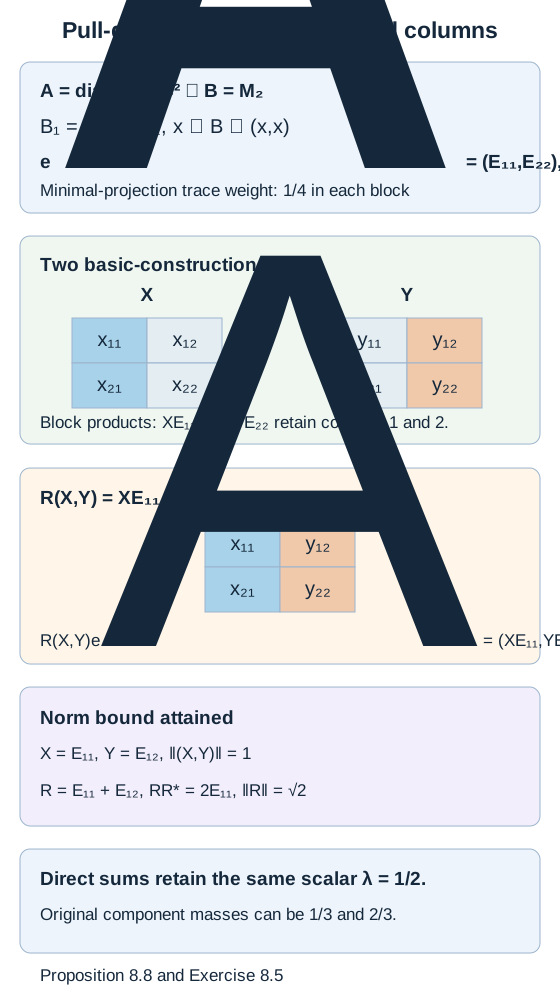
Figure 8.1. For the diagonal , , , and . The scalar Markov coefficient is , and pull-down assembles . Its products with the two components of recover exactly . The row example attains the norm bound . Exercise 8.5 verifies these formulas and their direct-sum version where both original algebras have nontrivial centers. Editable figure source.
A numerical example
Let and
Then , , and
Its largest eigenvalue is , with positive eigenvector . Normalize it by
Then , and the Markov modulus is . The restricted weights are
while the basic-construction weights are . Direct multiplication gives . This example uses unequal block sizes and a multiplicity greater than one, so it tests both parts of the notation.
Exercises
Exercise 8.1 — introductory. For with normalized matrix trace, find , and the minimal-projection weight of the Markov trace on the basic construction.
Solution. We have , , , , , and . The eigenvector equation gives . The basic-construction weight is , which is the normalized trace on . Its rank-one Jones projection has trace .
Exercise 8.2 — intermediate. For and , compute the squared norm, block sizes and a normalized Markov trace vector.
Solution. Here , and has largest eigenvalue . An eigenvector is , so
The basic-construction sizes are , and its weights are .
Exercise 8.3 — intermediate. Why does admit no faithful Markov trace with a single modulus?
Solution. The matrix has no eigenvector with both entries strictly positive. The two connected components demand moduli one and , respectively. A trace supported on one component could satisfy that component's condition, but it would not be faithful on the whole algebra.
Exercise 8.4 — advanced. In Theorem 8.6, give an explicit representation with .
Solution. Represent on , and put . The map is faithful because of the first summand, and the compression identity holds. The algebra generated is isomorphic to : the first summand carries the basic construction, and the second carries only . The projection's central support is . This directly illustrates the extra summand in the theorem.
Exercise 8.5 — advanced. Let be the diagonal algebra of . Identify , its trace, and . Show that the norm constant in Proposition 8.8 is attained. Then form two direct-sum copies with trace masses ; verify that the same scalar Markov coefficient works although both and now have centers.
Solution. Decompose by its two columns, the eigenspaces of the right diagonal action. Their commutant is , while left embeds as . Projection onto is . The trace with weight on each block's minimal projections restricts to on . Trace pairing gives , so .
Pull-down is , whose first column is that of and whose second is that of . Multiplying this common matrix by and gives and , proving . At , , both block norms are one, while has norm .
For two direct-sum copies, assign the two minimal-projection weights in the first basic-construction component and in the second component. Each component has two blocks, so their total masses are and . On each component the same average expectation and column assembly apply. Thus globally. No center-dependent coefficient or factor trace uniqueness is used.
Exercise 8.6 — advanced. In Example 8.9 take .
Compute , the raw actions of the two off-diagonal basic matrix units,
and decide whether this trace is Markov for any single modulus.
Solution. The normalized Jones matrix is
whose square is itself and whose ordinary trace is one.
The basic unit sends to ;
sends to .
On the orthonormal vectors both coefficients are one, as required for
adjoint matrix units. Here is the all-ones matrix and
, which is not a scalar multiple of
. Theorem 8.4 excludes a Markov modulus.
Equivalently the unique normalized trace on restricts to weights
on diagonal , so it cannot extend this .
Existence of the Jones projection for a faithful trace does not imply the Markov property.
Exercise 8.7 — intermediate. Let be the diagonal algebra, with normalized trace on . In , assign the minimal-projection weights
Show that this is a faithful tracial state extending the trace of . For
, compute and . Decide precisely which prescribed Markov condition holds.
Solution. Right multiplication by the diagonal algebra splits into its three columns. Its commutant is the displayed direct sum, left embeds diagonally, and . The positive weights sum to , so
This proves normalization, extension and faithfulness. Trace pairing against an arbitrary gives
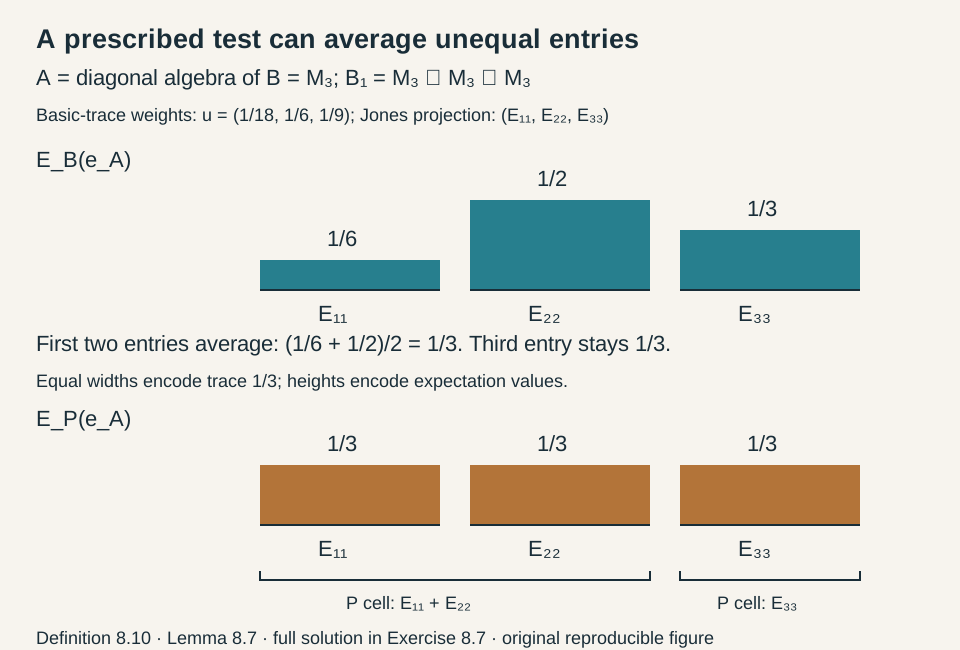
The trace-preserving expectation from onto averages the first two diagonal entries and retains the third, killing all off-diagonal entries. Nested expectations therefore give
Thus is a -trace for a nontrivial prescribed algebra, while it is not a -trace for any scalar , since has three different entries. The chosen is strictly smaller than ; Lemma 8.7 retains its hypothesis. This example confirms the scope of the definition and does not contradict the printed smaller-algebra lemma.
Figure 8.2. Exercise 8.7 uses the actual diagonal inclusion . Equal widths record the normalized -trace of each diagonal projection; heights record the entries of and then . The top bars are expectation values, not the rank-one Jones projections themselves. The brackets identify the two cells of . All weights and the expectation formulas appear in the full solution above. Editable figure source.