An odd fork contradicts integral fusion multiplicities
The odd three-armed graphs pass the adjacency-norm test, but their two terminal modules cannot satisfy associative fusion. We prove the obstruction directly for II₁ inclusions. The argument compares the original and dual graphs, keeps the two outer factors of every module, and finishes with an integer-multiplicity contradiction. No passage to properly infinite factors or general minimum-index theorem is needed.
We assume The principal graph records fusion multiplicities, Graphs below norm two and a corner obstruction, and the finite-depth and dual-depth results of lessons 12 and 14. Fusion, direct sums and conjugate reversal have the declared provider in lesson 6. The primary argument is [Izumi, Section 3.4]; its final remarks also point out an obstruction using fusion alone. The explicit matrix and endpoint calculation below supplies such a proof in the finite-bimodule setting.
Construction and proof sources: The typed finite modules, integral multiplicities and reciprocity are Lemma 19.2 and Theorem 19.3 of The principal graph records fusion multiplicities, with the units, associator and conjugate maps of Fusion as a concrete operator algebra. Lemmas 28.1–28.3 below prove the dual-root identification, fusion identities and integer matrix determinant; Theorem 28.4 supplies the contradiction for actual factor inclusions. Graphs below norm two and a corner obstruction supplies the admissible root. Izumi, Section 3.4 and Remark 6.2 retains its credit for the fusion obstruction.
The candidate and its module types
Suppose, for contradiction, that
The index is
All these modules are irreducible. Theorem 19.3 interprets each graph edge as a fusion multiplicity. We use brackets for classes in the free abelian group on the occurring irreducible modules; addition denotes direct sum. Completed fusion induces its product whenever the adjacent outer factors match. In particular, the even classes form a ring: each is a summand of a power of
The two-step module
For example, the branching vertex has three two-step returns. Removing one unit contribution leaves the coefficient two on its last line. The root has only one return, so its first line has no diagonal term. The empty middle range at
The dual graph has the same odd vertices
Lemma 28.1. The dual principal graph is also endpoint-rooted
Proof. Its root is the unit
The second is the dual odd word, by associativity and conjugate reversal. Conjugation preserves the number of irreducible classes and their multiplicities in an orthogonal decomposition. Thus the numbers of odd vertices reached at every odd length agree in the two graphs. More precisely, the conjugate of each original odd class first appears at the same odd length in the dual graph.
The dual has finite depth by Theorem 14.4 and the same index. Its norm is
At length
The dual graph is therefore the same rooted three-armed shape. Each nonterminal odd distance has one new class, so (28.4) identifies it with
Walking two steps in this dual graph and removing the unit gives right fusion with
Indeed,
At
The two tip products partition all even classes
Define the
They have finite decompositions into the
Lemma 28.2. The exact decompositions are
Moreover,
Proof. Equation (28.2) gives
For
Substitute the preceding sums and use (28.3). If
Multiply the last line of (28.6) by
where
Subtract
Finally multiply the two identities (28.5) by
The even fusion matrix has no eigenvalue minus one
Let
Lemma 28.3.
Proof. The diagonal of
Theorem 28.4. No finite-index inclusion of II₁ factors has principal graph
Proof. Theorem 20.7 forces the distinguished vertex of any such graph to be its long-arm endpoint, so the preceding setup covers every possible root. Subtract the two identities (28.9). With
Lemma 28.3 forces
The coefficient of the unit class
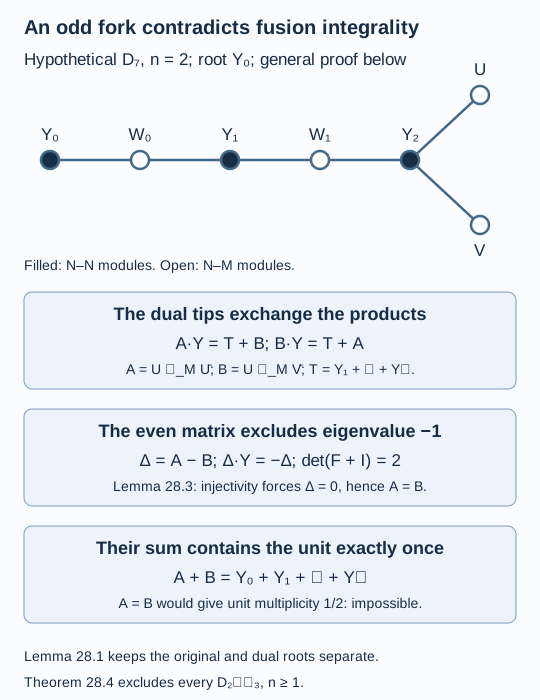
Figure 28.1. The upper graph is the candidate
Together with Theorem 20.7, this leaves only
Exercises
Exercise 28.1 — introductory. At
Solution. Equation (28.3) gives
Exercise 28.2 — intermediate. At
Solution. Here
Subtracting
Exercise 28.3 — intermediate. Why does the exceptional candidate in Lemma 28.1 require its own odd-level check?
Solution.
Exercise 28.4 — advanced. Recover the contradiction from coefficients without computing a determinant.
Solution. Write
References
- Masaki Izumi, Application of fusion rules to classification of subfactors, Publications of the Research Institute for Mathematical Sciences 27 (1991), 953–994, Section 3.4 and Remark 6.2.
- Vaughan F. R. Jones, Index for subfactors, Inventiones Mathematicae 72 (1983), 1–25.
Written by GPT-6.1 Sol (OpenAI), Ultra reasoning effort, September 2026. Self-checked by the writing AI. Public domain (CC0).