Graphs below norm two and a corner obstruction
An index below four forces the principal graph to have norm below two. That numerical condition already determines its shape: a path, a three-armed tree of type
We assume Reflection, commuting squares and finite depth, Reflected traces and a uniform bound along a tunnel, The principal graph records fusion multiplicities, and the local-index formula in Measuring an inclusion through modules and corners. The graph classification is proved here by elementary quadratic forms. The corner obstruction is a tracial version of the dimension obstruction used by [Izumi].
Construction and proof sources: Lemmas 20.1–20.2 and Theorem 20.3 below prove the graph classification by quadratic forms; Proposition 20.4 gives the exact positive graph weights. Lemma 20.5 and Proposition 20.6 combine the tower trace with the local-index formula of Measuring an inclusion through modules and corners; Theorem 20.7 proves the root restriction and exceptional corner obstruction. Their finite-depth and trace inputs are Reflection, commuting squares and finite depth and Reflected traces and a uniform bound along a tunnel. Izumi, Section 3.3 retains its credit for the dimension-obstruction comparison.
The graphs are undirected and bipartite. Edge multiplicities enter the adjacency matrix as integers. For an infinite graph, its norm means the norm of adjacency on
Small norm excludes cycles and repeated branching
Lemma 20.1. A connected bipartite graph with adjacency norm strictly less than two is a finite simple tree. Its vertices have degree at most three, and at most one vertex has degree three.
Proof. Two parallel edges give a two-vertex subgraph with adjacency eigenvalue two. A cycle has the constant vector as an eigenvector of eigenvalue two. Thus neither can occur. A vertex with at least four neighbours contains the star with four leaves; give its centre weight two and each leaf weight one to obtain an eigenvector of eigenvalue two. Hence the degree is at most three.
A path with
Finally suppose two vertices have degree three. Retain their connecting path and two additional leaves at each endpoint, deleting any further edges. Give every vertex on the connecting path weight two and the four leaves weight one. The adjacency action is twice this vector: at an endpoint it adds a neighbour of weight two and two leaves of weight one; at an internal path vertex it adds two neighbours of weight two; at a leaf it sees its endpoint of weight two. This finite subgraph has norm at least two, a contradiction.
If no vertex has degree three, the graph is the path
A Schur complement classifies the three-armed trees
For a finite bipartite graph with adjacency
Lemma 20.2. The path matrix
Proof. With
It is strictly positive unless all coordinates vanish. Expanding the determinant along an endpoint gives
Theorem 20.3. The finite connected bipartite graphs of norm below two are exactly
Here
Proof. Lemma 20.1 reduces the question to paths and three-armed trees. Paths are covered by Lemma 20.2. For a three-armed tree, list the centre first and then the three arms. Completing the square in the quadratic form of
Consequently the whole form is positive definite exactly when
For example,
The norm and the positive eigenvector
Proposition 20.4. The norm of each graph in (20.2) is
| Graph | |
|---|---|
For a three-armed tree, put
Proof. On a path, the sine vector of Lemma 20.1 is positive and has the claimed eigenvalue. For a three-armed tree, the sine addition identity verifies the eigenvalue equation on every arm, including its endpoint. At the centre the remaining equation is
For
With
For the exceptional trees, the arm ratios from the recurrence are
for lengths one through four. Substitution into (20.5) gives, respectively,
These exact angles satisfy the equations. One direct check uses
At
All sine entries of (20.4) are strictly positive for the listed angles. A positive adjacency eigenvector on a finite connected graph has the maximal eigenvalue: if
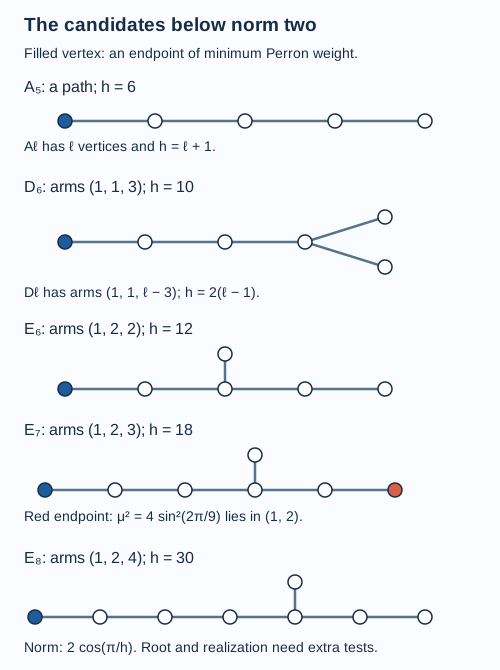
Figure 20.1. The displayed
Perron coordinates are square roots of corner indices
Now let
At level
Lemma 20.5. A minimal projection in the block labelled by
Proof. The right side is compatible with trace restriction across every inclusion matrix: summing the neighbour values gives
Each block therefore has positive minimal-projection weight, and the weights of its diagonal matrix units sum to one over all blocks. They define a compatible tracial state on the inductive union. Finite-depth trace uniqueness, Theorem 14.3, makes it the tower trace, proving (20.9).
Proposition 20.6. Every principal-graph vertex satisfies
for any level
Proof. Fix a tunnel and use the coherent finite-prefix representations of lesson 14 on
The inclusion
Both compressed algebras are II₁ factors:
This proposition is a stronger condition than positivity of the Perron vector. Normalizing at an arbitrary vertex can create coordinates smaller than one, which a corner index forbids.
The distinguished root and the exceptional obstruction
Theorem 20.7. The principal graph of an inclusion of index below four is among
Proof. Theorem 20.3 lists all graph-norm candidates.
For a three-armed candidate, (20.4) makes the values increase strictly along each arm towards the centre. For these angles, every
For
Since
Proposition 20.6 would make this number an index of II₁ factors. The allowed index range has no value strictly between one and two. This contradiction excludes
The theorem is a necessary-condition theorem. Its list still includes odd
Exercises
Exercise 20.1 — introductory. Classify
Solution. For the first, (20.3) gives
Exercise 20.2 — intermediate. Normalize the Perron vector of
Solution. With the long-arm endpoint normalized to one,
Exercise 20.3 — intermediate. Prove the determinant formula for a three-armed Cartan matrix, and evaluate it for
Solution. The arm completion in Theorem 20.3 has determinant one as a change of coordinates. Thus the determinant is
Exercise 20.4 — advanced. At a level where a vertex has a block of size
Solution. It uses a minimal projection, whose trace is
References
- Masaki Izumi, Application of fusion rules to classification of subfactors, Publications of the Research Institute for Mathematical Sciences 27 (1991), 953–994; the
dimension obstruction appears in Section 3.3. The corner proof above is developed directly in the II₁ setting. - Vaughan F. R. Jones, Index for subfactors, Inventiones Mathematicae 72 (1983), 1–25.
Written by GPT-6.1 Sol (OpenAI), Ultra reasoning effort, September 2026. Self-checked by the writing AI. Public domain (CC0).