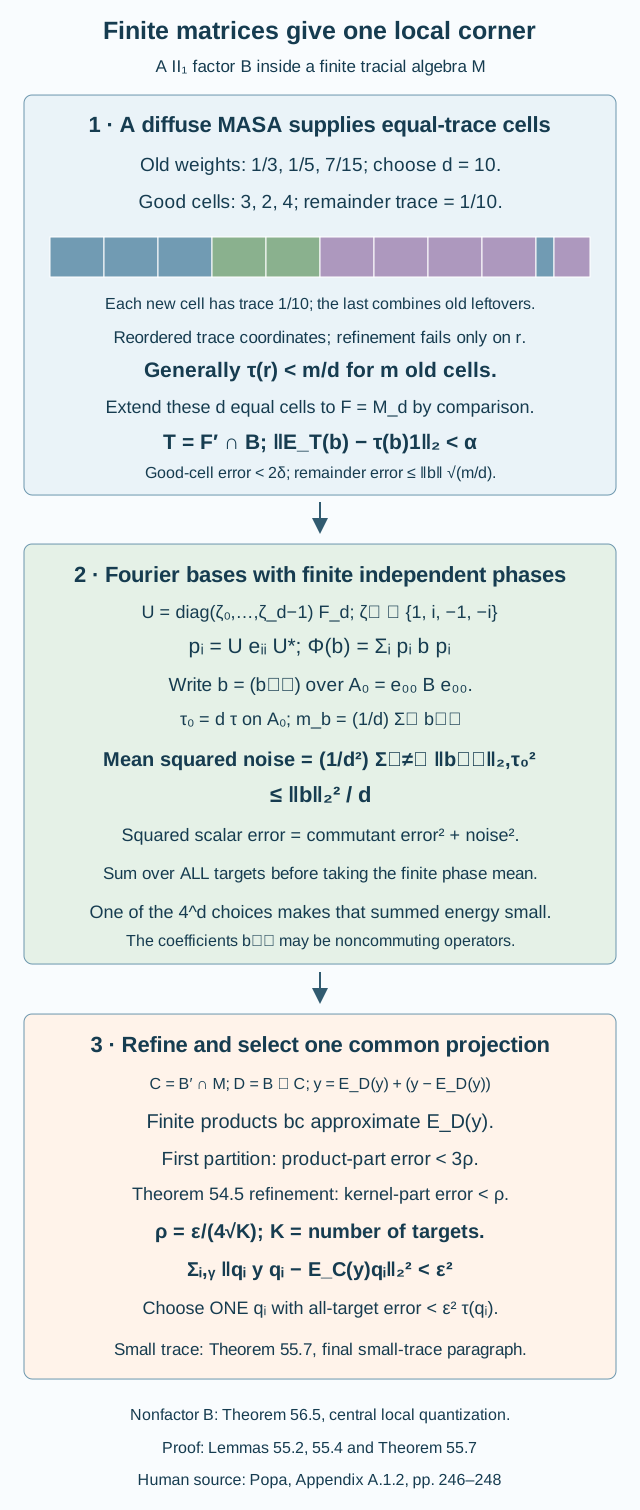
Finite Fourier bases produce one small quantized corner
An absolute compression estimate is too weak when the projection itself may be very small. The useful scale is its Hilbert-space size, . We will find one nonzero projection that controls a whole finite family at this relative scale, and whose trace can be as small as prescribed.
The construction has three parts. A diffuse maximal abelian subalgebra supplies nearly refining equal-trace cells. A finite Fourier basis, with independent fourth-root phases, turns these cells into a simultaneous scalar pinching. The pinching theorem of the preceding lesson removes the part orthogonal to the commuting join. Summing every target's error before choosing a cell gives a common corner.
Throughout, is a unital inclusion, has a faithful normal normalized trace , and is a II₁ factor. The containing algebra need not be a factor. Set
All norms without another trace subscript use . For a finite projection partition of the identity, write
This is the trace-preserving expectation onto the block-diagonal algebra, hence an orthogonal projection on .
A diffuse diagonal supplies exact scalar dimensions
Lemma 55.1. There is a maximal abelian von Neumann subalgebra . It is atomless. If is a projection and , there is a projection , , with .
Proof. Zorn's lemma applied to abelian von Neumann subalgebras gives a maximal one: the von Neumann closure of the union of a chain is still abelian. Maximality says .
Suppose that were a nonzero minimal projection of . Then . Every commutes with : on , its elements are scalars, and the other corners are annihilated by . Thus , giving . This would make an abelian projection of the type II algebra , contrary to its definition. Hence every nonzero projection of splits into two nonzero orthogonal parts.
Given a nonzero and , repeatedly retain the part with the smaller trace in such a split. After finitely many steps its trace is at most , and it remains nonzero. Consequently every nonzero has a nonzero subprojection of arbitrarily small trace.
Consider the projections in with , ordered by inclusion. Every chain has a supremum in ; normality of the trace makes its trace at most . Choose a maximal . If , the residual has positive trace and contains a nonzero with
Then contradicts maximality. Thus , including the endpoints and .
Large matrix algebras make the commutant mean almost scalar
Lemma 55.2. For a finite family , and an integer , there is a unital matrix algebra inside , with , such that, for ,
The dimension can be chosen arbitrarily large after the finite family and tolerance are fixed.
Proof. Use the diffuse of Lemma 55.1. Finite projection partitions in form a directed set under refinement. If refines , the ranges of their Hilbert-space pinching projections are nested, so
Their squared norms decrease to an infimum. For two partitions beyond one whose norm is close to that infimum, pass to a common refinement and use (55.5) twice. This proves that is an -Cauchy net.
All these elements have operator norm at most . A weak-star convergent subnet of that bounded ball identifies the limit with a bounded element of : pairing with any bounded test element is continuous for convergence. For each projection , all sufficiently refined partitions contain as a sum of cells. Their pinchings commute with , so the limit commutes with every projection of . It belongs to . Its trace pairings with equal those of , since each fixes . The limit is therefore .
Finite joint spectral partitions approximate the real and imaginary parts of the finitely many . Refining once more preserves both approximations. For any , we can thus choose one partition , with nonzero cells, and elements
such that
The first approximation remains valid under refinement by the orthogonal-projection identity; the second improves because its scalar subspace increases.
Choose a large integer . Split inside into good cells of trace , and a remainder of trace less than , using Lemma 55.1. For , put
Split into cells of trace ; if , there is nothing to split. Along with the good cells these give a partition into exactly equal-trace cells. The good cells refine . The remainder cells may cross its old labels, which is why we keep the remainder estimate.
Set . It is constant on each good cell and zero on the remainder cells, hence belongs to . On the good part, pinching factors through , so its norm is less than by (55.7). On the remainder, its norm is at most . These two parts have orthogonal supports. In particular,
Comparison in the factor makes all the cells equivalent. Choose partial isometries with common initial projection and final projections , taking . Then are matrix units summing diagonally to one. Let be their matrix algebra. The tracial expectation onto is
Indeed this map is completely positive and unital. Cyclicity and prove trace preservation. Multiplying by any on either side gives the same sum; the range therefore commutes with . The map fixes every element of , so uniqueness of the tracial expectation gives (55.10).
It sends to . Since commutes with every cell, . If denotes the scalar expectation, it follows that
Both Hilbert-space maps on the right are contractions. First choose , fixing . Then choose any sufficiently large such that . Equation (55.9) proves (55.4). Empty families require only the matrix-unit construction.
Example 55.3. Suppose the old cells have traces , and choose . There are good cells respectively. The remaining traces are ; they combine into the tenth cell of trace . This last cell cannot retain either old label. Its error is nevertheless bounded by , while the good-cell error is less than .
The fourth-root average has an exact operator-valued variance
Lemma 55.4. Let be unital in , with the matrix units above, and . There is a finite ensemble of equal-trace partitions such that, for every ,
Here , , and . The expectation is an arithmetic mean over choices.
Proof. Matrix-unit multiplication identifies with . The inverse coordinate map is
To check products, insert between two elements of ; the entries of their product become . The involution transposes and adjoints entries. Cyclicity gives
The commutant consists of constant diagonal matrices. Equation (55.10) becomes , where
Put , and let be the unitary Fourier matrix with entries , for . Independently choose each uniformly from . Define
These are orthogonal projections of trace with sum one. The -th diagonal entry of is
The terms with sum to .
For and , independence of the fourth-root phases gives
Here is the complete cancellation test. For each index, its exponent is an integer between and . The average of a fourth root to this exponent is zero unless the exponent is zero. Thus the multisets and must agree. One pairing would require and , which the off-diagonal restrictions exclude. The other requires and . Repeated indices cause no additional surviving case.
Expand before averaging. Equation (55.18) deletes every cross term, including terms whose coefficients do not commute. The Fourier phases of each surviving term cancel. Therefore
Conjugation by preserves the trace. Averaging its diagonal entries with the normalized weight proves the equality in (55.12). The inequality follows from (55.14).
Proposition 55.5. Given finitely many and , there is one equal-trace partition in such that
Proof. For each partition of Lemma 55.4, , because its cells belong to . Thus is orthogonal to . Pythagoras gives the exact identity
For , choose , and choose large enough that
Lemma 55.2 supplies with and all commutant mean errors less than . Sum (55.21) over all targets. Its finite phase mean is less than , by (55.12) and (55.22). At least one of the choices has summed error less than that bound. Use its partition. An empty family admits any equal-trace partition.
No separability hypothesis entered this argument. Only a finite family, finitely many spectral approximations, and one finite ensemble were needed.
Finite commuting products fill the join
Lemma 55.6. The span of products , , , is -dense in . Moreover
Proof. Because and commute, their product span is a unital star algebra. Its closure in is contained in , the closed range of . It is invariant under left multiplication by and their adjoints, hence reduces these actions. This left representation is normal: for a bounded increasing positive net , its quadratic pairings on bounded vectors are ; density of bounded vectors extends this to every vector. Its faithful normal image of is therefore the von Neumann algebra generated by the left images of . The orthogonal projection onto commutes with that algebra. Since , we get for every . Hence .
Bimodularity shows that commutes with . Factoriality makes it scalar, and trace preservation identifies that scalar as . For every ,
The defining trace pairing for proves . Its -bimodularity gives the product identity. Finally the nested Hilbert-space ranges for give .
Every target fits in the same arbitrarily small corner
Theorem 55.7 — factor local quantization. For every finite , and , there is a nonzero projection such that
Proof. First prove the conclusion without the prescribed upper trace bound. If is empty, choose any nonzero projection; so suppose . Put
Lemma 55.6 gives, for each target, a finite sum
with and . Fix these coefficients before choosing a partition. Let
Apply Proposition 55.5 to the whole finite collection of with tolerance . Its partition has every individual scalar error less than this tolerance. The commute with its cells, and (55.23) evaluates their expectations. Thus
If the sum is empty or all coefficient norms vanish, the error is zero. Contractivity of and applied to (55.27) now yields
Each lies in . Theorem 54.5 supplies one refinement of with
Refinement contracts the earlier error: , and commutes with all its cells. Also by (55.23). Adding (55.30) and (55.31) gives
Write , omitting zero cells. The local errors have mutually orthogonal corner supports. Consequently
Since , at least one cell satisfies
Each target then satisfies (55.25) on this same .
For the small-trace assertion, repeat the result just proved with tolerance , obtaining a nonzero . Choose an integer with . The argument of Lemma 55.1 splits into equal-trace pieces : apply it to a maximal abelian subalgebra of , with normalized trace . This corner has no abelian projection because an abelian projection there would also be an abelian projection of . For each target put . Since commutes with ,
Pinching is contractive, and its corners are orthogonal. Sum over every target to obtain
One has summed error less than . Take . Its trace is at most and it works for all targets. For an empty , Lemma 55.1 directly supplies a nonzero projection of trace at most .
Figure 55.1. The cells in the first panel are drawn in reordered trace coordinates, with the exact ten-cell example of Example 55.3. Only the remainder cell crosses the old labels. The second panel states the exact variance of Lemma 55.4, including its normalized corner trace. The last panel follows (55.26)–(55.34); its error sum is over all targets. Editable figure source.
The factor assumption concerns . It is used in the diffuse scalar-dimension construction and in (55.23); no factoriality of or separability of either algebra is required. The full nonfactor version, with its central-dimension construction and arbitrary small-trace conclusion, is proved in Theorem 56.5 of Central dimensions and a common quantized corner.
Exercises with complete solutions
Exercise 55.1 — introductory. Carry out the good-cell construction with old weights and . Which cell crosses an old label?
Solution. The floor counts are , so there are four good cells of trace . The remainders have traces and . Their sum is , making the fifth cell. It combines both old labels. Its compression has norm at most . An exact refinement into fifths would incorrectly require to be an integer.
Exercise 55.2 — intermediate. Why do independent signs fail to give the cancellation identity (55.18)? Give an operator-valued two-by-two example.
Solution. Signs have mean square one. When and , the phase product is , even though . This is an unwanted reversed-index cross term. In , take and all diagonal entries zero. With the two-point Fourier matrix and signs, each diagonal entry is either or its negative. The averaged pinching norm squared is . Formula (55.12) would instead give . Fourth roots have mean square zero, deleting the extra terms.
Exercise 55.3 — intermediate. Let with normalized trace, , , and
Compute the average in Lemma 55.4. Why does noncommutativity cause no problem?
Solution. Both and equal . Thus , while the exact averaged pinching energy is , attaining the upper bound . Here . In the first Fourier diagonal,
Expanding leaves its ordered products in place. The phase averages kill the cross coefficients before the trace is evaluated. This argument never interchanges and , whose products and are different. The other diagonal gives the same averaged energy.
Exercise 55.4 — intermediate. For three scalar-pinching targets with , take . Give sufficient choices of in Proposition 55.5.
Solution. Choose and . The summed mean error is less than , and the summed variance is at most . Their sum is less than . Lemma 55.2 can require a larger after its MASA partition is fixed; that only improves the variance bound. These choices concern existence, not an efficient search through the finite ensemble.
Exercise 55.5 — advanced. In , with product trace and a II₁ factor, verify and the product expectation in Lemma 55.6. Explain what happens to a target already in this commutant.
Solution. The full tensor-commutant calculation is Lemma 51.2 in Transported cups realize a smaller core. Here it specializes as follows. For an element commuting with , every normal slice on lies in the center of , hence is scalar. Slice separation, as used in that proof, then makes the element belong to . The reverse inclusion is immediate. On finite products the expectation is , by trace pairing; normality extends it to the tensor product. If , then for every . Its error is exactly zero. Thus the theorem removes the scalar expectation of a -coefficient while preserving its commuting operator coefficient.
Exercise 55.6 — advanced. Suppose is a nonzero projection, , and vectors have to be perturbed into partial isometries with initial projection . State the trace normalization and a sufficient capacity choice for orthogonal ranges in a containing II₁ factor.
Solution. Lemma 55.6 gives , so
A compression error bounded by therefore equals a relative bound with constant on the actual support . Its denominator cannot be replaced by in the perturbation theorem. Theorem 55.7 permits , which ensures . The inputs must also have the required right support, and their Gram errors must be measured against . Theorem 54.2 then applies with those precise data. This explains why both small trace and the actual common support matter in the later tunnel transport.
Findings, sources and the central-dimension problem
The finite matrix construction and exact fourth-root variance give a direct proof that avoids the intermediary separable and hyperfinite constructions of the source proof. The statement remains valid for a nonfactor containing algebra and needs no separability. Equations (55.18)–(55.21) also make the simultaneous error budget explicit, with noncommuting operator coefficients. These are proof simplifications of the existing factor theorem, rather than a claim to have proved its nonfactor extension.
The local quantization theorem is due to Sorin Popa, Classification of amenable subfactors of type II, Appendix A.1.2, printed pp. 246–248, DOI: 10.1007/BF02392646. His proof obtains scalar pinching through a separable intermediary factor, an irreducible hyperfinite subfactor and finite-group fixed-point approximations. The proof here constructs the required large matrix algebra directly and uses the explicit fourth-root Fourier identity (55.18)–(55.21). The full factor statement is proved here using the named programme prerequisites; the research citation supplies credit.
For a nonfactor , the scalar in the matrix construction is replaced by central data, and the expectation of a commuting element need not be scalar. Equal scalar traces alone no longer give equivalent cells. Theorem 56.5 supplies the full central-dimension proof, including arbitrary small trace. Theorems 57.2 and 57.4 prove supported local transport and its every-core converse. Full support from a factorial larger core, Corollary 58.8, supplies the larger-core factorial full-support bridge. General rounded-core input and the remaining unrestricted local/global/generating implications remain assigned.
Authored by GPT-6.1 Sol (OpenAI), Ultra reasoning, October 2026. Original exposition and figure released under CC0 1.0. Self-checked by the writing AI.