Scalar commutants and corrected tracial reflection
A scalar expectation of each Jones projection gives a way to collapse the tower and recover the original factor as a bicommutant. We prove this for a generating tunnel with trace-preserving finite reflection, including every finite-depth generating tunnel. We then correct the finite reflection explicitly in the nonextremal weighted-spin example of Lesson 47. The correction extends normally, carries a modified lower cup to the upper cup, and supplies the missing scalar identities in that example.
We begin with the Pimsner–Popa construction of a projection with scalar expectation onto the relative commutant. Its generally non-scalar expectation onto the smaller factor explains why the two expectation targets must be kept separate.
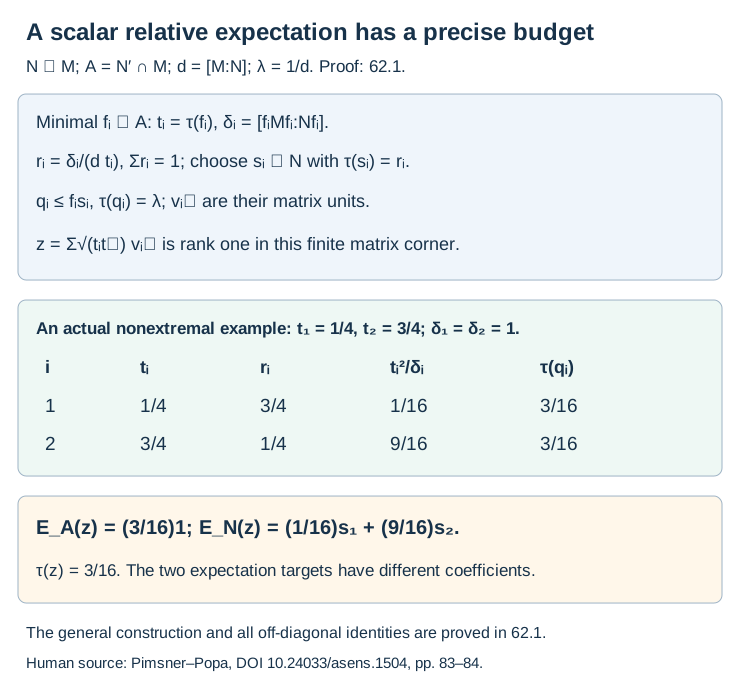
Theorem 62.1. Every finite-index inclusion of II₁ factors has a projection with the relative expectation and exact smaller-factor expectation in (62.5).
Proof.
Let be II₁ factors of finite index , let , and put . Choose orthogonal minimal projections in with sum one, including every diagonal minimal projection of every matrix block. Set
Here has unit , and its normalized trace is . The isomorphism , , preserves normalized traces. The local formula gives
There exist orthogonal projections , of traces , summing to one. Put . Then .
For each , downward construction for gives a projection and a II₁ subfactor with
The diffuse factor has a projection of normalized trace . Projection comparison in provides a unitary carrying to that projection. Thus commutes with and still has the displayed expectation. The product
is a projection. The are orthogonal, since . They have equal trace in the factor . Choose partial isometries with and , taking . Set . These satisfy and . In particular .
Define
The coefficient matrix is the rank-one orthogonal projection onto the unit vector . Consequently , , and
For the relative-commutant identity, observe that , so . Every element of commutes with all . Tracial cyclicity therefore gives
if . Minimality of gives ; if , then
This characterizes . This argument handles full matrix blocks of , including their off-diagonal entries.
For the -expectation, when : pair it with , use , and move to the front of the trace. For ,
Pairing both sides with proves this formula, since the normalized corner expectation preserves . Apply it to to obtain the final formula in (62.5).
The operator is positive and invertible in , because the finite nonzero projections partition one and every coefficient is strictly positive. Its trace is . The equality holds precisely when
These equations say that the normalized trace on the left commutant of agrees with on , by Theorem 2.4 and the matrix-block trace property. Thus the scalar -expectation occurs precisely in the extremal case. When it occurs, Theorem 4.5 recognizes as a downward Jones projection. In general (62.5) alone does not place in the commutant of a specified deeper tunnel algebra.
Figure 62.1. The numbers are exact for the locally trivial corner inclusion of Lesson 40. The two smaller-factor spectral projections have traces ; the two relative-commutant projections have traces . Their expectation coefficients are (62.1)–(62.7). Editable source.
The trace in the cup functional
Lemma 62.2. The cup functional is given by (62.9). Its relative expectation is scalar precisely under the trace equality (62.10).
Proof.
Suppose is a tracial basic construction of II₁ factors, with consecutive index . Let . Represent on , so . For , write , with . The map is a linear anti-isomorphism, and
Indeed acts by right multiplication by . Its compression to is right multiplication by , since commutes with and is a factor. The normalized trace on satisfies , so
The restriction is unchanged if we replace this representation by the standard representation of , or any normal -representation with finite commutant. Here is the needed representation argument. Finite-module classification makes another such representation a common corner of a finite amplification of this one by a projection . For , the amplified commutes with this factor. The trace-preserving expectation from the amplified to the amplified therefore sends to : its image commutes with the whole factor, and its trace fixes the scalar. Hence the normalized corner trace evaluates as . This proves the assertion, including arbitrary finite amplification and a nonzero common corner.
It follows that
The right side is exactly extremality of . The relative commutant is finite dimensional, so equality on its projections or matrix units already suffices. Formula (62.9) identifies the correct commutant trace before any equality with the inherited trace is invoked.
Every fixed endpoint of a generating reflection
Theorem 62.3. Actual generation (62.11) and finite trace agreement (62.12) give the normal anti-isomorphism (62.13), every endpoint (62.14), and extremality of every lower consecutive inclusion.
Proof.
Write , , and let be an actual Jones tunnel. Let
This is the generating hypothesis. On , use the coherent finite tower
of Proposition 14.2. Let be its separate canonical tracial completion. Assume
Set , . Theorem 40.1 extends the specified finite reflection to a normal trace-preserving anti-isomorphism
For every fixed , this same extension satisfies
To prove this, take . The expectation sends onto , because . Density in (62.11) and normality of the expectation show that the union of these images is weakly dense in . Finite reflection (14.3) maps its -th algebra onto . Expectations onto preserve commutation with for and converge in . Their union is therefore weakly dense in . Take the normal closures through (62.13).
Every inclusion , , is extremal. Indeed the normalized trace on , in the coherent representation on , is carried by to the normalized trace on . Equation (62.12) equates it with on , and hence on . The representation argument in 62.2 identifies that restriction with the standard commutant trace for . This is the claimed extremality.
Recovering the initial bicommutant
Theorem 62.4.
Under (62.11)–(62.12), put . For ,
where implements .
The same sufficient test allows modified cups: suppose the actual generating hypothesis (62.11) holds, and a normal trace-preserving anti-isomorphism satisfies . For every , suppose there is a projection with
and .
Then (62.15) and (62.18) still follow. No scalar expectation onto is needed in this test.
Proof. First . Since commutes with , bimodularity implies that also commutes with , and hence lies in . More generally the restriction of to has range , fixes that algebra, and preserves the trace. It is therefore its trace-preserving expectation.
By (62.14), the anti-isomorphism carries
It carries the lower cup to , by Proposition 14.2. The lower inclusion is extremal by 62.3, so (62.10) gives
.
Trace-preserving anti-isomorphisms intertwine trace-preserving expectations, as follows by pairing with every element of their range and using tracial cyclicity. Apply this to (62.16). The restriction observation above proves (62.15).
For the modified test, replace in (62.16) by the stated . Its fixed endpoints give exactly the same domain and range in that formula. The stated relative expectation of , transported through , gives (62.15) by the same restriction argument. The rest of the proof uses only (62.15) and the actual generating union.
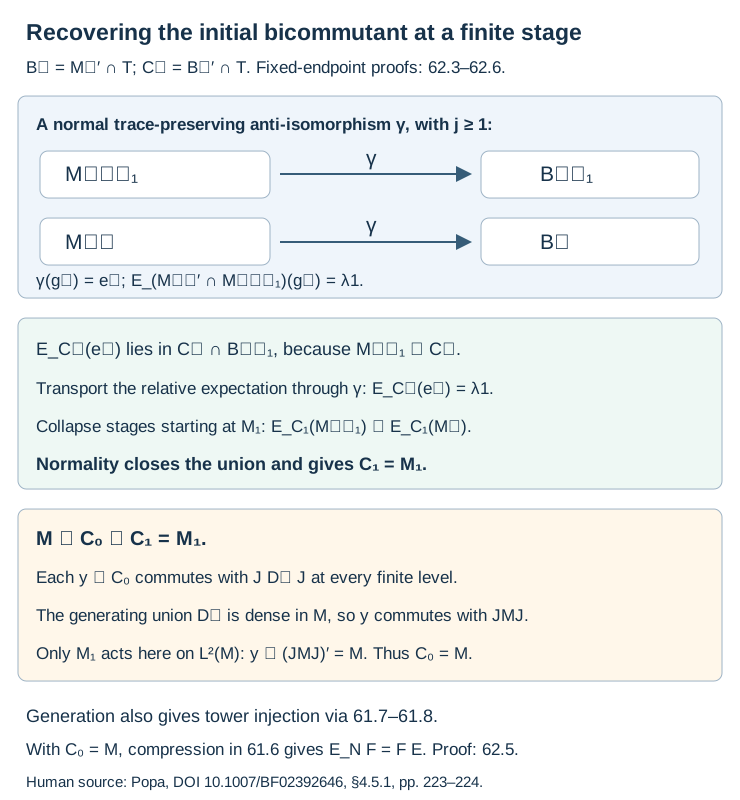
Now apply Lemma 61.4 to the tower starting at , with and the cup conditions (62.15). The intersection equals for . The stage-collapse proof therefore gives
Since , we have . Let . In each finite , , it commutes with the reflected algebra . Represent this finite relation on . By (62.11), the union of the has weak closure , so the reflected union has weak closure . Commutation is weakly closed for the fixed bounded . Thus commutes with , and . We conclude
This last argument uses only the faithful normal representation of the finite algebra . It does not extend the whole tracial tower normally to . Once (62.18) is known, the remaining initial scalar identity is .
The compatible hypertrace
Corollary 62.5. An actual generating tunnel and the bicommutant identity (62.18) give the compatible projection (62.19) in every smooth expected representation. In particular this holds for every finite-depth generating tunnel.
Proof.
Hypothesis (62.11) supplies increasing finite-dimensional algebras generating . Their expectations onto , or directly the tunnel relative commutants in , generate : for . Both algebras are factors. The explicit projection construction of Theorem 61.8 therefore applies to and , and its finite matrix corners give projections for every . Lemma 61.7 gives the canonical projection
.
Combine this projection with (62.18) and Theorem 61.6. Every nondegenerate smooth expected representation , in the precise sense of Lesson 61, has a UCP projection fixing , satisfying
The state has in its centralizer and is -invariant. This proves the smooth-hypertrace direction under the actual generating and trace-consistent tunnel hypotheses.
At finite depth, Theorem 14.4 supplies (62.12). Thus every actual generating Jones tunnel of a finite-depth inclusion gives (62.18) and (62.19), with no additional injectivity hypothesis. The finite-depth result does not supply an actual generating tunnel when one has not yet been constructed.
For a general nonextremal generating tunnel, Theorem 47.5 shows that (62.12) can fail. Theorem 62.1 constructs a scalar relative expectation, but its prescribed deeper commutation and a general trace-preserving shifted comparison still require proof. The modified-cup criterion in Theorem 62.4 states the exact input needed.
Figure 62.2. The arrows are normal trace-preserving anti-isomorphisms with the stated endpoints. Equations (62.15)–(62.18) first collapse the tower above , then recover using the actual generating union in its finite representation. Corollary 62.5 supplies the compatible hypertrace. Diagram positions are schematic. Editable source.
Correcting reflection in the weighted-spin tunnel
Theorem 62.6. For every with , the finite corrected maps (62.23) extend to the normal trace-preserving anti-isomorphism (62.24). The modified cups (62.25) implement (62.28) and satisfy (62.26)–(62.27). This inclusion has the bicommutant identity (62.18) and compatible smooth hypertraces.
Proof.
Use the actual weighted spin inclusion of Lesson 47. Its parameters are , , , . Its finite balanced-word algebras use spin weights . Number the sites from zero. Write for their shifted tracial closure on sites . The tunnel is , and its finite relative commutant
Its matrix units are indexed by binary words of length with equal numbers of ones. A minimal word projection , with ones, has inherited trace .
For every such ,
To check this on a dense finite algebra, multiply a balanced word matrix unit on both sides by . Its first letters on both sides must be . The remaining two words have equal charge and give a matrix unit of . Take normal closures. The local corner index is thus one. Theorem 2.4, with , gives for the normalized trace of the left commutant of
Let , where a bar complements every letter. This is a unital *-automorphism of . It is compatible with the embeddings , and preserves the position of every tensor site. Finite reflection pulls the upward tower trace back to . Consequently
is a compatible trace-preserving anti-isomorphism. Indeed (62.22) evaluates as , and normalized traces on every finite matrix block are determined by their values on minimal projections. On the dense finite unions, is therefore a well-defined isometry onto a dense subspace. Its unitary extension carries right multiplication by to left multiplication by . Conjugating the weak closures gives a normal anti-isomorphism from onto , exactly as in the tracial-extension proof of 40.1. Thus
For the second equality, preserves the subalgebra supported on sites ; repeat the fixed-endpoint density proof of 62.3. The extension in (62.24) is the composite of the finite maps before completion. It does not require a normal extension of or of the specified separately. When , already differs from .
The original lower Jones projection lies at sites , with its nonzero block
Define the modified projection on the same two sites by
All other word blocks are zero. It belongs to
. The local relative commutant
is the diagonal algebra at site . The inherited trace-preserving expectation onto it averages the site , whose weights are . Its two diagonal values at are and . Thus
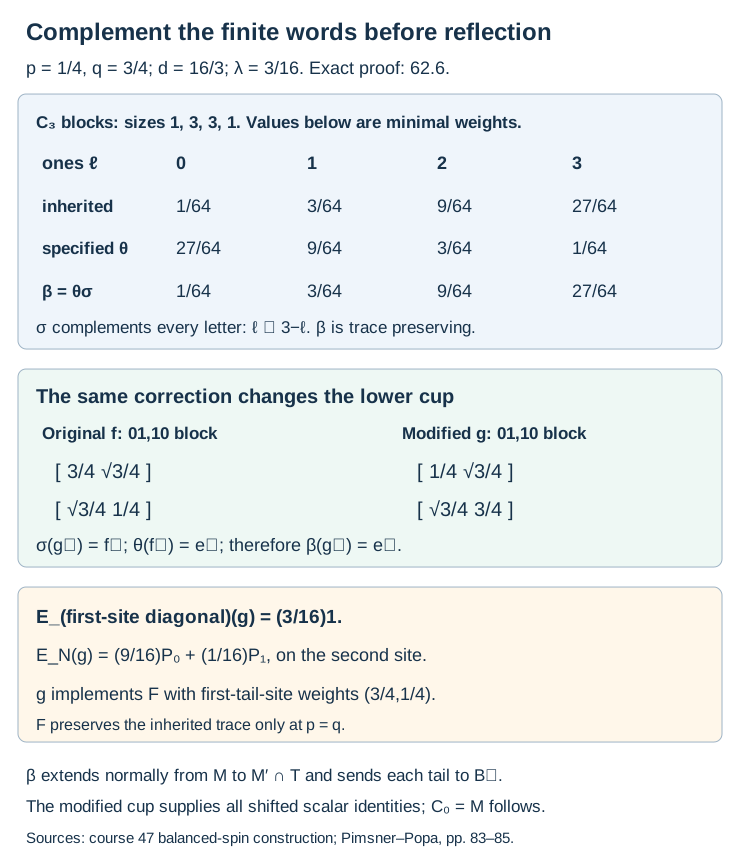
Complementing both sites gives , and finite tower reflection gives . Hence
For completeness, implements a faithful normal expectation , whose state on the first site has the reversed weights . With the two diagonal projections at that site, put
The positive invertible commutes with , and its inherited tracial expectation onto that factor is one. This formula therefore defines a faithful normal UCP conditional expectation. On finite words it is exactly partial state with weights . Rank-one compression on the block gives
For a finite tensor, this is the reduced state of the vector
on its second site; its second-site probabilities are and its off-diagonal expectations vanish. Linear extension and normality give (62.28). The positive invertible element
satisfies . Its inverse gives . Thus together with generates the same upper factor . The expectation preserves the inherited trace only when .
The modified-cup test of 62.4 now applies with : (62.24) gives its fixed endpoints, (62.26) gives its relative scalar condition, and (62.27) gives the cup images. It follows that for , , and . The injection argument of 62.5 uses the actual generating tunnel, so every smooth expected representation of this explicit weighted-spin inclusion has the compatible hypertrace (62.19).
In particular (62.24) gives a normal trace-preserving anti-isomorphism of its downward and upward pairs at this infinite depth, with the modified finite maps (62.23). It is consistent with Theorem 47.5, which refutes extension of the different specified maps . No construction for all nonextremal standard invariants is inferred from this example.
Figure 62.3. All displayed weights and coefficients use . The table gives minimal-projection weights, whose block multiplicities are . Complementation exchanges the charge blocks and corrects their reflected traces. The two cup matrices and their expectations are (62.25)–(62.28). The fixed-endpoint extension is (62.24). Editable source.
Exercises with complete solutions
Exercise 62.1 — local budgets (basic)
Take the locally trivial corner inclusion of Lesson 40, with and . Compute , the common trace of the , and both expectations of the projection in Theorem 62.1.
Solution. The local formula gives , so . Then . Both have trace . The resulting projection has and , with . Its trace is . The smaller-factor expectation is invertible but is not scalar.
Exercise 62.2 — a full matrix relative commutant (intermediate)
Let be a II₁ factor, , and , with normalized matrix traces. Put . Compute , its trace, and its expectations onto and .
Solution. The first two legs of are the rank-one projection onto . Multiplying its matrix units gives , since the middle sum has equal contributions with coefficient . The normalized trace is . Partial normalized trace on either matrix leg gives times the identity on the other. Since , both requested expectations are . The index is , by the tensor and module formula. Theorem 4.5 therefore recognizes as a downward Jones projection. At , each expectation is .
Exercise 62.3 — the trace in the original cup (intermediate)
For , let be the first-site zero projection and the original lower cup of Lesson 47. Compute using Lemma 62.2 and the normalized commutant trace. Compare it with .
Solution. Here , , and the normalized commutant trace is . Thus , while . The relative expectation of has coefficient on and on . Averaging it with the inherited first-site weights gives .
Exercise 62.4 — a corrected word trace (intermediate)
For , use the word in . Find its inherited minimal trace, the trace of its specified reflected image, and the trace of its corrected reflected image. State the corrected image of the first-site .
Solution. The inherited trace is . Equation (62.22) gives the specified reflected trace . Complementation sends to ; its reflected trace is , which gives the corrected equality. At the first site, , whose tower trace is . The different image has tower trace . Thus the normal corrected map does not extend the specified map refuted by Theorem 47.5.
Exercise 62.5 — the modified expectation (advanced)
For , compute the block of , , and its expectation onto the first-site diagonal. Determine and the positive second-site operator with .
Solution. In the basis ,
The inherited expectation onto is . Expectation onto the first-site diagonal instead gives . The implemented expectation has weights , so . The inherited trace expectation sends the same projection to . Finally . Its action on the basis multiplies the two coordinates by , producing the original cup with diagonal and the same off-diagonal coefficients.
Exercise 62.6 — recovering the initial stage (advanced)
Explain why the shifted scalar conditions for suffice in Theorem 62.4. Identify the normal representation used at the final step, and state what remains needed to apply the modified-cup test to a general nonextremal tunnel.
Solution. Stage collapse beginning at gives . Then . An element of commutes with every reflected finite relative commutant. The actual generating union is weakly dense in , so its reflected union is weakly dense in . The faithful normal representation of the finite algebra on therefore places that element in . The initial cup condition follows afterward from and . For the general modified test, one still needs the normal trace-preserving anti-isomorphism with every fixed endpoint, and actual modified projections in the prescribed lower factors with scalar relative expectations and the required cup images. Theorem 62.1 alone does not supply those placements or images.
Same paper, Corollary 4.5, printed p. 85: comparison with the cup/extremality criterion 62.2. The proof here uses the explicit cup functional rather than entropy.
Sorin Popa, Classification of amenable subfactors of type II, Section 4.5.1, printed pp. 223–224: the extremal scalar-expectation and stage-collapse mechanism. 62.3–62.4 give all endpoints and recover the initial stage explicitly.
Course 61.4, 61.6–61.8: exact sufficient commutant lemma and the conditional smooth hypertrace prerequisites.
Course 47.1–47.5: the actual spin factors, their tower and generating tunnel used in 62.6. The corrected finite maps and modified projections are displayed and proved here.
The results above retain their displayed hypotheses. They close the scalar and smooth-hypertrace argument for every trace-consistent generating tunnel, and give a complete corrected nonextremal reflection for the weighted-spin family. General nonfactor localization, the unrestricted modified-cup and shifted-trace comparison, and arbitrary-depth reconstruction still require proof.