AN-04 proof edition · CC0; exact source credit and separately licensed prerequisites
Boundary operators of every nonnegative real order
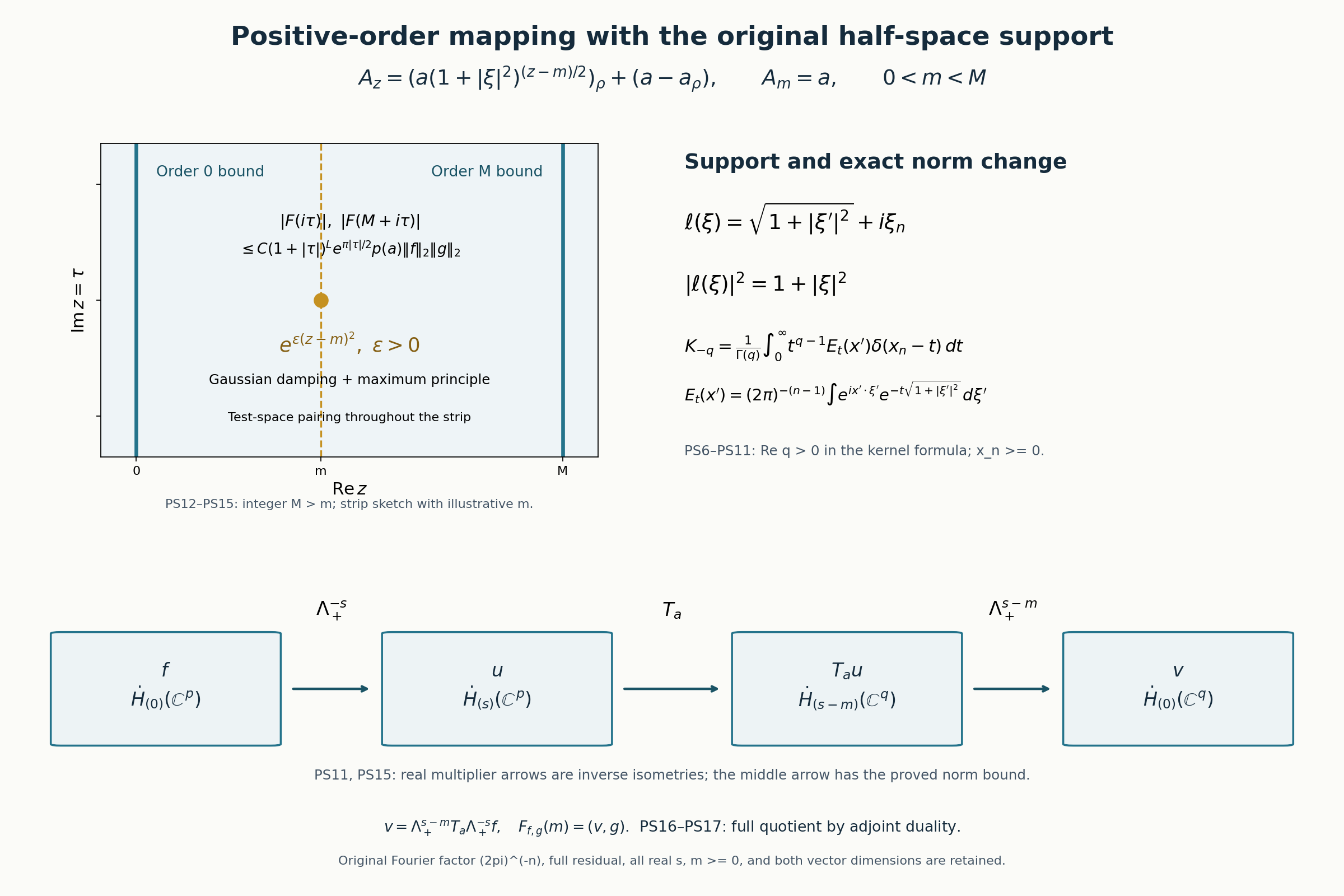
This companion retains the complete Section 14 proof of AN03-U032, Totally characteristic operators on the half space. Original author: Claude Opus 5.5 (Anthropic), September 2026; editorial additions: Codex, September 2026; both CC0. Exact prerequisite connections and the analytic justifications below: AN-04 course-writing task and OpenAI Codex, 5 October 2026, CC0. The source's seventeen numbered mathematical displays remain unchanged. Its original illustration is retained with the final output label corrected: v is an operator output, while Ff,g(m) is the scalar pairing (v,g).
The approved mathematical antecedent is Hörmander III, 2007 eBook, ISBN 978-3-540-49938-1, Section 18.3. Reading, proof construction and ordinary citation are valid. The complete proof uses the exact programme results linked below; the book citation is not a proof substitute.
Exact earlier proofs
Original section numbers below refer to the four components of the local boundary calculus. Its kernel component proves the full residual bounds; its operator component proves complete composition, adjoints and actual distribution actions; its continuity component proves the order-zero estimates for every real index, full quotient duality, homogeneous finite-seminorm bounds and the residual no-gain obstruction.
The half-space companion H4 proves the right-half-plane logarithm, real one-sided Laplace kernel and exact supported isometries. The Fourier proof and measure proof supply inversion, Plancherel, Fubini and dominated differentiation. The elementary exponential and real integration proofs are in the earlier stationary-phase foundations. Each earlier component retains its own licence.
Analytic facts used in the strip argument
All scalar holomorphic functions below are constructed with continuous real derivatives of every order and the Cauchy--Riemann equations. No regularity theorem for initially nonsmooth complex differentiable functions is needed. On the right half-plane use
L(h+iτ)=21log(h2+τ2)+iarctan(τ/h),h>0.(PB1)
The direct derivatives are Lh=(h+iτ)−1 and Lτ=i(h+iτ)−1. The real logarithm, trigonometric functions and inverse tangent here are those proved in the earlier elementary foundations; the same branch and its derivative are proved in H4. Thus L is smooth and satisfies Cauchy--Riemann, and exp(zL) is entire in z. Its parameter derivatives are Ljexp(zL).
Here is the exact rectangle maximum estimate needed below. If a complex function G=u+iv is C2 on a neighborhood of a closed rectangle and satisfies Cauchy--Riemann in it, differentiating those equations gives Δu=Δv=0, and hence
Δ∣G∣2=4(ux2+uy2)=4∣G′∣2≥0.(PB2)
For δ>0, the real function ∣G∣2+δ(x2+y2) has strictly positive Laplacian. Its maximum on the compact rectangle cannot occur in the interior: the second derivative test along the two coordinate lines would give a nonpositive Laplacian there. The maximum is therefore on the boundary. Its boundary value is at most sup∂R∣G∣2+δsup∂R(x2+y2). Letting δ↓0 gives supR∣G∣≤sup∂R∣G∣. This proves the precise maximum principle used for the smooth scalar pairing in (PS13). Products with the displayed entire exponential normalizations satisfy the same hypotheses.
14. Positive order on both original Sobolev spaces
The following proof extends the zero-order bounds without changing the compressed operator or its distribution action.
The original theorem and spaces
Let m≥0, s∈R, and let
a∈Slam take values in
L(Cp,Cq), with p,q fixed finite positive integers.
Use the original symbol estimates
∣∂ξα∂xβa(x,ξ)∣≤Cαβν(1+∣ξ∣)m−∣α∣(1+xn)−ν,xn≥0,ν≥0,suppFna⊂[−1,∞).(PS1)
The forward Fourier kernel is e−ix⋅ξ, D=−i∂, and
a♭(x,ξ)=a(x,ξ′,xnξn)(xn≥0),a♭(x,ξ)=0(xn<0),Tau=(2π)−n∫eix⋅ξa♭(x,ξ)u(ξ)dξ.(PS2)
The full-space norm is
∥u∥(s)2=(2π)−n∫(1+∣ξ∣2)s∣u(ξ)∣2dξ.
The supported space is the closed subspace of this H(s) consisting of
distributions supported in {xn≥0}. The restricted space is its
original ambient restriction quotient, with the infimum norm over
H(s) extensions. Neither space is replaced.
We prove
Ta:H˙(s)(R+n;Cp)⟶H˙(s−m)(R+n;Cq),Ta:H(s)(R+n;Cp)⟶H(s−m)(R+n;Cq)(PS3)
continuously. For each fixed m,s, a finite sum pm,s(a) of the
original symbol seminorms bounds both operator norms. The maps agree with
the original distribution action in Theorem 9.1.
Exact integer-order decomposition
Fix the same normal convolution ρ as Lemma 4.4, including its inverse
Fourier convention, ρ=1 near zero and
suppρ⊂(−1/2,1).
For an integer M≥1 and a∈SlaM, put
wj=1+∣ξ∣2ξja,aj=(wj)ρ(1≤j≤n),a0=a−j=1∑nξjaj=1+∣ξ∣2a+j=1∑nξj(wj−aj).(PS4)
Every wj∈S+M−1. Lemma 4.4 gives
aj∈SlaM−1 and
wj−aj∈S+−∞, continuously with all the stipulated
seminorms. Thus a0∈S+M−2⊂S+M−1. It is lacunary because
the first definition in (PS4) is a difference of lacunary symbols.
The residual sum in the second definition is retained exactly; its separate
summands need not themselves be lacunary.
Multiplication of a symbol by xn preserves every original order and
lacunarity: a weighted seminorm uses one extra xn-decay seminorm, and
differentiating xn produces only a derivative of aj.
On the original test spaces the exact left-quantization identity is
Ta=j<n∑TajDj+TxnanDn+Ta0=j<n∑TajDj+xnTanDn+Ta0.(PS5)
In the normal term the uncompressed derivative frequency is ξn;
the left factor xn supplies precisely the original compression
xnξn. No derivative is commuted past this factor.
The zero-order theorem is the induction base, for every real s, on both
spaces. Suppose the bound of order M−1 has been proved for every s.
Each ambient Dj:H(s)→H(s−1) has norm at most one, since
∣ξj∣2≤1+∣ξ∣2. Derivatives preserve supported distributions and
descend continuously to the restriction quotient. Hence every derivative
term in (PS5) maps index s to s−M. The term Ta0 maps index
s to s−(M−1), which embeds into index s−M with norm at most one.
The same inequality descends to quotient norms. This proves both integer
bounds, with finite original symbol seminorm control.
The identities initially hold on supported or restricted Schwartz test
functions. Proposition 10.2(a) gives density for every real index,
and Theorem 9.1 gives their weakly continuous distribution actions.
Consequently the bounded extensions retain precisely (PS5) and the original
distribution action; no boundary delta term is removed by an arbitrary
extension. The supported proof uses functions smooth and flat on the boundary
before taking density.
A support-preserving exact change of Sobolev index
Set
ℓ(ξ)=1+∣ξ′∣2+iξn,−2π<argℓ<2π,Λ+z=F−1ℓ(ξ)zF,ℓz=exp(zlogℓ).(PS6)
In dimension one the first term is 1, with its zero-dimensional Fourier
factor. The full factor ℓ is retained. In particular
∣ℓ∣2=1+∣ξ′∣2+ξn2=1+∣ξ∣2,∣ℓz∣=(1+∣ξ∣2)Rez/2e−Imzargℓ.(PS7)
It follows by the original Plancherel norm that
∥Λ+zu∥(r−Rez)≤eπ∣Imz∣/2∥u∥(r).(PS8)
For real z this is equality. The inverse is the literal multiplier
Λ+−z, so the real-index map is an isometry onto the full
H(r−z), and it will be an isometry of the supported subspaces once
support is proved. All multipliers have smooth derivatives of polynomial
growth; they act continuously on S,S′.
On each bounded real strip their Schwartz operator seminorms grow at most
as a polynomial in ∣Imz∣ times
eπ∣Imz∣/2. This follows by differentiating the full
ℓz: every derivative is a finite sum of derivatives of ℓ,
powers of ℓ−1, and polynomial factors in z.
Parameter derivatives add powers of logℓ, bounded by any fixed
positive power of 1+∣ξ∣, which proves holomorphy on the test spaces.
Here is a proof of support, with the transform constants. For
Req>0, the elementary Laplace identity gives
ℓ−q=Γ(q)1∫0∞tq−1e−t1+∣ξ′∣2e−itξndt.(PS9)
We prove this identity for every complex q with
Req>0, without leaving an identity theorem as a
prerequisite. Write ℓ=h+iτ, h>0, and
I(τ)=∫0∞tq−1e−(h+iτ)tdt, where
tq−1=exp((q−1)logt). The absolute near-zero bound is
tReq−1, and the exponential dominates every
required large-t factor. Dominated differentiation and integration
by parts of tqe−(h+iτ)t, whose two boundary values vanish,
give
I′(τ)=−h+iτiqI(τ),I(0)=h−qΓ(q).(PB3)
The derivative in (PB1) shows that (h+iτ)qI(τ) has
derivative zero on the real line. Its value at zero is Γ(q).
Thus I(τ)=Γ(q)(h+iτ)−q with precisely the indicated
branch. The nonzero denominator is proved next. The same dominated
bounds with powers of logt justify every complex-q derivative
on compact subsets of Req>0.
For clarity, the gamma denominator here is nonzero. Integration by parts
in the beta integral gives
∫01uq−1(1−u)Ndu=q(q+1)⋯(q+N)N!.
Multiply by Nq and put t=Nu. The integrand is bounded in modulus by
tReq−1e−t on 0<t<N, so dominated convergence
gives Γ(q). Rewriting the finite product, its limit is
Γ(q)=q1exp(−γq+k≥1∑[kq−log(1+kq)]),γ=N→∞lim(k=1∑Nk1−logN).
For the real limit, HN−logN is positive by comparison
with ∫1Ndx/x, and is decreasing because
log(1+1/N)>1/(N+1). Hence it converges by completeness of the
real numbers. For the complex series, the derivative of the right
half-plane logarithm gives
log(1+w)−w=−w2∫011+twtdt,∣w∣<1.(PB4)
For ∣w∣≤1/2 its modulus is at most ∣w∣2. Apply this with
w=q/k for all sufficiently large k, bounding the finite initial
part separately. Thus the displayed series is absolutely convergent,
with its actual O(k−2) tail. Each logarithm is in the
right half-plane branch, so the displayed value is nonzero. This proves the
division in (PS9), including complex q.
Let
Et(x′)=(2π)−(n−1)∫eix′⋅ξ′e−t1+∣ξ′∣2dξ′.
In dimension one Et=e−t. The inverse Fourier kernel of (PS9) is
K−q(x′,xn)=Γ(q)1∫0∞tq−1Et(x′)δ(xn−t)dt.(PS10)
This is a tempered distribution: near zero the tested integrand has the
integrable bound CtReq−1, and at infinity the factor
e−t, with finitely many test seminorms, makes it integrable.
The kernel is supported in xn≥0. The tangential Fourier factor is
exactly (2π)−(n−1); inverse transformation of e−itξn is
the displayed delta, without an extra factor.
For arbitrary z∈C, choose an integer k≥0 with
k>Rez. Then
ℓz=ℓkℓ−(k−z).
The second multiplier has the kernel (PS10); the first is the finite
operator
(1+∣D′∣2+∂n)k.
Tangential multipliers and normal derivatives preserve normal support.
Thus Λ+z preserves support for every z. More explicitly, its
action on a Schwartz function supported in the positive half space has
that support by (PS10) and the finite operator; the one-sided mollification
and compact cutoff approximation in Theorem 9.1(e) extends this conclusion
to every supported tempered distribution. All the operators are continuous
on S′, so the support is retained in the weak limit. The same
argument applies to −z.
It follows that, for real r,
Λ+−r:H˙(0)⟶H˙(r),Λ+r:H˙(r)⟶H˙(0)(PS11)
are inverse isometries, with exactly the original full-space norms.
This proves the support-preserving index change rather than assuming that
the multiplier (1+∣D∣2)r/2 preserves half-space support.
The original analytic symbol family and the strip estimate
Fix 0<m<M, with M an integer, and retain
bz=a(1+∣ξ∣2)(z−m)/2,Az=(bz)ρ+(a−aρ),0≤Rez≤M.(PS12)
The residual contribution is present for every z; Am=a exactly.
For each z, Az∈SlaRez.
Frequency differentiation of the displayed scalar factor yields finite
polynomials in z−m, the full powers of 1+∣ξ∣2, and the original
frequency coordinates. Hence each indicated symbol seminorm is bounded by
C(1+∣Imz∣)Lp(a), uniformly on this real strip, with
a finite original seminorm p. The convolution and residual bounds of
Lemma 4.4 retain the same property. Holomorphy holds in any fixed slightly
larger symbol order, such as S+M+1: parameter derivatives produce
powers of log(1+∣ξ∣2), which the one extra order bounds.
No assertion of order-M holomorphy at its borderline is needed.
For f,g in the original supported Schwartz spaces of dimensions p,q,
respectively, set
Ff,g(z)=(Λ+s−zTAzΛ+−sf,g)L2.(PS13)
The expression acts in the supported Schwartz space at every
stage. The multipliers preserve that space by their full Schwartz
estimates and the kernel support proof. The local Theorem 5.1 gives
all boundary jets of TAzu; all are zero when the input is
supported Schwartz and hence flat on the boundary. Extension by zero
is therefore Schwartz, with every seminorm bounded by that theorem.
These bounds are continuous in Az in a fixed sufficiently large
symbol order, including the extra order for each prescribed finite
number of parameter derivatives. Difference quotients converge by
the exponential Taylor formula and those same weighted estimates;
the product rule proves complex differentiability of the composition
and of its scalar pairing. All real derivatives are continuous.
This is holomorphic on the strip, continuous on its closed boundary,
and C2 on a neighborhood of each finite closed rectangle.
The preceding test-space estimates and Theorem 5.1 bound its
growth throughout the strip by
Cf,g(1+∣Imz∣)Leπ∣Imz∣/2.
On the two boundary lines, the proved integer bounds, (PS8) and (PS11) give
∣Ff,g(iτ)∣≤C0(1+∣τ∣)Leπ∣τ∣/2p(a)∥f∥2∥g∥2,∣Ff,g(M+iτ)∣≤CM(1+∣τ∣)Leπ∣τ∣/2p(a)∥f∥2∥g∥2.(PS14)
Take a single finite seminorm p large enough for both endpoints.
The zero-order norm depends continuously on finitely many original symbol
seminorms, as proved in Section 10. Rescaling a symbol by their sum gives
a linear bound in that sum; the integer induction uses only continuous
linear symbol operations. Thus the stated p(a) bounds are homogeneous,
including p(a)=0.
For any fixed ε>0, multiply F by
exp(ε(z−m)2). Its boundary bounds now have finite constants
C0′,CM′, since
(1+∣τ∣)Leπ∣τ∣/2−ετ2 is bounded.
Its modulus tends to zero on the horizontal edges of large rectangles in
the strip. Dividing it by
p(a)∥f∥2∥g∥2C0′ and multiplying by
exp[−(z/M)log(CM′/C0′)] makes the two vertical-edge bounds at most
one. The proved rectangle maximum principle (PB2), followed by the expanding
limit, therefore gives
∣Ff,g(m)∣≤(C0′)1−m/M(CM′)m/Mp(a)∥f∥2∥g∥2.(PS15)
The zero-seminorm or zero-test-function case is immediate and does not
require dividing by zero. This is the required strip estimate with its
growth control proved.
Since Am=a, duality in the supported L2 space and density of its
Schwartz subspace show that
Λ+s−mTaΛ+−s is bounded on supported L2.
Conjugating by the exact isometries (PS11) gives the supported bound (PS3)
for this real m, with finite original seminorm control.
Together with the integer case it covers every m≥0 and every real
s. The bounded extension agrees with the original supported distribution
action by test-space density and its weak continuity.
The full restriction quotient
Theorem 7.3 gives
a†∈Slam, continuously and conjugate-linearly,
with the original reversed vector dimensions. Apply the supported result
at the index m−s:
Ta†:H˙(m−s)(Cq)⟶H˙(−s)(Cp).(PS16)
For the supported/restricted duality of Proposition 10.2(b),
∣(Tau,v)∣=∣(u,Ta†v)∣≤Cpm,s(a)∥u∥H(s)∥v∥H˙(m−s).(PS17)
The antidual of H˙(m−s) is exactly
H(s−m) with its original quotient norm, so (PS17) proves
the restricted bound, without choosing or identifying a supported extension
of the restricted input. Density and Theorem 9.1(d) retain the original
quotient distribution action. This completes both assertions of (PS3).
For m<0, the same zero-order membership proves boundedness at the same
index, but the argument above does not assert a gain of −m. Theorem 12.1 gives nonzero residual examples forbidding every such gain.
The full residual term, and this exact limitation, remain part of the
calculus.