First suppose \(\{ f_n \}_{n=1}^\infty\) is Cauchy in the uniform norm. Let us define \(f\text{.}\) Fix \(x\text{.}\) The sequence \(\bigl\{ f_n(x) \bigr\}_{n=1}^\infty\) is Cauchy because
\begin{equation}
\babs{f_m(x)-f_k(x)}
\leq
\snorm{f_m-f_k}_S .
\end{equation}
Thus \(\bigl\{ f_n(x) \bigr\}_{n=1}^\infty\) converges to some real number. Define \(f \colon S
\to \R\) by
\begin{equation}
f(x) \coloneqq \lim_{n \to \infty} f_n(x) .
\end{equation}
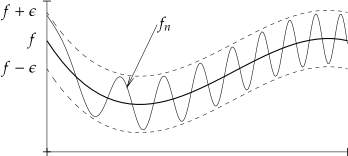
The sequence \(\{ f_n \}_{n=1}^\infty\) converges pointwise to \(f\text{.}\) To show that the convergence is uniform, let \(\epsilon > 0\) be given. Find an \(N\) such that for all \(m, k \geq N\text{,}\) we have \(\snorm{f_m-f_k}_S < \nicefrac{\epsilon}{2}\text{.}\) In other words, for all \(x\text{,}\) we have \(\babs{f_m(x)-f_k(x)} < \nicefrac{\epsilon}{2}\text{.}\) For any fixed \(x\text{,}\) take the limit as \(k\) goes to infinity. Then \(\babs{f_m(x)-f_k(x)}\) goes to \(\babs{f_m(x)-f(x)}\text{.}\) Consequently for all \(x\text{,}\)
\begin{equation}
\babs{f_m(x)-f(x)} \leq \nicefrac{\epsilon}{2} < \epsilon .
\end{equation}
Hence, \(\{ f_n \}_{n=1}^\infty\) converges uniformly.
Next, we prove the other direction. Suppose \(\{ f_n \}_{n=1}^\infty\) converges uniformly to \(f\text{.}\) Given \(\epsilon > 0\text{,}\) find \(N\) such that for all \(n \geq N\text{,}\) we have \(\babs{f_n(x)-f(x)} < \nicefrac{\epsilon}{4}\) for all \(x \in S\text{.}\) Therefore, for all \(m, k \geq N\) and all \(x\text{,}\)
\begin{multline*}
\babs{f_m(x)-f_k(x)} =
\babs{f_m(x)-f(x)+f(x)-f_k(x)}
\\
\leq
\babs{f_m(x)-f(x)}+\babs{f(x)-f_k(x)} < \nicefrac{\epsilon}{4} +
\nicefrac{\epsilon}{4} = \nicefrac{\epsilon}{2} .
\end{multline*}
Take the supremum over all \(x\) to obtain
\begin{equation}
\snorm{f_m-f_k}_S \leq \nicefrac{\epsilon}{2} < \epsilon . \qedhere
\end{equation}