Proof.
To prove existence, we define a candidate and show it satisfies all the properties. Let
\begin{equation}
L(x) \coloneqq \int_1^x \frac{1}{t}\,dt .
\end{equation}
Obviously,
i holds. Property
ii holds via the second form of the fundamental theorem of calculus (
Theorem 5.3.3).
To prove property
iv, we change variables
\(u=yt\) to obtain
\begin{equation}
L(x) =
\int_1^{x} \frac{1}{t}\,dt
=
\int_y^{xy} \frac{1}{u}\,du
=
\int_1^{xy} \frac{1}{u}\,du
-
\int_1^{y} \frac{1}{u}\,du
=
L(xy)-L(y) .
\end{equation}
Let us prove
iii. Property
ii together with the fact that
\(L'(x) = \nicefrac{1}{x} > 0\) for
\(x > 0\text{,}\) implies that
\(L\) is strictly increasing and hence one-to-one. Let us show
\(L\) is onto. As
\(\nicefrac{1}{t} \geq \nicefrac{1}{2}\) when
\(t \in [1,2]\text{,}\)
\begin{equation}
L(2) = \int_1^2 \frac{1}{t} \,dt \geq \nicefrac{1}{2} .
\end{equation}
By induction,
iv implies that for
\(n \in \N\text{,}\)
\begin{equation}
L(2^n) = L(2) + L(2) + \cdots + L(2) = n L(2) .
\end{equation}
Given
\(y > 0\text{,}\) by the
Archimedean property of the real numbers (notice
\(L(2) > 0\)), there is an
\(n \in \N\) such that
\(L(2^n) > y\text{.}\) The
intermediate value theorem gives an
\(x_1 \in (1,2^n)\) such that
\(L(x_1) = y\text{.}\) Thus
\((0,\infty)\) is in the image of
\(L\text{.}\) As
\(L\) is increasing,
\(L(x) > y\) for all
\(x > 2^n\text{,}\) and so
\begin{equation}
\lim_{x\to\infty} L(x) = \infty .
\end{equation}
Next \(0 = L(\nicefrac{x}{x}) = L(x) + L(\nicefrac{1}{x})\text{,}\) and so \(L(x) = - L(\nicefrac{1}{x})\text{.}\) Using \(x=2^{-n}\text{,}\) we obtain as above that \(L\) achieves all negative numbers. And
\begin{equation}
\lim_{x \to 0} L(x) =
\lim_{x \to 0} -L(\nicefrac{1}{x})
=
\lim_{x \to \infty} -L(x)
= - \infty .
\end{equation}
In the limits, note that only \(x > 0\) are in the domain of \(L\text{.}\)
Let us prove
v. Fix
\(x > 0\text{.}\) As above,
iv implies
\(L(x^n) = n L(x)\) for all
\(n \in \N\text{.}\) We already found that
\(L(x) = - L(\nicefrac{1}{x})\text{,}\) so
\(L(x^{-n}) = - L(x^n) = -n L(x)\text{.}\) Then for
\(m \in \N\)
\begin{equation}
L(x) = L\Bigl({(x^{1/m})}^m\Bigr) = m L\bigl(x^{1/m}\bigr) .
\end{equation}
Putting everything together for \(n \in \Z\) and \(m \in \N\text{,}\) we have \(L(x^{n/m}) = n L(x^{1/m}) = (\nicefrac{n}{m}) L(x)\text{.}\)
Uniqueness follows using properties
i and
ii. Via the first form of the fundamental theorem of calculus (
Theorem 5.3.1),
\begin{equation}
L(x) = \int_1^x \frac{1}{t}\,dt
\end{equation}
is the unique function such that \(L(1) = 0\) and \(L'(x) = \nicefrac{1}{x}\text{.}\)
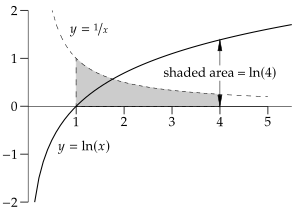
Having proved that there is a unique function with these properties, we simply define the logarithm, sometimes called the natural logarithm:
\begin{equation}
\ln(x) \coloneqq L(x) .
\end{equation}
See
Figure 5.6. Mathematicians usually write
\(\log(x)\) instead of
\(\ln(x)\text{,}\) which is more familiar to calculus students. For all practical purposes, there is only one logarithm: the natural logarithm. See
Exercise 5.4.2.