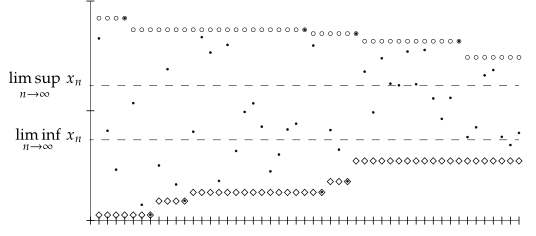
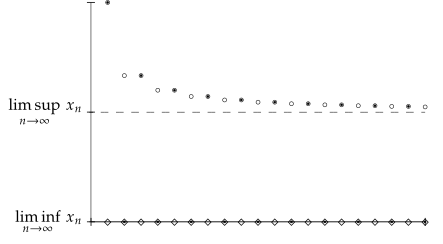
Let \(\{ x_n \}_{n=1}^\infty\) be defined by
\begin{equation}
x_n \coloneqq
\begin{cases}
\frac{n+1}{n} & \text{if } n \text{ is odd,} \\
0 & \text{if } n \text{ is even.}
\end{cases}
\end{equation}
Let us compute the
\(\liminf\) and
\(\limsup\) of this sequence. See also
Figure 2.6. First the limit inferior:
\begin{equation}
\liminf_{n\to\infty} x_n =
\lim_{n\to\infty}
\bigl(
\inf \{ x_k : k \geq n \}
\bigr)
=
\lim_{n\to\infty} 0 = 0 .
\end{equation}
For the limit superior, we write
\begin{equation}
\limsup_{n\to\infty} x_n =
\lim_{n\to\infty}
\bigl(
\sup \{ x_k : k \geq n \}
\bigr) .
\end{equation}
It is not hard to see that
\begin{equation}
\sup \{ x_k : k \geq n \} =
\begin{cases}
\frac{n+1}{n} & \text{if } n \text{ is odd,} \\
\frac{n+2}{n+1} & \text{if } n \text{ is even.}
\end{cases}
\end{equation}
We leave it to the reader to show that the limit is 1. That is,
\begin{equation}
\limsup_{n\to\infty} x_n = 1 .
\end{equation}
Do note that the sequence \(\{ x_n \}_{n=1}^\infty\) is not a convergent sequence.