Transport along a scaling action
Its proofs are relative to the explicit sheaf-theoretic imports below; it does not close those imports or the Microlocal Sheaves course. The consulted antecedents are Kashiwara and Schapira, Microlocal Study of Sheaves, Astérisque 128 (1985), §2.1.1, printed p. 39, and Pierre Schapira, An Introduction to Sheaves on Grothendieck Topologies, version dated 1 August 2026, Definition 5.4.4 and Exercise 5.13, pp. 114 and 120. Their conic objects use positive rays in a real vector bundle. This unit also treats arbitrary continuous positive-real actions, so it proves the required transport and topology statements below instead of importing them from that vector-bundle setting. The final section compares the actual source hypotheses and proof mechanisms. No constructibility or finite-generation condition is imposed.
SH02-CON-CONTRACT — Objects, degree conventions, and imports
Fix a commutative ring of finite global dimension . All spaces called locally compact are Hausdorff. Write for complexes of sheaves of -modules with cohomology bounded below. Bounds need not be zero and stalk modules need not be finitely generated. A shift satisfies . In particular a module in cohomological degree one is written . Tensor products and internal Hom below are derived over the constant sheaf of rings, unless specified otherwise.
The action group is under multiplication. Its orientation is the increasing coordinate . An action is a continuous map with and . The action is not required to be free, proper, effective, or a vector-space action. Set
Here are the exact prerequisite results used. Their proof routes are identified below; the exceptional-operation and orientation contracts retain their separately stated scopes.
SH02-IMPORT-INTERVAL — Interval cohomology (SH-01 import contract)
A locally constant sheaf on an interval is constant; its ordinary cohomology in positive degrees vanishes. Evaluation at any point identifies its sections with its stalk. These statements hold for arbitrary -modules. They also give the analogous evaluation statement for a bounded-below complex with locally constant cohomology, by the hypercohomology spectral sequence. The interval-constancy and evaluation proof establishes all these statements for arbitrary module coefficients, including open, closed, half-open and unbounded intervals. Its complex comparison is the actual section-to-germ map, using the bounded-below hypercohomology proof and its canonical edge, not an unspecified isomorphism.
SH02-IMPORT-CONTINUITY — Closed-exhaustion continuity (SH-01 import contract)
Stalks and filtered colimits of -modules are exact. For a closed exhaustion of a space , the usual sheaf-cohomology continuity theorem and its Mittag-Leffler criterion apply. In particular, if the restriction maps are isomorphisms for every and , then is an isomorphism. The same assertion is available after restriction to an open subset of a parameter space. The geometric derived-limit comparison and its degree-specific Milnor obstruction are proved in the closed-exhaustion comparison and its tower, Milnor and Mittag–Leffler proofs, specifically SH02-EXH-COMPARISON, SH02-EXH-MILNOR and SH02-EXH-STRIPS. That proof includes the noncompact strips used below.
SH02-IMPORT-DERIVED-SHEAVES — Derived sheaf operations (SH-01 import contract)
Exact inverse image, derived direct image, adjunction, derived sections, localization triangles, stalk detection of quasi-isomorphisms, and the bounded-below hypercohomology spectral sequence. Proper base change for is part of this import; ordinary base change is used below only when the relevant map is proper or when a separate proof is supplied. For the proper closed-strip projections in SH02-CON-CYLINDER, the proper-fibre and section-restriction proof supplies the exact ordinary direct-image comparison on locally compact Hausdorff spaces, for arbitrary module coefficients and bounded-below complexes. This does not assert ordinary base change for a general nonproper map.
SH02-IMPORT-SIX-FUNCTORS — Exceptional operations contract
If has finite cohomological dimension, on , with its units and counits, composition, projection formula, and
In these formulas the first internal-Hom argument is bounded above and the second is bounded below. All instances below meet these bounds. For an oriented topological submersion of relative dimension , . An oriented open interval has , and integration identifies with the identity in this identification. These assertions include the trace’s compatibility with proper base change.
The submersion comparison, SH02-MD-SUBMERSION, proves the oriented-submersion assertion for every bounded-below input on locally compact Hausdorff bases. Its product-chart argument checks the actual tensor comparison, not only the underlying objects. The compact-support generator, SH02-MD-EUCLIDEAN, and normalized trace and submersion base change, SH02-MD-TRACE, prove the interval calculation and its sign. They use the cylinder theorem above only at SH02-CON-CYLINDER, whose proof uses neither orientation nor exceptional inverse image.
For internal duality with a bounded first input and a bounded-below second input, SH02-EX-INTERNAL supplies the proof; that scope suffices for SH02-CON-INTERVAL-FIBRES. The opposite-bounded-range proof, (EXA.1)–(EXA.9), supplies the full bounded-above first-input contract displayed above under the same uniform proper-support dimension hypothesis. It uses the finite relative-soft model, the exact unbounded acyclic-model theorem and an explicit coefficient exchange, rather than assuming that a bounded-above/bounded-below tensor is bounded below.
SH02-IMPORT-PROPER-SUPPORTS — Proper-support sections contract
For a map of locally compact spaces, the stalks of can be computed by the filtered system of , where runs through neighbourhoods of the base point and is closed and proper over . For a closed embedding , , compatibly with inclusions of closed supports.
These are hypotheses on the available sheaf formalism, not additional geometric assumptions such as compactness of or constructibility of . Finite global dimension is a fixed convention of this unit; no noetherian assumption is added. Results about actual manifolds use finite dimension and countability at infinity, but the action and vector-bundle results below require only the stated locally compact spaces.
SH02-CON-CYLINDER — Descent across a contractible parameter
Lemma. Let be locally compact and let . For , assume every restricts to a locally constant sheaf on every fibre of . With , the evaluation and counit morphisms
are isomorphisms. Consequently is fully faithful; its essential image consists exactly of those with fibrewise locally constant cohomology. Restriction by is an inverse on that image.
Proof. Put , restrict to , and denote the proper projection by . It is proper because the inverse image of a compact is , which is compact; the spaces are Hausdorff. The proper-fibre comparison with its actual restriction map identifies the stalk at of with . In the spectral sequence for these sections the terms in positive sheaf cohomology degree vanish by SH02-IMPORT-INTERVAL. The remaining terms are the stalks at of . The spectral sequence is convergent because is bounded below, by HC1a–HC2. The interval evaluation theorem identifies this calculation with evaluation and proves that
is a quasi-isomorphism. For the restriction morphism between these direct images commutes with evaluation, so it too is an isomorphism.
For every open , this gives compatible isomorphisms
The closed strips exhaust , each lying in the interior of the next. The transition maps on cohomology are isomorphisms, so SH02-IMPORT-CONTINUITY shows that evaluation is an isomorphism for every . This is the asserted isomorphism .
For the counit, fix and choose . Its restriction to the strip fits into the adjunction diagram with the counit for . On the stalk at , the latter is evaluation from to . The same spectral sequence calculation, now evaluated at , makes this an isomorphism. The map was already shown to be an isomorphism. Thus the counit is an isomorphism on every stalk.
For its cohomology is constant along fibres, and the unit is inverse to evaluation: the composite is the identity by the adjunction identity. Hence this unit is an isomorphism. Adjunction now gives
This proves full faithfulness and the remaining assertions. The same proof works after replacing by through . Iterating it gives full faithfulness for for every finite . No finite-generation or upper-boundedness assertion was used.
SH02-CON-DEFINITION — Which orbit topology is meant?
For a subset , restriction in this unit means , where the subset has its induced topology. For a general action this must be distinguished from pullback along an orbit parameter. The distinction is invisible for an ordinary nonzero vector-bundle ray, whose induced and homogeneous-space topologies agree. Thus the raywise definitions in Astérisque 128, §2.1.1, and Schapira’s Definition 5.4.4 do not decide which definition to use for a dense orbit of a general action. We specify both and compare them directly.
For , let be its orbit with the topology induced from , and write and , , for the inclusion and the orbit map. The induced-orbit sheaf category is the full subcategory
Write for the full subcategory of whose cohomology sheaves belong to this category. These are definitions; they do not identify induced-orbit conicity with parameter conicity, or require to be locally compact.
In this unit, conic means parameter-conic: is conic if is locally constant on for every and . Write for this full subcategory. For an ordinary sheaf , the corresponding condition is local constancy of every .
Equivalently, one can restrict to each orbit with its homogeneous-space topology. Here is the topology check, including nonembedded orbits. The stabilizer is closed because is Hausdorff. Under , a closed subgroup of is either , for some , or . Indeed, if positive subgroup elements have infimum zero their integer multiples approximate every real number and closedness gives the whole line. Otherwise the positive infimum belongs to the closed subgroup, and division with remainder shows that it generates the subgroup. The remaining subgroup has no nonzero elements.
Thus is a line, a circle, or a point. Except for the point case the quotient map has local sections and is a local homeomorphism. A sheaf on the homogeneous orbit is locally constant if and only if its pullback to is: one direction is functorial pullback, and the other follows by pulling back along a local section and using a neighbourhood on which the pulled-back sheaf is constant. In the point case both statements hold for every module. Inverse image is exact, so this applies separately to every cohomology sheaf.
Here pullback from a homogeneous orbit means pullback along the continuous map induced by , with given its quotient topology. That map need not be an embedding, so its quotient topology cannot be silently replaced by the induced topology. The next example proves that can be strict, while the homogeneous and parameter conditions are equivalent as just proved.
SH02-CON-EXAMPLE-DENSE-ORBIT — A topology distinction detected by supports
Take , choose an irrational real number , and put
Use the continuous action
The map is injective: would give and , forcing . Its image is one orbit. It is dense. To see this, the closure of the subgroup contains and . By the closed-subgroup classification above, a proper such closure would be , making a ratio of integers. Thus this subgroup is dense, so the fractional parts of are dense in the circle. At each fixed first coordinate, adding to the parameter therefore gives a dense set of second coordinates. This proves density in . The nonconstancy argument below only needs the recurrence that we will also prove explicitly.
Let
Here is the direct image with proper supports for a continuous map between locally compact Hausdorff spaces. It does not require to be a locally closed embedding. Concretely, consists of locally constant integer-valued sections on whose closed support is proper over . Proper base change identifies the stalk of at with compactly supported cohomology of . That fibre is one point for and empty otherwise. Thus is concentrated in degree zero, equals , and has stalk on and zero off . The same fibre calculation for arbitrary sheaves on shows that has cohomological dimension zero.
For use the additive orbit parameter . If , the fibre product of and is the graph , with its usual graph topology. Projection to is a homeomorphism. If , the fibre product is empty. Proper base change for these squares gives the sheaf isomorphisms
These are isomorphisms of sheaves, not merely identifications of stalk groups. Hence is conic according to SH02-CON-DEFINITION.
We now show that is not locally constant when carries its topology as a subset of . Fix and a section over an ambient open neighbourhood of . Choose a compact neighbourhood of . If is the closed support of the section defining , properness makes compact in , hence bounded. Consequently there is such that the germ of at every with is zero.
There are positive integers such that the distance of to tends to zero. Indeed, subdividing into equal intervals and comparing the fractional parts of gives an integer with distance at most . Such integers cannot stay in a finite set as the distance tends to zero, since is irrational. Passing to an unbounded subsequence proves the assertion. Therefore
For all sufficiently large , these points lie in the interior of and their germs of vanish. Every ambient section with nonzero germ at consequently has zero germs at points of arbitrarily near .
If were locally constant near , a local trivialization and the nonzero element would provide a section with nonzero germ everywhere on some relative neighbourhood of . By the definition of inverse image to a subspace, that section is represented, after a further relative shrink around , by an ambient section of . The recurrent zero germs just proved give a contradiction.
Thus conicity along parameter maps, equivalently along homogeneous-space orbits, does not imply local constancy on an orbit with its induced subspace topology. Local constancy for the induced topology does imply the parameter condition, since the parameter map to that subspace is continuous and inverse image preserves locally constant sheaves. The implication is therefore strict. In particular, an equivalence formulated using parameter pullbacks cannot simply replace that condition by local constancy on induced-subspace orbits. This independently proved topology obstruction is distinct from the periodic-action failure in SH02-CON-RESTRICTION.
The topology distinction in pictures. Specialize the example to . The first figure shows the orbit on a standard embedded torus; the second separates long parameter travel from small return distance and shows why proper supports obstruct an induced-orbit trivialization.
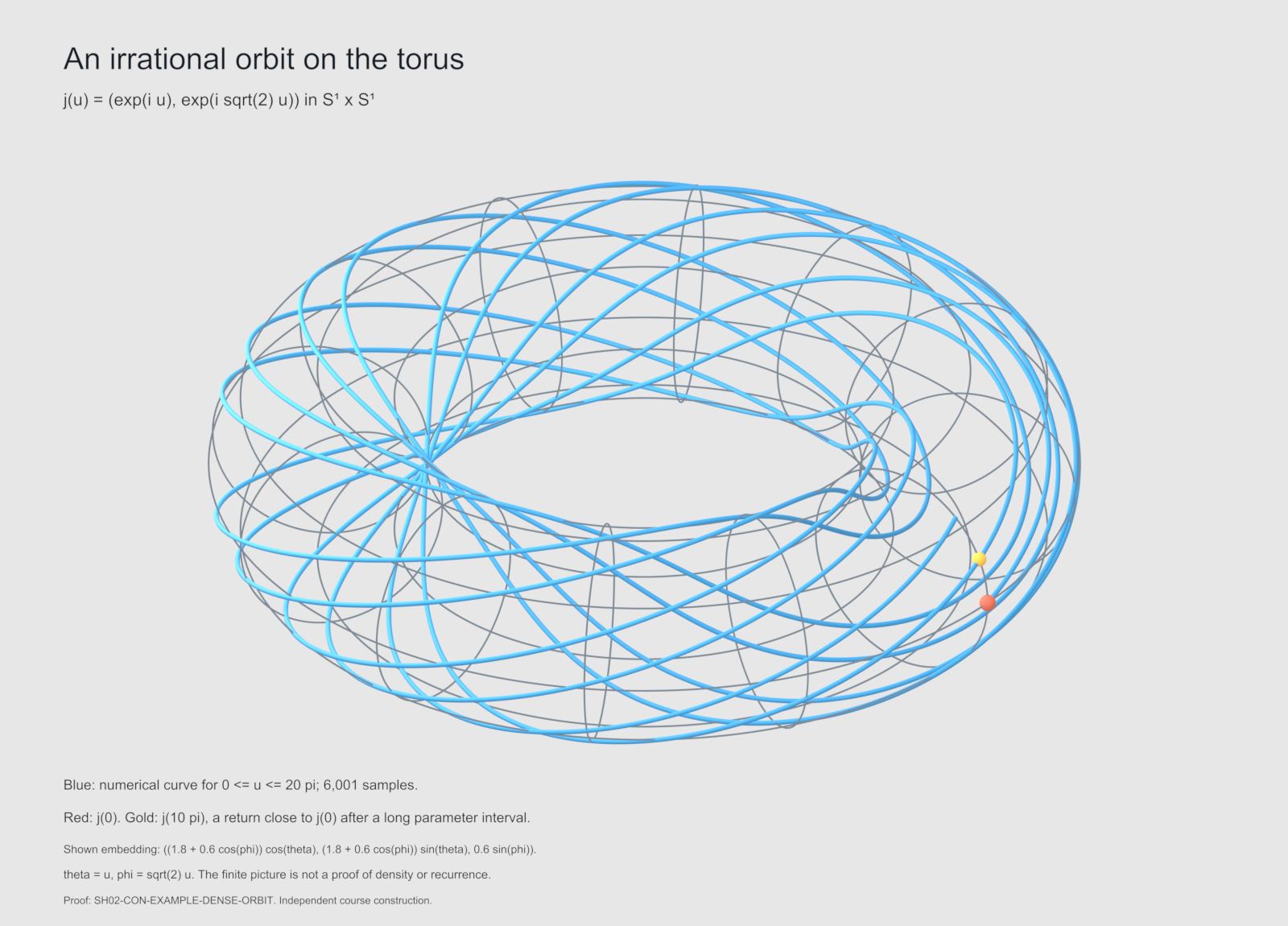
The blue curve samples for at 6,001 parameter values. It is shown through the embedding , with and . The red point is and the gold point is ; the latter has second-circle angle modulo . The gray grid describes the ambient torus and is not sheaf support. Curve thickness is only a drawing aid.
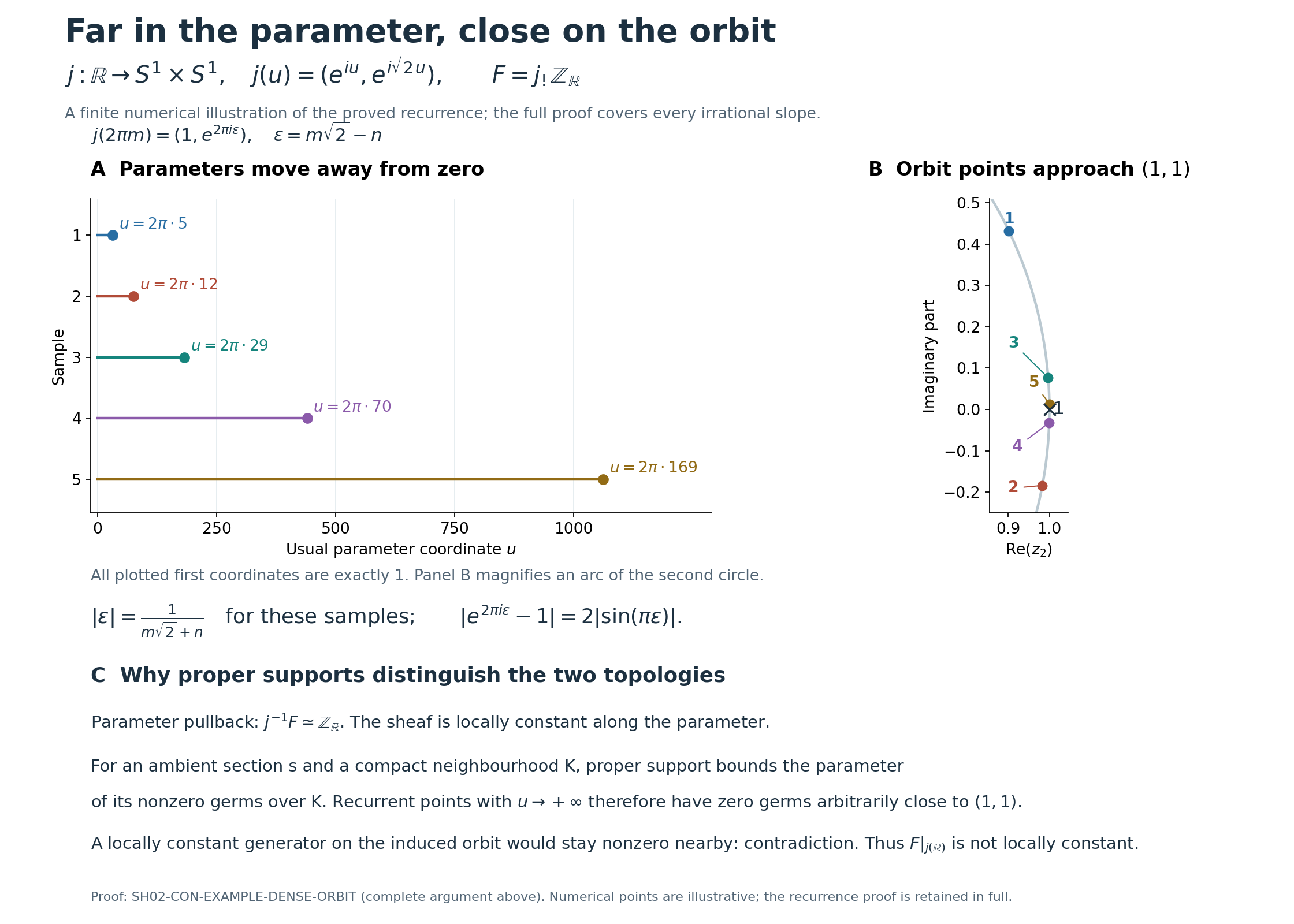
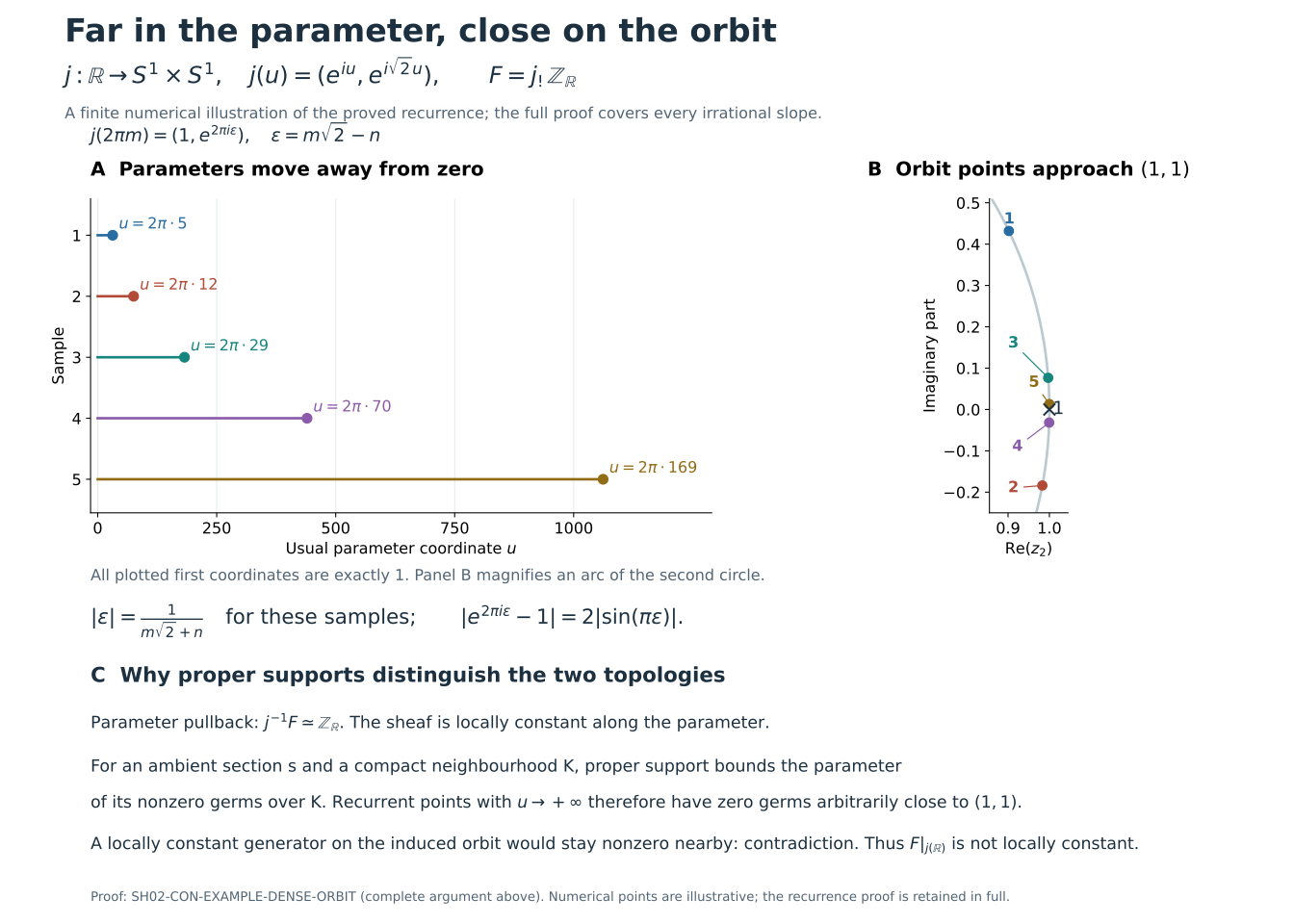
For the displayed pairs , put and . The first circle coordinate of is exactly . The right panel magnifies the second circle; its labelled distance is the Euclidean chord , not an intrinsic metric on the orbit. The lower panel depicts the proof above: properness of a section’s support over a compact neighbourhood bounds the parameters of its nonzero germs, while recurrence supplies arbitrarily large parameters whose images return near the basepoint. Those returning germs must vanish. No numerical bound for an arbitrary section is asserted.
These are finite illustrations of SH02-CON-EXAMPLE-DENSE-ORBIT. The full density, recurrence and sheaf arguments remain above. The proper-support definition used in that proof is compared with Schapira’s Definition 4.2.2 and Remark 4.2.5, pp. 85–86: compactness over each compact subset of the target bounds the returning parameters of any one section’s support. The dense-orbit example and its drawings are independently authored course material illustrating the mathematical distinction proved here. A vector copy of the return and support panels preserves the exact labels.
SH02-CON-COMPARISON — Canonical transport and its normalization
For any let . Define
by applying to the unit and using . There are two specified maps
where is the counit for . These definitions specify the maps, not just their source and target objects.
Theorem. The following conditions on are equivalent:
- is conic.
- Every is locally constant on every fibre of .
- Both and are isomorphisms.
- There exists an isomorphism in .
- There exists an isomorphism .
When these conditions hold, there is a canonical transport isomorphism
It is natural in and its restriction along is the identity.
Proof. Since inverse image is exact, restriction of to is exactly . This proves the equivalence of the first two conditions. Under the second condition SH02-CON-CYLINDER applies to : its evaluation is and its counit is . Both are isomorphisms, hence so is . The third condition gives the fourth by the displayed definition of . Conversely, any isomorphism in the fourth condition identifies the cohomology of , on each -fibre, with the constant cohomology of , giving condition two.
For condition five, the homeomorphism
has inverse , and . Thus both and are topological submersions of relative dimension one. Orient their fibres by the coordinate ; preserves that coordinate. The submersion identity gives and . Shifting by proves the equivalence with condition four, without an orientation sign change.
Finally, restriction of the counit by is precisely . The same is true of , by . Their quotient is the identity. Every construction used a unit, counit, or its inverse naturally, proving naturality.
The precise reach of the transport tests. Let mean induced-orbit conicity, parameter conicity, and homogeneous-orbit conicity. The existing topology comparison and the theorem give, under exactly the hypotheses of SH02-CON-CONTRACT,
To make the logical issue explicit, consider a proposed three-condition criterion labelled (i) induced-orbit conicity, (ii) invertibility of the comparison maps, and (iii) fibrewise local constancy. Conditions (ii) and (iii) are conditions three and two above. With condition (i) read as , none of the four transport tests implies in the stated generality. The same sheaf in SH02-CON-EXAMPLE-DENSE-ORBIT satisfies all four tests and fails .
The fibre-pullback identity in the first sentence of our proof is valid for every and proves . Together with it proves the forward implication (i)(iii) in that proposed criterion, but not the false converse (iii)(i). Thus the theorem supplies the full parameter/homogeneous equivalence and all valid induced-orbit implications, without adding an embedded-orbit hypothesis. These are independently proved implications between the definitions in this unit; they make no claim about the wording or intended meaning of an unconsulted source.
Corollary. is closed under shifts, cones of morphisms between its objects, and cohomological truncations.
Proof. Truncations and shifts preserve the defining orbital-pullback condition. For cones, use the natural transformations and : their source and target functors are triangulated. In the comparison of the two distinguished triangles, isomorphisms at the first two vertices force an isomorphism at the third. SH02-CON-COMPARISON applies to the cone.
SH02-CON-COCYCLE — What the canonical transport actually proves
Proposition. is the unique isomorphism whose restriction at is the identity. On it satisfies
Here the formula denotes equality of the corresponding pullback morphisms in the derived category, not a formula between chosen complexes of stalks.
Proof. For any other normalized isomorphism , the composite is an automorphism of . Full faithfulness in SH02-CON-CYLINDER says it is the pullback of one automorphism of ; applying identifies that automorphism with the identity. This proves uniqueness.
For the second assertion, the two sides are maps from to , where and . The left side is an isomorphism, and both sides restrict to the identity at . Compose the right side with the inverse of the left side. The result is an endomorphism of . Full faithfulness for and restriction at make it the identity. This is the required equality.
This proves normalized action data and its cocycle equality in the ordinary derived category. It makes no claim about a chosen dg or infinity-categorical equivariant enhancement or about higher coherences. Those are different constructions and have not been imported by the mere existence of an isomorphism in condition four.
SH02-CON-INTERVAL-FIBRES — An open-submersion calculation
Lemma. Let be locally compact Hausdorff, let be an open subset of , and let be the projection. Suppose each fibre is a nonempty interval. For every the unit is an isomorphism.
Proof. The map is an oriented topological submersion of relative dimension one and has finite cohomological dimension for proper direct image. Its relative dualizing object is . Consider the trace
By proper base change its stalk at is the integration morphism . A nonempty open interval, bounded or unbounded, is orientation-preservingly homeomorphic to , so this is an isomorphism by the positive-interval trace normalization and submersion base-change identity. Stalk detection proves that the trace is an isomorphism.
The submersion formula and the bounded-first-input internal duality proof identify
The first identity cancels the common shift in the two internal-Hom arguments; is the tensor unit, so it needs no stalk-finiteness assumption. Under the second identity, precomposition with the trace is the unit : this is the tensor-Hom adjunction identity for the counit . Thus the displayed isomorphism proves the assertion for the specified unit.
Here is the map check with its tensor order explicit. Write for the counit, and let be the submersion tensor isomorphism, with the relative dualizing factor first. Its defining trace identity, (EX.24), identifies the composite
with , followed by .
To see the unit explicitly, put and let be the curry of . The submersion formula makes an isomorphism. Write and for the ordinary unit and counit. The map in question, after internal duality, is
Uncurry using the evaluated construction (EX.22). Naturality of the ordinary counit and its triangle identity give
Evaluation of is , so this uncurry is precisely the displayed projection–tensor–trace composite. Currying the equal composite is exactly precomposition with the trace. Thus the identity concerns the original unit, with the signs fixed by the same tensor order. Here is bounded, so the bounded-first-input internal-Hom proof, (EX.20)–(EX.22), applies with the arbitrary bounded-below second input ; no unbounded internal-Hom extension is used.
This proof uses proper base change for ; it never invokes unrestricted nonproper base change for .
SH02-CON-RESTRICTION — Restricting sections without losing a winding
For an open and define the open subset of the parameter group
Theorem. Suppose is a nonempty interval in the coordinate for every . For conic the restriction map
is an isomorphism.
Proof. Let be the restricted action. The change of coordinates used above identifies this map with the projection from
to . This is open because is open and the inverse action is continuous. Its fibre at is . SH02-CON-INTERVAL-FIBRES therefore makes the unit an isomorphism.
Restrict to . It identifies with , where . The cylinder lemma and composition of direct images give isomorphisms
The first map is pullback along and the last is evaluation along . Since is the identity along that section, the composite is exactly pullback along , that is, restriction. Hence it is the required isomorphism.
Why the parameter fibre matters. A contractible intersection of an open set with the image of an orbit does not suffice for a general action. Take , , and
There is one orbit, its intersection with is a nonempty contractible open arc, and is conic. Nevertheless
For completeness, cover the circle by two contractible arcs whose intersection has two contractible components. Their constant-sheaf Cech complex has in degrees zero and one, with differential, after compatible trivializations, . Its kernel and cokernel are both ; interval acyclicity makes this Cech computation valid. The arc is acyclic by SH02-IMPORT-INTERVAL. Thus the restriction in degree one is the zero map from a nonzero group.
In this example is a disjoint union of infinitely many open intervals, rather than one interval. The same computation works with any nonzero allowed coefficient ring. An orbit-image version of the criterion is therefore false as a statement for arbitrary positive-real actions. SH02-CON-RESTRICTION states and proves a sufficient condition on the actual parameter fibres. The counterexample is retained with its complete cohomology calculation; no correspondence with an unconsulted source or errata entry is needed for the conclusion. For vector-bundle scaling the parameter fibres required below really are intervals.
SH02-CON-RADIAL-STAR — Ordinary contraction to the zero section
Let be a real vector bundle of finite rank over a locally compact space. Give the action , and let be its zero section. No orientation of or is chosen. For define
by restricting the counit to .
Theorem. is an isomorphism.
Proof. This can be checked on stalks at . Trivialize the bundle over an open neighbourhood of and use a Euclidean norm on that trivialization. For an open in the trivializing neighbourhood and , set . For with , the parameter fibre in the restriction theorem is
For it is all of . Thus SH02-CON-RESTRICTION gives
as an isomorphism. These are actual restrictions, so the isomorphisms are compatible as and shrink. The sets form a neighbourhood basis of : in a product topology, every neighbourhood of contains such a product.
For each degree , taking filtered colimits yields
Exactness of filtered colimits justifies passage to cohomology. The map in this display is induced by restriction to germs, hence is . It is an isomorphism for every and .
The proof is local on the base and therefore needs neither a global bundle metric nor a paracompactness assumption on . It also explains why a nonproper map is allowed: no properness of was invoked.
SH02-CON-RADIAL-SUPPORT — Proper-support contraction
Define a natural morphism in the other direction by the closed-embedding counit:
Here is proper and . The rank of is finite, so has finite cohomological dimension and all displayed functors are defined on .
Theorem. For every , is an isomorphism.
Proof. First assume and work in a local trivialization over . Write
On the invariant open space , take the open subset . Every point of the former has , and its parameter fibre for the latter is . It is a nonempty interval. SH02-CON-RESTRICTION therefore shows that
is an isomorphism. Compare the two localization triangles
The vertical maps are inclusion of supports, the identity, and restriction. The last two are isomorphisms, hence so is
It remains to check the support limit, since fibre compactness alone is not global properness. Each is proper. Conversely, take a closed support proper over , and fix . Choose a smaller neighbourhood of whose closure is compact and contained in ; local compactness and the Hausdorff condition provide it. Properness makes compact. The norm in the trivialization is bounded on this compact set, so after choosing we have . Thus closed disk supports are cofinal in the system of proper supports after passage to the stalk at .
By SH02-IMPORT-PROPER-SUPPORTS and this cofinality,
The first equality also uses . The compatible isomorphisms (SH02-CON-DISK-SUPPORT) identify these two colimits. Their map is inclusion of zero-section support into proper support, hence is exactly . This proves the theorem.
If , then and . Both and are the identity. This also avoids inserting a fictitious sphere or punctured fibre into the argument. If , all objects and maps are zero and both assertions hold.
There is no orientation twist or shift in either contraction comparison. Orientation and shifts enter only when the resulting stalk or costalk is subsequently computed. The proof of proper-support contraction did not use Verdier double-dual reflexivity, which would require unjustified finiteness hypotheses for the objects allowed here.
SH02-CON-FUNCTORS — Transport through sheaf operations
Let be a continuous equivariant map of locally compact -spaces. In this section assume has finite cohomological dimension, so that is available in the stated formalism. Set . Its proper direct image has the same finite cohomological-dimension bound, by proper base change on the identical fibres.
Theorem. If and , then
If , their derived tensor product is conic. If in addition , then is conic and belongs to . Since was already bounded below, this last hypothesis makes bounded; it does not say that it is perfect or has finite-rank stalks.
Proof. We check each comparison and its required base change.
For inverse image, equivariance and give
The middle map is transport for , with its direction inverted as needed. SH02-CON-COMPARISON proves conicity.
For extraordinary inverse image, functoriality of for the two commuting composites gives
The middle isomorphism is the shift of transport by . The orientations used for all use , preserved by . Hence their relative shifts agree and no minus sign is introduced. The extraordinary version of SH02-CON-COMPARISON applies.
For proper direct image, both squares with horizontal maps and with horizontal maps are Cartesian. For the action square this deserves verification: given and with , the unique preimage is , because equivariance gives . Proper base change therefore supplies
Here need not be proper: base change is for , whose supports are already proper over the target.
For ordinary direct image we justify the product base-change map instead of applying nonproper base change indiscriminately. The canonical map
is an isomorphism on stalks. Indeed, rectangles with an open interval form a neighbourhood basis at . The right-hand stalk is the filtered colimit of , which the cylinder lemma identifies naturally with , with the canonical pullback map providing that identification. Their colimit is , the left-hand stalk. The same holds for the action square by applying the homeomorphisms ; equivariance gives . Thus
and conicity follows. The rectangle argument is valid for bounded-below complexes because inverse image and stalk formation are exact and the cylinder lemma was proved in .
For tensor products, exact inverse image commutes with derived tensor, and therefore
If the two lower cohomological bounds are , finite global dimension gives lower bound for their derived tensor product. Thus it really is an object of , as required by the conicity criterion.
For internal Hom, put . If has upper bound and lower bound , derived Hom has lower bound . The extraordinary inverse-image/internal-Hom comparison, (EXA.2), gives
This proves conicity by the extraordinary comparison criterion. It does not assume that arbitrary inverse image commutes with internal Hom, an identity which would require additional justification.
All comparisons in this proof are composites of specified units, counits, base-change maps, functor-composition maps, and . Their restrictions at are identities by the adjunction and base-change identities. Hence they give the canonical transport on the resulting conic object by SH02-CON-COCYCLE. In particular this compatibility statement is independent of a chosen isomorphism witnessing condition four.
External products. If and , put . It is invariant under the two scaling parameters independently: pullback by is identified with pullback by the projection using the two transport isomorphisms and tensor. Thus its cohomology is locally constant along each parametrized -orbit. This is what biconic means here. Pulling this isomorphism back along proves conicity for the diagonal action. Finite global dimension gives the same lower bound as for tensor, so the external product remains in .
SH02-CON-EXAMPLE — A large angular family with zero ordinary sections
Let and let be the open embedding. Define
and let . For an arbitrary set . The angular data need not be locally constant, constructible, or of finite rank.
The action on is trivial. Every object there is conic, because each parametrized orbit is a constant map. Both and are equivariant; the fibres of are one-dimensional and is exact, so the functor theorem proves that is conic. Since extension by zero has zero stalks along the complement of its open domain, . Ordinary contraction therefore gives
Polar coordinates identify with projection from , with radial orientation . The projection formula and interval integration give . Composition of proper direct images, and properness of , now give
This displays a conic sheaf whose ordinary direct image vanishes while its proper direct image can be large. It also tests the direction of both contraction maps: the ordinary one reads a stalk, while the proper one reads a costalk.
For a concrete non-finite module, take to be a point, , and with . The two-arc Cech complex used above is now . Splitting its source into diagonal and difference coordinates and its target into diagonal and a complementary coordinate gives one copy of in degree zero, one in degree one, and a contractible identity summand. Consequently
Every use of interval acyclicity in this calculation applies to this arbitrary module. No finite-rank substitute was made.
SH02-CON-EXERCISE-MONODROMY — Transport after one period
Exercise. Give the action . Let be any -module and let be an automorphism. Let be the locally constant sheaf whose positive monodromy is . Compute its cohomology and the restriction to . Determine the canonical action transport at after identifying the fibre at one chosen point with .
Solution. Trivialize on two arcs as in the circle calculation, using one intersection component to identify the trivializations and the other to record . The Cech differential is, with one choice of ordering,
Subtract the first target coordinate from the second, and write the source in coordinates . The differential becomes . The identity map on the coordinate is a contractible summand, leaving the two-term complex in degrees zero and one. All intersections are acyclic for a locally constant sheaf by the interval import, so this complex computes derived sections. Hence
The restriction to is constant with fibre . In degree zero the map is evaluation of invariant sections, namely ; in degree one it maps to zero. Thus this restriction need not be an isomorphism even though meets the orbit in a contractible arc.
On the parametrized orbit , increasing traces the positive path. Local-system transport along that path defines a map restricting to the identity at . By SH02-CON-COCYCLE it equals . After one period its value is therefore , although the underlying homeomorphism of at that parameter is the identity. A periodic point is not a reason to force the action transport to be the identity.
SH02-CON-EXERCISE-BOUNDARY — Zero rank and a trivial action
Exercise. Check the comparison maps for a trivial action and for a rank-zero bundle. Explain why a radial shift must not be inserted into either contraction theorem.
Solution. For a trivial action , and for every . The unit and evaluation are inverse by the cylinder lemma. The counit and evaluation in the definition of consequently give the identity of ; this also follows from uniqueness of normalized transport. No condition on the cohomology of in the direction appears. The restriction criterion in this case requires : if , then is empty.
For rank zero, and both maps and are identities. Their units and counits are identities, so and are identities. In positive rank the two theorems identify direct images with the actual inverse and extraordinary inverse images along the zero section; any codimension shift is already contained in a separate computation of . For example, the costalk in SH02-CON-EXAMPLE has degrees one and two although its ordinary stalk is zero. Inserting another radial shift would contradict that computed proper cohomology.
SH02-CON-BOUNDARY — Scope and remaining proof dependencies
What the consulted sources establish. The comparisons here use the 1985 Astérisque 128 edition, §2.1.1, printed pp. 39–41 (PDF pp. 42–44), and Schapira’s An Introduction to Sheaves on Grothendieck Topologies, 1 August 2026 version. They concern the actual passages listed below, not the other works cited within those passages. No statement about an excluded book’s definitions, theorem numbering or errata is needed for the results of this unit.
| Step in this unit | Consulted passage and its scope | Argument supplied here |
|---|---|---|
| Positive-ray conicity | Astérisque 128, §2.1.1, p. 39, uses bounded-below complexes on a real vector bundle over a locally compact base, with locally constant cohomology on half-lines. Schapira, Definition 5.4.4, p. 114, uses bounded complexes on a finite-dimensional vector bundle over a real manifold. | SH02-CON-DEFINITION specifies parameter pullbacks for general continuous actions. The stabilizer classification proves equivalence with homogeneous-orbit pullback. The proper-support dense-orbit example proves that the induced-subspace condition can be strictly stronger. |
| Cylinder descent and its maps | Schapira, Proposition 3.5.3 and Lemma 3.6.4, pp. 73–75, prove interval constancy and the compact-interval product unit. Exercise 3.18, pp. 78–79, proposes a proper contractible exhaustion argument for bounded complexes. | SH02-CON-CYLINDER first applies proper base change to closed strips, then uses the separate closed-exhaustion bridge for their noncompact open-base restrictions. It checks the evaluation, counit and unit individually. The degreewise spectral sequence is bounded below; a uniform upper bound is unnecessary. |
| Open interval fibres and restriction | Schapira, Theorem 4.5.3 and equation (4.5.4), p. 93, give proper-direct-image base change and its compact-support fibre formula. Proposition 4.6.6, pp. 95–96, identifies internal duality by the counit; Proposition 5.1.9, pp. 107–108, identifies the submersion dualizing object for bounded-below input. | SH02-CON-INTERVAL-FIBRES applies base change to the trace, then internal duality to identify the specified ordinary unit. SH02-CON-RESTRICTION computes the action map’s actual fibres and checks that the composite is restriction. The periodic circle and monodromy solution detect why an orbit-image test loses winding. |
| The two radial contractions | Schapira, Exercise 5.13, p. 120, states both contractions for bounded conic objects over a locally compact base of finite soft dimension. It is an exercise, not a proof of the larger scope used here. | SH02-CON-RADIAL-STAR uses a local product-ball basis and compatible restrictions. SH02-CON-RADIAL-SUPPORT compares localization triangles, then proves disk supports cofinal after shrinking at a base point. Both identify the actual maps. Neither uses a global metric, a finite-soft-dimension base, double-dual reflexivity, finite generation, or an extra radial shift. |
| Equivariant operations | Schapira, §§4.4–4.6, pp. 90–98, supplies projection, base-change and adjunction machinery; Proposition 4.6.5 prints the exceptional internal-Hom identity for bounded inputs. Astérisque 128, Propositions 2.1.5–2.1.6, p. 41, concerns vector-bundle Fourier functoriality. | SH02-CON-FUNCTORS proves each action comparison separately, including the Cartesian action square and ordinary product base change by rectangles. Its internal-Hom conclusion uses the explicit exceptional-operation contract at the stated bounds, not an unsupported inverse-image/internal-Hom interchange or a wholesale import of vector-bundle Fourier functoriality. |
The proper-support calculation deserves a further distinction. Schapira’s Definition 4.2.2 and Remark 4.2.5, pp. 85–86, identify sections of proper direct image by closed supports proper over the target open set. They do not permit replacing properness by compactness of each individual fibre. That is why the dense-orbit proof bounds a section’s support over a compact target neighbourhood, and the radial proof shrinks the base before choosing a disk radius. The support-to-stalk comparison and its derived version are still named imports in SH02-CON-CONTRACT; the new geometric cofinality argument is supplied in full here.
The contraction statements themselves are established antecedents, and no priority claim is made for them or for a restriction criterion. The general action formulation, normalized maps, topology comparison and counterexamples are justified by the complete arguments in this reader, under the explicit definitions and hypotheses stated here. The independently authored course prose, proofs and figures remain under the edition’s CC0 dedication. The linked human works retain their own terms; in particular Astérisque 128 carries the Société mathématique de France 1985 copyright notice. Access for consultation does not relicense those works.
This unit proves the parametrized-orbit criterion, its canonical comparisons and ordinary derived-category cocycle, the actual-parameter restriction theorem with a counterexample to the overly broad orbit-image assertion, all listed equivariant operations with their stated boundedness, and both vector-bundle contractions. Fixed points, periodic actions, nonembedded orbits under the declared topology, zero rank, empty base, nonproper bundle projections, and arbitrary coefficient modules are accounted for.
The five prerequisite families in SH02-CON-CONTRACT remain explicit. The interval evaluation theorem, the closed-exhaustion comparison with its limit proofs, and the proper-fibre and hypercohomology proofs supply the cylinder inputs at the stated bounded-below scope. The closed-exhaustion argument includes noncompact strips; a bounded-complex exercise alone would not establish that scope. SH02-MD-SUBMERSION and SH02-MD-TRACE supply the orientation/trace package, its normalization and submersion base-change compatibility. Other parts of the derived sheaf formalism and the derived proper-support stalk formula retain their explicitly stated contracts. The exceptional internal-Hom contract with bounded-above first input and bounded-below second input is supplied by SH02-EX-BOUNDED-ABOVE at exactly that scope. Its finite resolution proof does not impose an upper bound on the second input. The separate unbounded supported-evaluation proof supplies the support-forgetting comparison without narrowing its first input; it is not needed to replace the interval argument above. Other declared prerequisites retain their own proof obligations. SH02-CON-EXAMPLE-DENSE-ORBIT proves that an induced-subspace interpretation of nonembedded orbits can give a strictly smaller category. This unit supplies no Fourier-Sato equivalence, specialization, microlocalization, microsupport estimate, or involutivity proof; these are subsequent course obligations. The source comparisons above do not by themselves admit the course or discharge its remaining proof dependencies.