The matrix Weyl index in the original phase coordinates
Written and dedicated to the public domain by Codex, September 2026 (CC0).
The preceding lesson constructed the full compact relative projector from both ordered Weyl errors and compared its classical Chern form with the cutoff differential form. Here we identify its formal trace using the exact flat algebra, the original cyclic cocycle and the higher algebraic index theorem. Two orientation signs arise in different places and cancel. We then transfer the resulting matrix formula from the isotropic symbol metric to the original product metric and left quantization.
Read Relative Weyl projectors and the Chern cutoff form for (RP1)–(RP16), (CP1)–(CP14) and (BN1)–(BN5). Read Radial compression and index transport for product-metric symbols for the full RC/PT endpoint argument. The Scaled Weyl parametrices and the surviving differential degree lesson defines the separate finite ordered Weyl coefficient; the present source-theorem route proves its integrated value without deleting any of its terms. The Weyl kernels, operator traces, and a finite trace-class test lesson fixes the original operator-trace normalization.
The external theorem used below is the higher algebraic index theorem of M. Pflaum, H. Posthuma and X. Tang. Its degree-zero specialization is stated at the point of use with the actual compact relative pair and full curvature. The local top Riemann–Roch input cited in their proof is due to B. Feigin, G. Felder and B. Shoikhet. Our proof here establishes the exact product map, cocycle value, characteristic side and analytic receiving map for the original course symbols.
1. The full source product and flat connection
1.1 The full product and parameter dictionary
Keep the original phase-space coordinates , original orientation , full matrix product order and formal parameter . The full compact-symbol product is: The source writes and For smooth compact symbols, (FM2) means the coefficientwise extension of the source’s polynomial product: at each fixed it contains finitely many derivatives, so it is defined without asserting convergence of the infinite -series.
Define the coordinate swap and coefficientwise parameter substitution This is an isomorphism of Laurent coefficient rings because . The source bidifferential operator in (FM2), acting on , is exactly this course operator in (FM1) after . Also for every nonnegative . The matrix factors remain in their written order. Thus each finite coefficient agrees, including and every noncommutative derivative word: The inverse is . Hence (FM4) is an algebra isomorphism of the actual formal smooth matrix-symbol algebras, not merely a comparison of their first Poisson brackets.
The support statement is equally exact. Every term of either product is a local differential expression, so for coefficientwise compact , The first equality uses the inverse linear diffeomorphism and nonzero parameter substitution; the second applies coefficient by coefficient. No completion changes the original support.
1.2 One exact flat Fedosov realization with the negative curvature
The source describes its general Fedosov curvature as the full closed formal form , CyclicWeyl.tex lines 365–376. To see concretely that the product (FM2) has a flat Fedosov realization whose curvature retains the stipulated negative leading term, take the trivial Weyl bundle over the same -space. Write for fiber coordinates, with the same fiber product (FM2), so . Use the flat base connection , zero curvature , and the explicit one-form Here is central in the fiber Weyl algebra; it changes the chosen curvature representative but contributes nothing to the commutator derivation. For every fiber section , Indeed and exactly: a linear fiber coordinate has no second or higher derivatives. Thus (FM7) has no hidden higher-order term. Its unique horizontal lift with value at is the coefficientwise Taylor section ; direct substitution into (FM7) gives .
The source curvature formula for the flat base connection is , with the graded bracket of one-forms. Since are fiber variables independent of the base, . The central satisfies and has no graded commutator contribution. The remaining product is In the first displayed coefficient, is exactly ; all cross-index contributions cancel by the separate coordinate commutators. Consequently This explicit representative has all higher . The full general source curvature remains in (FC4)–(FC7); the central shift stays in the cocycle computation below.
The central term is a choice of lift of the derivation-valued connection, not a degree-zero perturbation of its noncentral Fedosov correction. The source’s exact derivation sequence in CyclicWeyl.tex lines 37–43 has the constants as kernel. In the present flat model the actual derivation is in (FM7), with zero higher noncentral correction. Both and give this same derivation and hence the same horizontal algebra at every coefficient. The antecedent FFSrevised.tex lines 2189–2194 expressly permits a central one-form change of this lift before choosing its Chern–Weil representative. We keep the complete , including , rather than identify the two curvature forms pointwise.
For the particular degree-zero pairing used here, the equality of the trace densities under this central change is also direct. In the full determinant contraction (WR9), every one of the connection slots is differentiated once in a fiber coordinate. Any term with in one such slot vanishes because is fiber constant. Thus the complete cochain on equals that on ; no matrix word or noncentral term is removed. On the characteristic side the two closed curvature representatives are and . For the full compact closed relative Chern form of (FC3), put . The exact transgression, retaining the full exponential and its inverse parameter, is
Indeed , every degree of is even, and commutes with the other two-forms; differentiating the finite top-degree exponential gives exactly the displayed factor. The rank-difference term of is identically zero, and every remaining coefficient has the original compact support . The primitive in (FC8) is therefore compactly supported despite the noncompact . Stokes followed by integration over proves equality of the two characteristic integrals, coefficient by coefficient. Consequently the source pairing on the actual flat connection and the source negative-curvature representative used in (MB3) agree by an explicit cochain calculation and an exact compact transgression. No assumption that the central term belongs to the source’s degree-at-least-three noncentral correction is needed.
For horizontal lifts, fiber differentiation of is base differentiation of . Therefore This establishes the source-form Fedosov product for the explicit connection at every formal order and shows why (FM4), not an assumed gauge equivalence, is the exact algebra map used below.
1.3 Transport of the actual compact relative projector
Let be the specific formal idempotents of RP11, built from the original ordered and both error sides. RP11 proves Apply (FM4) to the whole matrix idempotents, not merely to their zeroth terms. With and , one obtains The reference rank, all original matrix off-diagonal terms, powers of , and both original error orders survive. The horizontal-lift map of (FM7)–(FM10) realizes as flat Fedosov idempotents for this explicit connection. Their difference is coefficientwise compact in the same fixed set , so every local source density evaluated on the difference has a legitimate compact support. This supplies the actual compact relative pair to the source theorem.
The orientation remains separate from the algebra map:
2. Degree-zero pairing and the exact cyclic sign
Let be the source trace density of CyclicWeyl.tex definition dfn:psi. For a compactly supported flat formal symbol , use the source’s own integral functional, as written in HAnaInThm.tex lines 541–548: The source’s definition dfn:chi, at and , gives directly Its subsequent construction, CyclicWeyl.tex equation consmor2, includes the explicit factor . At degree zero there is one summand, so no cyclic-periodicity convention or higher cochain can change the following exact identity: This statement uses only the source definitions and is valid for the compact-support algebra on the actual flat . The source extends the Weyl cocycles to finite matrices by the ordered ordinary trace, IndThms.tex lines 163–171. Thus (NS3) holds with replaced by a compactly supported matrix symbol and replaced by its matrix-trace extension.
For the relative pair of the preceding lesson, the difference is coefficientwise supported in the fixed compact . Locality of keeps its evaluation on the difference supported there. At cyclic degree zero, the source Chern chain is exactly , IndThms.tex lines 21–44; the higher do not enter. By linearity and the source pairing definition at lines 123–134, No finite-parametrix error, matrix order, rank reference or support term has been discarded. Equation (NS4) is the exact source cyclic pairing-to-source trace-density morphism needed before a comparison with RP16.
2.1 The operator that the source’s proof specifies
Write for . On ordered tensor slots , let . All the commute, even when different partial derivatives act on the same slot. The source’s Poisson operator is The plus sign before the displayed minus is ordinary addition; no is included in . For a -element subset , let be the -by- matrix with rows the tensor slots and columns for , in increasing plane order. Define the full alternating operator For , this is precisely the full determinant with its slots relabelled , including every one of the signed permutations and no factorial multiplier. The superscript records the ambient number of symplectic planes; it is not a matrix rank.
Here is an exact operator identity for . Let act on the ordered slots of a -slot tensor other than slots and . Then To prove it without a normalization convention, introduce exterior basis symbols over the commutative ring generated by the . Put . Direct expansion of (WR1) gives In , the square of each decomposable plane term vanishes. A set of distinct planes occurs times before division. The coefficient of is therefore . Equivalently, this coefficient is the Pfaffian of the skew matrix , with its fully written normalization This follows directly by expanding : each pairing appears in ordered and internally oriented forms. Sorting the pair containing slot gives the Pfaffian Laplace expansion The removed-slot Pfaffian equals by the same (WR4) calculation on those ordered remaining slots. Since , (WR6) is exactly (WR3). This proof also shows why repeated choices of one symplectic plane cancel rather than add a hidden : their exterior square is zero.
Pflaum–Posthuma–Tang explicitly take in their one-plane display, CyclicWeyl.tex lines 124–134. In the proof of , their lines 232–257 assert, on the actual ordered slots, that They first write the larger expression, then explicitly identify its part with the right side; (WR7) is that identification, not an inferred equality from the theorem alone. Starting from their displayed degree-one operator, (WR7) uniquely determines every subsequent power by induction. Equation (WR3), including the base , proves the source-specified power is The source’s separate remark at lines 113–115 that its top cocycle is Feigin–Felder–Shoikhet’s up to agrees with (WR8). A convention using the undivided exterior power would instead give , fail (WR7) already at , and disagree with that top-cocycle remark. The factor of two from an undivided exterior square at is thus resolved by the source’s own recursion.
2.2 Exact value of the source cochain for the written connection
The source definition at CyclicWeyl.tex lines 95–112 and (WR8), with the full ordered exponential product , give an equality of cochains in every dimension: No is omitted: (WR5) and (WR8) specify it. For the full FM6 connection and each compact formal matrix symbol , its horizontal section is . The central shift in supplies the written curvature and has zero fiber derivative; it is retained, not removed from the connection.
At degree , the source shuffle in CyclicWeyl.tex lines 393–411 has a length-zero first chain and only the identity -shuffle. Its definition of at lines 550–570 therefore gives All inverse powers, the ordinary ordered matrix trace and the full are present. By (WR9), this is the source cochain on the written connection. The determinant contraction can be calculated without a normalization shortcut:
Write Each factor is differentiated exactly once in every summand of (the full determinant). Exterior multiplication of the resulting differential-form slots gives The second equality uses the sign of the permutation once from the determinant and once from exterior permutation, so every one of the summands has the same sign. The third equality retains each original ordered coordinate pair: .
After (the full determinant) acts, every -slot has fiber-constant coefficients . Every positive-degree term in any exponential of (the ordered exponential) differentiates one such constant slot and vanishes, including the terms involving slot zero. Thus acts as the identity on this exact tensor. The simplex volume is , and evaluates at , yielding .
These equations retain all permutations, the ordered simplex volume , and the vanishing of every positive exponential term after the -slots become fiber-constant. Hence, coefficientwise for every finite matrix rank , There is no assumption that is scalar, idempotent or only a zeroth-order symbol. At each formal order the source expression is local in finitely many derivatives, so a fixed coefficientwise compact support remains compact.
Retain the source normalization , the exact algebra map of FM3–FM4, and both separate orientation signs of FM13. Their product is in the phase-space integral. Thus for every compact formal finite-matrix symbol in the original ordered Moyal algebra, The expression denotes evaluation on the horizontal Fedosov section; it does not pretend that a base function is already in the source’s section domain. In particular, for the actual relative idempotent pair, The difference has the fixed compact coefficientwise support proved in the preceding lesson and FM12, so both sides are defined. For , (WR13) is exactly the one-plane negative value; for it is positive, and for negative. This parity is proved by (WR3)–(WR12), not extrapolated from three examples.
3. The complete curvature and Chern orientation
Let be CP1. The constant reference projector is . CP1 gives The last rank equality follows from the exact global conjugation in CP1, including where is noninvertible. Thus the image bundles agree by the identity outside , not merely by an unspecified exterior isomorphism.
Differentiate . Multiplying by on both sides gives ; replacing by gives . Therefore is off-diagonal for the splitting , and every odd power has zero full matrix trace. Since , direct exterior differentiation yields For , these forms vanish outside because there. At , identically. Hence the relative Chern-character representative in whatever fixed source convention is a finite sum of compactly supported closed even forms Here records the source Chern normalization, calculated exactly in (CN1)–(CN2). Equation (FC2) proves the needed closure independently of that normalization. The source’s theorem uses precisely the difference of bundles determined by the zeroth idempotents, which are here.
Keep the source’s entire closed formal Fedosov two-form. Its leading term is negative the source symplectic form (CyclicWeyl.tex lines 365–376): on . No term has been set to zero, even though the base is flat. Each coefficient has an explicit global primitive by the radial Poincaré homotopy: for a closed two-form , let Differentiate in , use the coordinate closedness equation for , and integrate from zero to one. The zero endpoint is zero, while the other is ; this proves and hence coefficient by coefficient. The primitive need not decay, but its product with a compactly supported is compactly supported.
For every , closedness of and gives the exact compact-support identity The sign is because is even. The primitive is compactly supported by (FC3), so its integral over the original orientation is zero by Stokes. This handles every formal -coefficient and every negative -power from the source exponential without absorbing or dropping the original , the corrections , or their constants.
Choose the exact flat Euclidean connection on . Its curvature is zero, so its -form is ; the source characteristic class is unchanged by this connection choice. In the source theorem’s characteristic expression, expand the complete exponential and select top degree. Every term containing a positive power of integrates to zero by (FC6), and the rank-difference term is zero by (FC1). Thus the exact reduction is
IndThms.tex lines 385–387 defines the invariant Chern polynomial on matrices as . Its source pairing formula at lines 431–475 has the global factor and applies this polynomial to the vector-bundle curvature and . In the flat tangent case, where the chosen exact Euclidean connection has , distributing that factor among the homogeneous terms gives the entire top-degree source characteristic integrand Here the trace means the rank difference, are the two actual bundle curvatures, and the displayed polynomial is finite by degree. In particular, the source’s degree- Chern normalization is Indeed the -th factor in (CN2) times the remaining in reconstructs exactly the global in (CN1). No , , factorial or source curvature sign has been absorbed.
Choose the Grassmann connections allowed by IndThms.tex lines 150–154: They agree under the identity outside , because there. Differentiate and multiply on both sides to get ; likewise . Thus is off-diagonal and commutes with . For a section , Consequently on , , and for every The identity follows by multiplying the commuting factors and ; it keeps the full matrix order and all one-form factors. The traces vanish outside because there. The rank difference at is zero by CP1.
Equation (FC6) proves that for , every term of (CN1) with a positive -power has a compactly supported primitive and integrates to zero, coefficient by coefficient in . Substituting (CN5) in the surviving term yields, on the source phase space oriented by , the exact value Now apply the same coordinate map as (FM3). Its degree from the original orientation to the source symplectic orientation is . The source projector is , so naturality of and matrix trace gives . Unlike the source trace-density density , this Chern form supplies no second standalone volume-form sign. The oriented change of variables is therefore
4. Applying the theorem to the actual relative projector
4.1 The actual algebra, projectors and source theorem hypotheses
Keep the original isotropic metric , , and the original full , uniformly invertible outside a compact set. Let be the written exterior cutoff, on the invertibility region extended by zero, , and . These are the objects of IP1–IP3, not a normalized replacement. The preceding lesson constructs from both ordered errors the full formal idempotents with The individual projectors need not be compactly supported. The coefficientwise support statement is the precise hypothesis needed for the source’s relative pairing.
Equations (FM1)–(FM12) prove an algebra identity, not a formal equivalence claim: with and , the complete ordered product becomes the source’s written Weyl product at every coefficient. The explicit FM6 Fedosov one-form, its derivation, curvature and horizontal lift are The central term in is essential to the displayed curvature. The two horizontal source projectors and remain idempotent; their difference is coefficientwise supported in as a section because every Taylor coefficient differentiates a compactly supported base coefficient. Both lie in the source formal Laurent algebra ; in fact they have no negative -powers before the trace normalization.
At cyclic degree zero take the source theorem’s closed total-form sequence . Pflaum–Posthuma–Tang’s theorem thm:higher-algind, IndThms.tex lines 412–424, applies to these two actual projectors with compact difference and states Here are determined by the zeroth source projectors, not by an exterior-only rank surrogate. Equation (CP1) proves globally, , , and outside . Thus the theorem’s bundle and support hypotheses hold. The base is an ordinary symplectic manifold, so no orbifold specialization or unstated properness argument is needed; the source theorem itself expressly assumes compact projector difference on .
4.2 Both sides in the original coordinates, with every sign
Equations (NS3)–(NS4) identify the source degree-zero pairing with on a compact relative difference. Equations (WR1)–(WR14) prove the original source wedge normalization from its displayed recurrence and evaluate that same -shuffle for the full of (MB2). Its all-dimensional identity on the actual projectors is The two signs in the coordinate-swapped trace-density integral cancel separately: and . The remaining is the source cocycle sign. Every coefficient of the difference has fixed compact support, so (MB4) is an equality in , not an integral of the individual noncompact projectors.
On the characteristic side, choose the exact flat Euclidean connection for , giving . Keep the full closed source curvature ; for the particular connection (MB2), all later coefficients happen to vanish, but Equations (FC5)–(FC6) prove the stronger exact statement needed here: every positive power of multiplied by a compactly supported closed positive-degree relative Chern form has a compactly supported primitive and integrates to zero, coefficient by coefficient, including its negative -powers. The rank-difference -form is exactly zero. Therefore FC7 reduces the entire exponential, without suppressing it from (MB3), to the top source Chern form.
Equations (CN1)–(CN6) obtain that form from the source’s complete factor and the actual Grassmann curvature : In contrast to the trace density, this Chern form has no separate symplectic-volume factor. Naturality gives , while the oriented-domain change contributes one . Equations (CN7) and (CP14) then give, with the original cutoff and all matrix words retained, The one Chern orientation sign is the same parity as the one source-cocycle sign in (MB4); neither sign has been set to individually.
Combining the two evaluations of the same source pairing (MB3)–(MB6) cancels those two factors , which are invertible over . The exact resulting formal identity is The right side has no : the rank term is zero and FC6 kills every curvature power after integration. This is an equality of the original full formal trace with the exact classical relative form, not only an equality of their leading symbols.
4.3 The analytic index and the further coefficient consequence
Equation (RP16) proves from the original two error orders and the actual analytic Fredholm index that Taking of the full left side of (MB7) reproduces precisely (MB8), since shifts the coefficient by . The right side of (MB7) is constant. Thus the original matrix analytic index formula is proved for every under the stated and exterior invertibility hypotheses: The preceding lesson proves the complete scalar cutoff primitive, its exact beta moment , and Stokes with the original outward boundary orientation. Applying that already proved identity to the written right side of (MB9), without a convention change, gives the original boundary coefficient The boundary lies in the exterior invertibility region and carries the orientation induced by . No rank, cutoff term, matrix order, factorial, power of , or coordinate sign has been discarded.
There is a further exact consequence of (MB7). Write , each supported in . Since the full Laurent series is constant, coefficient comparison in gives RP16 had independently established the vanishing for ; (MB11) supplies every through the source theorem. The conclusion concerns integrated matrix traces, not pointwise vanishing of those coefficients.
There is also an analytic proof of every coefficient assertion in (MB11), with no algebraic index theorem used for this part. Fix any integer , and choose the original finite correction integer . Repeat (RP12)–(RP15) through degree : outside , both errors have zero zeroth coefficient, so vanishes through degree . The same full triangular interpolation is idempotent, and each coefficient of its derivative through degree is compactly supported. The complete double-commutator in RP14 then has integrated trace zero by RP13 at each of these degrees. This proves equality between the integrated relative-projector coefficient and the coefficient of the two original ordered error powers for every .
Use the original scaling , its full cutoff inverse, and the original scaled metric . The induction in DE5–DE7, with its entire high-degree product case, expands those same powers through degree . Since , the remainder is uniformly in ; coefficients through degree have the original compact support after the full dilation. IP22–IP28 prove its actual trace norm is , including both factors and all output domains. CI12 retains the full phase Jacobian and Fourier factor . RP6 and the positive-scale index equality thus give, with the same as (MB11),
The error constant may depend on the fixed , which is sufficient for the following exact coefficient argument. Start with , multiply by , and let ; this gives the zero coefficient. After each zero coefficient, divide by the next displayed power and repeat, obtaining zero for every . At the same limit gives the index. Subtract that exact constant. Divide successively by for ; every later term and the remainder then tend to zero, so each such coefficient is zero. For an arbitrary prescribed , choose before this calculation. This proves all of (MB11) analytically for the original full compact projector. The theorem identifies its surviving value with the complete Chern form in (MB7). The independent direct calculation is proved in From ordered Weyl errors to the exterior index form, Sections 2–6, equations (5)–(18), using these same original symbols and errors.
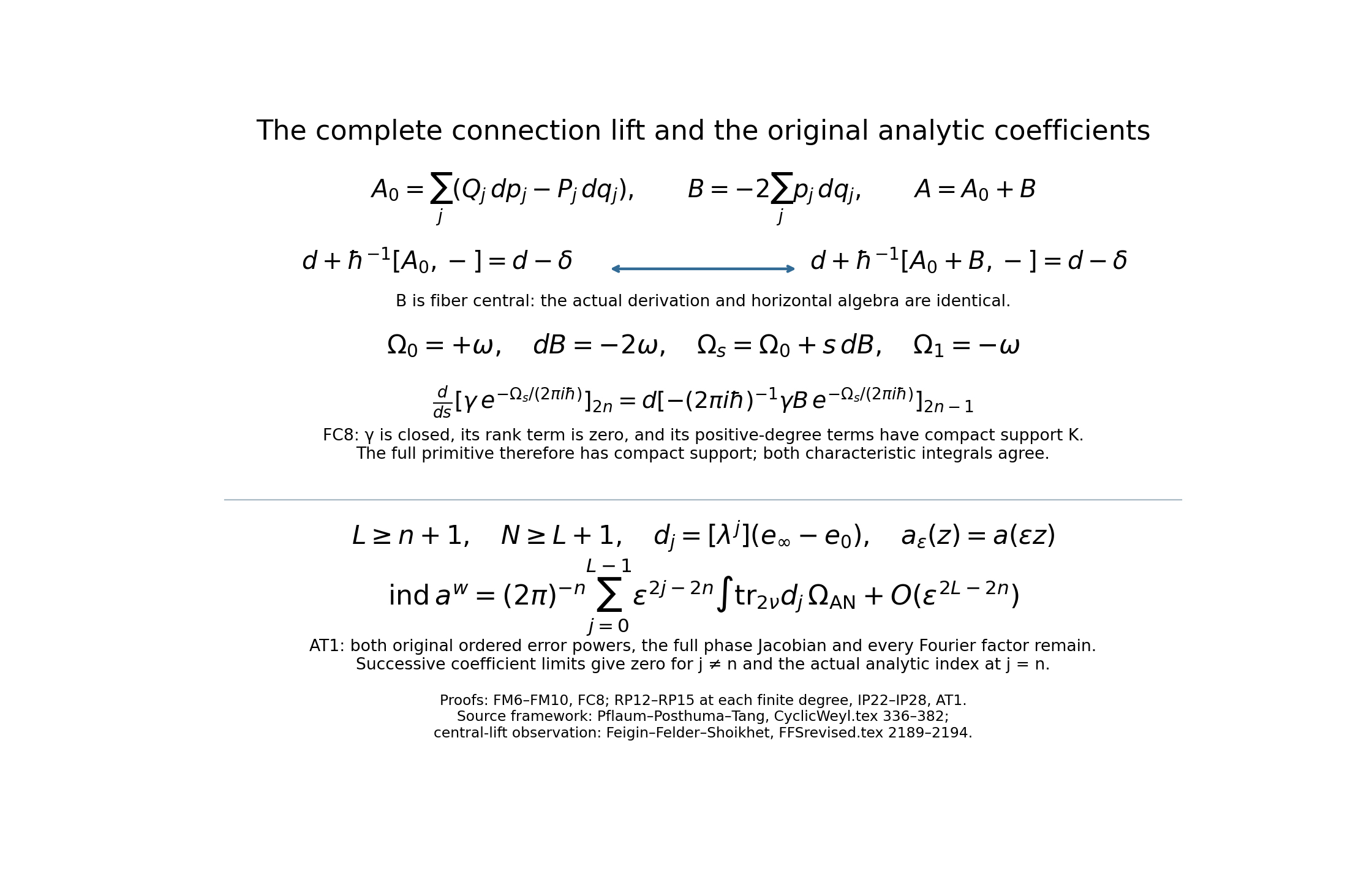
FM6–FM9 and FC8 prove the exact central connection and curvature maps in the figure. RP12–RP15, IP22–IP28 and AT1 prove the displayed analytic coefficient comparison, with every original cutoff, ordered error power, Jacobian and Fourier factor retained. The source connection framework is Pflaum–Posthuma–Tang, CyclicWeyl.tex lines 336–382; the central-lift observation is Feigin–Felder–Shoikhet, FFSrevised.tex lines 2189–2194.
The scaled Weyl lesson proves , where is its complete finite ordered Weyl coefficient, including every and cutoff derivative. Equation (MB9) identifies its integrated value with the original cutoff expression. This route uses the full relative projector, exact source cyclic trace and source index theorem. The independent direct proof is From ordered Weyl errors to the exterior index form, equations (5)–(18): it proves the complete multi-degree selection, atomic derivative involution, ordered exterior count and full beta moment for every integer error power . Its equation (17) is exactly the cutoff expression in (MB9); its equation (18) gives the same outward boundary value in (MB10). The two complete arguments therefore agree on the actual original operators.
5. The product metric and left quantization
5.1 Retain the original product structure
Let and keep the two coordinate groups , , with the actual metrics Assume the full matrix symbol has a uniformly bounded inverse outside some ball . Choose the original cutoff inverse with for , supported in the invertibility region, and write there, extended by zero. Then , with the two matrix orders retained. Let , , have the outward orientation induced by . The radial profile below is a different scalar function from .
Equations (RC3) and (RC9) construct, for every fixed sufficiently small , For , , so its image is on the sphere of radius . Choose ; then is uniformly invertible at phase infinity with the same exterior inverse bound as , evaluated on that sphere. This checks every hypothesis of MB1–MB10 for ; it does not pretend that the endpoint lies in .
5.2 The fixed boundary and the analytic endpoint
Equations (PT2)–(PT9) construct both product-metric Weyl error sides for and , with the exact common compact cutoff defect for small . Taking , Equation (PT7) supplies one integrable majorant for every original weighted trace-class seminorm of both -th error powers. Equation (PT9) then proves trace-norm convergence of those powers, and Equation (PT10) concludes This is an operator-index equality derived from the original full errors, not a claim of operator-norm convergence of .
After fixing , make smaller so that . Then is the identity on a neighborhood of . Equation (PT11) gives both the exact symbol and tangential one-form equalities there: The sphere, its outward orientation and all matrix-valued one-form factors are identical on the two sides. No global change-of-variables factor is needed: the comparison occurs on the same fixed sphere, where the radial map is literally the identity.
Apply the proved isotropic theorem MB10 to , then use (PM3)–(PM4). The exact product-metric matrix Weyl index is The coefficient is MB10’s original one, including its sign and both factorials. The proof holds at every and matrix rank under the stated product-metric hypotheses.
5.3 The cutoff and left-quantization versions
The same in (PM1) gives and the full original compact differential form . Equations (BN1)–(BN5) derive its exact transgression and beta moment solely from this identity on the invertibility region and compact cutoff support. Applying (BN5) to the original , and comparing its written coefficient with (PM5), gives the equivalent product-metric cutoff formula The cutoff formula here is for the original product symbol, not for ; it follows from the original transgression and the common boundary integral. Every coefficient is the same as MB9 and equation (17) of From ordered Weyl errors to the exterior index form.
Finally (PT12) is the exact left-to-Weyl symbol identity The product Planck weight tends to zero at full phase infinity, so the actual operator difference is compact by the metric operator bounds lesson. Equation (PT14) proves equality of Fredholm indices. Equations (PM5)–(PM6) therefore give the same exact numerical values for the original left quantization:
The left and Weyl operators and their symbols remain distinct. Their proved compact correction identifies their indices. The full finite term-by-term integration is proved independently in From ordered Weyl errors to the exterior index form, equations (5)–(18).
The metric assumptions set the scope of this result. The isotropic metric is covered by the matrix-index argument, and the product metric by the radial transport just proved. For a general -temperate metric , let be its symplectic dual. The further condition as does not by itself enter either proof above. This broader metric setting is not established by either proof above. No general-metric index theorem is asserted in this lesson.
6. Worked example: a nonzero scalar index
In one phase plane take For every multiindex , differentiating the numerator and denominator gives ; thus . Its only zero is at the origin and is bounded below outside any fixed ball about the origin. On the positively oriented circle , the radial denominator is positive and . Formula (MB10) at has coefficient . Therefore The full bounded symbol, the outward orientation and the original Weyl operator are used; no unbounded model is substituted.
7. Exercises with solutions
Exercise 1. Evaluate the exact boundary coefficient in (MB10) for , retaining its sign and factorials.
Solution. Since and , the coefficient is . This uses the original orientation.
Exercise 2. Let as in (MB11). Show what the full formal identity (MB7) says about .
Solution. Its contribution to is . The right side of (MB7) has no term, so the integral is zero. No pointwise assertion about follows.
References
The external higher algebraic index theorem is M. Pflaum, H. Posthuma and X. Tang, arXiv:0805.1411v3, original IndThms.tex, theorem thm:higher-algind. Its top local Riemann–Roch antecedent is B. Feigin, G. Felder and B. Shoikhet, arXiv:math/0311303v2, original FFSrevised.tex. These are cited source results; the specialization, exact normalizations and original-operator receiving argument are proved above. The direct term-by-term integration of the separate finite Weyl coefficient is completed in the direct exterior-reduction lesson, equations (5)–(18).
8. Editorial completion: a full proof of the operative flat pairing
The source statements, all formulas and their order above are retained. In this lesson (MB3) is an operative assertion: a citation alone would not prove (MB7)–(MB10). We now prove (MB3) for its exact written projectors and every dimension by the finite original Weyl calculation. This supplies the complete required theorem specialization within the programme. The more general theorem on other symplectic manifolds and higher closed sequences is not invoked to fill any step below.
8.1. Full tensor definitions and the actual smooth horizontal algebra
The exponential denoted by in (WR9) is the complete source expression Every pair, the , the full parameter and the slot order are retained. Its scalar constant derivative operators commute; this permits regrouping derivative operators without regrouping the matrix factors. For matrix-valued slots, the map evaluates their fiber arguments at zero and takes the ordinary trace of their product in the original order. Its scalar version omits only that final trace. A fixed formal coefficient contains finitely many input degrees and contraction degrees, so these maps are defined for smooth base coefficients as formal differential expressions.
For such a coefficient, the notation in (FM7) means its full formal Taylor jet It asserts no convergence of a Taylor series of a smooth function. The equations and follow by reindexing the individual coefficients, including the factorials. Conversely, these equations and the value at determine every coefficient by induction in its total fiber degree. Thus the horizontal-lift and evaluation maps are exact inverses. At every base formal degree, the diagonal chain rule and each finite fiber contraction give exactly (FM10). This proves the full smooth horizontal algebra and the exact (FM4) map with inverse, fixed supports and both matrix orders.
The determinant in (WR9) differentiates each of its connection slots once. The full commutative exterior computation (WR4)–(WR6) proves the divided Pfaffian normalization (WR8): its coefficient of an ordered basis wedge is the sum of the distinct-plane determinants, each occurring once after the written division. Sorting the pair containing the first slot gives the full recurrence (WR3). Its base is , . Hence induction matches the source recurrence at every degree, rather than assuming an exterior-power convention. On the actual in (FM6), all its central contributions have zero fiber derivative and each remaining derivative is precisely or . Every determinant permutation therefore contributes the same oriented volume term in (FD6). After that operation every nonzero slot other than slot zero is fiber constant. Every positive term of each factor of (LP1) differentiates one of those constant slots, and is zero. There are no remaining exponential terms.
For completeness, the volume of is : it is one for , and integrating the -dimensional volume over the final coordinate proves the formula inductively. Thus all determinant terms cancel exactly the simplex volume, while the original and remain. This proves (WR12) and (WR13) for every finite matrix rank. At degree zero the pairing is evaluation on the actual relative difference; (NS2)–(NS4) have one summand with the complete factor. Its cyclicity can also be proved here without a higher cocycle theorem: (WR13) is the constant multiple of the compact coefficient integral, and integration by parts annihilates every positive by antisymmetry of against symmetric second derivatives, as proved in FC1–FC3 of the relative-projector lesson. Thus its degree-zero trace and pairing have their actual domains and do not require an unproved general cyclic-cohomology assertion.
8.2. The full finite coefficient and every linear-path hypothesis
Fix an integer and retain the original . Put , , with their full formal expansions. DE3–DE5 and OC27–OC30 of the scaled Weyl lesson construct the finite degree- coefficient of , with every intrinsic term and every later contraction. Both scaled analytic remainders lie in the original , with the complete product weight and its derivative comparison in RP1–RP5. RA1–RA10 prove their actual trace-norm bound . Each retained coefficient is compact: in any degree at most , one of the intrinsic slots has degree zero, and its differentiated is supported in the original . CI12 gives its trace with . T28 and IP16 give the index of the unchanged at every positive scale. The finite asymptotic coefficient comparison consequently proves To check that comparison directly, multiply the finite expansion by and take its limit to prove the degree-zero coefficient zero; after each lower coefficient is zero, multiply by the power which makes the next coefficient constant and take its limit. At degree the remainder tends to zero and gives (LP3). The whole calculation is finite and has a proved trace-norm remainder.
We will use arbitrary invertible real linear maps only through their exact original symbols. On a compact parameter interval let be a continuously differentiable path of invertible matrices, with , . Then The lower bound follows from , retaining the term one in both brackets; the upper bound follows from the operator norm. The chain rule gives the second inequality as the complete finite sum of products of entries of times the corresponding derivative of the unchanged at . For its parameter derivative differentiate that same sum. A derivative falling on a matrix entry retains the same weight. A derivative falling on inserts , bounded by , and one further derivative of , with weight ; the extra leaves exactly the weight in (LP4). Integrating this bound in proves continuity of every original symbol seminorm. B26 proves operator-norm continuity. Exterior invertibility is preserved because is uniformly bounded, and the original bounded inverse evaluates at . The corresponding cutoff is , supported in the actual transformed inverse region, with a fixed compact support for its defect along this compact path. The full parametrix proves Fredholmness at every , so F6–F7 make the index constant along the path. No assertion about a non-symplectic Weyl algebra automorphism has been made.
Expand the integrand in (LP3) completely into occurrences of the original atomic factors . Each term has exactly labeled coordinate derivatives. Let be the integral of the entire group with counts in each original coordinate, including all its scalar coefficients and ordered matrix words, where . Positive diagonal maps are joined to the identity by their positive diagonal path; (LP4) proves every hypothesis of the preceding index argument. Each derivative supplies its , while the actual positive Jacobian is . Hence This is a finite Laurent identity. Here is its complete independence argument. Include the exponent zero in its finite exponent set, and choose an integer vector with pairwise distinct dot products on that set. Such a vector exists: fails a prescribed distinct pair only when the integer is a root of its nonzero difference polynomial. Each such polynomial has finitely many roots by induction on its degree using polynomial division at a root, and there are finitely many pairs. Choose an integer outside their union. Substitution gives a finite exponential identity. Differentiating it at through one less than the number of exponents gives its Vandermonde system. The determinant is : subtracting two equal columns at shows all these factors divide the determinant, and its highest-degree term fixes their coefficient to one. Thus the distinct coefficients are zero. Consequently
A reflection in one original coordinate multiplies the unique surviving derivative-count group by minus one; its absolute Jacobian is one. Applying (LP3)–(LP6) to that reflected symbol proves its index is the negative of the original. Every positive-determinant invertible matrix is joined to the identity by a path as in (LP4). To prove this last statement, Gram–Schmidt factors it into an orthogonal matrix and an upper triangular matrix with positive diagonal. Linear interpolation of the latter to its diagonal and then of its diagonal to the identity keeps every diagonal positive. An orthogonal matrix of determinant one is reduced to the identity by coordinate-plane rotations. For two entries in slots , if , the rotation with matrix sends them to ; if both entries are zero, leave them unchanged. Applying this successively for sends its first unit column to the first basis vector. Repeat on the orthogonal complement. The last one-dimensional orthogonal factor is one because the determinant remains one. Every rotation has its sine/cosine path from the identity, including the half-turn when . The resulting finite paths remain invertible on compact intervals, so the bounds in (LP4) hold. For a coordinate permutation, its sign is therefore its index transport sign. This proves the complete alternation step in all dimensions.
8.3. The atomic involution, the surviving words, and the full count
Let be the original untraced differential expression with each coordinate count one, so that . For each coordinate-label permutation , apply (LP6) to and change back to the unchanged integration variables. Its sign from the preceding paragraph is . Thus each integral of equals , and In each fully expanded atomic word, if two derivative slots reach the same occurrence of or , transpose their coordinate labels. The unchanged mixed derivatives commute on that occurrence; all other slots and every matrix position remain unchanged. The transposition reverses the alternating sign and has no fixed point because the labels are distinct. Pairing all permutations by this involution cancels that entire word. This is a finite sum of pairs, not an assumed matrix cancellation.
For completeness, every later contraction of an ordered -fold product is generated by the finite degree part of Its coefficients follow by induction from the diagonal chain rule: contracting a product of the first slots against the next slot is the sum of their pair contractions. These scalar operators commute, so the finite multinomial formula gives the displayed exponential coefficients, with their original factorials. Matrix factors keep their order throughout. Any intrinsic or with has two derivatives on each of its two atomic occurrences, and cancels by the involution. Any later contraction reaching a first intrinsic bracket likewise makes one of its atomic occurrences carry a second derivative, and cancels. Among remaining scalar -occurrences, the contraction graph has degree at most one at every vertex, and hence is a matching. Each of its edges is the exact scalar factor . The scalar factors can be moved past the other factors without moving any matrix factor; that whole edge contribution is zero. These cases exhaust every contraction in (LP8).
Only undifferentiated scalar ’s and first intrinsic brackets remain. Since , their full expression before taking the alternating sum is Exactly of the original error slots supply a bracket, accounting for the full binomial. The two matrix brackets have not been replaced by negatives of one another.
Put . A bracket word using each coordinate once uses each canonical pair once. It has choices of the order of pairs and choices of their internal bracket terms. For any fixed ordered exterior word in , every one of these base words has one unique coordinate-label permutation taking it to the target word. The base bracket sign times that permutation sign is precisely the target exterior sign: an internal pair switch contributes one minus, and a switch of two length-two blocks contributes plus. Thus every exterior word occurs with exactly the same multiplicity. The original factor leaves , proving the untraced identity The finite graded matrix trace is proved entry by entry in ES1 of the relative-projector lesson. Moving the first one-form past the other one-forms gives . Inserting (LP10) in (LP7), with the pair-order sign and every factorial retained, gives The numerator is twice , and the denominator retains . Choosing retains and the exact factor , so This proves (MB9) directly at its entire original scope. Every finite original Weyl term was either retained in (LP9) or paired by an explicit zero mechanism before this integration. Sections2–6 of the direct exterior-reduction lesson record the same calculation; the detailed proof above supplies its use within the present lesson without importing an external index theorem.
8.4. The exact two sides of MB3, including the full curvature
The relative-projector lesson’s FC5–FC11 prove, by arbitrarily deep finite expansions and actual trace-norm remainders, Its complete proof is also the finite argument already written in (AT1): for each prescribed coefficient choose a fixed deeper integer truncation before sending to zero. It does not assign convergence to a formal series. Combining the actual flat density (WR14), (LP13) and (LP12) gives its entire source pairing value times the right side of (LP12).
Here are all characteristic-side prerequisites with no imported theorem. The global conjugating matrix supplies a smooth frame for from its first columns and a complementary frame from its other columns, so both the image and kernel of the actual nonorthogonal are smooth bundles. The original Grassmann operator obeys the connection product rule; its full curvature calculation is (CN4). Differentiating makes off-diagonal, so commutes with . This proves (CN5), and the finite trace of every odd power is zero by that block decomposition. Thus all the closed relative forms in (FC3) are globally defined and compact; their degree-zero rank difference is identically zero. The chosen tangent connection has zero curvature, so the complete formal series has value one at , its constant term. No statement about a nonflat characteristic class is needed.
The tangent connection choice also has a complete local comparison. Any other smooth connection on this globally trivial tangent bundle has a matrix one-form . Put and . Direct expansion proves and , where . The full graded matrix trace therefore gives and , for every , with no reordered matrix products. At each exterior degree the written characteristic series is a finite polynomial in these traces. Indeed the formal identity , with and constant term one, follows by the adjugate differentiation formula for the determinant, its inverse geometric series, and equality of the initial constant terms; comparison of successive formal coefficients proves the identity. Thus each positive-degree derivative of the characteristic form is exact: apply the displayed trace derivative to one factor of each finite polynomial and retain the other closed factors. Integrating in gives with the full characteristic coefficients retained. The product of with the original closed is compact. The proved compact Stokes receiver consequently shows that this actual connection change leaves the entire relative characteristic integral unchanged coefficient by coefficient. This establishes the connection-choice assertion in Section3 without invoking a general characteristic-class theorem.
The radial primitive (FC5) also has an exact coordinate proof. Write for a closed two-form and . Differentiating under this compact parameter integral and using the full closedness identity gives The endpoint at zero is zero by smoothness. Hence every original formal coefficient of has its written global primitive. In top degree, the full exponential in (CN1) is a finite sum of exterior powers; a prescribed Laurent coefficient of it is a finite sum as well because its exterior power is bounded by and the curvature has no negative intrinsic formal powers. Each term with a positive curvature power has exactly the compact primitive (FC6), including its factorial, power of and negative parameter powers. ES5–ES7 of the relative-projector lesson prove the required full-space and ball Stokes receivers in the actual original orientation. Their integral is therefore zero; no curvature contribution was suppressed before this exact comparison.
The surviving characteristic term is the full Grassmann top form . The original compact exact defect (CP11)–(CP14), with its full polynomial and both endpoints, proves its integral equals the right side of (LP12). The source oriented coordinate swap supplies the single in (CN7). Thus its characteristic value is also times that same right side. We have proved both sides of (MB3) equal, on its exact actual pair, all matrices and all dimensions. This proves (MB3), (MB7), (MB9) and their formal and analytic receiving maps without assuming the higher algebraic index theorem or local Riemann–Roch theorem. Their cited general formulations remain free reference context; they are not missing proof prerequisites for these original programme conclusions.
9. Editorial strengthening: every central formal lift and every invertible linear map
9.1. Arbitrary higher curvature terms are actually realized
Keep the same unchanged flat horizontal algebra, and let be any closed smooth scalar two-forms for . Define the full central one-form and curvature The commutator with a central scalar one-form is zero as a derivation of sections, so (FM7) and the horizontal jets (LP2) are unchanged. Its graded self-commutator and cross commutators are zero because exterior scalar one-forms anticommute and scalar coefficients commute. The full curvature is therefore , by (FM8) and (LP14). This proves an actual connection realizing every written higher coefficient, rather than merely an exactness assertion about a prospective curvature.
Every term of the determinant density containing any slot from is zero after that slot’s fiber derivative. Thus the full density and its degree-zero pairing are identical coefficient by coefficient for all these lifts. On the characteristic side, the full transgression (FC8) with has compact primitive, retaining all exponential factors and inverse powers; equivalently (FC6) proves all positive curvature terms integrate to zero. Hence the completely proved equality (MB3) holds for the exact same relative pair under every lift (CL1). The identity map on horizontal sections, the identical algebra product, the unchanged compact support and the explicit central curvature morphism are all proved. No general existence theorem for nonflat Fedosov connections is being used.
9.2. Linear index transport and the exact algebra defect
Let , preserve , , , and . The exact path proof (LP4) and its reflection computation give the stronger index comparison For negative determinant, compose with one fixed coordinate reflection to obtain positive determinant, apply its proven path and then the negative sign. All transformed original symbols remain in the same isotropic class with their own exact finite bounds; no quantization identity for a general linear change was presumed. Applying (LP13) to each rebuilt original relative projector gives the corresponding exact integrated formal trace with that same sign. This is index transport between the actual bounded operators, not equality of their kernels.
There is also a full algebra map, with its exact failure object in the original product. Write , retain all original ordered derivatives, and define by the complete formula (RP7) with this displayed tensor. The chain rule proves at every coefficient This defines an exact algebra isomorphism from the smooth formal algebra with tensor to that with tensor , with inverse pullback by ; supports map exactly by , and matrices retain their order. In the unchanged original -product its defect is the fully specified bilinear map For formal input series the displayed contraction is further summed over their finite intrinsic degrees, as in (RP7). Thus the nonzero defect defines an exact family of deformed algebra structures and the actual morphism (LI2); it is not an assertion of unrelated objects. If , the defect is zero at every order. If , the same full comparison is the parameter map , retaining its in every degree. A nonsymplectic index comparison (LI1) therefore does not silently replace a product map by a coordinate-only automorphism.
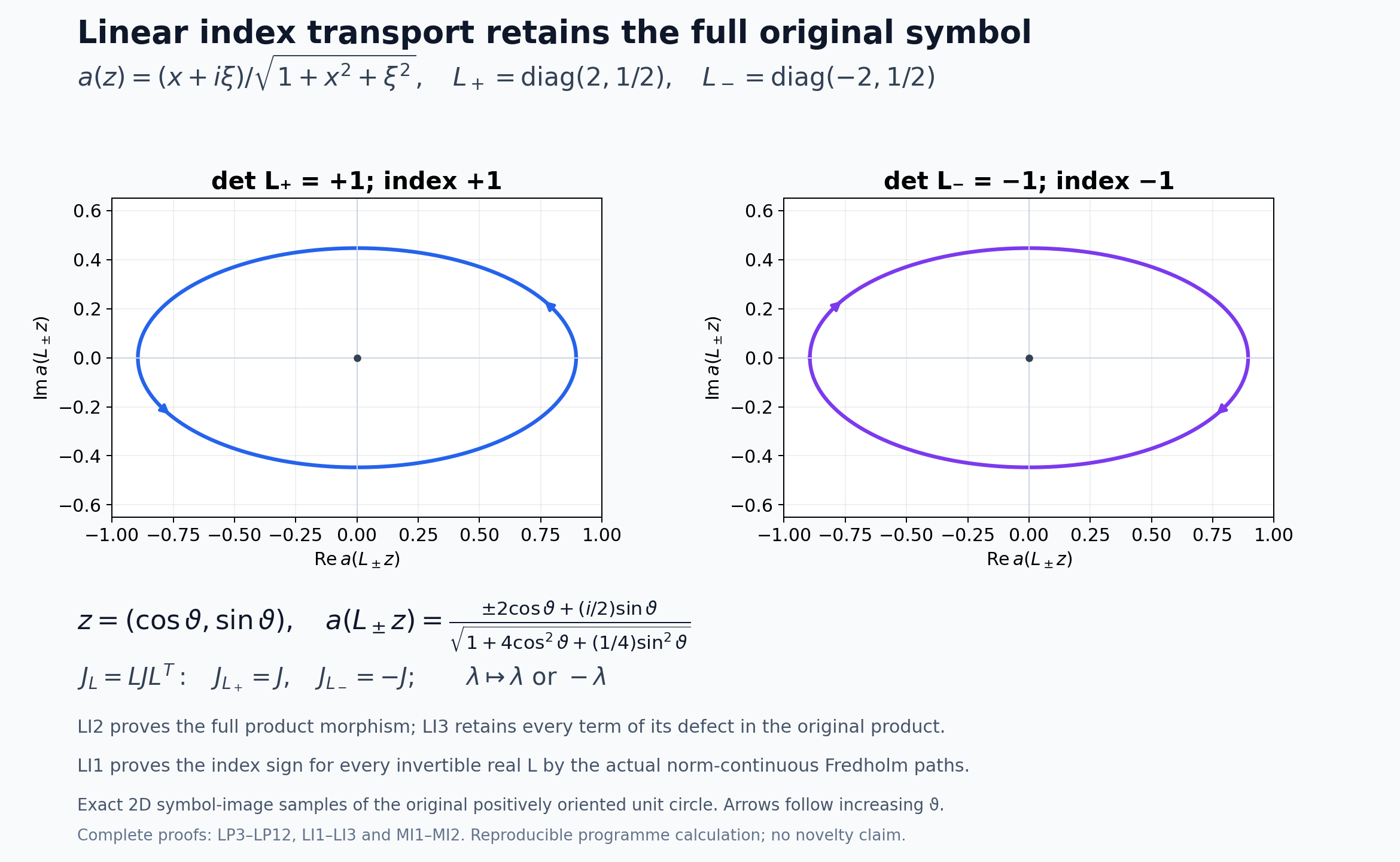
These are exact two-dimensional symbol images of the original positively oriented unit circle under the full MI1 symbol composed with and . The complete denominator remains displayed; the arrows follow increasing circle parameter. LI1 proves the respective original bounded Weyl indices and . LI2–LI3 prove the exact tensor and parameter comparisons, rather than infer them from the pictures. The reproducible figure source accompanies the full proof.
10. Editorial proof of the product endpoint and the original example
10.1. Every operative endpoint bound and both quantizations
For (PM1)–(PM8), use the exact radial profile and separate cutoff already defined there. RC4–RC7 of the radial transport lesson prove all separate-coordinate bounds of the full composition. To spell out their receiver, and are each at most . Distributing any mixed derivative of the profile yields the complete bound . Every chain-rule term of contains exactly as many positive powers of and from the derivatives of the two components as the derivatives of the unchanged at that point contain negative powers. They cancel term by term, leaving the stated original -seminorm with uniform constants. On the outer region for fixed positive , the map has compact image and its derivative of order has degree , so the original compact part and outer part give the exact estimate separately. None is claimed uniform in that isotropic class at zero.
Let . Choose with . On the compression is the identity; on its complement . These two actual domains prove globally. The compact zeroth defect has one fixed support; its original positive has a positive minimum there, so it lies in every fixed .
Both full ordered errors are uniformly in . At each product the complete provider weight is ; WG4 retains its , directional and tensor factors in every derivative estimate. Since symbol seminorms divide by the weight rather than differentiate it, this pointwise bound gives the exact target inclusion with that full constant. Iterating a fixed finite number of products retains the product of these constants, proving every ordered error power in . These symbols and the input symbols have bounded Euclidean derivatives of every order, because the separate coordinate weights are at most one. The complete Schwartz/operator composition WO6–WO8 consequently applies in the Euclidean order-zero class; B26 then extends its identities to bounded maps on the original spaces by density. This proves the actual PT5–PT6 domains.
For the original integer , every actual CT1 term with total monomial and derivative degree at most has the full bound Its square is integrable separately in both -dimensional coordinate groups: on dyadic annuli of radius , the bound is a geometric series with exponent , and the compact ball has finite volume. Exact local smooth continuity of the complete product sends the full errors and their powers to their endpoint symbols. Dominated convergence applies to each of the finitely many original weighted CT1 terms, using twice the common bound in (PE1). CT2 gives trace-norm convergence of both error powers. T28 expresses each actual Fredholm index as their trace difference; trace continuity gives convergence to the endpoint index. Since both values are integers, choose an endpoint neighborhood in which their difference has absolute value less than one to obtain exact equality. This proves (PM3) with the actual original operators, without an operator-norm convergence claim for that radial endpoint.
For any fixed original , choose . The compression is literally the identity on a neighborhood of the unchanged sphere, so its tangent map and all factors are identical, proving (PM4). The already proved (LP12) and the full cutoff primitive of BN1–BN5 yield (PM5)–(PM6) with the original sign and factorials. For left quantization, W40 gives the full exponential multiplier in (PM7), including . In its original product metric put , and . Direct inversion gives , so its full phase parameter is . The temperateness comparison is exactly , with the same actual displacement in both terms. The finite-bound Gauss remainder G24–G26, applied to this phase on the full -dimensional space, retains the counting factor , all original structural constants, and its first remainder factor . Its full directional bound is . Consequently with the displayed factor retained in the seminorm estimate. B35 proves its finite-matrix Weyl operator compact: the full identity gives in full phase infinity. F10 supplies the exact compact Fredholm stability, with all operators on the same original domain and target, so the two original indices agree while their operator difference and symbols stay explicit. This closes all of (PM1)–(PM8) at their written original scope.
10.2. Every derivative and the actual nonzero example
Put . Repeated differentiation of gives a finite sum of with : differentiating its polynomial part decreases by one, and differentiating its denominator increases by one and by one. Both preserve that equation at the next derivative degree. Hence every term is bounded by . The complete product rule for the original degree-one numerator has only its zero and first derivative terms. Multiplication of the first bound by , or use of the bound with one fewer denominator derivative for the second term, gives precisely . This proves every original MI1 symbol seminorm, with its full denominator retained.
The original modulus has its only zero at zero, is increasing in by differentiating the full quotient, and is bounded below outside any fixed positive-radius ball. On the original positively oriented circle , the full symbol is ; its reciprocal differential is exactly . The boundary theorem now has the complete proof (LP3)–(LP12) and the already proved global cutoff moment, so (MI2) is the index of this original bounded Weyl operator, equal to one. No unbounded operator model is substituted.
As further exact consequences, a direct sum of two symbols satisfying the same hypotheses has the sum of their indices: choose one cutoff supported in both inverse regions and use the ordinary finite block trace in (LP12) or (PM6). A globally uniformly invertible original symbol has index zero, by the following exact extension of the calculation to the identity cutoff. Repeatedly differentiating writes every derivative of as a finite ordered sum of inverse factors and derivatives of ; their total derivative orders add to the original order. The uniform inverse bound therefore gives the same full symbol derivative estimates for . Set , so the unchanged zeroth defect is , with empty compact support. All finite composition, trace-remainder and Fredholm hypotheses of (LP3) remain valid with this globally smooth . In every coefficient of degree , at least one of the intrinsic error slots has degree zero and is identically zero, even after all its later derivatives. Thus (LP3) gives index zero. Equivalently the full classical conjugating matrix is and its relative projector is exactly . This extension removes the unnecessary inner cutoff only when the original inverse is globally defined and uniformly bounded; the earlier exterior-inverse proof and its cutoffs remain intact. It does not assert that the Weyl operator itself is invertible. Finally, in scalar rank and , the scalar one-form squares to zero by exterior antisymmetry, so its -st power is zero. The exact boundary formula proves its index zero under either written metric, and also for the written left quantization. These are consequences for the original objects, with no hypothesis or factor removed.
11. Editorial proof of the finite factorization used in the linear path
Here is the exact finite construction used in Section8.2. Let the original real invertible matrix have columns . Define successively The induction starts with . If the earlier are orthonormal, then for every . If , the formula writes in the span of the earlier , which by the earlier formulas is the span of ; this contradicts invertibility. Thus every displayed square root is strictly positive. The new is unit and orthogonal to the earlier vectors. This proves the induction and, with the actual columns retained, , , and upper triangular with its written positive diagonal.
For , the full determinant gives . Orthogonality gives , so it is exactly one. Set . The two actual paths retain respectively the original positive diagonal entries and the entries . Their determinants are the products of these entries because the matrices are upper triangular. Consequently joins to , and joins to , through invertible real matrices. The explicit coordinate-plane rotations already proved in Section8.2 join to . This gives the claimed finite piecewise differentiable path with every endpoint. On each compact segment the adjugate formula for the inverse and the strictly nonzero continuous determinant give the finite uniform bounds on and used in (LP4). The actual symbol, cutoff, operator and index comparisons therefore have all their finite factorization prerequisites proved within this lesson.