The basic construction turns an inclusion of algebras into an algebra of operators on a Hilbert space. Its extra generator is the projection onto the smaller algebra. That projection records the conditional expectation, and the trace of the resulting operator algebra measures the size of the inclusion.
The prerequisite Finite traces and Jones projections, M1–M6 and M10, proves the trace-preserving normal faithful expectation and the mutual-commutant theorem used here. Projection comparison is proved in Projections and types of von Neumann algebras, Proposition 5.1, Lemma 5.3 and Theorem 5.5. We give the needed trace construction from a full finite corner and its normalization below. The same construction, with a more general corner trace, appears in Traces on von Neumann algebras, Lemma 6.1 and Theorem 6.2; Lemma 2.4 and Proposition 7.1 there prove the bounded definition-ideal and trace-norm facts.
Basic references are [Anantharaman–Popa], [Jones] and [Pimsner–Popa]. The proofs below use the finite tracial prerequisites specified above and establish the required corner trace and index normalization directly.
The smaller Hilbert space
Let be a von Neumann algebra with faithful normal tracial state , and let have the same identity. Write for the trace-preserving expectation. Our inner product is linear in the first variable:
Left multiplication is ; right multiplication is . Thus . We suppress when writing an element of as an operator. The conjugation satisfies .
Let be the orthogonal projection onto the closure of .
Proposition 1.1. For and ,
Proof. For , trace preservation and bimodularity give
Hence is the orthogonal projection of onto . The subspace reduces left and right multiplication by , because it is invariant under both and . It is also invariant under , giving the next three identities. Finally, for ,
Both sides vanish on . Density of in proves the last identity.
The identity is an operator version of averaging. Its right side is multiplication inside the smaller algebra, followed by the same projection.
The algebra generated by the projection
Define
This is the basic construction. It contains , and its position inside depends on the inclusion .
Theorem 1.2. The basic construction has the following descriptions:
The map is a normal faithful isomorphism from to . The projection has central support in . Moreover,
is a strongly dense, nondegenerate *-subalgebra of .
Proof. The tracial commutation theorem gives . For , if commutes with , evaluating on gives
Thus . Proposition 1.1 proves the converse. Consequently,
and taking commutants gives . Conjugating by gives the same algebra.
The compression identity yields
Hence is a *-algebra. Its range on is dense, because and is dense in . The norm closure of has a contractive approximate identity that converges strongly to . Existence is Theorem 11.4 and Corollary 11.5(1) of the C*-algebra prerequisite. Strong convergence follows first on vectors , with in that norm closure, from norm convergence of the approximate identity, and then on all of from nondegeneracy and its uniform norm bound. Also , so its strong closure contains every element of : multiply the approximate identity by that fixed element and approximate its terms in norm by elements of . It contains , and therefore equals , by the double commutant theorem.
Compressing the spanning operators gives
Since is a von Neumann algebra on , strong density now implies . Indeed, M10 applied to identifies its standard left action with the commutant of its standard right action, so that left action is strongly closed. Compression by the fixed projection preserves strong convergence. This step takes a strong limit in a strongly closed algebra; it does not pass an arbitrary strongly convergent net through a normal functional. The representation of on is faithful and normal by M1 and M10, proving the isomorphism assertion.
Finally, if is a projection with , then
Density gives . This is precisely the full-central-support assertion.
Lemma 1.2a — extending a finite trace from a full corner. Let be a von Neumann algebra, let have central support , and let be a faithful normal finite trace on . There is a unique faithful normal semifinite trace on restricting to .
Proof. Choose a maximal family of partial isometries with and mutually orthogonal initial projections . Their sum is . To see this, if the remainder were nonzero, full central support would give : otherwise , so would annihilate the dense space . The polar decomposition of a nonzero element of supplies another nonzero initial projection below and final projection below , contradicting maximality. All sums below mean nets of finite partial sums; no countability is assumed.
For , define
Additivity and positive homogeneity hold term by term. If , each summand increases to its value at by normality of ; taking the supremum over finite sets and over in either order proves normality of .
For , put . The positive strong sums and the trace identity in the finite corner give
For the first equality, insert between and ; for the last, insert it between and . Each insertion is a bounded increasing positive sum, so normality applies. The two middle sums agree because they are sums of nonnegative numbers. Thus is a normal trace.
If , the trace identity inside gives , and normality yields . If , faithfulness of gives for every , hence and . This proves faithfulness.
For a finite set , put . Formula (BC1) gives . The trace identity now gives
These positive elements increase to , so they prove semifiniteness, including the supremum formulation. Finally any normal trace restricting to satisfies
The first equality uses a bounded increasing net, and the second is the trace identity. This proves uniqueness and independence of the chosen family.
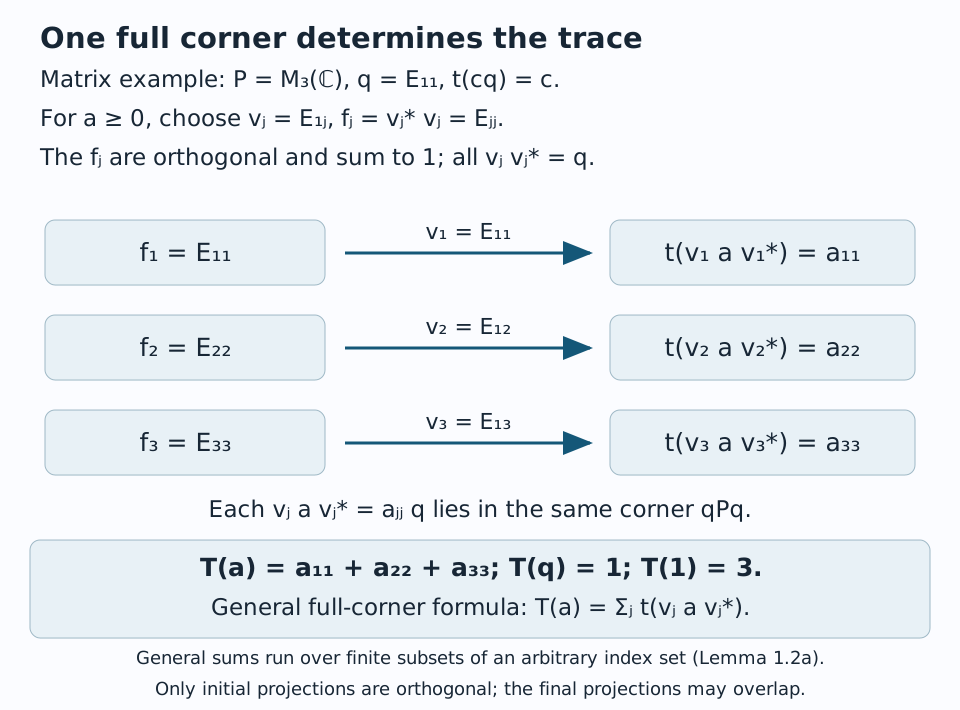
Figure 1.1. In the displayed matrix example, , and . The initial projections are orthogonal and sum to the identity; their final projections all equal . With , formula (BC1) is the ordinary sum of the diagonal entries, so and . Lemma 1.2a, (BC1)–(BC4), proves the same construction for an arbitrary family using nets of finite sums. The finite-corner trace construction also appears in the linked trace prerequisite, Lemma 6.1 and Theorem 6.2.
Corollary 1.3. If is a factor, then is a factor. If is of type II, then is of type II or II.
Proof. The center of equals the center of , so it is scalar. The full corner is finite and diffuse. Its trace extends to a faithful normal semifinite trace on by Lemma 1.2a. A semifinite factor with a diffuse finite full corner has type II. More explicitly, is finite because its corner is finite. If had a nonzero abelian projection , Lemma 5.3 of the projection prerequisite, applied to the nonzero projections in a factor, would give equivalent nonzero subprojections and . The isomorphism of their corners would make abelian, contradicting type II of . Thus has no nonzero abelian projection and has a nonzero finite projection. Since its only central projections are , its identity is either finite, giving type II, or infinite, giving type II.
A trace normalized at the projection
The trace of the basic construction is normalized at , rather than at its identity. This distinction is essential at infinite index.
Theorem 1.4. There is a unique faithful normal semifinite trace on whose restriction to is . It satisfies
Every belongs to the trace's linear definition ideal.
Proof. Apply Lemma 1.2a to , using Theorem 1.2. Full central support proves both uniqueness and faithfulness. For , the trace property for gives
In particular, and lie in . Their product is in by the tracial Cauchy–Schwarz inequality. Here a bounded operator belongs to the square-integrable ideal when its squared modulus has finite trace; products of two such operators belong to the bounded linear definition ideal, by Lemma 2.4 of the trace prerequisite. That lemma and Proposition 7.1 identify its trace-norm completion with . To check the stated inequality entirely in this ideal, take square-integrable bounded and the polar decomposition . Positivity of the form gives
For the last inequality, the trace identity gives . Only bounded products are used here.
For a direct verification that also computes the trace, put . Expanding the four products gives
Every unweighted product in (BC5) is positive with finite trace by the preceding calculation. Thus lies in the linear definition ideal. Applying the linear trace to (BC5), using , gives . This is precisely the polarization of the preceding identity.
Suppose now that are II factors. Define their index by
Equivalently, this is the dimension of the right -module : the trace on its endomorphism algebra is normalized to assign dimension one to the standard submodule . For this module, dimension means the trace of a submodule's orthogonal projection in its endomorphism algebra. The standard submodule has projection ; its corner is the standard left action of , carrying . Theorem 1.4 proves that this corner normalization uniquely determines the trace of every submodule projection, so its value at the whole module is exactly the displayed index. This verifies the normalization directly and also covers infinite index.
Lemma 1.4a — comparison and uniqueness for a factor already carrying a trace. In a factor with faithful tracial state , projections satisfy exactly when . Any other tracial state on equals .
Proof. Subequivalence implies the trace inequality. Conversely, the factor comparison theorem says either or . In the second case write . The inequality gives ; positivity and faithfulness give , hence . This proves comparison by the given trace.
For uniqueness, work in the factor with its faithful tracial state . Positivity follows by writing the diagonal entries of as sums of ; the same computation proves faithfulness and the trace identity. The center is scalar, as commutation with the matrix units forces a central element to be a scalar diagonal matrix over . Define in the same way from . Compare with a diagonal projection having identity entries and zero entries, for . Comparison by , followed by monotonicity of , yields
Rational bounds imply for every projection. A bounded self-adjoint element is a norm limit of real linear combinations of its spectral projections; positive unital linear functionals are norm continuous. Thus on self-adjoint elements and hence on all of . This proof uses an existing faithful trace and the proved projection comparison theorem, and does not require a general trace-existence theorem.
Corollary 1.5. Put .
, with equality precisely when .
precisely when is a finite factor.
When , the normalized trace satisfies
Proof. Since and , we have . If , faithfulness gives ; hence for all . Conversely, if , then and .
If , has a faithful finite trace, so it is finite: an isometry has , and faithfulness gives .
Conversely, suppose is finite. Starting with the remainder , compare each nonzero remainder with in the factor . If , stop. Otherwise ; choose equivalent to , and set . This procedure stops after finitely many steps. If it continued forever, the mutually orthogonal projections would have a sum equivalent to its proper tail : the strong sum of partial isometries taking onto implements that equivalence. But every subprojection of the finite identity is finite, a contradiction. At the stopping time, the trace identity and monotonicity give
Thus the normalized trace , defined by , exists by this construction. Its corner has ; Lemma 1.4a on gives , and full-corner uniqueness gives , which is finite at . Finally is a normalized trace on the factor , so it equals by Lemma 1.4a; Theorem 1.4 supplies the formula.
Two laboratories
Example 1.6: scalar averaging in a matrix algebra. Let , , and . The projection is the rank-one projection onto . Since the right scalar action has scalar image,
The trace normalized at is the ordinary matrix trace on , so . This is a useful finite-dimensional model of the construction. It is not a II inclusion.
There is another numerical question: what is the largest such that for every positive matrix? Here , and positivity gives
A rank-one projection shows that . Thus its reciprocal is , whereas the basic-construction trace size is . The later equality between these two definitions of index requires diffuse II factors; this example explains why that hypothesis matters.
Example 1.7: a tensor inclusion of II factors. Let be a II factor and set
The expectation is . On
, the projection is . Taking the commutant of the right -action gives
The commutant equality needs only a finite matrix calculation: relative to an orthonormal basis of the nine-dimensional space , an operator commutes with the right -action exactly when each of its nine-by-nine blocks does. M10 for makes every such block a left multiplication by an element of . The stated product trace restricts to on the corner of ; uniqueness in Lemma 1.2a therefore identifies it with the basic-construction trace. The same finite matrix calculation shows that the center of is scalar, and its full corner has type II; the corner argument of Corollary 1.3 makes type II.
Consequently . In contrast to Example 1.6, both algebras are II factors. Their relative commutant is , so the inclusion is reducible. Coefficientwise, an element commuting with has all its matrix entries in , which proves the relative-commutant assertion.
Exercises
Exercise 1.1 — introductory. For , where is the diagonal algebra, identify , and using the standard matrix units.
Solution. The expectation deletes off-diagonal entries, so projects onto the span of . Right multiplication by acts by a scalar on each column subspace . Thus
The compression of to each has rank one. Its corresponding corner projection has trace . Hence is times the sum of the ordinary traces of the three blocks, and . This trace size depends on the prescribed trace in general finite-algebra inclusions.
Exercise 1.2 — introductory. Prove without taking any commutants of von Neumann algebras.
Solution. Every commutes with by Proposition 1.1. Conversely, if commutes with , then , so .
Exercise 1.3 — intermediate. For , find , and compute its trace.
Solution. The compression identity gives
and Theorem 1.4, followed by cyclicity of the finite trace, gives
This expression is nonnegative and finite. It is also the squared -norm of .
Exercise 1.4 — intermediate. In Example 1.7, replace by , . Show that , , give mutually orthogonal copies of the standard right -module in .
Solution. Put . Then
Thus is an isometry of right -modules, and the ranges are orthogonal. Matrix units span , so their ranges span . There are standard summands, agreeing with .
Exercise 1.5 — advanced. If for II factors, show that for every nonzero projection . Explain why this does not contradict .
Solution. If , choose an integer with . Projection comparison in says that is subequivalent to the direct sum of copies of . Trace monotonicity then gives , a contradiction. The projection lies in , and generally lies outside . Its finite trace therefore concerns a different set of projections.
Here is embedded as , and Lemma 1.4a applies to the given faithful normalized trace on . For the second comparison, amplify the possibly infinite trace on by defining
Diagonal entries of a positive matrix are positive, so this is additive, positively homogeneous and normal. Expanding the diagonal entries of and , and using the trace identity on each block, proves the trace identity for (BC8). The implementing partial isometry belongs to , so this trace gives exactly the asserted inequality. All its uses under the contradictory assumption have finite trace values.