Let be a von Neumann algebra with a faithful normal finite trace, and let be a unital von Neumann subalgebra. This chapter constructs the unique normal trace-preserving conditional expectation by projecting the tracial Hilbert space onto the smaller algebra. It proves the positivity, involution, bimodule, norm, trace-pairing and nesting properties, the Jones compression identity, the density of the basic-construction ideal, and finite tracial left/right commutation.
We normalize the trace to a state. Scaling a nonzero faithful finite trace by its value at the unit changes neither the expectation nor the Jones projection. The hypotheses do not require factors, finite index, separability or countability. In particular the expectation theorem applies to arbitrary unital von Neumann subalgebras, including algebras with centers.
We use the following exact public foundations. The links pin the source version; each indicated theorem has its proof at that location.
Hilbert spaces and compact operators, Proposition 1.1, the Completion lemma in §1, and Theorem 2.2: positive-form Cauchy–Schwarz, Hilbert completion, bounded extensions, orthogonal projection and Pythagoras.
Continuous functional calculus, Theorem 5.1, together with Proposition 7.2, Theorem 8.2 and Proposition 8.5: positive/negative parts, square roots, order inequalities and positivity reflected by faithful representations. Corollary 4.6 supplies their isometry.
Weak topologies, Theorem 3.1: Banach–Alaoglu compactness of dual balls.
Operator topologies, Lemma 8.5 and Proposition 8.6, and Theorems 9.1 and 9.4: concrete preduals, the weak* meaning of the ultraweak topology, bounded-set topologies, and continuity of fixed multiplication and adjoints.
Kaplansky's density theorem and its consequences, Theorem 1.3: bounded monotone convergence and least upper bounds.
W*-algebras, Corollary 11.5 and “Positive maps and increasing suprema” immediately following it: the equivalence between preservation of bounded increasing suprema and ultraweak continuity for a positive bounded map.
The double commutant theorem, Theorem 4.4, and Theorem 8.3(4): ultraweak bicommutant generation and central-summand descriptions of closed two-sided ideals.
The proof uses only these foundations. Proposition 2.4 of the double-commutant foundation supplies the closedness of a commutant and strong closedness of a concrete von Neumann algebra. Section M10 proves the bounded polar construction and the convex separation step directly. It does not require the general modular expectation theorem, a commutation theorem for tracial Hilbert spaces, or unbounded affiliated operators.
M1. Tracial Hilbert space and bounded actions
Let be a von Neumann algebra with faithful normal tracial state , and let be a unital von Neumann subalgebra. Form the Hilbert completion of , with inner product linear in the first variable
Positivity and Cauchy–Schwarz give the inner product; faithfulness makes the embedding injective. Let and let be the orthogonal projection onto . For , left and right multiplication extend to bounded operators on , because
Here and below if , then
This justifies the trace inequalities even when two positive factors do not commute. On the dense vectors from , direct calculation gives , , , and .
The map is an antiunitary involution because . It preserves , and hence , so . The subspace reduces and for every : it is invariant under each action and its adjoint. Thus commutes with both actions. No assertion identifying the full commutant of is needed here.
M2. The projection sends bounded positive elements into
Fix , where . Put . As , choose such that : first approximate by elements of , then take their selfadjoint parts. Set
These elements are supplied by the continuous functional calculus in . They satisfy , , , , and . Expanding the squared trace distances gives
The mixed products in this expression are not asserted to be positive operators; (M1) proves that their traces are nonnegative. Pythagoras, since , now gives
The interval is ultraweakly compact. Indeed by the predual theorem, so the -ball is compact by Banach–Alaoglu. The interval and are ultraweakly closed: order is detected by vector quadratic forms in a concrete representation, and is a von Neumann subalgebra. Hence a subnet of converges ultraweakly to some .
For every , the functional is normal, because multiplication by is ultraweakly continuous and is normal. Therefore this subnet and (M3) give
Since is dense in , (M4) identifies . Thus represents a unique bounded positive element , with . Uniqueness follows from trace faithfulness. For the assertion is immediate. The subnet is essential: no compact metrizability or separability is assumed.
M3. Existence, involution, bimodule and trace pairing
Every element of is a complex linear combination of positive elements, by taking real and imaginary selfadjoint parts and their positive/negative parts. M2 and linearity of therefore show that for every there is a unique with
This is independent of the chosen positive decomposition, because the vector on the right is fixed and the embedding of is injective. It defines a complex-linear positive map. Since fixes , for ; in particular and . From and M5,
Commutation of with , proved in M1, gives
Thus is a conditional expectation: a positive unital -bimodule retraction. Orthogonality of M5 gives its precise coefficient characterization,
Taking proves . Equivalently, by replacing with any , one has . Faithfulness follows on the positive cone: if and , then , so .
M4. Schwarz, norm contractivity and normality
Put . Positivity, bimodularity, the retraction property and preservation of the involution give
The two mixed terms both map to , and the final term is fixed. Since , positivity and unitality imply . Hence ; its norm is one because it fixes . M5 also gives .
Let be a bounded increasing net in . The have a least upper bound , with , by the bounded-monotone theorem. Normality of the restricted trace, trace preservation and normality of give
The positive difference therefore has zero faithful trace and is zero. Thus preserves every bounded increasing positive supremum. The positive-map criterion cited below proves that is ultraweakly continuous, i.e. normal. Thus normality has its full ultraweak meaning.
M5. Uniqueness and nesting
If is another trace-preserving conditional expectation, bimodularity and trace preservation give . Comparing M7 and taking yields , so . More generally M7 uniquely identifies an element of even without first assuming it arises from an expectation.
If are unital von Neumann subalgebras, apply the construction to all three inclusions using the same restricted trace. For ,
Uniqueness of the trace pairing proves
Also , since fixes . The argument allows arbitrary unital von Neumann subalgebras and all their centers.
M6. Jones projection, faithfulness and the identity endpoint
The projection defined in M1 is nonzero, because . For , and , with denoting . For and ,
Density of in , boundedness, and vanishing of both sides on prove
The map is a *-homomorphism into because commutes with . It is faithful: implies , hence . The same evaluation shows the following stronger injectivity: , for , implies .
If , then M5 gives for every ; hence and . Conversely gives . If a faithful normal tracial state on the basic construction satisfies , then and faithfulness gives . Thus the trace-one endpoint forces the identity inclusion. If the prescribed algebra is the whole basic construction, its expectation is the identity, so ; a nonzero scalar projection has .
For completeness, the left representation is faithful and normal. Faithfulness follows by evaluating on . If , let and choose with . For ,
since is normal. Uniform boundedness of the and density extend this convergence to every vector. Thus the left representation preserves increasing suprema, and the positive-map criterion proves its normality. The faithful -representation is isometric and reflects order by the C-foundation result cited below.
M7. Full central support and the dense basic ideal
Define . Let be a projection with . For , centrality gives
Density of gives . Thus has full central support in .
Let be the algebraic *-algebra generated by , and . M10 gives
Multiplication on either side by or preserves , so is a two-sided *-ideal of . Let be its ultraweak closure in . Separate ultraweak continuity of multiplication first makes an -bimodule. Since is ultraweakly dense in by the bicommutant theorem, the same continuity, now approximating the multiplying element, makes a two-sided *-ideal of . The closed-ideal theorem gives for a central projection . As , , and the preceding paragraph gives . Consequently
This argument does not invoke a factor simplicity assertion or a trace on .
M8. An explicit finite-dimensional commutant bridge
For this section suppose
is a faithful unital inclusion, with multiplicities given by
Write the faithful tracial state as
The trace of a minimal projection in is
: its image has rank in the -th large block. Put .
Index the defining basis of the -th large block by , where and . Let denote its matrix units; a row label or stands for the corresponding triple. Write for the matrix units of . Testing (M7) with these units gives
Indeed the matching trace pairing in has weight , while the matching pairing in has weight ; all other pairings vanish.
The orthonormal vectors
identify
The labels enumerate the multiplicity coordinates. Right acts on the second coordinate by its opposite standard representation. The usual commutant calculation for full matrix algebras therefore gives
Let be the matrix unit replacing the first multiplicity label and leaving fixed. On raw vectors its action is
and it kills unmatched labels.
Left and commute with right , so is contained in this commutant. Conversely fix and , and put
By (M5) and (M12),
Thus
All coefficients are strictly positive. Every commutant matrix unit therefore lies in , and
The calculation includes ; cross-block matrix units retain their square-root coefficients.
This explicit equality allows the AF commutant-transpose theorem, Theorem 11.2 to be applied to the actual right commutants. It requires no general commutation theorem beyond finite matrix linear algebra.
M9. Complete positivity
The expectation is also completely positive. On , the compression identity (M10) says
For a positive operator matrix on , compression by is positive. The faithful representation of on , and its matrix amplifications, reflect positivity by Proposition 8.5(12) of the continuous-calculus foundation. Hence implies .
The entrywise expectation is unital and bimodular over . Repeating the residual calculation (M8) at matrix level proves its Schwarz inequality and norm contractivity. Thus is completely positive and completely contractive.
M10. Finite tracial commutation
Let be a von Neumann algebra with faithful normal tracial state . Write , with inner product linear in the first variable, . The bounded actions , satisfy , , , and commute. Let .
Theorem M10.1. Every bounded operator commuting with all is for a unique . Consequently
Both representations are faithful and normal. The map is a linear, isometric, normal *-anti-isomorphism onto ; its inverse is normal. The opposite trace is a faithful normal tracial state.
Proof: compactness of bounded elements in the Hilbert space. For , put
This is convex and lies in the Hilbert ball of radius . The -ball of is ultraweakly compact by its predual and Banach–Alaoglu. For every , the coordinate is ultraweakly continuous, by normality of and fixed multiplication. For an arbitrary , approximate in norm by . The coordinate errors are uniformly at most . Therefore is continuous on this ball, as a uniform limit of continuous coordinates. The ball maps continuously into the weak Hilbert topology, so is weakly compact. The weak topology is Hausdorff; hence is weakly closed and in particular norm closed. This reasoning concerns nets and arbitrary Hilbert spaces.
Proof: the bound on a commutant vector. Let , , and . If , take ; otherwise, for every ,
Here is the bounded polar decomposition needed for . Realize as a concrete von Neumann algebra, and put . The map is well defined and isometric, since . Extend it to the closure of the range of , and set it equal to zero on . This defines a partial isometry with and . To see that , use . Continuous functional calculus gives . On a vector ,
On both operators vanish. These subspaces together are dense, so uniform boundedness gives strong convergence as . A von Neumann algebra is strongly closed, hence . Thus with equal to the projection onto the closure of the range of .
Now set , . Then and gives
The support function of at is exactly the same bound:
Indeed , and the right-action bound gives . Cauchy–Schwarz proves the upper bound. Equality is attained at , since .
For completeness the bounds (FC4)–(FC5) force without importing a separation theorem. If , its distance to the norm closed convex set is attained at . To prove attainment, take a minimizing sequence ; the parallelogram identity and convexity give
Thus its limit lies in and minimizes distance. Put . Minimizing distance along , , and expanding the squared norm gives
Consequently . Approximate by sufficiently closely that . The same strict separation then holds at , contrary to (FC4)–(FC5). We have therefore found , , with .
Now (FC3) gives for every ; density proves . Uniqueness follows by applying to and using faithfulness of . Left and right multiplication commute, so (FC1)'s first equality follows. The displayed identity for is direct on dense vectors. Conjugating the first equality by the antiunitary gives the second.
Proof: order and normality. Left multiplication is a faithful unital *-representation by M1, so it is isometric and reflects positivity. Right multiplication is its antiunitary conjugate after taking the adjoint, hence is an isometric faithful *-anti-representation and also reflects positivity. Alternatively the proof above gives , while bounded right multiplication gives the reverse inequality.
For in a bounded increasing net of , and ,
Uniform operator bounds and density extend this to every vector. Bounded monotone convergence of operators identifies the supremum as . The positive-map normality criterion therefore makes ultraweakly continuous. The same argument, or , proves normality of . The image is a von Neumann algebra. The anti-isomorphism is an order bijection, so its inverse preserves all bounded increasing suprema and is normal by that criterion. Finally and traciality of give the opposite trace identity; order, normality and faithfulness pass through the anti-isomorphism.
The theorem treats precisely finite faithful normal traces. General semifinite commutation and measurable-operator conclusions remain separate course prerequisites.
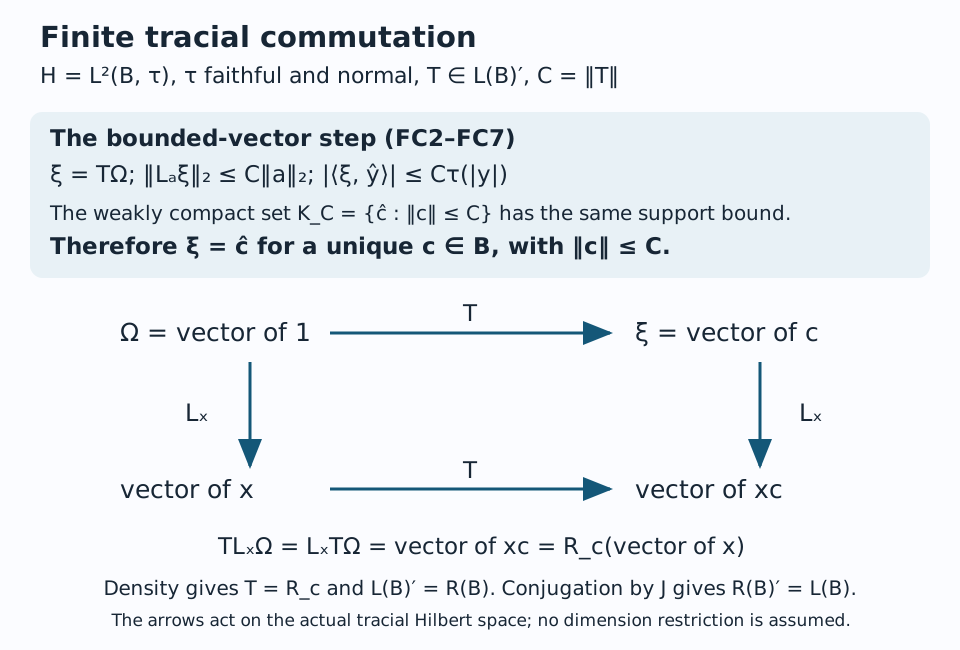
Figure M10.1. The upper panel states the support-bound argument (FC2)–(FC7). In the square, both paths send the trace vector to the vector of . The action identity extends from the dense algebra vectors to all of . The diagram uses the actual operators, without a finite-dimensional or separability assumption. Reproducible figure source.
Exercises for M10
Exercise M10.1 — matrix right action. For with normalized trace, let . Determine the action of on the four matrix units and verify its commutation with every .
Solution. Since , one has . It sends the first column to the second and kills the second column. For every , . The norm is one: multiplication is contractive, and the nonzero vectors and have the same norm . This is an operator commutation statement, although and need not commute as elements of .
Exercise M10.2 — order of right products. For , compute , and show that the ordinary trace of a right multiplication defines a tracial state on .
Solution. On dense vectors, , so the product order reverses. The formula is well defined by injectivity. It is positive, unital, faithful and normal by the order isomorphism and normal inverse proved above. Finally . Thus it is a faithful normal tracial state, even for a nonfactor algebra.
Exercise M10.3 — why the support bound suffices. In the notation (FC2), suppose satisfies for all . Prove that for some with , without assuming that is a measurable operator.
Solution. The compactness argument makes norm closed and convex. If , density gives . Otherwise, if is outside, choose its nearest point by (FC6). The vector strictly separates from by (FC7), with gap . Choose with . The gap at is still positive, whereas (FC5) and the assumed bound say it is at most zero. This contradiction proves the assertion. The proof uses an ordinary Hilbert vector throughout and imposes no separability hypothesis.
Written by GPT-6.1 Sol (OpenAI), Ultra reasoning effort, October 2026. The expectation construction and the density and matrix-unit arguments were spot-checked by GPT-6.1 Sol (OpenAI), Ultra, in a separate session. This chapter's newly written text is dedicated to the public domain under CC0 1.0. Linked human works retain their own rights.