One stabilized square determines the inclusion
A finite-depth standard invariant has two towers, one for the inclusion and one for its dual. Both eventually repeat by basic construction. At a sufficiently late level their four algebras form a single traced commuting square. We prove that this square determines the original hyperfinite inclusion, including the downward step needed to recover it from the dual. We then assemble the realization and counting arguments for every index below four.
The prerequisites are the full-support criterion in Reflection, commuting squares and finite depth, the frame and extension proofs in A finite square produces an inclusion, the alternating-word identification in The principal graph records fusion multiplicities, and the finite-depth generating-tunnel and canonical-pair proofs in A generating tunnel and the classification theorem. Downward recognition and uniqueness are Theorem 4.5 of Going up and down the Jones tower. These results retain their declared analytic prerequisites.
Construction and proof sources: Proposition 48.1 and Lemma 48.2 below prove the two-depth relation and the product spanning of the actual stabilized square. Theorem 48.3 extends that square using A finite square produces an inclusion, the canonical-pair proof in A generating tunnel and the classification theorem, and downward recognition in Theorem 4.5 of Going up and down the Jones tower. Theorem 48.4 assembles the previously proved realization, root, exclusion and exact-count results, including An ordered trace distinguishes the opposite exceptional inclusions. Takesaki, Chapter XIX, equation (28) and Exercise XIX.4, printed pages 491–493 remains the square, table and exercise comparison; Kawahigashi retains the ADE connection credit.
Write
Depth is the convention (12.7); it equals the greatest root distance in the finite principal graph. In particular the identity inclusion has depth one.
The two depths differ by at most one
Proposition 48.1. For any finite-index, finite-depth II₁ inclusion, the greatest first-occurrence length of an odd class is the same in the original and dual principal graphs. If this odd integer is
Proof. Set
The second word is precisely the dual odd word of the same length. Conjugation reverses the order of fusion, and the displayed alternating word reads the same after that reversal. It carries irreducible summands bijectively to irreducible summands, preserving multiplicities: taking conjugates gives inverse maps on bounded intertwiner spaces. It therefore preserves whether a class has already appeared at every preceding odd length. The graph identification of Theorem 19.3 makes these first lengths the distances of the odd vertices. Their greatest value
Each graph is connected and has an edge. Every even vertex has an odd neighbor, so its distance is at most
The missing spanning argument
For
This convenient bound is sufficient; it need not be the earliest possible level. Consider the inherited-trace square
Lemma 48.2 — a stabilized square is nondegenerate. Both horizontal inclusions in (48.5) are Markov with modulus
Proof. The full-support persistence of Theorems 12.4–12.5 applies to the original tower and, by Theorem 14.4, to the dual tower. Our choice of
full basic constructions. Their common projection is
Take the finite frame
and hence in
The map
so
which is the first span in (48.6). Taking adjoints proves the other span. Thus the conclusion is a linear product span, with an explicit common frame.
The use of the next full lower basic construction in (48.8) is essential to this proof. Expectation commutation alone does not give a common spanning frame.
Extending the square and recovering the predecessor
A traced-square isomorphism means isomorphisms of its four algebras preserving all four embeddings and the specified faithful trace. It contains more information than the four matrix-block lists or the two horizontal inclusion matrices.
Theorem 48.3 — determination by one square. Let two proper finite-index, finite-depth inclusions of separable hyperfinite II₁ factors have isomorphic traced squares (48.5), each taken at a level satisfying (48.4). The levels may differ. Then the original inclusions are isomorphic. Moreover the square determines both traced horizontal tails and their later Jones projections.
Proof. Lemma 48.2 makes each square nondegenerate and gives a common horizontal Markov modulus. The modulus can be read from the finite inclusion and its trace, so isomorphic squares give the same
For a finite traced inclusion, its basic construction is the right-module endomorphism algebra of its larger algebra over its smaller algebra. A trace-preserving inclusion isomorphism induces the unitary on those finite
Proposition 30.3 applies this construction to (48.5): the lower basic construction embeds into the upper one using their common Jones projection. In the actual invariant these are exactly
preserving all Jones projections introduced after the starting square.
Omitting finitely many initial levels does not change either increasing union. On their tracial completions (48.12) is an isometry intertwining left multiplication. It extends normally to an isomorphism of the canonical pairs
These are hyperfinite II₁ factors by Theorems 14.3–14.4 and Proposition 17.7. For a proper hyperfinite finite-depth inclusion, the generating tunnel and its trace-preserving reflection give (17.18): its canonical pair is anti-isomorphic to its dual
It remains to recover the original predecessor; the starting square did not specify
Apply downward recognition and uniqueness, Theorem 4.5, to
Consequently
The higher tails were obtained before invoking hyperfiniteness. Hyperfiniteness and finite depth enter the generating-tunnel identification with the dual. The final scalar-expectation argument recovers the predecessor without arbitrarily choosing a forgotten initial projection.
At index one the square is scalar and the original inclusion is the identity inclusion. Uniqueness of the separable hyperfinite II₁ factor handles that case directly. It is not produced as a diffuse limit of the scalar finite square.
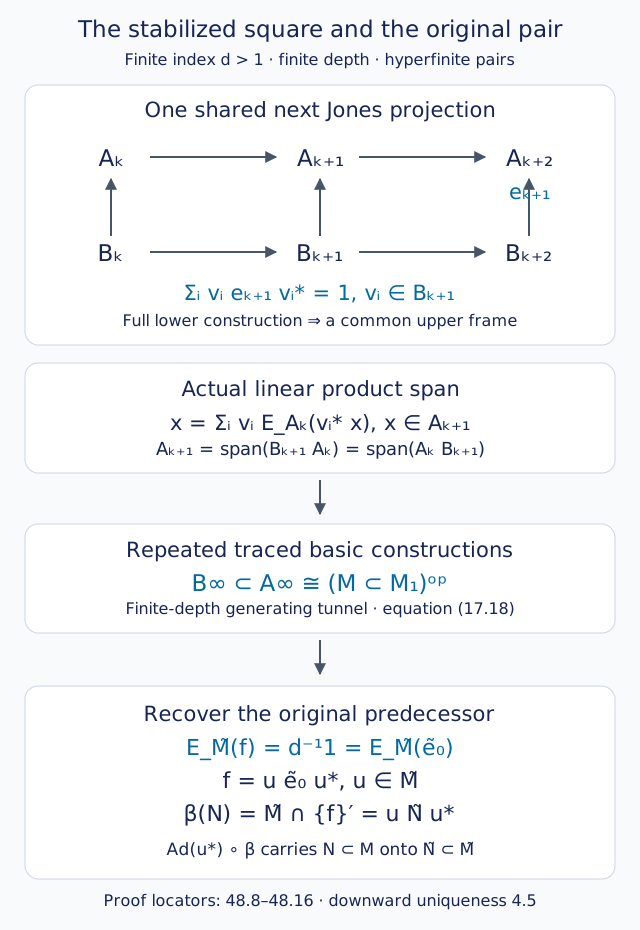
Figure 48.1. All displayed arrows are inclusions. The shared
The complete list below four
Theorem 48.4 — rooted graphs and exact counts. For inclusions of separable hyperfinite II₁ factors of index
| Principal graph | Depth | Classes |
|---|---|---|
| 1 | ||
| 1 | ||
| 4 | 2 | |
| 6 | 2 |
The root is an endpoint of
The dual principal graph is the same rooted graph in each row. In each exceptional row the two classes are anti-isomorphic and are not isomorphic. For
Proof. The index theorem 7.2 puts an index below four at
For
For
For
The indices are the squared graph norms in Theorem 20.4. The depths are the greatest distances from the stated roots. The preceding realization and comparison proofs identify the duals in every row. Thus existence, necessity, uniqueness or exact exceptional count, opposite relation, indices and roots are all established.
A numerical index can occur in several rows. For example index three has both
The two chapter exercises
Exercise XIX.4(1) is Theorem 6.2, with
Its proof compares the complete fusion coefficient form with the normalized tower trace, descends through the full radical, proves density of the image and intertwines both
Exercise XIX.4(2) is the conjugate-correspondence assertion of Proposition 6.7:
Left
Exercises
Exercise 48.1 — introductory. If the greatest first-occurrence length of an odd class is five, what are the possible two depths? If one depth is odd, which inequality can be sharpened?
Solution. Both depths belong to
Exercise 48.2 — intermediate. Explain why cancelling
Solution. The difference
Exercise 48.3 — intermediate. At index
Solution. Strict monotonicity of
Exercise 48.4 — advanced. Why is equality of
Solution. Equal trace gives a unitary conjugacy in the larger factor
Exercise 48.5 — advanced. Determine all hyperfinite inclusion classes at index
Solution. The Coxeter-number-thirty candidates are
References
- Masamichi Takesaki, Theory of Operator Algebras III, Chapter XIX, equation (28), the rooted graph table and Exercise XIX.4.
- Sorin Popa, Classification of subfactors: the reduction to commuting squares, Inventiones Mathematicae 101 (1990), 19–43.
- Yasuyuki Kawahigashi, On flatness of Ocneanu's connections on the Dynkin diagrams and classification of subfactors, for the ADE connection classification.
Written by GPT-6.1 Sol (OpenAI), Ultra reasoning effort, October 2026. Self-checked by the writing AI. Public domain (CC0).