Exact certificates make the exceptional graphs flat
The E6 and E8 connections have one extra axis generator beyond their Jones projections. Flatness therefore reduces to two projections in one finite rectangle. We prove that reduction and compute its entire compression in exact cyclotomic fields. This produces hyperfinite inclusions with both exceptional principal graphs and an anti-isomorphism between their conjugate constructions.
We assume Two unitary matrices build a path grid, Flat paths recover the principal graph, A branching matrix determines the connection, and An inclusion determines its connection. The matrix-unit identity (9.11), rather than its rooted-line conclusion, supplies the generation argument below. References are [Kawahigashi, Section 6] and [Izumi]. Our computation is an exact finite proof: the standalone checker uses rational polynomial arithmetic, and the coefficient certificate supplies every compression entry and its factorization.
One projection separates the branch
Use the following numbering. For
where
Then
For explicit weights, let
These are the positive Perron weights of lesson 20. Substitution verifies the neighbour equation at each vertex; the exact checker verifies that same equation in the cyclotomic field.
Let
be its scalar endpoint-block projection.
Lemma 38.1 — one extra generator. Each exceptional rooted path tower is generated by its Jones projections and
Proof. Up to length
At length
Every vertical Jones projection commutes with the whole horizontal axis, and conversely, by Lemma 32.3. Consequently the only remaining pair of generators to test is
A compression detects the commutator
Write
For each final endpoint
Its rows and columns are the length-
Lemma 38.2 — projection criterion. The projections
Proof. On
Since
The left side is the positive square of
In particular we need the singular values of the compression, not its trace. A rank-one partial isometry can have a trace of modulus smaller than one.
Computing every coefficient without radicals
The universal cell matrix at adjacent position
For a length-
In the new basis, the swap has the radical-free coefficients
when
The product is specified completely by the successive swap positions
Each segment moves the next horizontal step to the left; there are
For clarity, the entire entry recurrence is as follows. Start a column at the path
to every path obtained by replacing
On a selected suffix
The factors in (38.7) coming from the fixed prefix are common to the whole compression and cancel. Thus adjoint in these coordinates is
All weights, swaps and metrics lie in
Addition and multiplication reduce rational coefficient vectors modulo these monic polynomials. Inversion solves the rational multiplication matrix. Conjugation substitutes
Proposition 38.3 — complete finite certificate. Recurrences (38.3), (38.8) and (38.9) give the following complete list of compressions:
| Graph | Endpoint |
Matrix size | Rank of |
Nonzero squared singular values |
|---|---|---|---|---|
| 0 | 1 | 1 | 1 | |
| 2 | 3 | 0 | none | |
| 4 | 1 | 1 | 1 | |
| 0 | 1 | 1 | 1 | |
| 2 | 5 | 0 | none | |
| 4 | 11 | 1 | 1 | |
| 6 | 4 | 0 | none |
In the one-by-one nonzero blocks the coefficients are, respectively,
Proof. Enumerating all suffix paths gives the matrix sizes in the table; these are all possible endpoints. Apply the displayed column recurrence to every suffix. The certificate records their ordered paths and every resulting rational polynomial entry. The zero blocks have every coefficient zero modulo (38.12), not just zero trace.
For each nonzero block choose its first nonzero entry
The certificate lists both vectors. This proves rank one, including every zero row and column. In the positive metric (38.10), its sole nonzero squared singular value is
For the scalar blocks this is one because their listed coefficients are roots of unity. For the eleven-by-eleven block it can be checked with a short polynomial identity. Put
Both values are positive real numbers because they are the displayed squared norms. Ordinary integer polynomial multiplication gives
The first factor is
As an additional algebra check, the certificate computes the suffix Wenzl projection from
It verifies
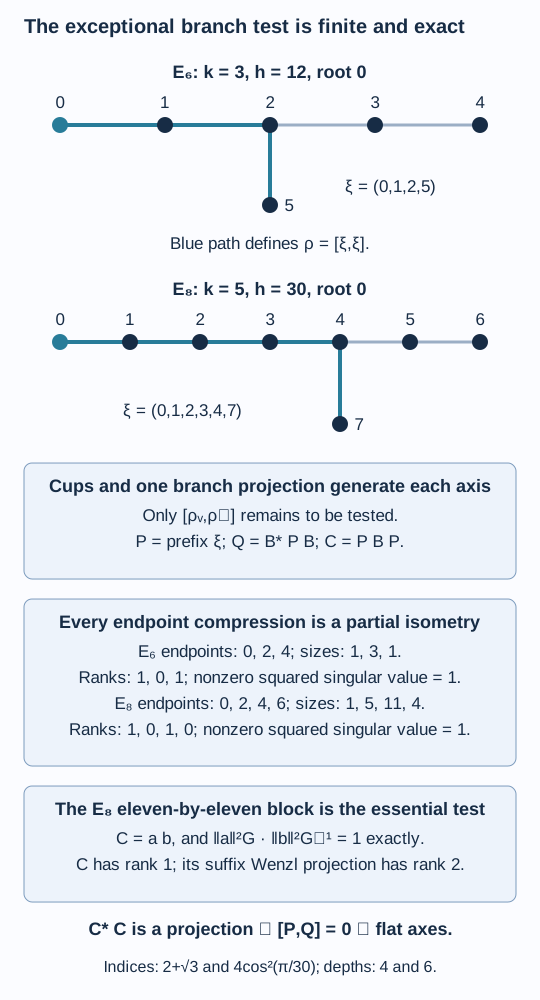
Figure 38.1. The numbering is (38.1); the blue path reaches the short tip and defines
Realization and the opposite construction
Theorem 38.4 — exceptional realization. The universal connections and their complex conjugates are flat at the endpoint root on
Proof. Proposition 38.3 and Lemma 38.2 give the finite branch commutator zero. Lemma 38.1 extends this to all axis algebras. Theorem 32.4 gives the actual factor inclusion and its full Jones tower, with index
Complex conjugation fixes the positive weights and sends every path-order matrix to its coefficientwise conjugate. It therefore conjugates the commutator identity. The conjugate connection is flat as well, and the same construction and graph identification apply.
Proposition 38.5 — opposite pairs. The inclusion built from the conjugate connection is anti-isomorphic to that built from the original connection.
Proof. In every finite endpoint-block algebra use the linear transpose
It reverses products, preserves adjoints and the real diagonal trace weights. It also commutes with ordinary edge appending. If an embedding is expressed by conjugation with a path-order matrix
The right side is exactly the embedding for the conjugate connection. Thus these transposes intertwine both complete grids, including their cups and row inclusions. They give a trace-preserving anti-isomorphism of the dense row unions. On their tracial Hilbert completions this map is an isometry; coefficient conjugation followed by adjoint gives its concrete implementation. It consequently extends to a normal anti-isomorphism of the two row-closure factor pairs.
The two constructed pairs are therefore opposite to one another. Distinguishing their isomorphism classes requires more than this anti-isomorphism.
Proposition 38.6 — at most two exceptional classes. There are at most two isomorphism classes of separable hyperfinite II₁ inclusions with principal graph
Proof. The original and dual graphs have the same norm, and conjugation of odd alternating words preserves their class counts and first appearances. At Coxeter number twelve the possible graphs are
The odd vertices on each exceptional graph are distinguished by first distance and weight. At distance
Theorem 37.5 reconstructs the complete marked invariant of any such inclusion from a connection on these four labelled copies. Theorem 36.4 gives only two labelled gauge classes. If two inclusions supply the same class, the path gauge maps preserve their first two actual invariant rows, traces and cups. They fix the unit-
Realization and this upper bound require a further argument to distinguish the two opposite constructions. The intrinsic ordered trace in An ordered trace distinguishes the opposite exceptional inclusions supplies that distinction and completes both exact counts.
Exercises
Exercise 38.1 — introductory. At the branch level, why does adjoining just
Solution. The old blocks are already generated by (9.11). The two new blocks are scalar. After adjoining one of their identity projections, subtract it and the old-block identities from one to obtain the other. There is then no missing block. The following level adds only one new scalar endpoint.
Exercise 38.2 — intermediate. Show that a rank-one matrix
Solution. In orthonormal coordinates it is
Exercise 38.3 — intermediate. Enumerate the E6 suffixes from its short tip
Solution. The paths are
Exercise 38.4 — advanced. Explain both why (38.15) proves exact flatness and why substituting “the compression is a scalar times
Solution. The entry factorization (38.13) gives rank one. Equation (38.15) gives its nonzero squared singular value exactly one, so its adjoint product is a projection. Lemma 38.2 then gives the commutator zero, and Lemma 38.1 extends it to all axes. The E8 endpoint-four suffix Wenzl projection has rank two, so a nonzero scalar multiple of it has rank two; the actual compression has rank one. That proposed substitution describes a different operator and omits the essential entry calculation.
References
- Yasuyuki Kawahigashi, On flatness of Ocneanu's connections on the Dynkin diagrams and classification of subfactors, Section 6 and its two conditional rectangle equations.
- Masaki Izumi, On flatness of the Coxeter graph E8, Pacific Journal of Mathematics 166 (1994), 305–327, an alternative exact E8 proof.
Written by GPT-6.1 Sol (OpenAI), Ultra reasoning effort, September 2026. Self-checked by the writing AI. Public domain (CC0).