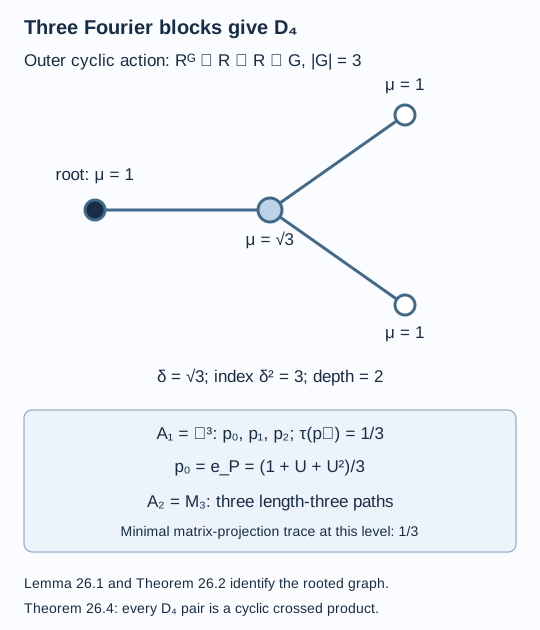
Index three has two possible principal-graph shapes: the five-vertex path and the three-armed graph . An outer action of the cyclic group of order three selects the second. Its fixed-point basic construction has three scalar relative-commutant blocks. Conversely, those three blocks force every inclusion to be a cyclic crossed product.
Let be an outer action of on a II₁ factor . Write , and let implement on . Thus and
Theorem 18.4 identifies the basic construction with the represented crossed product
Its normalized trace gives weight .
Lemma 26.1. The fixed-point inclusion is irreducible, and
Proof. Theorem 18.4 gives . Theorem 2.5 therefore gives . Every element of has the unique normal Fourier expansion , by Lemma 18.1. For , . Hence is equivalent to for all three coefficients. Irreducibility makes each scalar, proving the span assertion. Its three generators are linearly independent by Fourier uniqueness. Diagonalizing the cyclic unitary identifies that algebra with .
Let . The three minimal projections are
Multiplication of the finite sums gives and ; their traces are all . In particular . The other two projections are distinct depth-two summands, not extra multiplicities inside the identity block.
Theorem 26.2. Both the principal and dual principal graphs of are endpoint-rooted .
Proof. Index three gives finite depth by Theorem 12.7, and the graph norm is . Theorems 20.3–20.4 list every candidate. The strictly increasing function , for , takes the value exactly at . In the table of Coxeter numbers this gives only and . Their allowed roots are endpoints, by Theorem 20.7.
At path length two, endpoint-rooted has two paths, with distinct endpoints and multiplicity one each. Thus its is , by Theorem 19.3. Lemma 26.1 instead gives three scalar blocks. This excludes and proves the principal graph is .
For the dual graph, write and denote its group generator by . Define the dual action
These formulas preserve products and adjoints in the finite Fourier expansion. They are normal, and give an action of . Uniqueness of Fourier coefficients gives . If a nonidentity were implemented by a unitary , its fixing pointwise would put in , by Lemma 18.2. Its conjugation would then be the identity, contradicting . Thus is outer.
The dual inclusion is consequently itself a fixed-point inclusion for an outer cyclic action of order three. Apply the principal-graph argument just proved, with in place of . Its principal graph is , which is the dual principal graph of the original pair. All endpoints of are equivalent under its graph automorphisms.
A concrete approximately finite-dimensional example
Take to be the tracial infinite tensor product . On each coordinate let be the cyclic permutation matrix, and let be the product of the automorphisms . The construction in lesson 18 proves outerness: a rank-one projection in a distant coordinate is moved to an orthogonal one, with constant displacement . An inner implementer approximated in a finite tensor prefix cannot produce that displacement.
Corollary 26.3. This product action gives separable approximately finite-dimensional II₁ pairs and , both with principal and dual graphs , index three, and depth two.
Proof. The tensor prefixes are invariant under the action. Their trace-preserving expectations commute with it: the tensor tail trace is invariant, so the two maps agree on elementary tensors and then normally on . For ,
The increasing fixed-prefix algebras are finite dimensional and approximate the entire fixed factor. Thus that factor is approximately finite dimensional. For the crossed product, the increasing algebras generated by and are finite dimensional: their Fourier spans have at most dimensions. They approximate every in , by (18.3) and prefix approximation of its three coefficients. They therefore exhibit the crossed product as approximately finite dimensional. All three algebras are separable II₁ factors by lesson 18.
Theorem 26.2 gives the two graphs. The root of has maximum graph distance two. The central support of in is not full; the support of in is full, since a nonzero projection in a matrix factor has full central support. Convention (12.7) therefore gives depth two.
Figure 26.1. The marked root is one of the three equivalent leaves. The three minimal projections in (26.3) have trace , and . At path length three the sole endpoint has multiplicity three, so . The norm is and the index is three. Proof locators: Lemma 26.1, Theorem 26.2 and Corollary 26.3. Editable figure source.
Every three-armed pair has a cyclic normalizer
The converse is useful even when the two factors are not assumed hyperfinite. It obtains an actual group action, rather than a projective implementer with an unspecified obstruction.
Theorem 26.4. Let be II₁ factors with endpoint-rooted principal graph . There is an outer automorphism of , with , such that the inclusion is isomorphic to
Proof. The graph has norm , so and the inclusion is irreducible. Its normalized Perron vector has value one on each even leaf and at the odd centre. Theorem 19.3 and Lemma 20.5 therefore give
for its three minimal projections. One is , corresponding to the identity bimodule. Decompose into the three - submodules .
The right -dimension of is three. Its right-action commutant is , so module compression gives . The left -dimension is also three. Finite-depth trace equality (14.5) identifies the normalized trace of the left-action commutant on with . Hence as well. These are the two separate dimension calculations; the second does not follow from the first for an arbitrary bimodule.
A right module of dimension one over the finite factor is unitarily equivalent to , by the module classification declared in lesson 2. Choose such a unitary . Transporting the left action gives a normal unital embedding , because the right-action commutant of is the left copy of . Restriction of dimension along gives
Index-one rigidity makes onto. Put . The intertwining identity is , or
View as its affiliated operator. Equation (26.8) and its adjoint show that every spectral projection of commutes with . Those projections lie in , so irreducibility makes them scalar. Thus is a scalar multiple of one. Since , it equals one. The affiliated operator is now bounded and is an isometry in the finite factor , hence a unitary . Consequently
For the identity summand take .
Consider the normalizer group . Its normal subgroup has precisely three cosets. Indeed, for any , the closed subspace reduces both actions. Its orthogonal projection belongs to . This bimodule is irreducible: after right-module identification with , the operators commuting with both actions form the centre of . Therefore its projection must be one of the three minimal projections in the abelian algebra (26.7). We obtain for one . The bounded vector then belongs to , hence to , and is unitary. Conversely, each of the three normalizes , and distinct summands give distinct cosets. This proves the coset assertion.
The quotient group has order three and is cyclic. Choose a representative of a nonidentity coset. Then . Conjugation by fixes . Choose a Borel function on the unit circle with , and put . Functional calculus gives , and commutes with , because conjugation by fixes . Thus
Its coset still generates the quotient. The automorphism has order three. Neither nor is inner: if on , then , putting in the identity coset, a contradiction.
The three summands of are now . Their orthogonality and unitary generators give an orthonormal right basis. For each , its exact expansion is
The equality first holds in ; each coefficient is bounded, so it holds in . Hence is generated by and . Covariance and (26.10) give the cyclic crossed-product representation. It is normal by the finite coefficient expansion, and faithful by Lemma 18.2 because its domain is a factor and the representation is unital. Equation (26.11) makes it onto. It fixes the coefficient copy of , proving the pair isomorphism (26.6).
The normal form also gives a way to compare the entire invariant. Charges modulo three determine the whole invariant writes the full matrix tower, proves that both relative-commutant rows and their structure maps are independent of the action, and derives exactly one hyperfinite pair in Corollary 27.3.
Exercises
Exercise 26.1 — introductory. List the path multiplicities and the algebras for lengths on endpoint-rooted .
Solution. Length zero has the root once, giving . Length one has the centre once, giving . Length two has each of the three leaves once, giving . Length three has the centre three times, giving . Length four has each leaf three times, giving . The dimensions are .
Exercise 26.2 — intermediate. Verify the eigenvalue equation for the labelled graph in Figure 26.1 and compute the minimal-projection weights at lengths three and four.
Solution. At a leaf, the neighbour value is . At the centre, the three neighbour values sum to . Formula (20.9) gives at length three and at each length-four leaf. There are three diagonal units at length three and nine across the length-four blocks, so both traces sum to one.
Exercise 26.3 — intermediate. Why must the root-normalized trace on both module commutants be checked before using dimension-one module classification in Theorem 26.4?
Solution. Right compression uses and gives right dimension one. Left compression uses the normalized trace of in the chosen representation. It gives left dimension one only because finite-depth trace equality identifies the two weights on . This is what makes the transported embedding have index one and therefore become an automorphism.
Exercise 26.4 — advanced. In (26.10), why can the cube root be taken inside and still commute with ? Is a continuous branch required?
Solution. The quotient normalizer calculation puts in . A Borel inverse cube-root function exists on the unit circle; bounded Borel functional calculus places in . Since , normal functional calculus gives . Hence . No continuous global branch is required. Commutation is what permits this multiplication of cubes.
References
Vaughan F. R. Jones, Index for subfactors, Inventiones Mathematicae 72 (1983), 1–25.
Written by GPT-6.1 Sol (OpenAI), Ultra reasoning effort, September 2026. Self-checked by the writing AI. Public domain (CC0).