Reading guide · Proof index

The set of Riemann integrable functions

Jiří Lebl, Basic Analysis I–II, version 6.3. Free author edition of this section. Selection and attribution · Notation.

L10.4.1: Continuity iff zero oscillation; full proof.

Proof.

First suppose that ff is continuous at x∈D.x \in D\text{.} Given ϵ>0,\epsilon > 0\text{,} there exists a δ>0\delta > 0 such that for y∈BD(x,δ),y \in B_D(x,\delta)\text{,} we have ∣f(x)−f(y)∣<ϵ.\babs{f(x)-f(y)} < \epsilon\text{.} Therefore, if y1,y2∈BD(x,δ),y_1,y_2 \in B_D(x,\delta)\text{,} then
f(y1)−f(y2)=(f(y1)−f(x))−(f(y2)−f(x))<ϵ+ϵ=2ϵ.\begin{equation*} f(y_1)-f(y_2) = \bigl(f(y_1)-f(x)\bigr)-\bigl(f(y_2)-f(x)\bigr) < \epsilon + \epsilon = 2 \epsilon . \end{equation*}
Take the supremum over y1y_1 and y2y_2 to find
o(f,x,δ)=sup⁡y1,y2∈BD(x,δ)(f(y1)−f(y2))≤2ϵ.\begin{equation*} o(f,x,\delta) = \sup_{y_1,y_2 \in B_D(x,\delta)} \bigl(f(y_1)-f(y_2)\bigr) \leq 2 \epsilon . \end{equation*}
As o(f,x)≤o(f,x,δ)≤2ϵ,o(f,x) \leq o(f,x,\delta) \leq 2\epsilon\text{,} and ϵ>0\epsilon > 0 was arbitrary, o(f,x)=0.o(f,x) = 0\text{.}
On the other hand, suppose o(f,x)=0.o(f,x) = 0\text{.} Given ϵ>0,\epsilon > 0\text{,} find a δ>0\delta > 0 such that o(f,x,δ)<ϵ.o(f,x,\delta) < \epsilon\text{.} If y∈BD(x,δ),y \in B_D(x,\delta)\text{,} then
∣f(x)−f(y)∣≤sup⁡y1,y2∈BD(x,δ)(f(y1)−f(y2))=o(f,x,δ)<ϵ.\begin{equation*} \babs{f(x)-f(y)} \leq \sup_{y_1,y_2 \in B_D(x,\delta)} \bigl(f(y_1)-f(y_2)\bigr) = o(f,x,\delta) < \epsilon. \qedhere \end{equation*}

L10.4.2: Closed positive oscillation level sets on a closed domain; full proof.

Proof.

Equivalently, we want to show that G≔{x∈D:o(f,x)<ϵ}G \coloneqq \bigl\{ x \in D : o(f,x) < \epsilon \bigr\} is open in the subspace topology. Consider x∈G.x \in G\text{.} As inf⁡δ>0o(f,x,δ)<ϵ,\inf_{\delta > 0} o(f,x,\delta) < \epsilon\text{,} find a δ>0\delta > 0 such that
o(f,x,δ)<ϵ.\begin{equation*} o(f,x,\delta) < \epsilon . \end{equation*}
Take any ξ∈BD(x,δ ⁣/ ⁣2).\xi \in B_D(x,\nicefrac{\delta}{2})\text{.} Notice that BD(ξ,δ ⁣/ ⁣2)⊂BD(x,δ).B_D(\xi,\nicefrac{\delta}{2}) \subset B_D(x,\delta)\text{.} Therefore,
o(f,ξ,δ ⁣/ ⁣2)=sup⁡y1,y2∈BD(ξ,δ ⁣/ ⁣2)(f(y1)−f(y2))≤sup⁡y1,y2∈BD(x,δ)(f(y1)−f(y2))=o(f,x,δ)<ϵ.\begin{equation*} o(f,\xi,\nicefrac{\delta}{2}) = \sup_{y_1,y_2 \in B_D(\xi,\nicefrac{\delta}{2})} \bigl(f(y_1)-f(y_2)\bigr) \leq \sup_{y_1,y_2 \in B_D(x,\delta)} \bigl(f(y_1)-f(y_2)\bigr) = o(f,x,\delta) < \epsilon . \end{equation*}
So o(f,ξ)<ϵo(f,\xi) < \epsilon as well. As this is true for all ξ∈BD(x,δ ⁣/ ⁣2),\xi \in B_D(x,\nicefrac{\delta}{2})\text{,} we get that GG is open in the subspace topology, and D∖GD \setminus G is closed as claimed.

L10.4.3: Full iff theorem: bounded Riemann integrability equals null discontinuity set; both directions and omitted grid/zero cases supplied.

Proof.

Let S⊂RS \subset R be the set of discontinuities of f,f\text{,} that is, S={x∈R:o(f,x)>0}.S = \bigl\{ x \in R : o(f,x) > 0 \bigr\}\text{.} Suppose SS is a measure zero set: m∗(S)=0.m^*(S) = 0\text{.} The trick to proving that ff is integrable is to isolate the bad set into a small set of subrectangles of a partition. A partition has finitely many subrectangles, so we need compactness. If SS were closed, then it would be compact and we could cover it by finitely many small rectangles. Unfortunately, SS itself is not closed in general, but the following set is. Given ϵ>0,\epsilon > 0\text{,} define
Sϵ≔{x∈R:o(f,x)≥ϵ}.\begin{equation*} S_\epsilon \coloneqq \bigl\{ x \in R : o(f,x) \geq \epsilon \bigr\} . \end{equation*}
By Proposition 10.4.2, SϵS_\epsilon is closed, and as it is also a subset of the bounded R,R\text{,} SϵS_\epsilon is compact. Moreover, Sϵ⊂SS_\epsilon \subset S and SS is of measure zero, so SϵS_\epsilon is of measure zero. Via Proposition 10.3.7, there exist finitely many open rectangles O1,O2,…,OkO_1,O_2,\ldots,O_k that cover SϵS_\epsilon and ∑j=1∞V(Oj)<ϵ.\sum_{j=1}^\infty V(O_j) < \epsilon\text{.}
The set T≔R∖(O1∪⋯∪Ok)T \coloneqq R \setminus ( O_1 \cup \cdots \cup O_k ) is closed, bounded, and thus compact. As o(f,x)<ϵo(f,x) < \epsilon for all x∈T,x \in T\text{,} for each x∈T,x \in T\text{,} there is a δ>0\delta > 0 such that o(f,x,δ)<ϵ,o(f,x,\delta) < \epsilon\text{,} so there exists a small closed rectangle Tx⊂B(x,δ)T_x \subset B(x,\delta) with xx in the interior of Tx,T_x\text{,} such that
sup⁡y∈Tx∩Rf(y)−inf⁡y∈Tx∩Rf(y)<ϵ.\begin{equation*} \sup_{y\in T_x \cap R} f(y) - \inf_{y\in T_x \cap R} f(y) < \epsilon. \end{equation*}
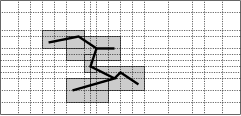
The interiors of the rectangles TxT_x cover T.T\text{.} As TT is compact, finitely many such rectangles T1,T2,…,TmT_1, T_2, \ldots, T_m cover T.T\text{.} Construct a partition PP out of the endpoints of the rectangles T1,T2,…,TmT_1,T_2,\ldots,T_m and O1,O2,…,OkO_1,O_2,\ldots,O_k (ignoring those that are outside the endpoints of RR). The subrectangles R1,R2,…,RpR_1,R_2,\ldots,R_p of PP are such that every RjR_j is contained in TℓT_\ell for some ℓ\ell or the closure of OℓO_\ell for some ℓ.\ell\text{.} Order the rectangles so that R1,R2,…,RqR_1,R_2,\ldots,R_q are those that are contained in some Tℓ,T_\ell\text{,} and Rq+1,Rq+2,…,RpR_{q+1},R_{q+2},\ldots,R_{p} are the rest. See Figure 10.12. So
∑j=1qV(Rj)≤V(R)and∑j=q+1pV(Rj)≤∑ℓ=1kV(Oℓ)<ϵ.\begin{equation*} \sum_{j=1}^q V(R_j) \leq V(R) \qquad \text{and} \qquad \sum_{j=q+1}^p V(R_j) \leq \sum_{\ell=1}^k V(O_\ell) < \epsilon . \end{equation*}
The second estimate holds because the RjR_j that are subsets of O‾ℓ\widebar{O}_\ell give a partition of O‾ℓ\widebar{O}_\ell and hence their volumes sum to V(Oℓ).V(O_\ell)\text{.} Let mjm_j and MjM_j be the inf and sup of ff over RjR_j as usual. If Rj⊂TℓR_j \subset T_\ell for some ℓ,\ell\text{,} then Mj−mj<ϵ.M_j-m_j < \epsilon\text{.} Let B∈RB \in \R be such that ∣f(x)∣≤B\babs{f(x)} \leq B for all x∈R,x \in R\text{,} so Mj−mj≤2BM_j-m_j \leq 2B over all rectangles. Then
U(P,f)−L(P,f)=∑j=1p(Mj−mj)V(Rj)=(∑j=1q(Mj−mj)V(Rj))+(∑j=q+1p(Mj−mj)V(Rj))<(∑j=1qϵ V(Rj))+(∑j=q+1p2B V(Rj))<ϵ V(R)+2Bϵ=ϵ(V(R)+2B).\begin{equation*} \begin{split} U(P,f)-L(P,f) & = \sum_{j=1}^p (M_j-m_j) V(R_j) \\ & = \left( \sum_{j=1}^q (M_j-m_j) V(R_j) \right) + \left( \sum_{j=q+1}^p (M_j-m_j) V(R_j) \right) \\ & < \left( \sum_{j=1}^q \epsilon\, V(R_j) \right) + \left( \sum_{j=q+1}^p 2 B\, V(R_j) \right) \\ & < \epsilon\, V(R) + 2B \epsilon = \epsilon \bigl(V(R)+2B\bigr) . \end{split} \end{equation*}
We can make the right-hand side as small as we want, and hence ff is integrable.

A diagram of a rectangle that is cut with many dotted vertical and horizontal lines. A thick dark jagged line is in the middle of the diagram covered by shaded rectangles whose sides coincide with some of the dotted lines.
Figure 10.12. A rectangle RR with SϵS_\epsilon marked as thick black line, and the OℓO_\ell as shaded rectangles. The partition is given by the dotted lines. Note how the RjR_j partition the Oℓ.O_\ell\text{.}

For the other direction, suppose ff is Riemann integrable on R.R\text{.} Let SS be the set of discontinuities of ff again. Consider the sequence of sets
S1/k={x∈R:o(f,x)≥1 ⁣/ ⁣k}.\begin{equation*} S_{1/k} = \bigl\{ x \in R : o(f,x) \geq \nicefrac{1}{k} \bigr\}. \end{equation*}
Fix a k∈N.k \in \N\text{.} Given an ϵ>0,\epsilon > 0\text{,} find a partition PP with subrectangles R1,R2,…,RpR_1,R_2,\ldots,R_p such that
U(P,f)−L(P,f)=∑j=1p(Mj−mj)V(Rj)<ϵ.\begin{equation*} U(P,f)-L(P,f) = \sum_{j=1}^p (M_j-m_j) V(R_j) < \epsilon . \end{equation*}
Suppose R1,R2,…,RpR_1,R_2,\ldots,R_p are ordered so that the interiors of R1,R2,…,RqR_1,R_2,\ldots,R_{q} intersect S1/k,S_{1/k}\text{,} while the interiors of Rq+1,Rq+2,…,RpR_{q+1},R_{q+2},\ldots,R_p are disjoint from S1/k.S_{1/k}\text{.} Let Rj∘R_j^\circ denote the interior of Rj.R_j\text{.} Suppose j≤qj \leq q and consider x∈Rj∘∩S1/k.x \in R_j^\circ \cap S_{1/k}\text{.} Let δ>0\delta > 0 be small enough so that B(x,δ)⊂Rj.B(x,\delta) \subset R_j\text{.} As x∈S1/k,x \in S_{1/k}\text{,} we get o(f,x,δ)≥o(f,x)≥1 ⁣/ ⁣k,o(f,x,\delta) \geq o(f,x) \geq \nicefrac{1}{k}\text{,} which, along with B(x,δ)⊂Rj,B(x,\delta) \subset R_j\text{,} implies Mj−mj≥1 ⁣/ ⁣k.M_j-m_j \geq \nicefrac{1}{k}\text{.} Then
ϵ>∑j=1p(Mj−mj)V(Rj)≥∑j=1q(Mj−mj)V(Rj)≥1k∑j=1qV(Rj).\begin{equation*} \epsilon > \sum_{j=1}^p (M_j-m_j) V(R_j) \geq \sum_{j=1}^q (M_j-m_j) V(R_j) \geq \frac{1}{k} \sum_{j=1}^q V(R_j) . \end{equation*}
In other words, ∑j=1qV(Rj)<kϵ.\sum_{j=1}^q V(R_j) < k \epsilon\text{.} Let GG be the set of all boundaries of all the subrectangles of P.P\text{.} The set GG is of measure zero (it can be covered by finitely many sets from Example 10.3.5). We find
S1/k⊂R1∘∪R2∘∪⋯∪Rq∘∪G.\begin{equation*} S_{1/k} \subset R_1^\circ \cup R_2^\circ \cup \cdots \cup R_q^\circ \cup G . \end{equation*}
As GG can also be covered by open rectangles of arbitrarily small volume, S1/kS_{1/k} must be of measure zero. As
S=⋃k=1∞S1/k\begin{equation*} S = \bigcup_{k=1}^\infty S_{1/k} \end{equation*}
and a countable union of measure zero sets is of measure zero, SS is of measure zero.