Reading guide · Proof index

Outer measure and null sets

Jiří Lebl, Basic Analysis I–II, version 6.3. Free author edition of this section. Selection and attribution · Notation.

L10.3.2: Full small-ball characterization of null sets, with finite subdivision and countable regrouping supplied.
Proof.

If CC is a closed cube (rectangle with all sides equal) of side s,s\text{,} then CC is contained in a closed ball of radius n s\sqrt{n}\, s by Proposition 10.1.14 and so in an open ball of radius 2n s.2 \sqrt{n}\, s\text{.}
 1 
A closed ball of radius n s2\frac{\sqrt{n}\,s}{2} could be used but that requires an argument and n s\sqrt{n}\, s is good enough.
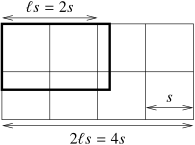
Suppose RR is a rectangle of positive volume. Let s>0s > 0 be a number less than the smallest side of RR and such that 2n s<δ.2\sqrt{n} \, s < \delta\text{.} If each side of RR is an integer multiple of s,s\text{,} then RR is contained in a union of closed cubes C1,C2,…,CmC_1, C_2, \ldots, C_m of side ss such that ∑k=1mV(Ck)=V(R).\sum_{k=1}^m V(C_k) = V(R)\text{.} So suppose the sides of RR are not integer multiples of s.s\text{.} Consider a side of length (ℓ+α)s,(\ell+\alpha) s\text{,} for an integer ℓ\ell and 0≤α<1.0 \leq \alpha < 1\text{.} As ss is less than the smallest side, ℓ≥1,\ell \geq 1\text{,} and so (ℓ+α)s≤2ℓs.(\ell+\alpha)s \leq 2\ell s\text{.} Increasing this side to 2ℓs,2\ell s\text{,} and similarly increasing every side of R,R\text{,} we obtain a new larger rectangle of volume at most 2n2^n times larger, whose sides are multiples of s.s\text{.} See Figure 10.7. Thus RR is contained in a union of closed cubes C1,C2,…,CmC_1, C_2, \ldots, C_m of side ss such that
∑k=1mV(Ck)≤2nV(R).\begin{equation*} \sum_{k=1}^m V(C_k) \leq 2^n V(R) . \end{equation*}

A rectangle marked in bold line. There is a grid of squares of side length s with 2 rows and 4 columns that is aligned on the top left corner with the dark rectangle. The dark rectangle goes a little further than 2 s across and a little further than s down. The first two lengths across are marked as ell s equals 2 s and the entire set of 4 lengths across is marked as 2 ell s equals 4 s.
Figure 10.7. Covering a rectangle by cubes of total size at most 2nV(R).2^n V(R)\text{.}

So suppose that SS is a null set and there exist open rectangles {Rj}j=1∞\{ R_j \}_{j=1}^\infty whose union contains SS and such that (10.2) is true. Choose closed cubes {Ck}k=1∞\{ C_k \}_{k=1}^\infty with CkC_k of side sks_k as above that cover all the rectangles {Rj}j=1∞\{ R_j \}_{j=1}^\infty and so that
∑k=1∞skn=∑k=1∞V(Ck)≤2n∑j=1∞V(Rj)<2nϵ.\begin{equation*} \sum_{k=1}^\infty s_k^n = \sum_{k=1}^\infty V(C_k) \leq 2^n \sum_{j=1}^\infty V(R_j) < 2^n \epsilon. \end{equation*}
Covering each CkC_k with a ball BkB_k of radius rk=2n sk<δ,r_k = 2\sqrt{n} \, s_k < \delta\text{,} we obtain
∑k=1∞rkn=∑k=1∞(2n)nskn<(4n)nϵ.\begin{equation*} \sum_{k=1}^\infty r_k^n = \sum_{k=1}^\infty {\bigl(2\sqrt{n}\bigr)}^n s_k^n < {\bigl(4\sqrt{n}\bigr)}^n \epsilon . \end{equation*}
As S⊂⋃jRj⊂⋃kCk⊂⋃kBkS \subset\bigcup_{j} R_j \subset \bigcup_{k} C_k \subset \bigcup_{k} B_k and (4n)nϵ{\bigl(4\sqrt{n}\bigr)}^n \epsilon can be arbitrarily small, the forward direction follows.
For the other direction, suppose SS is covered by balls BjB_j of radii rj,r_j\text{,} such that ∑j=1∞rjn<ϵ,\sum_{j=1}^\infty r_j^n < \epsilon\text{,} as in the statement of the proposition. Each BjB_j is contained in an open cube RjR_j of side 2rj.2r_j\text{.} So V(Rj)=(2rj)n=2nrjn.V(R_j) = {(2 r_j)}^n = 2^n r_j^n\text{.} Therefore,
S⊂⋃j=1∞Rjand∑j=1∞V(Rj)≤∑j=1∞2nrjn<2nϵ.\begin{equation*} S \subset \bigcup_{j=1}^\infty R_j \qquad \text{and} \qquad \sum_{j=1}^\infty V(R_j) \leq \sum_{j=1}^\infty 2^n r_j^n < 2^n \epsilon. \qedhere \end{equation*}

L10.3.4: Countable union theorem with the nonnegative double-series exercise completed in P19.1.

Proof.

Suppose
S=⋃j=1∞Sj,\begin{equation*} S = \bigcup_{j=1}^\infty S_j , \end{equation*}
where SjS_j are all measure zero sets. Let ϵ>0\epsilon > 0 be given. For each j,j\text{,} there exists a sequence of open rectangles {Rj,k}k=1∞\{ R_{j,k} \}_{k=1}^\infty such that
Sj⊂⋃k=1∞Rj,kand∑k=1∞V(Rj,k)<2−jϵ.\begin{equation*} S_j \subset \bigcup_{k=1}^\infty R_{j,k} \qquad \text{and} \qquad \sum_{k=1}^\infty V(R_{j,k}) < 2^{-j} \epsilon . \end{equation*}
Then
S⊂⋃j=1∞⋃k=1∞Rj,k.\begin{equation*} S \subset \bigcup_{j=1}^\infty \bigcup_{k=1}^\infty R_{j,k} . \end{equation*}
All V(Rj,k)V(R_{j,k}) are nonnegative, so the sum over all jj and kk can be done by summing first over the kk and then over the j,j\text{,} see Exercise 2.6.15. In particular,
∑j=1∞∑k=1∞V(Rj,k)<∑j=1∞2−jϵ=ϵ.\begin{equation*} \sum_{j=1}^\infty \sum_{k=1}^\infty V(R_{j,k}) < \sum_{j=1}^\infty 2^{-j} \epsilon = \epsilon . \qedhere \end{equation*}

L10.3.7: Finite open rectangle and small-ball covers of compact null sets; omitted ball case supplied.

Proof.

As EE is of measure zero, there exists a sequence of open rectangles {Rj}j=1∞\{ R_j \}_{j=1}^\infty such that
E⊂⋃j=1∞Rjand∑j=1∞V(Rj)<ϵ.\begin{equation*} E \subset \bigcup_{j=1}^\infty R_j \qquad \text{and} \qquad \sum_{j=1}^\infty V(R_j) < \epsilon. \end{equation*}
By compactness, there are finitely many of these rectangles that still contain E.E\text{.} That is, there is some kk such that E⊂R1∪R2∪⋯∪Rk.E \subset R_1 \cup R_2 \cup \cdots \cup R_k\text{.} Hence
∑j=1kV(Rj)≤∑j=1∞V(Rj)<ϵ.\begin{equation*} \sum_{j=1}^k V(R_j) \leq \sum_{j=1}^\infty V(R_j) < \epsilon. \end{equation*}
The proof that we can choose balls instead of rectangles is left as an exercise.

L10.3.10: Full null-image theorem; the omitted noncompact case and positive ball-bound convention are P19.4.

Proof.

We prove the proposition for a compact EE and leave the general case as an exercise. Suppose EE is compact and of measure zero. First, we will replace UU by a smaller open set to make ∥f′(x)∥\bnorm{f'(x)} bounded. At each point x∈Ex \in E pick an open ball B(x,rx)B(x,r_x) such that the closed ball C(x,rx)⊂U.C(x,r_x) \subset U\text{.} By compactness, we only need to take finitely many points x1,x2,…,xqx_1,x_2,\ldots,x_q to cover EE with the balls B(xj,rxj).B(x_j,r_{x_j})\text{.} Define
U′≔⋃j=1qB(xj,rxj),K≔⋃j=1qC(xj,rxj).\begin{equation*} U' \coloneqq \bigcup_{j=1}^q B(x_j,r_{x_j}), \qquad K \coloneqq \bigcup_{j=1}^q C(x_j,r_{x_j}). \end{equation*}
We have E⊂U′⊂K⊂U.E \subset U' \subset K \subset U\text{.} The set K,K\text{,} being a finite union of compact sets, is compact. The function that takes xx to ∥f′(x)∥\bnorm{f'(x)} is continuous, and therefore there exists an M>0M > 0 such that ∥f′(x)∥≤M\bnorm{f'(x)} \leq M for all x∈K.x \in K\text{.} So without loss of generality, we may replace UU by U′U' and from now on suppose that ∥f′(x)∥≤M\bnorm{f'(x)} \leq M for all x∈U.x \in U\text{.}
At each x∈E,x \in E\text{,} take the maximum radius δx\delta_x such that B(x,δx)⊂UB(x,\delta_x) \subset U (we may assume U≠RnU \neq \R^n). Let δ≔inf⁡x∈Eδx.\delta \coloneqq \inf_{x\in E} \delta_x\text{.} We want to show that δ>0.\delta > 0\text{.} Take a sequence {xj}j=1∞\{ x_j \}_{j=1}^\infty in EE so that δxj→δ.\delta_{x_j} \to \delta\text{.} As EE is compact, we can pick the sequence to be convergent to some y∈E.y \in E\text{.} Once ∥xj−y∥<δy2,\snorm{x_j-y} < \frac{\delta_y}{2}\text{,} then δxj>δy2\delta_{x_j} > \frac{\delta_y}{2} by the triangle inequality. Thus, δ>0.\delta > 0\text{.}
Given ϵ>0,\epsilon > 0\text{,} there exist balls B1,B2,…,BkB_1,B_2,\ldots,B_k of radii r1,r2,…,rk<δ ⁣/ ⁣2r_1,r_2,\ldots,r_k < \nicefrac{\delta}{2} such that
E⊂B1∪B2∪⋯∪Bkand∑j=1krjn<ϵ.\begin{equation*} E \subset B_1 \cup B_2 \cup \cdots \cup B_k \qquad \text{and} \qquad \sum_{j=1}^k r_j^n < \epsilon. \end{equation*}
We can assume that each ball contains a point of EE and so the balls are contained in U.U\text{.} Suppose B1′,B2′,…,Bk′B_1', B_2', \ldots, B_k' are the balls of radius Mr1,Mr2,…,MrkMr_1, Mr_2, \ldots, Mr_k from Lemma 10.3.9, such that f(Bj)⊂Bj′f(B_j) \subset B_j' for all j.j\text{.} Then,
f(E)⊂f(B1)∪f(B2)∪⋯∪f(Bk)⊂B1′∪B2′∪⋯∪Bk′and∑j=1k(Mrj)n<Mnϵ.\begin{equation*} \begin{aligned} f(E) & \subset f(B_1) \cup f(B_2) \cup \cdots \cup f(B_k) \\ & \subset B_1' \cup B_2' \cup \cdots \cup B_k' \end{aligned} \qquad \text{and} \qquad \sum_{j=1}^k {(Mr_j)}^n < M^n \epsilon. \qedhere \end{equation*}