Reading guide · Proof index

Riemann integral over rectangles

Jiří Lebl, Basic Analysis I–II, version 6.3. Free author edition of this section. Selection and attribution · Notation.

L10.1.2: Full Darboux bounds, with the used volume exercise now proved.

Proof.

Let PP be a partition of R.R\text{.} For all i,i\text{,} we have m≤mi≤Mi≤M.m \leq m_i \leq M_i \leq M\text{.} Also ∑i=1NV(Ri)=V(R).\sum_{i=1}^N V(R_i) = V(R)\text{.} Therefore,
m V(R)=m(∑i=1NV(Ri))=∑i=1Nm V(Ri)≤∑i=1Nmi V(Ri)≤≤∑i=1NMi V(Ri)≤∑i=1NM V(Ri)=M(∑i=1NV(Ri))=M V(R).\begin{gathered} m \, V(R) = m \left( \sum_{i=1}^N V(R_i) \right) = \sum_{i=1}^N m \, V(R_i) \leq \sum_{i=1}^N m_i \, V(R_i) \leq \\ \leq \sum_{i=1}^N M_i \, V(R_i) \leq \sum_{i=1}^N M \,V(R_i) = M \left( \sum_{i=1}^N V(R_i) \right) = M \,V(R) . \qedhere \end{gathered}

L10.1.5: Both refinement inequalities; upper half is P17.1.

Proof.

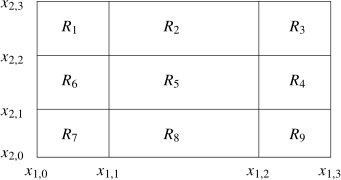
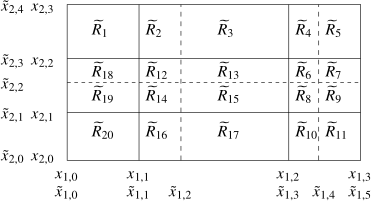
We prove the first inequality, and the second follows similarly. Let R1,R2,…,RNR_1,R_2,\ldots,R_N be the subrectangles of PP and R~1,R~2,…,R~N~\widetilde{R}_1,\widetilde{R}_2,\ldots,\widetilde{R}_{\widetilde{N}} be the subrectangles of P~.\widetilde{P}\text{.} Let IkI_k be the set of all indices jj such that R~j⊂Rk.\widetilde{R}_j \subset R_k\text{.} For example, in figures 10.1 and 10.2, I4={6,7,8,9}I_4 = \{ 6, 7, 8, 9 \} as R4=R~6∪R~7∪R~8∪R~9.R_4 = \widetilde{R}_6 \cup \widetilde{R}_7 \cup \widetilde{R}_8 \cup \widetilde{R}_9\text{.} Then,
Rk=⋃j∈IkR~j,V(Rk)=∑j∈IkV(R~j).\begin{equation*} R_k = \bigcup_{j \in I_k} \widetilde{R}_j, \qquad V(R_k) = \sum_{j \in I_k} V(\widetilde{R}_j). \end{equation*}
Let mk≔inf⁡{f(x):x∈Rk},m_k \coloneqq \inf \bigl\{ f(x) : x \in R_k \bigr\}\text{,} and m~j≔inf⁡{f(x):x∈R~j}\widetilde{m}_j \coloneqq \inf \bigl\{ f(x) : x \in \widetilde{R}_j \bigr\} as usual. If j∈Ik,j \in I_k\text{,} then mk≤m~j.m_k \leq \widetilde{m}_j\text{.} Then
L(P,f)=∑k=1NmkV(Rk)=∑k=1N∑j∈IkmkV(R~j)≤∑k=1N∑j∈Ikm~jV(R~j)=∑j=1N~m~jV(R~j)=L(P~,f).\begin{equation*} \begin{aligned} L(P,f) = \sum_{k=1}^N m_k V(R_k) & = \sum_{k=1}^N \sum_{j\in I_k} m_k V(\widetilde{R}_j) \\ & \leq \sum_{k=1}^N \sum_{j\in I_k} \widetilde{m}_j V(\widetilde{R}_j) = \sum_{j=1}^{\widetilde{N}} \widetilde{m}_j V(\widetilde{R}_j) = L(\widetilde{P},f) . \qedhere \end{aligned} \end{equation*}

L10.1.6: Complete common-refinement proof of lower <= upper integral and volume bounds.

Proof.

For every partition P,P\text{,} via Proposition 10.1.2,
m V(R)≤L(P,f)≤U(P,f)≤M V(R).\begin{equation*} m\,V(R) \leq L(P,f) \leq U(P,f) \leq M\,V(R). \end{equation*}
Taking the supremum of L(P,f)L(P,f) and the infimum of U(P,f)U(P,f) over all partitions P,P\text{,} we obtain the first and the last inequality in (10.1).
The key inequality in (10.1) is the middle one. Let P=(P1,P2,…,Pn)P=(P_1,P_2,\ldots,P_n) and Q=(Q1,Q2,…,Qn)Q=(Q_1,Q_2,\ldots,Q_n) be partitions of R.R\text{.} Define P~=(P~1,P~2,…,P~n)\widetilde{P} = ( \widetilde{P}_1,\widetilde{P}_2,\ldots,\widetilde{P}_n ) by letting P~k≔Pk∪Qk\widetilde{P}_k \coloneqq P_k \cup Q_k for every k.k\text{.} Then P~\widetilde{P} is a partition of R,R\text{,} and P~\widetilde{P} is a refinement of PP and also a refinement of Q.Q\text{.} By Proposition 10.1.5, L(P,f)≤L(P~,f)L(P,f) \leq L(\widetilde{P},f) and U(P~,f)≤U(Q,f).U(\widetilde{P},f) \leq U(Q,f)\text{.} Therefore,
L(P,f)≤L(P~,f)≤U(P~,f)≤U(Q,f).\begin{equation*} L(P,f) \leq L(\widetilde{P},f) \leq U(\widetilde{P},f) \leq U(Q,f) . \end{equation*}
In other words, for two arbitrary partitions PP and Q,Q\text{,} we have L(P,f)≤U(Q,f).L(P,f) \leq U(Q,f)\text{.} Via Proposition 1.2.7, we obtain
sup⁡ {L(P,f):P a partition of R}≤inf⁡ {U(P,f):P a partition of R}.\begin{equation*} \sup \, \bigl\{ L(P,f) : P \text{ a partition of } R \bigr\} \leq \inf \, \bigl\{ U(P,f) : P \text{ a partition of } R \bigr\} . \end{equation*}
In other words, ∫R‾f≤∫R‾f.\underline{\int_R} f \leq \overline{\int_R} f\text{.}

L10.1.12: Both directions of the small-gap criterion with supremum/infimum operations explicitly available.

Proof.

First, if ff is integrable, then the supremum of L(P,f)L(P,f) and infimum of U(Q,f)U(Q,f) over all partitions PP and QQ are equal and hence the infimum of U(P,f)−L(Q,f)U(P,f)-L(Q,f) is zero. Taking a common refinement P~\widetilde{P} of PP and QQ we find U(P~,f)−L(P~,f)≤U(P,f)−L(Q,f).U(\widetilde{P},f)-L(\widetilde{P},f) \leq U(P,f)-L(Q,f)\text{.} Hence the infimum of U(P,f)−L(P,f)U(P,f)-L(P,f) over all partitions PP is zero, and so for every ϵ>0,\epsilon > 0\text{,} there must be some partition PP such that U(P,f)−L(P,f)<ϵ.U(P,f) - L(P,f) < \epsilon\text{.}
For the other direction, given an ϵ>0\epsilon > 0 find PP such that U(P,f)−L(P,f)<ϵ.U(P,f) - L(P,f) < \epsilon\text{.}
∫R‾f−∫R‾f≤U(P,f)−L(P,f)<ϵ.\begin{equation*} \overline{\int_R} f - \underline{\int_R} f \leq U(P,f) - L(P,f) < \epsilon . \end{equation*}
As ∫R‾f≥∫R‾f\overline{\int_R} f \geq \underline{\int_R} f and the above holds for every ϵ>0,\epsilon > 0\text{,} we conclude ∫R‾f=∫R‾f\overline{\int_R} f = \underline{\int_R} f and f∈R(R).f \in \sR(R)\text{.}

L10.1.13: Restriction to a subrectangle including the locally supplied degenerate cases.

Proof.

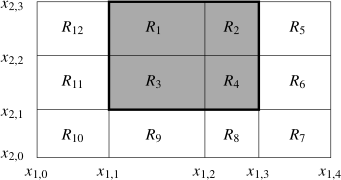
Given ϵ>0,\epsilon > 0\text{,} find a partition P=(P1,…,Pn)P=(P_1,\ldots,P_n) of SS such that U(P,f)−L(P,f)<ϵ.U(P,f)-L(P,f) < \epsilon\text{.} By making a refinement of PP if necessary, assume that the endpoints of RR are in P.P\text{.} That is, if R=[a1,b1]×[a2,b2]×⋯×[an,bn],R = [a_1,b_1] \times [a_2,b_2] \times \cdots \times [a_n,b_n]\text{,} then ai,bi∈Pi.a_i,b_i \in P_i\text{.} Let P~=(P~1,…,P~n)\widetilde{P} = (\widetilde{P}_1,\ldots,\widetilde{P}_n) be the partition of RR given by P~i=Pi∩[ai,bi].\widetilde{P}_i = P_i \cap [a_i,b_i]\text{.} Subrectangles of P~\widetilde{P} are subrectangles of P,P\text{,} that is, RR is a union of subrectangles of P.P\text{.} Divide the subrectangles of PP into two collections: Let R1,R2…,RKR_1,R_2\ldots,R_K be the subrectangles of PP that are also subrectangles of P~\widetilde{P} and let RK+1,…,RNR_{K+1},\ldots, R_N be the rest. See Figure 10.3. Let mkm_k and MkM_k be the infimum and supremum of ff on RkR_k as usual. Then,
ϵ>U(P,f)−L(P,f)=∑k=1K(Mk−mk)V(Rk)+∑k=K+1N(Mk−mk)V(Rk)≥∑k=1K(Mk−mk)V(Rk)=U(P~,f∣R)−L(P~,f∣R).\begin{equation*} \begin{split} \epsilon & > U(P,f)-L(P,f) = \sum_{k=1}^K (M_k-m_k) V(R_k) + \sum_{k=K+1}^N (M_k-m_k) V(R_k) \\ & \geq \sum_{k=1}^K (M_k-m_k) V(R_k) = U(\widetilde{P},f|_R)-L(\widetilde{P},f|_R) . \end{split} \end{equation*}
Therefore, f∣Rf|_R is integrable.

L10.1.14: Full rectangle-diameter inequality.

Proof.

∥x−y∥=(x1−y1)2+(x2−y2)2+⋯+(xn−yn)2≤(b1−a1)2+(b2−a2)2+⋯+(bn−an)2≤α2+α2+⋯+α2=n α.\begin{equation*} \begin{split} \snorm{x-y} & = \sqrt{ {(x_1-y_1)}^2 + {(x_2-y_2)}^2 + \cdots + {(x_n-y_n)}^2 } \\ & \leq \sqrt{ {(b_1-a_1)}^2 + {(b_2-a_2)}^2 + \cdots + {(b_n-a_n)}^2 } \\ & \leq \sqrt{ {\alpha}^2 + {\alpha}^2 + \cdots + {\alpha}^2 } = \sqrt{n} \, \alpha . \qedhere \end{split} \end{equation*}

L10.1.15: Complete continuous-integrability argument, with its fine-grid and zero-case omissions supplied.

Proof.

The proof is analogous to the one-variable proof with some complications. The set RR is a closed and bounded subset of Rn,\R^n\text{,} and hence compact. So ff is uniformly continuous by Theorem 7.5.11. Let ϵ>0\epsilon > 0 be given. Find a δ>0\delta > 0 such that ∥x−y∥<δ\snorm{x-y} < \delta implies ∣f(x)−f(y)∣<ϵV(R).\babs{f(x)-f(y)} < \frac{\epsilon}{V(R)}\text{.}
Let PP be a partition of R,R\text{,} where the longest side of every subrectangle is strictly less than δn.\frac{\delta}{\sqrt{n}}\text{.} If x,y∈Rkx, y \in R_k for a subrectangle RkR_k of P,P\text{,} then, by the proposition, ∥x−y∥<nδn=δ.\snorm{x-y} < \sqrt{n} \frac{\delta}{\sqrt{n}} = \delta\text{.} Therefore,
f(x)−f(y)≤∣f(x)−f(y)∣<ϵV(R).\begin{equation*} f(x)-f(y) \leq \babs{f(x)-f(y)} < \frac{\epsilon}{V(R)} . \end{equation*}
As ff is continuous on Rk,R_k\text{,} which is compact, ff attains a maximum and a minimum on this subrectangle. Let xx be a point where ff attains the maximum and yy be a point where ff attains the minimum. Then f(x)=Mkf(x) = M_k and f(y)=mkf(y) = m_k in the notation from the definition of the integral. Thus,
Mk−mk=f(x)−f(y)<ϵV(R).\begin{equation*} M_k-m_k = f(x)-f(y) < \frac{\epsilon}{V(R)} . \end{equation*}
And so
U(P,f)−L(P,f)=(∑k=1NMkV(Rk))−(∑k=1NmkV(Rk))=∑k=1N(Mk−mk)V(Rk)<ϵV(R)∑k=1NV(Rk)=ϵ.\begin{equation*} \begin{split} U(P,f) - L(P,f) & = \left( \sum_{k=1}^N M_k V(R_k) \right) - \left( \sum_{k=1}^N m_k V(R_k) \right) \\ & = \sum_{k=1}^N (M_k-m_k) V(R_k) \\ & < \frac{\epsilon}{V(R)} \sum_{k=1}^N V(R_k) = \epsilon. \end{split} \end{equation*}
Proposition 10.1.12 then says that f∈R(R).f \in \sR(R)\text{.}

L10.1.19: Independence of support-containing rectangle, with the exact zero-extension exercise and empty-support case supplied in P17.3.
Proof.

As ff is continuous, it is automatically integrable on the rectangles R,R\text{,} S,S\text{,} and R∩S.R \cap S\text{.} Applying Exercise 10.1.7 twice, ∫Sf=∫S∩Rf=∫Rf.\int_S f = \int_{S \cap R} f = \int_R f\text{.}
A diagram of a rectangle divided by two horizontal and two vertical lines into 9 smaller rectangles. The four vertices on the horizontal axis from left to right are labeled x sub 1,0, x sub 1,1, x sub 1,2, and x sub 1,3. On the vertical axis from bottom to top the vertices are labeled x sub 2,0, x sub 2,1, x sub 2,2, and x sub 2,3. The smaller rectangles are labeled in a snaking pattern from top left to bottom right R sub 1, R sub 2, and so on until R sub 9.
Figure 10.1. Example partition of a rectangle in R2.\R^2\text{.} The order of the subrectangles is not important.
A diagram of a divided rectangle as the previous one with extra marks. There are two more vertical cuts and one horizontal one marked in dashed line, now dividing the rectangle into 20 smaller rectangles labeled R tilde sub 1 through R tilde sub 20 in no particular order. The vertices on the horizontal and the vertical axis are marked similarly to before but now with x tilde sub 1,0 through x tilde sub 1,5 and x tilde sub 2,0 through x tilde sub 2,4 in order. On the old cuts both the old and new markings are shown, so for example x sub 1,2 has also the mark x tilde sub 1,3.
Figure 10.2. Example refinement of the partition from Figure 10.1. New “cuts” are marked in dashed lines. The exact order of the new subrectangles does not matter.
A rectangle subdivided into subrectangles in the same manner as before, this time with 2 horizontal and 3 vertical cuts into 12 smaller rectangles. A set of 4 smaller rectangles from the second and third row and second and third column is marked in dark shade and these 4 rectangles are labeled R sub 1, R sub 2, R sub 3, and R sub 4.
Figure 10.3. A partition of a large rectangle S,S\text{,} that also gives a partition of a smaller rectangle (shaded and outlined) R⊂S.R \subset S\text{.} The subrectangles R1,R2,R3,R4R_1,R_2,R_3,R_4 are the subrectangles of P~=({x1,1,x1,2,x1,3},{x2,1,x2,2,x2,3}).\widetilde{P} = \bigl( \{ x_{1,1}, x_{1,2} , x_{1,3} \} , \{ x_{2,1}, x_{2,2} , x_{2,3} \} \bigr)\text{.}