L10.7.2: Full compact Jordan change-of-variables theorem for Riemann-integrable amplitudes. The neighbourhood restriction and every used exercise are supplied by P19–P21.2.
Theorem10.7.2.
Suppose U⊂Rn is open, S⊂U is a compact Jordan measurable set, and g:U→Rn is a one-to-one continuously differentiable mapping, such that Jg is never zero on S. Suppose f:g(S)→R is Riemann integrable. Then f∘g is Riemann integrable on S and
∫Sf(g(x))Jg(x)dx=∫g(S)f(u)du.
Proof.
The set S can be covered by finitely many closed rectangles P1,P2,…,Pk, whose interiors do not overlap such that each Pj⊂U (Exercise 10.7.2). Proving the theorem for Pj∩S instead of S is enough as we can simply add up the integrals. Define f(y):=0 for all y∈/g(S). The new f is Riemann integrable as g(S) is Jordan measurable. We can now replace the integrals over S with integrals over the whole rectangle. We therefore assume without loss of generality that S is a closed rectangle.
The matrix g′(x) is invertible for every x∈S, and it is continuous. Therefore, (g′(x))−1 and consequently (g′(x))−1 is continuous and never zero. As S is compact, then there exists an M>1 so that (g′(x))−1≤M for all x∈S.
Let ϵ>0 be given. For every x∈S, let
Wx:={y∈U:g′(x)−g′(y)<2Mϵ}.
By Exercise 10.7.3, Wx is open. As x∈Wx for every x, we have an open cover. By the Lebesgue covering lemma (Lemma 7.4.10), there exists a δ>0 such that for every y∈S, there is an x such that B(y,δ)⊂Wx. In other words, if Q is a rectangle of maximum side length less than nδ and y∈Q, then Q⊂B(y,δ)⊂Wx. By the triangle inequality, g′(ξ)−g′(η)<ϵ/M for all ξ,η∈Q.
Let φ(x):=f(g(x))Jg(x). There exists a partition P of S such that ϵ+∫Sφ≥U(P,φ). We can assume δ is sufficiently small relative to the side of each subrectangle of the partition P so that we can cut each such subrectangle into further subrectangles each of whose sides s satisfies 2nδ≤s≤nδ (Exercise 10.7.4). Denote these subrectangles by R1,R2,…,RN. For each j=1,2,…,N, find xj∈Rj so that ∣Jg(xj)∣≤∣Jg(x)∣ for all x∈Rj, which is possible as ∣Jg(x)∣ is continuous and Rj is compact.
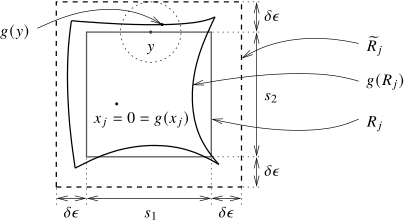
Consider some Rj. First suppose xj=0,g(0)=0, and g′(0)=I. We claim that g(Rj) is contained in a rectangle of volume at most V(Rj)(1+4nϵ)n. Let us prove this claim. For any given y∈Rj, apply the fundamental theorem of calculus to the function t↦g(ty) to find g(y)=∫01g′(ty)ydt. As the side of Rj is at most nδ, we have ∥y∥≤δ. We note that g′(x)−I<ϵ as M>1 and so
Therefore, g(Rj)⊂Rj, where Rj is a rectangle obtained from Rj by extending by δϵ on all sides. See Figure 10.17.
Figure10.17.Image of Rj under g lies inside Rj. A sample point y∈Rj (on the boundary of Rj in fact) is marked and g(y) must lie within with a radius of δϵ (also marked).
If the sides of Rj are s1,s2,…,sn, then V(Rj)=s1s2⋯sn. Recall δ≤2nsj. Thus,
In other words, the claim above applies to g as what we needed in its proof was precisely that g′(x)−I<ϵ. Therefore, we have that g(Rj) is contained in a rectangle Rj with V(Rj)≤V(Rj)(1+4nϵ)n.
Translation does not change volume, and therefore for every Rj, and xj∈Rj, including when xj=0 and g(xj)=0, we find
V(g(Rj))≤Jg(xj)V(Rj)(1+4nϵ)n.
Write f as f=f+−f− for two nonnegative Riemann integrable functions f+ and f−:
f+(u):=max{f(u),0},f−(u):=max{−f(u),0}.
So, if we prove the theorem for a nonnegative f, we obtain the theorem for arbitrary f. Therefore, suppose without loss of generality that f(u)≥0 for all u∈g(S).
As the rectangles R1,R2,…,RN give a refinement of the partition P,
The last equality follows because the overlaps of the rectangles are their boundaries, which are of measure zero, and hence the image of their boundaries is also measure zero. Let ϵ go to zero to find
∫Sf(g(x))Jg(x)dx≥∫g(S)f(u)du.
Recall that g−1 exists and g−1(g(S))=S. Also, 1=Jg∘g−1=Jg(g−1(u))Jg−1(u) for u∈g(S). So