A convergent sequence in a metric space is Cauchy.
Proof.
Suppose {xn}n=1∞ converges to p. Given ϵ>0, there is an M such that for all n≥M, we have d(p,xn)<ϵ/2. Hence, for all n,k≥M, we have d(xn,xk)≤d(xn,p)+d(p,xk)<ϵ/2+ϵ/2=ϵ.
L7.4.4: Euclidean completeness by coordinatewise real completeness
Proposition7.4.4.
The space Rn with the standard metric is a complete metric space.
Proof.
Let {xm}m=1∞ be a Cauchy sequence in Rn, where xm=(xm,1,xm,2,…,xm,n)∈Rn. As the sequence is Cauchy, given ϵ>0, there exists an M such that for all i,j≥M,
Hence, the sequence {xm,k}m=1∞ is Cauchy. As R is complete, the sequence converges; there exists a yk∈R such that yk=limm→∞xm,k. Write y=(y1,y2,…,yn)∈Rn. By Proposition 7.3.9, {xm}m=1∞ converges to y∈Rn, and hence Rn is complete.
L7.4.9: Compact sets are closed and bounded, with the empty-set case explicit locally
Proposition7.4.9.
Let (X,d) be a metric space. If K⊂X is compact, then K is closed and bounded.
Proof.
First, we prove that a compact set is bounded. Fix p∈X. We have the open cover
K⊂n=1⋃∞B(p,n)=X.
If K is compact, then there exists some set of indices n1<n2<…<nm such that
K⊂j=1⋃mB(p,nj)=B(p,nm).
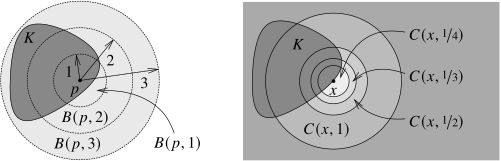
As K is contained in a ball, K is bounded. See the left-hand side of Figure 7.11.
Next, we show that a set that is not closed is not compact. Suppose K=K, that is, there is a point x∈K∖K. If y=x, then y∈/C(x,1/n) for n∈N such that 1/n<d(x,y). Furthermore, x∈/K, so
K⊂n=1⋃∞C(x,1/n)c.
A closed ball is closed, so its complement C(x,1/n)c is open, and we have an open cover. If we take any finite collection of indices n1<n2<…<nm, then
j=1⋃mC(x,1/nj)c=C(x,1/nm)c
As x is in the closure of K, then C(x,1/nm)∩K=∅. So there is no finite subcover and K is not compact. See the right-hand side of Figure 7.11.
L7.4.10: Lebesgue covering lemma proved directly from sequential compactness
Lemma7.4.10.Lebesgue covering lemma.
Let (X,d) be a metric space and K⊂X. Suppose every sequence in K has a subsequence convergent in K. Given an open cover {Uλ}λ∈I of K, there exists a δ>0 such that for every x∈K, there exists a λ∈I with B(x,δ)⊂Uλ.
Proof.
We prove the lemma by contrapositive. If the conclusion is not true, then there is an open cover {Uλ}λ∈I of K with the following property. For every n∈N, there exists an xn∈K such that B(xn,1/n) is not a subset of any Uλ. Take any x∈K. There is a λ∈I such that x∈Uλ. As Uλ is open, there is an ϵ>0 such that B(x,ϵ)⊂Uλ. Take M such that 1/M<ϵ/2. If y∈B(x,ϵ/2) and n≥M, then
B(y,1/n)⊂B(y,1/M)⊂B(y,ϵ/2)⊂B(x,ϵ)⊂Uλ,
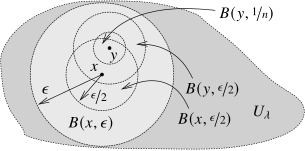
where B(y,ϵ/2)⊂B(x,ϵ) follows by triangle inequality. See Figure 7.12. Thus y=xn. In other words, for all n≥M,xn∈/B(x,ϵ/2). The sequence cannot have a subsequence converging to x. As x∈K was arbitrary, we are done.
L7.4.11: Sequential compactness and the finite-subcover definition are equivalent
Theorem7.4.11.
Let (X,d) be a metric space. Then K⊂X is compact if and only if every sequence in K has a subsequence converging to a point in K.
Proof.
Claim: Let K⊂X be a subset of X and {xn}n=1∞ a sequence in K. Suppose that for each x∈K, there is a ball B(x,αx) for some αx>0 such that xn∈B(x,αx) for only finitely many n∈N. Then K is not compact.
Proof of the claim: Notice
K⊂x∈K⋃B(x,αx).
Any finite collection of these balls contains at most finitely many elements of {xn}n=1∞, and so there must be an xn∈K not in their union. Hence, K is not compact and the claim is proved.
So suppose that K is compact and {xn}n=1∞ is a sequence in K. Then there exists an x∈K such that for all δ>0,B(x,δ) contains xn for infinitely many n∈N. We define the subsequence inductively. The ball B(x,1) contains some xk, so let n1:=k. Suppose nj−1 is defined. There must exist a k>nj−1 such that xk∈B(x,1/j). Define nj:=k. We now possess a subsequence {xnj}j=1∞. Since d(x,xnj)<1/j,Proposition 7.3.5 says limj→∞xnj=x.
For the other direction, suppose every sequence in K has a subsequence converging in K. Take an open cover {Uλ}λ∈I of K. Using the Lebesgue covering lemma above, find a δ>0 such that for every x∈K, there is a λ∈I with B(x,δ)⊂Uλ.
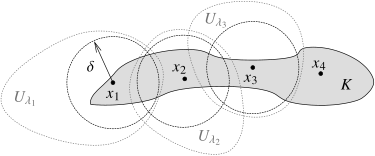
Pick x1∈K and find λ1∈I such that B(x1,δ)⊂Uλ1. If K⊂Uλ1, we stop as we have found a finite subcover. Otherwise, there must be a point x2∈K∖Uλ1. Note that d(x2,x1)≥δ. There must exist some λ2∈I such that B(x2,δ)⊂Uλ2. We work inductively. Suppose λn−1 is defined. Either Uλ1∪Uλ2∪⋯∪Uλn−1 is a finite cover of K, in which case we stop, or there must be a point xn∈K∖(Uλ1∪Uλ2∪⋯∪Uλn−1). Note that d(xn,xj)≥δ for all j=1,2,…,n−1. Next, there must be some λn∈I such that B(xn,δ)⊂Uλn. See Figure 7.13.
Figure7.13.Covering K by Uλ. The points x1,x2,x3,x4, the three sets Uλ1,Uλ2,Uλ3, and the first three balls of radius δ are drawn.
Either at some point we obtain a finite subcover of K, or we obtain an infinite sequence {xn}n=1∞ as above. For contradiction, suppose that there is no finite subcover and we have the sequence {xn}n=1∞. For all n and k,n=k, we have d(xn,xk)≥δ. So no subsequence of {xn}n=1∞ is Cauchy. Hence, no subsequence of {xn}n=1∞ is convergent, which is a contradiction.
Figure7.11.Proving compact set is bounded (left) and closed (right).Figure7.12.Proof of Lebesgue covering lemma. Note that B(y,ϵ/2)⊂B(x,ϵ) by triangle inequality.