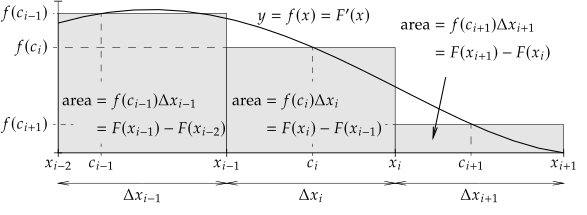
Using the notation from the definition of the integral,
mi≤f(ci)≤Mi, and multiplying by
Δxi gets
miΔxi≤F(xi)−F(xi−1)≤MiΔxi.
We sum over
i=1,2,…,n to get
i=1∑nmiΔxi≤i=1∑n(F(xi)−F(xi−1))≤i=1∑nMiΔxi.
In the middle sum, all the terms except the first and last cancel and we end up with
F(xn)−F(x0)=F(b)−F(a). The sums on the left and on the right are the lower and the upper sums, respectively. So
L(P,f)≤F(b)−F(a)≤U(P,f).
We take the supremum of
L(P,f) over all partitions
P and the left inequality yields
∫abf≤F(b)−F(a).
Similarly, taking the infimum of
U(P,f) over all partitions
P yields
F(b)−F(a)≤∫abf.
As
f is Riemann integrable, we have
∫abf=∫abf≤F(b)−F(a)≤∫abf=∫abf.
The inequalities must be equalities and we are done.