Reading guide · Proof index

Mean value theorem

Jiří Lebl, Basic Analysis I–II, version 6.3. Free author edition of this section. Selection and attribution · Notation.

L4.2.2: Scalar Fermat theorem at an interior extremum.

Proof.

Suppose cc is a relative maximum of f.f\text{.} That is, there is a δ>0\delta > 0 such that for every x∈(a,b)x \in (a,b) where ∣x−c∣<δ,\sabs{x-c} < \delta\text{,} we have f(x)−f(c)≤0.f(x)-f(c) \leq 0\text{.} Consider the difference quotient. If c<x<c+δ,c < x < c+\delta\text{,} then
f(x)−f(c)x−c≤0,\begin{equation*} \frac{f(x)-f(c)}{x-c} \leq 0 , \end{equation*}
and if c−δ<y<c,c-\delta < y < c\text{,} then
f(y)−f(c)y−c≥0.\begin{equation*} \frac{f(y)-f(c)}{y-c} \geq 0 . \end{equation*}
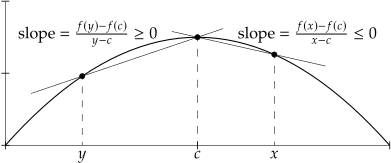
See Figure 4.3 for an illustration.

A graph of a function f is shown. Three points are marked on the horizontal axis, from left to right, y, c, and x. The function has a maximum at the point c. The points corresponding to x, c, and y are marked on the graph. Through the points corresponding to y and c is a secant line that slopes upwards and is marked with slope equals f of y minus f of c the whole thing over quantity y-c is greater than or equal to 0. Through the points corresponding to c and x is a secant line that slopes downwards and is marked with slope equals f of x minus f of c the whole thing over quantity x-c is less than or equal to 0.
Figure 4.3. Slopes of secants at a relative maximum.

As a<c<b,a < c < b\text{,} there exist sequences {xn}n=1∞\{ x_n \}_{n=1}^\infty and {yn}n=1∞\{ y_n \}_{n=1}^\infty in (a,b)(a,b) such that c<xn<c+δc < x_n < c+\delta and c−δ<yn<cc-\delta < y_n < c for all n∈N,n \in \N\text{,} and such that lim⁡n→∞xn=lim⁡n→∞yn=c.\lim_{n\to\infty} x_n = \lim_{n\to\infty} y_n = c\text{.} Since ff is differentiable at c,c\text{,}
0≥lim⁡n→∞f(xn)−f(c)xn−c=f′(c)=lim⁡n→∞f(yn)−f(c)yn−c≥0.\begin{equation*} 0 \geq \lim_{n\to\infty} \frac{f(x_n)-f(c)}{x_n-c} = f'(c) = \lim_{n\to\infty} \frac{f(y_n)-f(c)}{y_n-c} \geq 0. \end{equation*}
We are done with a maximum. For a minimum, consider the function −f.-f\text{.}

L4.2.3: Rolle theorem on a nondegenerate closed interval.

Proof.

As ff is continuous on [a,b],[a,b]\text{,} it attains an absolute minimum and an absolute maximum in [a,b].[a,b]\text{.} We wish to apply Lemma 4.2.2, and so we need to find some c∈(a,b)c \in (a,b) where ff attains a minimum or a maximum. Write K≔f(a)=f(b).K \coloneqq f(a) = f(b)\text{.} If there exists an xx such that f(x)>K,f(x) > K\text{,} then the absolute maximum is larger than KK and hence occurs at some c∈(a,b),c \in (a,b)\text{,} and therefore f′(c)=0.f'(c) = 0\text{.} On the other hand, if there exists an xx such that f(x)<K,f(x) < K\text{,} then the absolute minimum occurs at some c∈(a,b),c \in (a,b)\text{,} and so f′(c)=0.f'(c) = 0\text{.} If there is no xx such that f(x)>Kf(x) > K or f(x)<K,f(x) < K\text{,} then f(x)=Kf(x) = K for all xx and then f′(x)=0f'(x) = 0 for all x∈[a,b],x \in [a,b]\text{,} so any c∈(a,b)c \in (a,b) works.

L4.2.4: Scalar mean-value theorem by subtraction of the affine secant.

Proof.

Define the function g ⁣:[a,b]→Rg \colon [a,b] \to \R by
g(x)≔f(x)−(f(b)+f(b)−f(a)b−a(x−b))=f(x)−f(b)−f(b)−f(a)b−a(x−b).\begin{equation*} g(x) \coloneqq f(x)- \left( f(b)+\frac{f(b)-f(a)}{b-a}(x-b) \right) = f(x)- f(b)-\frac{f(b)-f(a)}{b-a}(x-b) . \end{equation*}
The function gg is differentiable on (a,b),(a,b)\text{,} continuous on [a,b],[a,b]\text{,} such that g(a)=0g(a) = 0 and g(b)=0.g(b) = 0\text{.} Thus there exists a c∈(a,b)c \in (a,b) such that g′(c)=0,g'(c) = 0\text{,} that is,
0=g′(c)=f′(c)−f(b)−f(a)b−a.\begin{equation*} 0 = g'(c) = f'(c)-\frac{f(b)-f(a)}{b-a} . \end{equation*}
In other words, f(b)−f(a)=f′(c)(b−a).f(b)-f(a) = f'(c)(b-a)\text{.}

L4.2.6: Zero derivative implies constant on an interval.

Proof.

Take arbitrary x,y∈Ix,y \in I with x<y.x < y\text{.} As II is an interval, [x,y]⊂I.[x,y] \subset I\text{.} Then ff restricted to [x,y][x,y] satisfies the hypotheses of the mean value theorem. Therefore, there is a c∈(x,y)c \in (x,y) such that
f(y)−f(x)=f′(c)(y−x).\begin{equation*} f(y)-f(x) = f'(c)(y-x). \end{equation*}
As f′(c)=0,f'(c) = 0\text{,} we have f(y)=f(x).f(y) = f(x)\text{.} Hence, the function is constant.