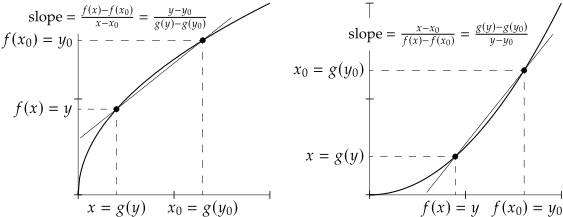
By
Proposition 3.6.6,
\(f\) has a continuous inverse. For convenience, call the inverse
\(g \colon J \to I\text{.}\) Let
\(x_0,y_0\) be as in the statement. For
\(x \in I\text{,}\) write
\(y \coloneqq f(x)\text{.}\) If
\(x \neq x_0\text{,}\) and so
\(y \neq y_0\text{,}\) we find
\begin{equation}
\frac{g(y)-g(y_0)}{y-y_0} =
\frac{g\bigl(f(x)\bigr)-g\bigl(f(x_0)\bigr)}{f(x)-f(x_0)} =
\frac{x-x_0}{f(x)-f(x_0)} .
\end{equation}
Let
\begin{equation}
Q(x) \coloneqq
\begin{cases}
\frac{x-x_0}{f(x)-f(x_0)} & \text{if } x \neq x_0, \\
\frac{1}{f'(x_0)} & \text{if } x = x_0 \quad \text{(notice that }
f'(x_0) \neq 0 \text{)}.
\end{cases}
\end{equation}
As \(f\) is differentiable at \(x_0\text{,}\)
\begin{equation}
\lim_{x \to x_0} Q(x) =
\lim_{x \to x_0}
\frac{x-x_0}{f(x)-f(x_0)}
=
\frac{1}{f'(x_0)}
=
Q(x_0) ,
\end{equation}
that is,
\(Q\) is continuous at
\(x_0\text{.}\) As
\(g(y)\) is continuous at
\(y_0\text{,}\) the composition
\(Q\bigl(g(y)\bigr) = \frac{g(y)-g(y_0)}{y-y_0}\) is continuous at
\(y_0\) by
Proposition 3.2.7. Therefore,
\begin{equation}
\frac{1}{f'\bigl(g(y_0)\bigr)}
= Q\bigl(g(y_0)\bigr)
= \lim_{y \to y_0} Q\bigl(g(y)\bigr)
= \lim_{y \to y_0} \frac{g(y)-g(y_0)}{y-y_0} .
\end{equation}
So \(g\) is differentiable at \(y_0\text{,}\) and \(g'(y_0) =
\frac{1}{f'\left(\vphantom{1^1_1}g(y_0)\right)}\text{.}\)
If
\(f'\) is continuous and nonzero at all
\(x \in I\text{,}\) then the lemma applies at all
\(x \in I\text{.}\) As
\(g\) is also continuous (it is differentiable), the derivative
\(g'(y) =
\frac{1}{f'\left(\vphantom{1^1_1}g(y)\right)}\) must be continuous.