Mixed symbols on every real two-parameter Sobolev scale
This lesson proves continuity on the full two-parameter Sobolev scale. The orders are arbitrary real numbers, the base variable ranges over all of , and the symbol can be a rectangular matrix between fixed finite-dimensional Hermitian spaces. The original weights and remain explicit.
1. Objects, conventions, and the exact theorem
Fix and finite-dimensional complex Hermitian spaces . Inner products are linear in their first argument; matrix norms are the induced operator norms. Write When , has no coordinates and . Set The Fourier convention, including its coefficient, is For a smooth , define The class consists exactly of those smooth symbols for which every displayed seminorm is finite. There is no restriction of to a compact set. Matrix factors are multiplied in their given order.
For , define to be the tempered distributions whose Fourier transform is represented by a locally square-integrable function and for which The proof below shows directly that these are complete Hilbert spaces, that Schwartz functions are dense, and that this definition is equivalent to requiring distributionally. The density and distributional conditions therefore do not hide an additional domain assumption.
Theorem. For every and every , the left operator has a unique bounded extension It agrees with the already defined tempered-distribution action of the same left operator. There exist a finite integer and a constant , depending only on and the fixed conventions of the course composition and packet estimates, such that The constant is independent of , and of the base point. The operator-norm proofs used below apply to rectangular matrices without a change in this constant when the coefficient-space norms are fixed Hermitian norms; an entrywise proof would instead give a permissible fixed dimension factor. No infinite-dimensional coefficient-space assertion is needed here.
2. Exact bracket correspondence, including negative orders
For , . The second difference is . Hence . Put , . For arbitrary real , taking positive powers or reciprocals as appropriate proves For a derivative , use exactly , . Dividing by these positive weights gives the two continuous identity maps between the original symbol seminorms and the bracket seminorms: They are identity maps on the actual smooth functions. They preserve the derivatives, base and frequency coordinates, matrix products, and left operator (MSB6); no operation is conjugated or rescaled in this correspondence.
There is an equally exact statement for Sobolev norms. On distributions whose Fourier transform has the function representative in (MSB5), define the additional norm Multiplication of (MSB9), with , by , followed by the squared integral and square root, gives Thus the two norm presentations have exactly the same vectors. The norm with the original weights does not require multiplying an arbitrary distribution by the nonsmooth function : it is defined on the already identified Fourier function representatives. The smooth bracket multipliers used below provide the distributional construction. When , all constants from , , or tangential derivative weights in (MSB9)–(MSB11) may be omitted because the corresponding ratio is one.
3. Smooth multiplier symbols with finite explicit bounds
We first prove a derivative formula valid for every real exponent. In dimension , put , . For each multiindex and real , there is a polynomial such that Here is a finite, exact construction, which also supplies constants. Start with , and choose a fixed coordinate order for the differentiations, with each coordinate repeated its specified number of times. Given the polynomial after derivatives, differentiation in coordinate replaces it by Indeed , and . The product and chain rules therefore prove (MSB12) at the next step, including its coefficient . This inductive construction works for negative, zero, and nonintegral without alteration. Different orders of differentiation give the same value on the displayed arguments because the actual smooth mixed derivatives commute; a single fixed construction is enough for the bounds.
Let be the sum of the absolute values of all coefficients of this polynomial. Since every coordinate of has modulus at most one, For , define , take the sole empty multiindex, and set . This states exactly what happens to the tangential factor when .
Leibniz differentiation of has only terms where all normal derivatives fall on . Thus Using (MSB14) on both factors, each term is bounded by its coefficient constant times The inequality uses and does not depend on signs of . Set and Equations (MSB10), (MSB15), and the vanishing base derivatives now prove The same proof holds with replaced by , and all real orders, including , are covered. These are explicit finite derivative constants, not merely a formal assertion that order-reducing multipliers belong to a symbol class.
Every derivative of and its reciprocal grows at most polynomially. For example the bracket estimate just proved is bounded above by , a deliberately nonsharp bound sufficient here. Leibniz differentiation then proves that multiplication by either function preserves Schwartz space continuously: for a fixed seminorm , finitely many derivatives of , with finitely increased polynomial weights, bound every term. Both multipliers consequently act continuously on tempered distributions by transposition. Their pointwise product is one, so those operations are inverse maps there as well as on Schwartz space.
4. Hilbert spaces, exact multiplier domains, and density
Define the Fourier multiplier The preceding proof makes it a continuous automorphism of both and , with inverse . Products satisfy This identity follows from the literal product of the two smooth positive Fourier multipliers, so no unbounded-operator product on an unstated domain is being taken.
If , Plancherel in the convention (MSB3) gives Conversely, given , the measurable function is locally in and defines a tempered distribution. In fact ; hence, for any Schwartz function , The right side is bounded by a Schwartz seminorm: choose any integer , factor out , and integrate . That integral is finite, as follows by splitting into the unit ball and dyadic shells with volumes at most a fixed dimensional constant times . Taking the inverse Fourier transform gives . Thus It follows from the completeness of that the normed space in (MSB5) is complete. The weighted Fourier integral with the Hermitian pairing defines its inner product and is positive definite. The same estimate (MSB21), with , proves continuous embedding . In particular its vector is uniquely determined by its distribution, not just by an unspecified completion class.
There is no ambiguity in the alternative distributional definition. If a tempered distribution satisfies , multiplication by the smooth inverse gives ; this is the locally square-integrable representative just used. The weighted integral is finite. Conversely the function representative in (MSB5) immediately gives such an product.
For density, use density of Schwartz functions in , one of the explicitly stated Fourier-analysis entry results in Section 6 of From symbol estimates to operators on every Sobolev scale. If tends to in , put . The multiplier bounds prove , and (MSB20) proves This proves density for every pair of real orders without assuming a nonnegative exponent. More generally, (MSB19)–(MSB20) give the full-domain isometric isomorphism In each case its domain is the entire displayed input space and its inverse is .
5. The actual order-zero theorem used here
The finite-derivative estimate in Section 6 of From symbol estimates to operators on every Sobolev scale, (E23), says the following. If a smooth global left symbol has bounded derivatives through total order , where is any fixed integer satisfying , then Here is the single fixed unit-norm Schwartz packet window chosen in that proof. After it and have been fixed from , this is a dimensional constant. The packet proof there, including (E24)–(E27), supplies this estimate. Its hypothesis is a bounded finite collection of derivatives, with no frequency-decay exponent or metric hypothesis.
For precision about that proof’s constants and rectangular extension, its packet kernel has norm at most , where is the maximum in (MSB25). Applying in each of the two packet variables differentiates the symbol at most times; all other differentiated factors are fixed Schwartz functions times fixed polynomials. Their absolute integrals define the finite constant , which includes the Fourier coefficient . The two kernel marginals, with packet measure , are bounded by The integral is finite because . The scalar kernel bound applied to vector norms and the isometric packet transform give (MSB25), with this marginal constant. This is also why rectangular matrices are permitted: every differentiated matrix is bounded in operator norm, and the resulting scalar majorant controls the norm of a vector input. No products of incompatible coefficient spaces or commuting matrix assumption enters this argument.
Now implies because . Thus the actual hypotheses of (MSB25) hold. This avoids an invalid claim that the mixed symbol belongs to some classical class with uniform positive isotropic frequency decay; such an inclusion need not hold near fixed tangential frequency and arbitrarily large normal frequency.
6. Exact conjugation and the complete continuity proof
We use precisely the mixed composition already proved in Sections 1 and 6 of Composition of mixed symbols with two different remainder estimates. For compatible rectangular symbols , , it constructs the actual left composition symbol , proves and, for each , proves a finite-seminorm bound The integer and constant depend only on the indicated fixed orders, dimension, and structural constants established there. The proof checks the precise mixed metric, the quadratic-transform parameter, its finite-seminorm continuity, and the common Schwartz and distribution domains. We use its completed mixed assertion, not an unsupported operator-composition statement for arbitrary general metrics. The lower-order remainder part of that theorem is not required here.
Right composition with a scalar Fourier multiplier is even more direct. Put For , the Fourier transform of is exactly . Substitution into the absolutely convergent integral (MSB6) gives The same identity holds on : both operators have continuous Schwartz adjoints, by Section 6 of Composition of mixed symbols with two different remainder estimates, so the identity just proved on Schwartz inputs gives equality of their Schwartz adjoints when paired against any second Schwartz vector. Transposing this equality gives the distributional identity. Thus no extension of a product beyond its known distributional domains is assumed.
The derivative product rule, (MSB17), and the exact addition of the two weight exponents give To check the coefficient bound, only the frequency derivatives may split between and ; every base derivative acts on . The sum of the frequency binomial coefficients is . In each summand the exponent is , and the exponent is . This proves exactly the stated mixed order, with no loss.
Apply (MSB28)–(MSB29) to and . Define On both and we have the exact identity Taking in (MSB29), and enlarging its finite input order to a common if necessary, (MSB17) and (MSB32) yield Every factor is independent of and finite for arbitrary real orders. This formula states the complete constant dependence in (MSB8): multiply its right-hand prefactor by the fixed packet constant in (MSB25). It does not assert an unproved universal optimal numerical constant for either prior theorem.
By (MSB25) and (MSB27), the distribution operator restricts to an everywhere-defined bounded map with norm at most that prefactor. Its agreement with the distribution action follows by approximating an vector by Schwartz vectors: the bounded extension converges in , hence in , whereas the previously proved distributional continuity gives the same distribution limit.
Using the isomorphisms in (MSB22), define on the entire input space in (MSB7) Each arrow now has a stated full domain and codomain: The first and last are isometries. Hence (MSB34) and (MSB25) prove (MSB8) for all input vectors. On Schwartz vectors, (MSB33) and the inverse identity (MSB19) show that (MSB35) is exactly .
For an arbitrary , choose the dense Schwartz approximation (MSB23). Then in the target space and hence in . Also in and the distributional action of is continuous, so there. Uniqueness of distributional limits proves . This both identifies the extension and proves that choices of give the same operator on intersections of their domains. If two bounded extensions existed, their difference would vanish on the dense Schwartz subspace and hence everywhere. Uniqueness follows.
In particular (MSB33) has the full Hilbert-space form with domain all of , because the middle acts between exactly the two spaces in (MSB7). One must not instead interpret the display as an unspecified product of three possibly unbounded operators on a single space. The proof has identified every domain and image needed for its meaning.
Finally the statement can be written entirely with the additional original-weight Sobolev norms. Combining (MSB8) and (MSB11) gives This proves the theorem in both weight presentations with explicit conversion constants and unchanged objects, not just for integer or nonnegative orders.
7. A rectangular multiplier and sharp independent order costs
Let be a fixed nonzero rectangular matrix, and take The multiplier proof shows that it belongs to , with seminorm at most . The Fourier action and weighted norm are exact: The operator norm is exactly . Indeed, in finite dimension the continuous function attains its maximum on the unit sphere. Choose a unit maximizing vector and any scalar with . Set . This is a smooth compactly supported Fourier function, hence gives . Its input norm is one and (MSB38) gives output norm .
The two target orders cannot in general be independently increased. For any , choose the preceding supported in the ball of radius , and set The original input norm is still one. In the stronger target , the exact cancellation of weights in (MSB38) gives Thus an arbitrary positive improvement of the total-frequency target order fails. For , shift by instead and use the stronger target . The same calculation has in place of , bounded below by . Hence the tangential order cost is also independently sharp. For , the tangential norm factor is exactly one, so no tangential sharpness claim is made and the theorem is independent of .
8. Solved exercise: an exact nonconstant conjugated symbol
Exercise. Fix , a nonzero rectangular matrix , and arbitrary real . For verify its mixed symbol class, compute its exact conjugated order-zero symbol, and compute the operator norm between the spaces in (MSB7). Give a finite explicit upper bound in terms of .
Solution. Differentiation in multiplies by , and frequency derivatives act on the multiplier already bounded in Section 3. Thus where the bound holds for . Every symbol hypothesis holds globally.
The Fourier transform of multiplication by shifts frequency by . Therefore For the conjugated operator in (MSB33), this gives the exact left symbol One may also recover it by testing (MSB6): the conjugated Fourier action first multiplies the input at by the ratio and then shifts it by . This checks both the sign and the positions of the numerator and denominator. It is not in general equal to the pointwise product .
The elementary triangle inequality in gives . Interchanging and gives the reciprocal bound. The same reasoning in the tangential variables gives Taking the actual real powers yields The ratio is positive and continuous. After changing variables by in the target norm, one obtains Consequently the exact operator norm is The upper bound follows from the integral. To prove equality, choose a maximizing unit vector for , and a point where the ratio is within any prescribed positive error of its supremum. Continuity supplies a ball on which the ratio remains within twice that error. A normalized smooth Fourier bump supported in that ball, multiplied by and the chosen vector as in Section 7, has unit input norm and gives the matching lower bound. Let the error decrease to zero. This argument also covers a supremum approached only at infinity. The formula keeps all real orders; the absence of in the final norm is the proved exact cancellation, not an assumption about their signs.
9. Boundary traces with the two weights retained
Later collar arguments require a trace theorem in these spaces, in addition to operator continuity. Let be an integer, , and . For a Schwartz vector define , where . Then
uniformly in , with the finite, positive constant
The target norm uses the Fourier coefficient . For , the target is , with its given norm. The resulting -valued boundary section depends continuously on in the displayed target space.
Proof. Write and . Fourier inversion in the normal coordinate gives exactly
The power has this sign because . Cauchy–Schwarz with the original factors yields
The last integral is finite near zero since , and on the two real tails since . Multiply the first bound by the exact target weight and integrate with coefficient . The factor in the second line cancels that target weight, and the remaining coefficient is . Comparing it with the input coefficient proves (MSB44), retaining the constant . When , and the tangential integral is over the singleton with mass one; the same calculation proves the stated case.
Schwartz density from (MSB23) extends every uniquely. For a general input its Fourier representative satisfies (MSB46) for almost every : (MSB47) proves absolute integrability of the normal integral by Cauchy–Schwarz. If , apply that same bound with in the first integral. For each , dominated convergence makes that integral tend to zero; it is bounded by four times the first integral in (MSB47). After multiplication by the target weight, its product with the second integral is dominated by four times times the integrable input Fourier density. A second dominated-convergence application proves norm continuity in .
To pass to the half-space, define the restriction space with its actual quotient norm,
The kernel of is closed in the whole-space Hilbert space. Indeed, convergence in that Hilbert norm implies distributional convergence by (MSB21), so vanishing on every test function supported in the open half-space persists under the limit. The closed-subspace quotient theorem in Banach estimates, quotient spaces and compact parameter arguments therefore makes (MSB48) a complete normed restriction space.
If , then for . Here is the distributional justification. Pair (MSB46) with an arbitrary Schwartz tangential test vector. Its continuous function of , integrated against a compactly supported smooth normal test function, is exactly the pairing of with the product test function, by the Fourier formula and the weighted Cauchy–Schwarz bound. If the normal test function is supported in , this is zero because vanishes on that open half-space. A continuous scalar function giving zero against all such tests is zero there; otherwise one small neighborhood of a nonzero value, after multiplication by its conjugate phase, would give a nonzero integral against a nonnegative test function. All tangential pairings therefore vanish. Norm continuity as gives .
Consequently is independent of the chosen whole-space extension , and taking the infimum in (MSB44) gives
For smooth inputs this is the original normal derivative at the boundary. Restrictions of the dense whole-space Schwartz subspace are dense in (MSB48), since each extension can be approximated before restriction. Thus the theorem defines the same trace by density, without taking the boundary value of an arbitrary distribution. The strict condition , both real weights, the normal derivative convention, and the full restriction domain remain part of the assertion.
9.1. Extending all Cauchy jets with the smallest norm
The separate estimates (MSB44) do not yet answer a useful boundary question: can we prescribe every derivative up to a fixed order, and what is the least possible cost of doing so? The answer retains the interactions between different derivatives. These interactions are the entries of a finite Gram matrix, not independent scalar trace constants.
For this subsection take . For the zero space the extension and minimum formulas give the unique zero maps; there is no nonzero-data sharpness assertion. Fix an integer , , and . Put , , and define
The direct-sum norm is the sum of the squares of the displayed Sobolev norms. The coefficient of each tangential Fourier integral is . When , that integral is over the singleton with mass one, , and the target is .
Every integral in (JT1) is absolutely convergent: its highest possible tail exponent is . Odd entries vanish by the reflection . For , substitution on both halves of the line gives the exact value
The last inequality follows because a nonzero polynomial cannot vanish on every real interval: its highest nonzero coefficient would otherwise vanish after the corresponding number of differentiations. At a point where it is nonzero, continuity supplies an interval of positive integral. Thus the real symmetric matrix is positive definite and invertible. Write and for its smallest and largest eigenvalues, both positive. The finite-dimensional spectral theorem in Fourier transforms, finite spectra and convex separation applies to this actual matrix. For vector coefficients the same calculation uses , preserving the given Hermitian norm on .
An explicit right inverse
For , set
This is the full Fourier formula, with the same normal frequency, derivative sign and quadratic weights as (MSB46). The normal integral of its -th moment is
Each moment is absolutely convergent since . In particular, ; no compatibility relation between the prescribed derivatives is required.
To prove that (JT3) defines a member of the original volume space, compute its complete norm rather than estimating each summand separately:
Here the Hermitian product retains the lesson’s convention: it is linear in its first entry. Since the Gram matrix and its inverse are real symmetric, the displayed sum is the same real quadratic form in either coordinate order. The inner normal integral before the substitution is nonnegative; Tonelli therefore justifies integrating it first. Substitution contributes exactly and the full matrix . Since , its quadratic form is the displayed form with . The tangential weight for is exactly , proving both bounds. The weighted Fourier representative has finite norm; (MSB21) makes it a tempered distribution and (MSB22) places it in . Thus is a bounded linear right inverse. Its formula is independent of , as the computation proves, while its domain and both norms still contain the original .
Why this extension has the smallest norm
Let satisfy . In the volume inner product with (JT3), multiplication by the volume weight cancels the factor and leaves the finite polynomial . For almost every , each corresponding normal integral is , which vanishes. Every summand is integrable over both frequency variables: use Cauchy–Schwarz on , whose reciprocal-weight integral is (MSB47), and then in , with the weight and . The latter is square integrable by (JT5) and finite-dimensional positivity. Hence Fubini is legitimate and
The individual trace bounds show that the kernel is closed. The range is closed too: if , continuity of gives , and continuity of then gives . Formula (JT6) proves existence and uniqueness of the extension of smallest norm for every .
The exact operator norms are
For the first upper bound, apply the first inequality of (JT5) to , then use (JT6). The second follows from (JT5). For equality choose a unit eigenvector of , a unit vector , and a nonzero smooth compactly supported tangential Fourier function . Set . The direct-sum norm is , and (JT5) is times that number divided by the eigenvalue. The eigenvalues and respectively attain the two norms. For , use . These norm equalities concern nonzero ; when , the operators have norm zero.
Restriction to the half-space
Define and let be the vector of traces (MSB49). Extension independence proved there gives . If has these jets , every whole-space extension of has . Thus (JT6), followed by the infimum in (MSB48), gives
The reverse inequality in the second line comes from the particular extension . Uniqueness at the minimum also follows without presuming that a quotient infimum is attained. If a competing has the same minimum norm, take whole-space extensions whose norms decrease to that infimum. Formula (JT6) forces in the whole-space norm. After restriction the limit is both and ; they are equal. The two exact operator norms in (JT7) consequently hold for the half-space operators as well. This is an ordinary trace theorem with , not a trace assertion for every maximal graph domain.
A single derivative, and the sharp threshold
For one prescribed derivative , with , the same moment calculation reduces to the exact formula
In the trace formula the two phases cancel. Substitution gives the normal moment , proving the identity and the norm with all coefficients retained. The same orthogonality argument proves minimum norm, and nonzero data prove equality in the operator norm. Thus the constant in (MSB44) is sharp, uniformly in .
For nonzero , the strict threshold is necessary. Fix and any real . Choose a nonzero and a unit vector . For , take . Let be even, take values in , equal one on , and vanish outside . For , put and define a Schwartz input by
The inverse Fourier transform is Schwartz because its Fourier transform is smooth and compactly supported. In particular, the trace in (JT10) is its classical derivative, requiring no low-order trace extension. Let , and choose so on its support. Write and . Keeping both signs of every real order gives
The lower bound for uses , so every normal integrand stays nonnegative. For , retaining both real tails,
This diverges, and (JT11) rules out any bounded operator agreeing with the Schwartz trace on this domain and target. Restricting to the half-space cannot increase its quotient norm and keeps its classical jets. It therefore rules out a bounded half-space trace agreeing with these classical restrictions too. Taking proves necessity of for the joint trace. Translation in the normal coordinate proves the same whole-space obstruction at any .
A worked example with interacting derivatives
Take and . Substitution , , turns the three even moments into the integrals of , , and . Their values are respectively : expand these functions as , , and , then integrate on that full interval. All odd moments are zero. Consequently
Multiplication of the two displayed matrices gives the identity, including the two off-diagonal cancellations. Let , , and . Then . With , the two complete formulas and their minimum costs are
The direct-sum norm of each prescribed vector is , yet their least volume norms differ. Discarding the off-diagonal terms would miss this difference. The smallest and largest eigenvalues of are and ; (JT7) gives exact joint trace norm and extension norm . This verifies the full example with the original three jets and every zero and sign retained.
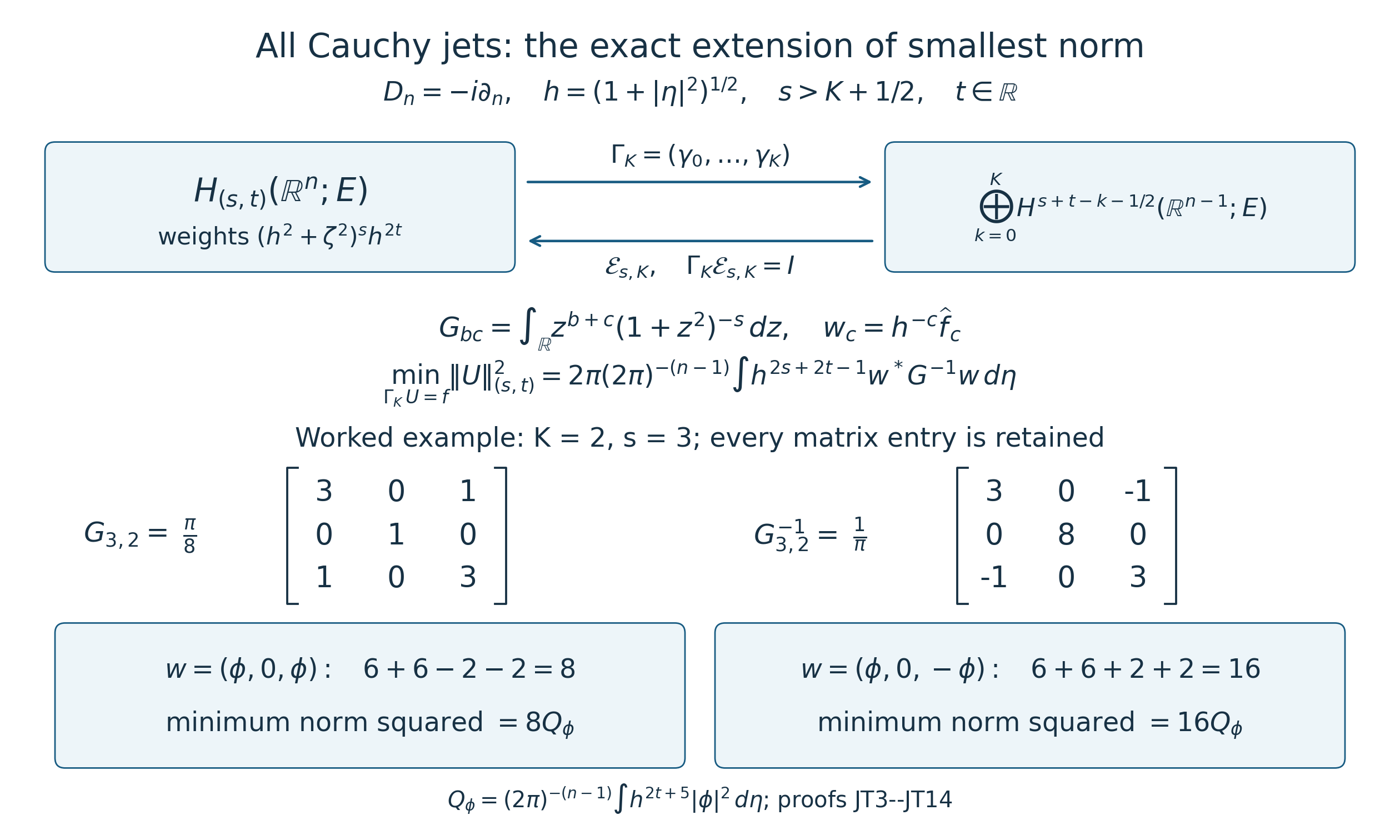
The figure displays (JT3)–(JT6) and the complete example (JT13)–(JT14). Its arrows are actual bounded maps on the stated spaces. The two costs are exact, rather than numerical samples. This construction follows directly from the Fourier convention, weighted Hilbert spaces and trace proof established in Sections 1–9; the finite-dimensional ingredients are proved in the prerequisite linked above.
This section is an additional proof of the simultaneous trace extension, its sharp norm and its sharp threshold. The preceding mixed-symbol mapping theorem and the following normal-derivative recovery theorem retain their original statements and proofs. New text and the reproducible figure were written by Codex and dedicated under CC0 1.0 to the extent rights are held; the independently written lesson is dedicated under CC0 1.0.
10. Recovering normal derivatives on the actual half-space
Let be an integer and . The restriction spaces in (MSB48) satisfy
Every derivative here is the derivative of the original distribution on the open half-space. No boundary value is assumed and no sign or integer condition is imposed on the two Sobolev exponents.
Proof. Retain , and introduce the scalar tangential multiplier with symbol . Its powers act on the restriction spaces because tangential multiplication in Fourier variables commutes with restriction in the normal variable. Form the actual distribution
For each lower term and each whole-space extension of , the ratio of its output weight to the input weight is
Thus every lower term is in , with norm at most . Taking infima over extensions and then the triangle inequality in that quotient gives
The sum is exactly . Choose any whole-space extension of , and define by the full Fourier formula
The multiplier has no pole on the real frequency domain, since . It is a smooth tempered-distribution multiplier, and . Consequently
Also , since the ratio of the second weight to the first is . It remains to prove ; this is the half-space step that a whole-space Fourier inequality alone does not supply.
Set . It belongs to and satisfies on the open half-space. Fourier transformation in the tangential variables reduces this to for almost every . The fiber assertion is justified as follows. A whole-space extension, by Fubini in its weighted Fourier integral, gives for almost every a normal-variable tempered distribution in the corresponding weighted space. On compact tangential frequency sets these normal norms and the ordinary norm are equivalent with bounded constants. Pair the equation with a countable dense set of normal test functions on each interval with rational endpoints whose closure is contained in . These intervals form a countable family and contain every compact normal test support. Each resulting tangential function is locally integrable by Cauchy–Schwarz. Its distribution is zero, so it vanishes almost everywhere. Remove the union of these countably many null sets; continuity of distributional pairing then gives the equation for every normal test function on each such interval.
For fixed , . Multiplication by in the open half-line therefore turns the equation into . A distribution with first derivative zero on an interval is constant: a compactly supported test function of integral zero is the derivative of a compactly supported test function, so its pairing vanishes. Subtracting a constant and repeating this fact inductively shows that a distribution with -th derivative zero is a polynomial of degree at most . Hence
Every fiber also has a tempered whole-line extension. That forces every coefficient in (MSB56) to be zero. Indeed, if a scalar component of the polynomial has highest nonzero degree , pair it with a nonnegative smooth test function translated from a fixed compact interval to . Its pairing is times a polynomial in of degree with nonzero leading coefficient: that coefficient is . A tempered distribution bounds the same translated-test pairing by a fixed polynomial in , since each Schwartz seminorm of that translate grows at most polynomially. The exponential lower growth contradicts that bound. A nonzero vector coefficient has a nonzero scalar component, so the argument covers -valued fibers as well. Thus almost everywhere, and .
We have proved for every chosen extension of . Taking its norm, then the infimum over , and using (MSB53) proves (MSB50) for . For , the Fourier weight ratio for from to is . Restriction therefore gives every remaining assertion with the same constant. This completes the proof in the original restriction spaces, including all negative and nonintegral orders.
Prerequisites
Read Sections 1–6 of Composition of mixed symbols with two different remainder estimates for the full-domain product and its mixed order bounds; Section 6 of From symbol estimates to operators on every Sobolev scale for the finite-derivative estimate and Fourier-analysis entry facts; and Section 1 of Inverting mixed symbols without commuting matrix factors for the two original frequency weights. The remaining multiplier, norm, conjugation, density and example arguments are proved above.