# Fourier indicators and the convex hull of a measure's support
Written by GPT-6.1 Sol (OpenAI), Ultra reasoning effort, October 2026. Original proof exposition, examples, solutions and diagrams: CC0 1.0.
A complex measure can cancel at many Fourier frequencies, including frequency zero. Nevertheless the largest exponential growth of its transform in each imaginary direction determines the convex hull of its support exactly. The proof uses a uniform upper bound in every real frequency. A single imaginary ray or a noncancelling endpoint atom is not required.
Our precise earlier inputs are [the compact-convex Fourier growth converse and uniqueness, L122 Theorem CF2.1](../../AN02-L122.html#2-the-compact-support-growth-criterion), [the scalar log-modulus proof, L137 Lemma Z2](../../AN02-L137.html#proof-Z2), and [the PSH envelope/support construction, L139 Theorem E1](../../AN02-L139.html#psh-envelope-theorem), especially [the recession proof and (E17)](../../AN02-L139.html#recession-support-function). We prove the measure/distribution support identification and the remaining support-function steps directly. The Fourier convention is the negative exponential throughout.
## MI1. The exact assertion
Let \(n\ge1\) and let \(u\) be a complex Radon measure on \(\mathbb R^n\) with compact support. Total variation is denoted by \(|u|\). Support means
\[
S=\operatorname{supp}u
=\{x:|u|(V)>0\text{ for every open neighborhood }V\text{ of }x\}.
\tag{MI1}
\]
Vanishing on an open set means the restriction of the measure is zero, rather than just that its total integral over that set is zero. Cancellation can make the latter vanish even when the restriction is nonzero.
For \(u\ne0\), set
\[
m=|u|(\mathbb R^n)>0,\qquad K=\operatorname{conv}S,\qquad
h_K(y)=\max_{s\in K}s\cdot y,
\tag{MI2}
\]
and define its entire Fourier transform and logarithm by
\[
F(z)=\int e^{-is\cdot z}\,du(s),\qquad
v(z)=\log|F(z)|,\qquad \log0=-\infty.
\tag{MI3}
\]
**Theorem MI.** For \(u\ne0\), \(F\) is not identically zero, \(v\) is PSH, and
\[
v(x+iy)\le\log m+h_K(y)\le\log m+R|y|,
\qquad R=\max_{s\in S}|s|.
\tag{MI4}
\]
Consequently the L139 horizontal envelope and indicator are well defined:
\[
M(y)=\sup_{x\in\mathbb R^n}\log|F(x+iy)|\in\mathbb R,
\qquad H(y)=\lim_{t\to\infty}\frac{M(ty)}t.
\tag{MI5}
\]
The exact identification is
\[
H(y)=h_K(y)=\max_{s\in S}s\cdot y
\quad(y\in\mathbb R^n).
\tag{MI6}
\]
Thus the compact convex set constructed from \(H\) is exactly \(K\). No positivity of \(u\), nonzero total complex mass, endpoint atoms, full-dimensional hull, or attainment of the real-frequency supremum is assumed.
For \(u=0\), take \(F=0\), \(v=M=H=-\infty\), \(S=K=\varnothing\), and \(h_\varnothing=-\infty\), including at the zero vector. This is the extended convention in L139; the finite indicator construction applies to the nonzero case.
## MI2. A measure and its distribution have the same support
The measure acts on smooth compact tests by
\[
T_u(\phi)=\int\phi\,du,
\qquad |T_u(\phi)|\le m\|\phi\|_\infty.
\tag{MI7}
\]
This is a complex-linear distribution of order zero. A compactly supported Radon measure has finite total variation: \(|u|\) is finite on the compact support, and the complement has zero variation. The latter statement follows by covering the complement with countably many rational balls on which \(|u|\) is zero. It also shows that empty support forces the measure to be zero.
We prove the support equality
\[
\operatorname{supp}T_u=\operatorname{supp}u.
\tag{MI8}
\]
One inclusion is immediate: if the measure vanishes on an open region \(O\), every smooth test there integrates to zero. Conversely suppose every \(\phi\in C_c^\infty(O)\) pairs to zero. Given \(f\in C_c(O)\), extend it by zero and convolve with smooth approximate identities small enough that all supports remain in one compact subset of \(O\). Uniform continuity gives uniform convergence to \(f\); (MI7) passes the zero pairings to \(\int f\,du=0\).
Here is the measure-determination step. For any compact \(A\subset O\), choose \(\delta>0\) such that its closed \(\delta\)-neighborhood is compact and contained in \(O\). The continuous cutoff \(\chi(s)=\max(0,\min(1,2-2\operatorname{dist}(s,A)/\delta))\) lies in \(C_c(O)\), stays between zero and one, and equals one near \(A\). Put
\[
f_j(s)=\chi(s)\max(0,1-j\operatorname{dist}(s,A)).
\tag{MI9}
\]
These continuous compact tests tend pointwise to \(\mathbf1_A\) and are bounded by one. Dominated convergence with respect to \(|u|\) proves \(u(A)=0\). For a Borel set \(B\subset O\), inner regularity of the finite positive measure \(|u|\) supplies compact \(A\subset B\) with \(|u|(B\setminus A)<\varepsilon\). Therefore
\[
|u(B)|\le |u(A)|+|u|(B\setminus A)<\varepsilon.
\tag{MI10}
\]
Let \(\varepsilon\downarrow0\). Every Borel subset of \(O\) has zero measure, so its restriction there is zero and so is its total variation there. This proves (MI8). The same argument proves that agreement on all smooth compact tests determines a finite complex Radon measure.
## MI3. The compact hull and entire Fourier transform
For completeness, \(K=\operatorname{conv}S\) is compact even when it has empty interior. In a convex combination with more than \(n+1\) positive coefficients, the corresponding points are affinely dependent. Choose real \(c_j\), not all zero, with \(\sum c_j=0\), \(\sum c_js_j=0\), and some \(c_j>0\). Subtract
\[
a c_j\quad\hbox{from each coefficient},\qquad
a=\min_{c_j>0}\lambda_j/c_j.
\tag{MI11}
\]
The coefficients remain nonnegative, their sum and represented point are unchanged, and one positive coefficient becomes zero. Repeating reduces to at most \(n+1\) points. Thus \(K\) is the image of the compact product of \(S^{n+1}\) and the closed coefficient simplex; shorter combinations can be padded with zero coefficients. Linear functionals obey
\[
\max_K s\cdot y=\max_S s\cdot y,
\tag{MI12}
\]
because each convex combination pairs at most as large as the maximum on \(S\), while \(S\subset K\).
For the transform, expand at any \(z_0\). On the compact support, the exponential's product series is absolutely and uniformly convergent for \(h\) in compact complex sets. If \(|s_j|\le R\), its absolute series is bounded by \(\exp(R\sum_j|h_j|)\), multiplied by a fixed bound for \(|e^{-is\cdot z_0}|\). Finite total variation allows termwise integration, giving the locally normally convergent series
\[
F(z_0+h)=\sum_{\alpha\in\mathbb N^n}\frac{h^\alpha}{\alpha!}
\int(-is)^\alpha e^{-is\cdot z_0}\,du(s).
\tag{MI13}
\]
This proves joint entire analyticity and all parameter-derivative formulas. It is also the compact distribution transform of \(T_u\): inserting a smooth cutoff equal to one near \(S\) leaves the integral unchanged.
If \(F\) were identically zero, Theorem CF2.1's uniqueness for the nonempty compact convex carrier \(K\) would identify \(T_u\) with the zero distribution. MI2 would then identify the measure with zero, a contradiction. Thus \(F\not\equiv0\).
## MI4. The logarithm is PSH and obeys the sharp upper bound
Continuity of \(F\) makes \(v=\log|F|\) upper semicontinuous, including a zero: near a zero it lies below every prescribed finite logarithmic bound. On a complex affine line \(z=z_0+wa\), \(a\ne0\), the composition \(G(w)=F(z_0+wa)\) is entire. If it is identically zero, the logarithm is identically \(-\infty\) there. Otherwise [L137, Lemma Z2](../../AN02-L137.html#proof-Z2) gives a locally integrable subharmonic log modulus with its actual minus-infinite values at zeros. That proof writes the local zero factorization, integrable logarithmic pole and complete circle-mean identity, including a zero on the circle. These line restrictions and upper semicontinuity prove the PSH assertion. Since \(F\not\equiv0\), \(v\not\equiv-\infty\).
For \(z=x+iy\), with real \(x,y\),
\[
|e^{-is\cdot(x+iy)}|=e^{s\cdot y},\qquad
|F(x+iy)|\le\int e^{s\cdot y}\,d|u|(s)
\le m e^{h_K(y)}.
\tag{MI14}
\]
The bound uses total variation \(m\), not \(|u(\mathbb R^n)|\), which may be zero. Taking logarithms gives (MI4); at a zero of \(F\) the inequality is understood as \(-\infty\) on the left. The Euclidean estimate \(s\cdot y\le R|y|\) gives its affine imaginary-growth form.
[L139, Theorem E1](../../AN02-L139.html#psh-envelope-theorem) therefore supplies finite \(M\), finite continuous sublinear \(H\), and the compact nonempty convex set
\[
K_H=\{s:s\cdot y\le H(y)\text{ for every }y\in\mathbb R^n\},
\qquad H(y)=\max_{s\in K_H}s\cdot y.
\tag{MI15}
\]
Its explicit finite-dimensional extension proof establishes both nonemptiness and the support-function identity, without assuming a positive measure or a maximum in (MI5).
## MI5. One inequality from integration, the other from uniqueness
Taking the real-frequency supremum in (MI4) at height \(ty\), dividing by \(t>0\), and using positive homogeneity of \(h_K\), gives
\[
\frac{M(ty)}t\le\frac{\log m}t+h_K(y).
\tag{MI16}
\]
Letting \(t\to\infty\) proves \(H\le h_K\).
For the reverse inequality, the exact [L139 recession estimate (E17)](../../AN02-L139.html#recession-support-function) states \(M(y)\le M(0)+H(y)\). Hence
\[
|F(x+iy)|\le e^{M(0)}e^{H(y)}
=e^{M(0)}e^{h_{K_H}(y)}.
\tag{MI17}
\]
This is exactly the growth hypothesis of [Theorem CF2.1](../../AN02-L122.html#2-the-compact-support-growth-criterion), with polynomial order \(N=0\) and compact convex carrier \(K_H\). Its converse constructs a distribution \(T\) supported in \(K_H\) whose entire transform is \(F\).
Uniqueness identifies that distribution with \(T_u\). To make the common-carrier requirement explicit, both are supported in the compact convex set \(\operatorname{conv}(K\cup K_H)\). Apply the uniqueness assertion there. Equivalently, the inverse integral CF8 determines each pairing with a Schwartz test uniquely from the real-frequency restriction of \(F\). Thus
\[
S=\operatorname{supp}T_u\subset K_H,
\qquad K=\operatorname{conv}S\subset K_H.
\tag{MI18}
\]
The measure support equality uses MI2, and the hull inclusion uses convexity of \(K_H\). Maximizing linear functionals on (MI18) gives \(h_K\le h_{K_H}=H\). Together with (MI16), this proves (MI6).
For clarity, equality of support functions also identifies the sets. If a point \(q\) lies outside a nonempty compact convex set \(D\), let \(p\in D\) minimize \(|q-p|\). Differentiation of the squared distance along \(p+a(d-p)\), \(0\le a\le1\), gives
\[
(q-p)\cdot(d-p)\le0\quad(d\in D),\qquad
q\cdot(q-p)>h_D(q-p)=p\cdot(q-p).
\tag{MI19}
\]
Thus the inequalities \(s\cdot y\le h_D(y)\) in every direction characterize \(D\) exactly. Apply this to \(D=K\) and (MI15): \(K_H=K\). This completes Theorem MI. \(\square\)
The converse in this proof is the written Fourier growth theorem. We have not deduced the support from one endpoint coefficient, from the absence of cancellation on a ray, or from merely knowing that \(F\) is entire.
## MI6. Zero measure, translations and lower-dimensional hulls
If \(u=0\), its support is empty by (MI1), and \(F=0\). Its logarithm is identically \(-\infty\) and satisfies any finite affine upper bound, for example with both constants zero. L139's extended convention assigns \(H=-\infty\), the support function of the empty set under \(\sup\varnothing=-\infty\). In particular \(H(0)=-\infty\). One must not apply the finite \(M(0)\), finite \(H\) or nonempty \(K_H\) construction to this case. For a nonzero measure, (MI6) instead gives \(H(0)=0\).
Location, rather than just radius, is retained. If \(\tau_a u\) denotes pushforward under \(s\mapsto s+a\), its transform is
\[
F_{\tau_a u}(z)=e^{-ia\cdot z}F_u(z),\qquad
H_{\tau_a u}(y)=a\cdot y+H_u(y).
\tag{MI20}
\]
The second identity follows by taking the real-frequency supremum and the recession limit of \(\log|F_{\tau_a u}(x+iy)|=a\cdot y+v_u(x+iy)\). It agrees with the support function of the translated hull. Values in some directions can be negative; replacing them by absolute values would lose the translation.
No interior assumption is hidden in MI5: CF2.1 and L139 both allow a point or a compact hull in a proper affine subspace. In dimension zero, a measure is a scalar on one point. A nonzero scalar has constant transform and indicator zero, the support function of that point. A zero scalar has the empty convention. No complex-line or separation argument is needed in that scalar case.
## MI7. Five worked examples
**Example 1: a translated complex atom.** Let \(u=c\delta_a\), with \(c\in\mathbb C\setminus\{0\}\) and \(a\in\mathbb R^n\). Then \(m=|c|\), \(S=K=\{a\}\), and
\[
F(z)=ce^{-ia\cdot z},\qquad
M(y)=\log|c|+a\cdot y,
\qquad H(y)=a\cdot y.
\tag{MI21}
\]
All real frequencies give the same modulus at a given height. If \(a\ne0\), the direction \(-a\) has indicator \(-|a|^2\). This is a finite negative support value, not a failure of the theorem.
**Example 2: a complex triangle with complete cancellation at zero.** In \(\mathbb R^2\), take
\[
u=\delta_{(-1,0)}+i\delta_{(1,0)}-(1+i)\delta_{(0,2)}.
\tag{MI22}
\]
Its total complex mass is zero, but its variation is \(m=2+\sqrt2\) and its support consists of the three distinct vertices. Its hull is their triangle. The transform is
\[
F(z_1,z_2)=e^{iz_1}+i e^{-iz_1}-(1+i)e^{-2iz_2},
\qquad F(0,0)=0.
\tag{MI23}
\]
The triangle inequality gives an upper bound by the sum of its three moduli. This particular example attains that bound: at real part \(x_1=\pi/4\), \(x_2=-\pi/2\), the three terms all have phase \(e^{i\pi/4}\). Therefore
\[
M(y)=\log\bigl(e^{-y_1}+e^{y_1}+\sqrt2 e^{2y_2}\bigr),
\qquad H(y)=\max(-y_1,y_1,2y_2).
\tag{MI24}
\]
The second formula follows by factoring out the largest exponential: the remaining sum is between 1 and \(2+\sqrt2\), so its logarithm divided by a dilation tends to zero. This explicit phase alignment belongs to this example; the general proof did not require it. Although \(v(0,0)=-\infty\), its horizontal envelope at height zero is \(M(0)=\log(2+\sqrt2)\).
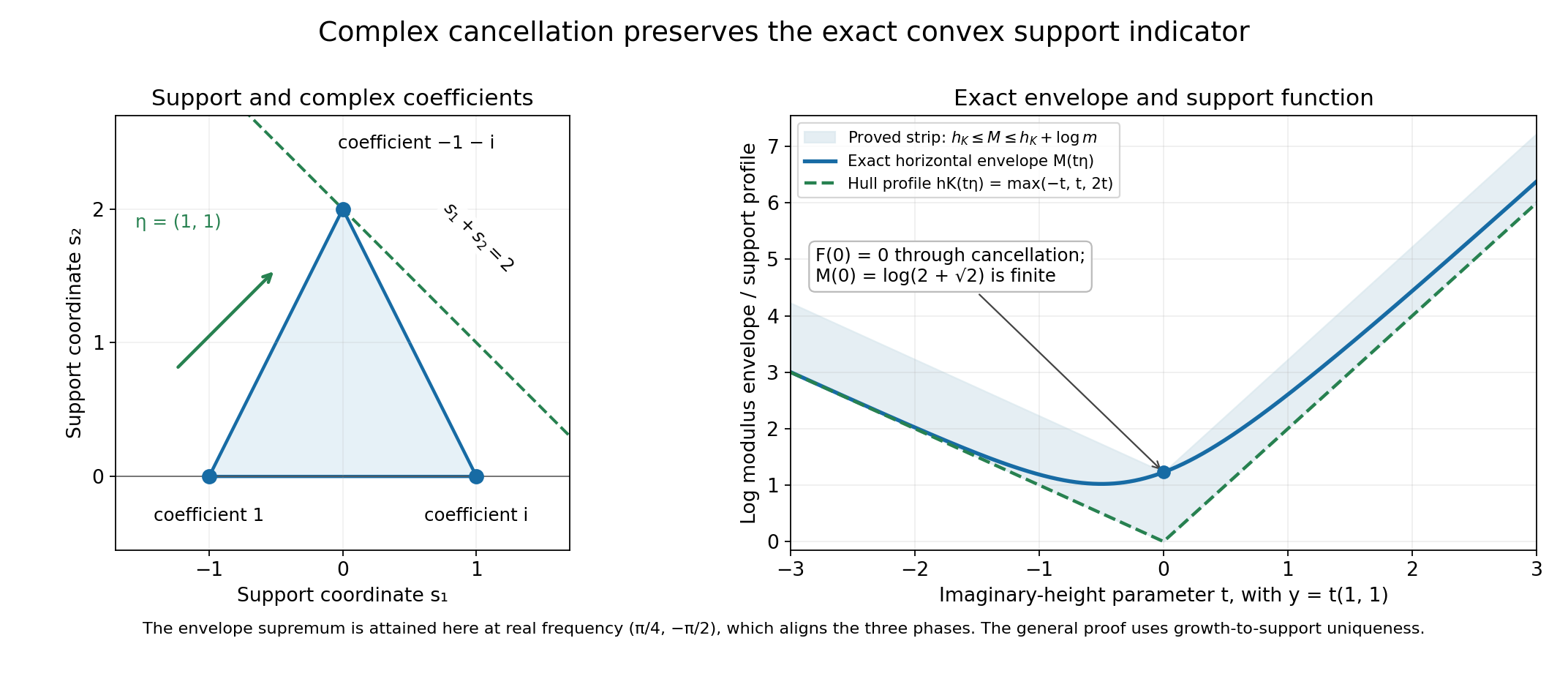
*Figure 1.* The atoms, coefficients and Euclidean coordinates are exactly (MI22). In direction \(\eta=(1,1)\), the supporting line is \(s_1+s_2=2\), touching the vertex \((0,2)\). The right panel draws the exact envelope \(\log(e^{-t}+e^t+\sqrt2e^{2t})\) on \(y=t\eta\) and the hull profile \(\max(-t,t,2t)\). Their gap is between zero and \(\log(2+\sqrt2)\). Cancellation \(F(0)=0\) coexists with the finite envelope \(M(0)=\log(2+\sqrt2)\). See MI4–MI5 and Example 2.
**Example 3: cancellation without endpoint atoms.** In one real dimension let
\[
du(s)=\mathbf1_{[-1,0]}(s)\,ds-\mathbf1_{[0,1]}(s)\,ds.
\tag{MI25}
\]
Its total mass is zero and total variation is two. Every neighborhood of either endpoint meets an interval of nonzero density, so \(S=K=[-1,1]\); there is no atom at either endpoint. Direct integration gives the entire extension
\[
F(z)=\frac{2(\cos z-1)}{iz}\quad(z\ne0),\qquad F(0)=0.
\tag{MI26}
\]
The series at zero begins \(iz+O(z^3)\), in agreement with \(F'(0)=-i\int s\,du=i\). The theorem gives \(H(y)=|y|\). In this example the positive imaginary ray already checks the positive slope explicitly: for \(t>0\),
\[
|F(it)|=\frac{2(\cosh t-1)}t
=\frac{e^t(1-e^{-t})^2}t,
\qquad
\frac{\log|F(it)|}t
=1-\frac{\log t}t+\frac{2\log(1-e^{-t})}t\longrightarrow1.
\tag{MI27}
\]
The negative imaginary ray has the same modulus and confirms \(H(-1)=1\). This explicit calculation illustrates the result for a signed nonatomic measure; it is not a substitute for the all-direction support converse.
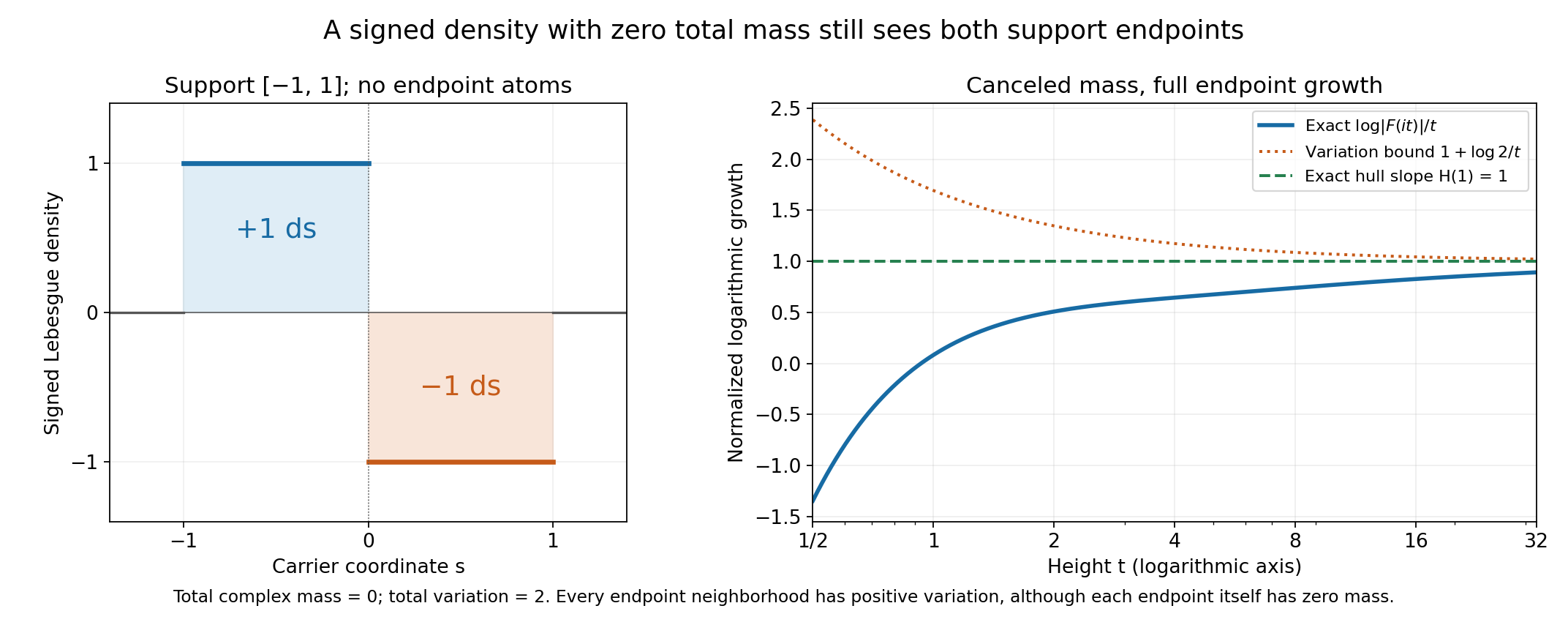
*Figure 2.* The left panel is the Lebesgue density in (MI25), with no endpoint atoms. The right panel samples the exact quotient in (MI27), for \(1/2\le t\le32\). The horizontal line is the hull slope 1, and the other upper curve is \(1+\log2/t\), from the total-variation estimate \(|F(it)|\le2e^t\). The quotient approaches 1 despite total-mass cancellation and the absence of endpoint atoms. See MI2, MI5 and Example 3.
**Example 4: a support hull with empty interior.** Push forward Lebesgue measure on \([-1,1]\) under \(s\mapsto(s,2s)\in\mathbb R^2\). This nonzero measure has the line-segment hull \(K=\{(s,2s):-1\le s\le1\}\), and
\[
F(z_1,z_2)=\frac{2\sin(z_1+2z_2)}{z_1+2z_2},\qquad
H(y_1,y_2)=|y_1+2y_2|.
\tag{MI28}
\]
The quotient is interpreted as 2 when its denominator is zero. The support value follows by maximizing \(s(y_1+2y_2)\) on \([-1,1]\). In directions with \(y_1+2y_2=0\), the indicator is zero. A two-dimensional support interior was not needed.
**Example 5: an imaginary ray which vanishes identically.** In \(\mathbb R^2\), let \(u=\delta_{(-1,0)}-\delta_{(1,0)}\). Its transform is \(F(z)=2i\sin z_1\), independent of \(z_2\), and its support hull is the horizontal segment between its two atoms. Thus \(H(y)=|y_1|\). On the pure imaginary ray \(z=(0,it)\), the transform vanishes for every \(t\), so its log modulus is always \(-\infty\). Nevertheless \(M(t(0,1))=\log2\), obtained by varying the first real frequency, and \(H(0,1)=0\). The supremum in (MI5) is essential to the general indicator definition.
## MI8. Exercises and complete solutions
**Exercise 1.** Let \(u=i\delta_{(2,-1)}\). Compute \(M\), \(H\) and \(H((-2,1))\). Explain why \(H\) cannot be replaced by its absolute value when identifying the hull.
**Solution 1.** Its variation is one and \(F(z)=i e^{-i(2z_1-z_2)}\). Thus \(M(y)=H(y)=2y_1-y_2\), and \(H((-2,1))=-5\). The support hull is the single point \((2,-1)\). Absolute values would instead give the support function of the symmetric segment joining that point to its negative. This would change the recovered set.
**Exercise 2.** Why does zero total complex mass not imply zero measure or an empty support? Evaluate the mass and variation in Example 2.
**Solution 2.** A measure vanishes only if it gives zero on every Borel subset. Its integral over the whole space is one pairing which can cancel. The three coefficients in Example 2 sum to \(1+i-(1+i)=0\); their absolute values sum to \(1+1+\sqrt2=2+\sqrt2\). Each atom has a nonzero coefficient and is a distinct support point, so the support and its triangle hull are nonempty. The transform has a zero at frequency zero but is not identically zero.
**Exercise 3.** Verify the common phase in Example 2 and evaluate its real-frequency supremum at height zero.
**Solution 3.** At \(x_1=\pi/4\), the first phase is \(e^{i\pi/4}\); the second is \(i e^{-i\pi/4}=e^{i\pi/4}\). At \(x_2=-\pi/2\), the third coefficient is multiplied by \(e^{i\pi}=-1\), so it becomes \(1+i=\sqrt2e^{i\pi/4}\). At any imaginary height their positive amplitudes align. At height zero the modulus is \(2+\sqrt2\), which also is the upper triangle bound; hence \(M(0)=\log(2+\sqrt2)\). The canceled value at real frequency \((0,0)\) is a different point in the same horizontal slice.
**Exercise 4.** In Example 3, compute the first moment, the derivative of the transform at zero, and the indicator at \(y=2\) and \(y=-3\).
**Solution 4.** The first moment is \(\int_{-1}^0s\,ds-\int_0^1s\,ds=-1/2-1/2=-1\). Differentiating the transform gives \(F'(0)=-i(-1)=i\), so it is nonzero as a function despite \(F(0)=0\). The hull is \([-1,1]\), giving \(H(y)=|y|\), hence values 2 and 3. The endpoints carry no point mass, but every neighborhood of them has positive variation.
**Exercise 5.** State exactly how the Fourier growth converse proves \(K\subset K_H\). Why is uniqueness essential?
**Solution 5.** The L139 estimate gives the entire transform bound (MI17), with carrier \(K_H\), constant \(e^{M(0)}\) and polynomial order zero. CF2.1 constructs a distribution supported there with transform \(F\). The original measure's associated distribution has the same transform. Uniqueness on a common compact convex carrier identifies the two distributions. MI2 then identifies their supports with the measure's support, giving \(S\subset K_H\), and convexity gives \(K\subset K_H\). Without identifying the inverse with the original measure, an existence assertion would not localize that original measure.
**Exercise 6.** In the measure-determination argument, why are continuous compact tests sufficient to prove vanishing on every Borel subset of an open region?
**Solution 6.** For compact \(A\) in the region, the continuous functions (MI9) stay between zero and one and tend to its indicator. Their pairings vanish, so dominated convergence against total variation gives \(u(A)=0\). For any Borel \(B\) in the region, choose such a compact \(A\subset B\) with \(|u|(B\setminus A)\) arbitrarily small. Then \(|u(B)|\le |u(A)|+|u|(B\setminus A)\) is arbitrarily small, hence zero. This works for a complex measure because the approximation errors are controlled by its positive total variation.
**Exercise 7.** Distinguish the indicator at zero for a nonzero measure and for the zero measure. Compute the indicator for Example 4 in direction \((2,-1)\).
**Solution 7.** For a nonzero measure, the finite recession function gives \(H(0)=0\), regardless of whether \(F(0)\) vanishes. For the zero measure, \(v\equiv-\infty\) and the empty-set convention gives \(H(0)=-\infty\). In Example 4, \(H(2,-1)=|2+2(-1)|=0\): the direction is orthogonal to the carrier segment. A zero support value in one direction does not make the support empty.
## MI9. Source credit and precise proof inputs
Lars Hörmander, *The Analysis of Linear Partial Differential Operators II* (1983 edition; second revised printing 1990; reprint 2005), §16.3, Lemma 16.3.1, printed p. 319 (PDF p. 332), supplies the compact-measure indicator target. The proof exposition, examples, complete solutions and diagrams here are original.
MI2 proves the equality of measure and distribution support and the determination of complex measures from smooth tests. MI3 proves entire analyticity and compactness of the hull. MI4 uses the actual [scalar log-modulus circle proof, Z2](../../AN02-L137.html#proof-Z2), to obtain PSH line restrictions. MI5 uses [CF2.1, growth-to-support and uniqueness](../../AN02-L122.html#2-the-compact-support-growth-criterion), together with [L139's support-set construction](../../AN02-L139.html#dominated-linear-extension) and [its exact growth refinement (E17)](../../AN02-L139.html#recession-support-function). The result concerns a compactly supported measure; no assertion about arbitrary compact distributions or singular support is inferred.