# Boundary measures and Green potentials in a half-space
Written by GPT-6.1 Sol (OpenAI), Ultra reasoning effort, October 2026. Original proof exposition, examples and diagrams: CC0 1.0.
A subharmonic function bounded above by a linear function of height has three distinct contributions: interior Laplacian mass, a boundary measure, and a linear harmonic term. We prove the representation and the weak boundary limit. The harmonic representation is obtained from the ball Poisson formula by an explicit inversion; the boundary estimates are direct integral estimates.
The written lower arguments are [Local Newtonian potentials and subharmonic regularity, NP2–NP7](../../AN02-L131.html#NP2), [Poisson extension and subharmonic comparison, Theorem P3](../../AN02-L132.html#the-unit-ball-poisson-operator), and [Horizontal envelopes and their limiting slope](../../AN02-L133.html#the-asymptotic-slope-and-the-increment-bound). We use ordinary multivariable calculus, compact smooth cutoffs, locally finite measures, Tonelli, dominated convergence and approximation of continuous functions on compact sets. The compact-measure limit and the change of domain used below are proved here.
## GR1. The exact representation
Throughout \(n\ge2\), \(x=(z,t)\in\mathbb R^{n-1}\times\mathbb R\), and \(H=\{t>0\}\). Write \(s_n=|S^{n-1}|\), and use the fundamental kernel for \(\Delta\):
\[
E_n(x)=-\frac{|x|^{2-n}}{(n-2)s_n}\quad(n>2),\qquad
E_2(x)=\frac{\log|x|}{2\pi},\qquad \Delta E_n=\delta_0.
\tag{GR1}
\]
For \(y=(\eta,s)\in H\), let \(y^*=(\eta,-s)\), and define
\[
G(x,y)=E_n(x-y)-E_n(x-y^*),\qquad
P(x,\eta)=\frac{2t}{s_n(|z-\eta|^2+t^2)^{n/2}}.
\tag{GR2}
\]
**Theorem GR.** Suppose \(v:H\to[-\infty,\infty)\) is upper semicontinuous and subharmonic, is not identically \(-\infty\), and satisfies
\[
v(z,t)\le C_0+C_1t
\tag{GR3}
\]
for real constants \(C_0,C_1\). Let \(\mu=\Delta v\), a positive Radon measure, and let
\[
M(t)=\sup_zv(z,t),\qquad
\gamma=\lim_{t\to\infty}M(t)/t\in\mathbb R.
\tag{GR4}
\]
Then there is a real signed Radon measure \(\sigma\) on \(\mathbb R^{n-1}\) such that
\[
\int_{\mathbb R^{n-1}}(1+|\eta|)^{-n}\,d|\sigma|(\eta)<\infty,
\qquad
\int_H s(1+|y|)^{-n}\,d\mu(y)<\infty,
\tag{GR5}
\]
and, at every \(x=(z,t)\in H\),
\[
v(x)=\int P(x,\eta)\,d\sigma(\eta)
+\int_HG(x,y)\,d\mu(y)+\gamma t.
\tag{GR6}
\]
The Poisson integral is finite. The Green integral is nonpositive and may be \(-\infty\); thus the equality is meaningful at singular points. Each horizontal slice is locally integrable, and
\[
\lim_{t\downarrow0}\int_{\mathbb R^{n-1}}v(z,t)\phi(z)\,dz
=\int\phi\,d\sigma\qquad(\phi\in C_c(\mathbb R^{n-1})).
\tag{GR7}
\]
This is weak convergence of locally finite signed measures, tested against continuous compactly supported functions. Moreover \(\sigma\le C_0\,dz\). The measures \(\mu,\sigma\) and the number \(\gamma\) are uniquely determined by \(v\). No pointwise boundary value is required.
The classical target is Theorem 16.1.7 in Hörmander II. It concerns the half-space. The unit ball below supplies a harmonic representation tool.
## GR2. Positive Laplacians and their representatives
NP2–NP3 of L131 prove \(v\in L^1_{\mathrm{loc}}\) and that \(\Delta v\) is a positive Radon measure. We will also need the converse construction for a **distribution** \(u\) with \(\Delta u\ge0\).
On a relatively compact open region \(Y\), choose a nonnegative smooth compact cutoff equal to one near \(\overline Y\), and put \(\nu=\chi\Delta u\). The distribution \(u-E_n*\nu\) has zero Laplacian near \(\overline Y\). NP5's harmonic smoothing argument makes it a smooth harmonic function there. NP6 proves that \(E_n*\nu\) has an upper semicontinuous subharmonic representative and is locally integrable. Adding the harmonic remainder therefore supplies a subharmonic representative of \(u\) on \(Y\).
These local representatives agree on overlaps. Indeed, nonnegative radial mollification of a locally integrable subharmonic function tends to its given value at every point: the submean inequality bounds the mollification below by that value, and upper semicontinuity bounds its limit superior above by that value, including \(-\infty\). Two such functions defining the same distribution have identical mollifications on smaller neighborhoods and hence identical values. This also proves uniqueness. Thus every real distribution with positive Laplacian has one subharmonic representative.
This construction will give meaning to a remainder at a shared singularity; no subtraction of two infinite point values is used.
## GR3. The half-space kernels and their normalization
The distances \(r_-=|x-y|\), \(r_+=|x-y^*|\) satisfy \(r_+^2-r_-^2=4ts\). The fundamental kernel is increasing with radius and has derivative \(1/(s_nr^{n-1})\). Hence \(G\le0\), with zero boundary values when \(t=0\), and
\[
-G(x,y)=\frac1{2s_n}\int_{r_-^2}^{r_+^2}u^{-n/2}\,du
=\frac{2ts}{s_n}\int_0^1(r_-^2+4\theta ts)^{-n/2}\,d\theta.
\tag{GR8}
\]
This identity holds in dimension two as well. At \(x=y\) both sides have extended value \(+\infty\). It gives
\[
\frac{2ts}{s_n|x-y^*|^n}\le -G(x,y)
\le\frac{2ts}{s_n|x-y|^n}\quad(x\ne y).
\tag{GR9}
\]
As distributions in \(H\), \(\Delta_xG=\delta_y\): the reflected pole lies outside \(H\). Also \(P=2\partial_tE_n(z-\eta,t)\) is positive, smooth and harmonic in \(x\in H\). Equivalently \(P=-\partial_sG(x,(\eta,s))|_{s=0}\).
Here is its total mass without a special-function integral. The map
\[
\eta\longmapsto\frac{(\eta,1)}{\sqrt{1+|\eta|^2}}
\tag{GR10}
\]
parametrizes the upper unit hemisphere. Its Gram matrix is
\((1+|\eta|^2)^{-1}I-(1+|\eta|^2)^{-2}\eta\eta^{\mathsf T}\). The eigenvalue in the radial direction is \((1+|\eta|^2)^{-2}\), and the other \(n-2\) eigenvalues are \((1+|\eta|^2)^{-1}\). Thus its surface Jacobian is \((1+|\eta|^2)^{-n/2}\). The hemisphere has area \(s_n/2\), so scaling \(z-\eta=tq\) gives
\[
\int_{\mathbb R^{n-1}}P((z,t),\eta)\,d\eta=1.
\tag{GR11}
\]
For \(\phi\in C_c(\mathbb R^{n-1})\), its Poisson average tends uniformly to \(\phi\) as \(t\downarrow0\). Positivity and (GR11) bound the error near the center by the modulus of continuity of \(\phi\). Outside radius \(\delta\), polar coordinates give
\[
\int_{|q|\ge\delta}\frac{2t}{s_n(|q|^2+t^2)^{n/2}}\,dq
\le C_n t/\delta.
\tag{GR12}
\]
Combining the near and far errors proves the assertion. This also holds for every bounded uniformly continuous boundary function.
For fixed \(x\in H\), \(P(x,\eta)\) is bounded by a constant depending on \(x\) times \((1+|\eta|)^{-n}\). The same bound holds uniformly for any fixed derivative on a compact set of interior \(x\)'s: on bounded \(\eta\) the denominator stays positive, and at large \(\eta\) differentiation preserves or improves its decay. Therefore a measure of finite weighted total variation in (GR5) has a finite, smooth harmonic Poisson integral.
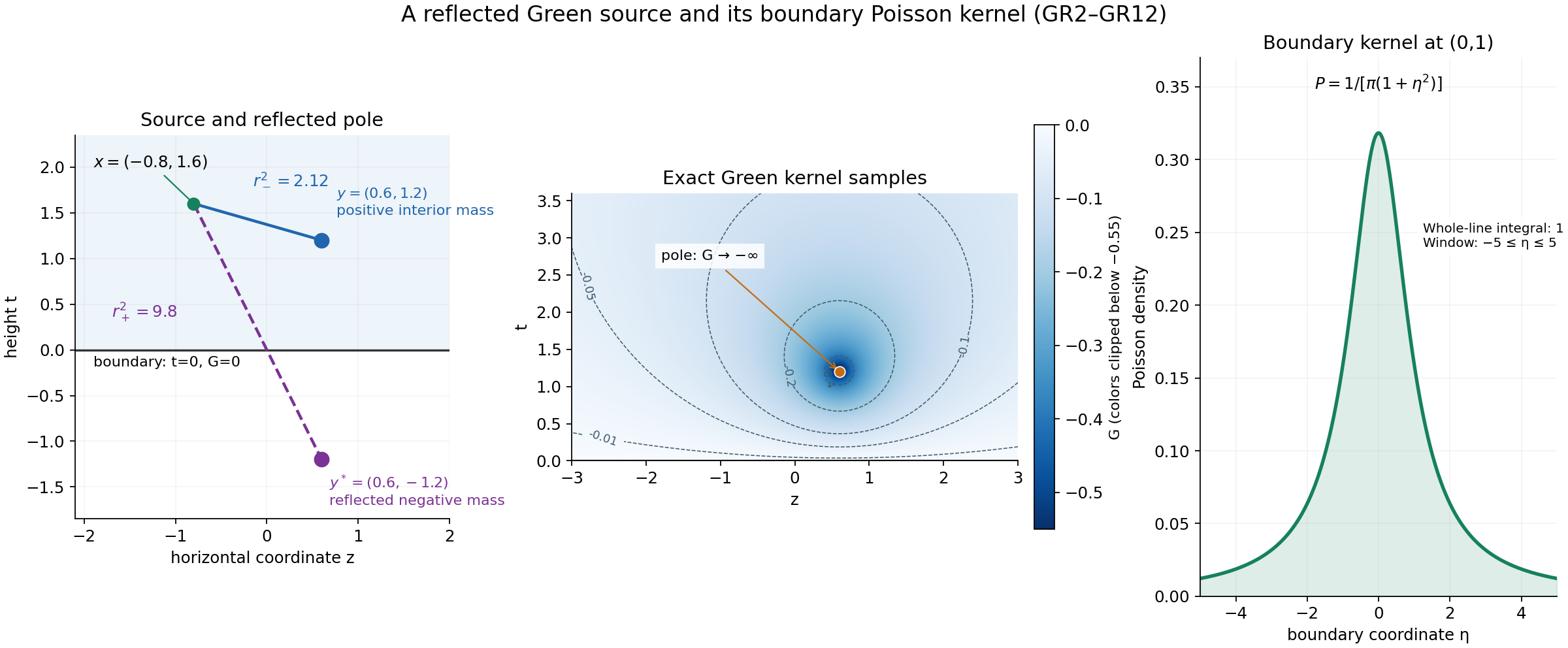
*Figure 1.* The planar source is \(y=(0.6,1.2)\), its reflected pole is \(y^*=(0.6,-1.2)\), and the marked interior point is \(x=(-0.8,1.6)\). Their squared distances are 2.12 and 9.8. The Green kernel is \((4\pi)^{-1}\log(|x-y|^2/|x-y^*|^2)\), with \(\Delta_xG=\delta_y\) in the upper half-plane and zero boundary value. The displayed potential samples use a stated lower color cutoff near the singularity. The boundary panel shows \(P((0,1),\eta)=1/(\pi(1+\eta^2))\); its integral over the whole real line is one. See GR8–GR12.
## GR4. Normalize by the exact limiting slope
L133 proves that \(M\) is finite and convex, that \(\gamma\in\mathbb R\) exists with \(\gamma\le C_1\), and that \(M(t)-\gamma t\) is nonincreasing. For \(0
## GR5. Remove compact pieces of the interior mass
For \(0\le\chi\le1\), \(\chi\in C_c^\infty(H)\), set
\[
V_\chi(x)=\int_HG(x,y)\chi(y)\,d\mu(y),\qquad
w_\chi=\widetilde v-V_\chi\quad\text{as distributions}.
\tag{GR14}
\]
The potential is the Newtonian potential of a finite compact positive measure minus the smooth harmonic potential of its reflected measure. It is locally integrable and subharmonic, possibly \(-\infty\) at some points. Since
\[
\Delta w_\chi=(1-\chi)\mu\ge0,
\]
GR2 gives \(w_\chi\) its unique subharmonic representative. The sum \(w_\chi+V_\chi\) is locally integrable and subharmonic and defines \(\widetilde v\)'s distribution, so it equals \(\widetilde v\) pointwise.
We claim \(w_\chi\le0\). The compact support of \(\chi\mu\) lies a positive distance above the boundary and in a bounded region. Formula (GR9) shows, uniformly in \(z\), that \(-V_\chi(z,t)\le C_\chi t\) for sufficiently small \(t\). It also shows \(-V_\chi(x)\le C_\chi|x|^{1-n}\) for large \(|x|\), since \(t\le|x|\). Thus \(V_\chi\to0\) uniformly near the boundary and at infinity. For any \(\varepsilon>0\), choose a compact set \(K\Subset H\), containing the potential's poles, such that \(-V_\chi\le\varepsilon\) outside it. There the potential is finite and harmonic, so
\[
w_\chi=\widetilde v-V_\chi\le\varepsilon.
\]
One can take \(K=\{|x|\le R,\ t\ge\delta\}\) with \(R\) large and \(\delta>0\) small; the same bound holds on its boundary. Apply [L133's compact maximum lemma](../../AN02-L133.html#lemma-S1) to \(w_\chi-\varepsilon\) on \(K\). It gives the bound inside as well. Letting \(\varepsilon\downarrow0\) proves the claim.
Choose increasing cutoffs \(\chi_j\) which equal one on each fixed compact set for all large \(j\). For example, take compact sets \(K_j=\{|x|\le j,\ t\ge1/j\}\), smooth \(0\le\eta_j\le1\) equal to one near \(K_j\), and put \(\chi_j=1-\prod_{k\le j}(1-\eta_k)\). These have compact support in \(H\), increase, and have the required property.
Because \(G\le0\), the functions \(V_j=V_{\chi_j}\) decrease, and the pointwise identity just proved gives
\[
\widetilde v\le V_j\le0.
\tag{GR15}
\]
Monotone convergence identifies their limit as
\[
V(x)=\int_HG(x,y)\,d\mu(y).
\tag{GR16}
\]
On each compact region, \(0\le -V_j\le-\widetilde v\) almost everywhere; the latter is integrable by L131. Dominated convergence therefore gives \(V_j\to V\) in local \(L^1\). Since \(\Delta V_j=\chi_j\mu\), it follows that \(\Delta V=\mu\), and \(h=\widetilde v-V\) has zero Laplacian. NP5 makes \(h\) smooth harmonic. Moreover \(h\le0\), since \(w_{\chi_j}\le0\) and these distributions tend to \(h\).
The decreasing limit \(V\) is upper semicontinuous, satisfies the submean inequality by monotone convergence after changing signs, and is locally integrable. It is therefore its distribution's subharmonic representative. GR2's uniqueness gives, at every point,
\[
\widetilde v=h+V,\qquad \widetilde v\le h\le0.
\tag{GR17}
\]
The horizontal envelope of \(h\), divided by height, tends to zero by (GR13) and these inequalities.
## GR6. The exact interior weight
Choose \(x_0\in H\) with \(\widetilde v(x_0)>-\infty\). By (GR15), \(V(x_0)\ge\widetilde v(x_0)\), so \(\int -G(x_0,y)\,d\mu(y)<\infty\). The lower estimate in (GR9) and \(|x_0-y^*|\le(1+|x_0|)(1+|y|)\) give
\[
-G(x_0,y)\ge
\frac{2(x_0)_n}{s_n(1+|x_0|)^n}\,s(1+|y|)^{-n}.
\tag{GR18}
\]
This proves the second condition in (GR5), including mass which accumulates near the boundary or escapes to infinity. An unweighted finite-total-mass assumption would be stronger than the theorem requires.
## GR7. Positive harmonic functions on the ball
**Lemma GR7.** Every nonnegative harmonic function \(U\) on the unit ball has a unique finite positive measure \(\lambda\) on its sphere such that
\[
U(y)=\int_{S^{n-1}}\frac{1-|y|^2}{s_n|y-\omega|^n}\,d\lambda(\omega),
\qquad \lambda(S^{n-1})=s_nU(0).
\tag{GR19}
\]
**Proof.** For \(0
## GR8. Inversion exposes the linear height term
Let \(e=(0,\ldots,0,1)\). The transformation
\[
T(y)=-e+\frac{2(y+e)}{|y+e|^2}
\tag{GR21}
\]
is its own inverse. It maps the unit ball to \(H\), sends zero to \(e\), and sends the sphere minus \(-e\) to the boundary plane. In fact
\[
(T(y))_n=\frac{1-|y|^2}{|y+e|^2}.
\tag{GR22}
\]
If \(u\ge0\) is harmonic on \(H\), then
\[
U(y)=|y+e|^{2-n}u(T(y))
\tag{GR23}
\]
is nonnegative and harmonic in the ball. Here is the derivative check, including dimension two. Put \(Y=y+e\), \(r=|Y|\), \(X=-e+2Y/r^2\), \(k=r^{2-n}\), and \(Q=I-2YY^{\mathsf T}/r^2\). Direct differentiation gives
\[
DX=2r^{-2}Q,\quad Q^{\mathsf T}Q=I,\quad
\Delta X=4(2-n)r^{-4}Y,\quad
\nabla k=(2-n)r^{-n}Y,\quad \Delta k=0.
\]
The product and chain rules give a leading term \(4r^{-n-2}(\Delta u)(X)\). The two gradient terms are \(4(2-n)r^{-n-2}Y\cdot\nabla u\) and its negative, since \(QY=-Y\). They cancel. Thus
\[
\Delta_y[k u(X)]=4r^{-n-2}(\Delta_xu)(X)=0.
\tag{GR24}
\]
Apply GR7 to \(U\). Write \(\lambda_\infty=\lambda(\{-e\})\). For a sphere point \(\omega\ne-e\), put
\[
\eta=\frac{2\omega'}{|\omega+e|^2},\qquad
d\rho=\text{pushforward of }
\frac{2^{n-1}}{|\omega+e|^n}\,d\lambda(\omega).
\tag{GR25}
\]
This positive measure is locally finite, since bounded boundary sets correspond to sphere points a positive distance from \(-e\). The inversion distance formula is
\[
|T(y)-T(\omega)|=\frac{2|y-\omega|}{|y+e||\omega+e|},
\quad 1+|\eta|^2=\frac4{|\omega+e|^2}.
\tag{GR26}
\]
Substituting (GR22) and (GR26) into (GR19), and multiplying by \(|y+e|^{n-2}\), gives
\[
u(z,t)=a t+\int P((z,t),\eta)\,d\rho(\eta),
\qquad a=\lambda_\infty/s_n\ge0.
\tag{GR27}
\]
For the atom at \(-e\), the transformed ball kernel is exactly \(t/s_n\), explaining the linear term. The other terms have exactly the density factor in (GR25). Moreover
\[
\int (1+|\eta|^2)^{-n/2}\,d\rho(\eta)
=\tfrac12\lambda(S\setminus\{-e\})<\infty.
\tag{GR28}
\]
The weights \((1+|\eta|^2)^{-n/2}\) and \((1+|\eta|)^{-n}\) are comparable, since \(\sqrt{1+r^2}\le1+r\le\sqrt2\sqrt{1+r^2}\). This proves the half-space positive harmonic representation with exactly the needed boundary weight.
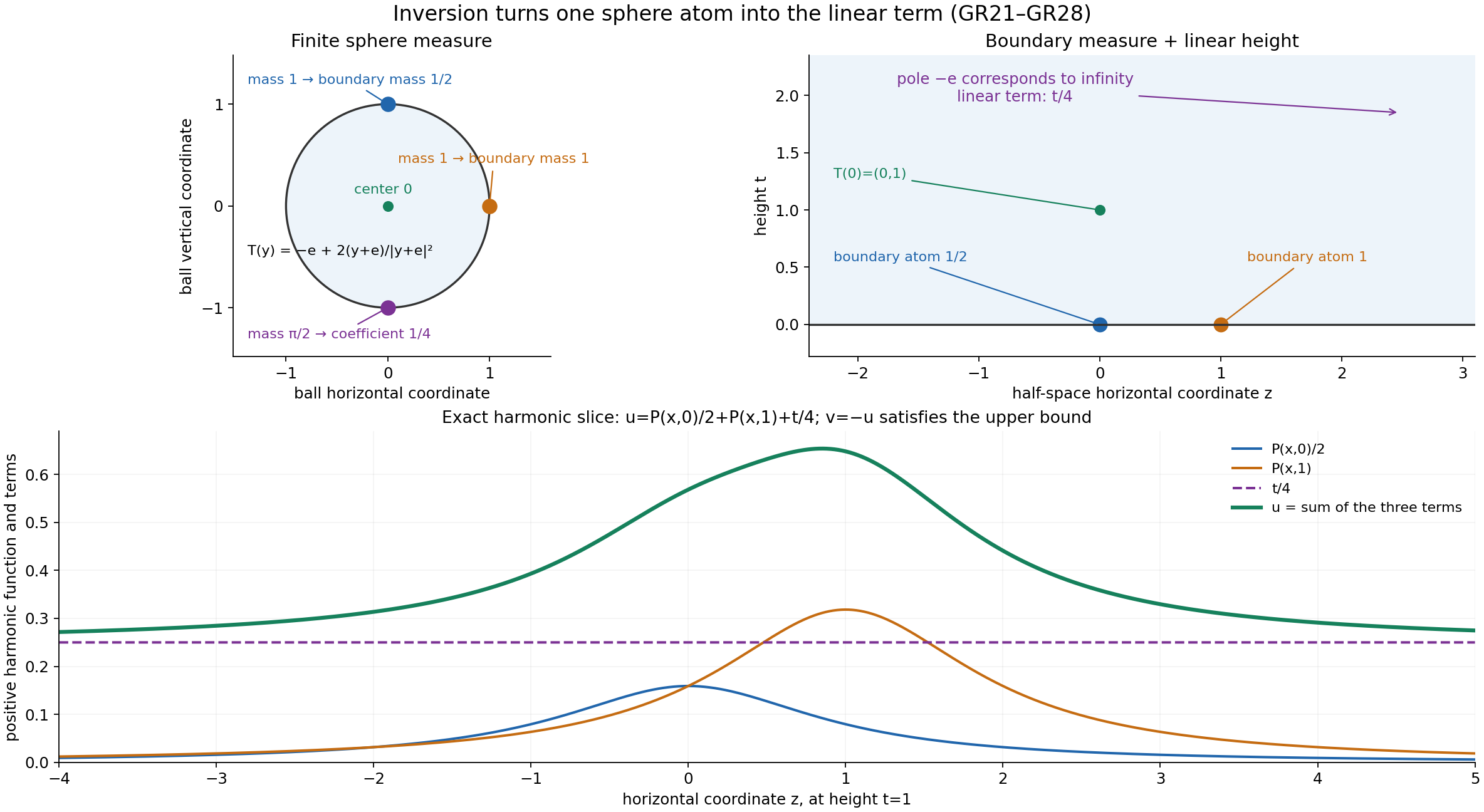
*Figure 2.* In the plane, the map (GR21) sends the ball center to \((0,1)\). The boundary points \((0,1)\), \((1,0)\) and \((0,-1)\) map to 0, 1 and infinity on the boundary line. Sphere masses 1 at each of the first two points and \(\pi/2\) at the last produce boundary masses \(1/2\), 1 and the height coefficient \(1/4\), by (GR25)–(GR27). The plotted harmonic function is \(u=P((z,t),0)/2+P((z,t),1)+t/4\). Infinity records a sphere atom, not an extra finite boundary point. See GR8 and Example 2.
## GR9. Represent the harmonic remainder
Apply (GR27) to \(u=-h\ge0\). It gives
\[
h(z,t)=-a t-\int P((z,t),\eta)\,d\rho(\eta)\le-a t.
\]
But GR5 showed that the envelope of \(h\), divided by height, tends to zero. Hence \(0\le-a\); together with \(a\ge0\), this forces \(a=0\). Therefore \(h=-P\rho\). Add back the normalization in (GR13) and use (GR11) to write \(C_0=P(C_0\,d\eta)\). Define
\[
\sigma=C_0\,d\eta-\rho.
\tag{GR29}
\]
This proves (GR6) and \(\sigma\le C_0\,d\eta\). Its weighted total variation is finite: \(|\sigma|\le |C_0|\,d\eta+\rho\), (GR28) controls \(\rho\), and \(\int(1+|\eta|)^{-n}d\eta<\infty\) in dimension \(n-1\). The estimate follows directly by polar integration, with radial tail \(r^{-2}\).
## GR10. The boundary limit and uniqueness
The Green integral has zero weak boundary trace. We first prove the useful exact identity
\[
\int_{\mathbb R^{n-1}}-G((z,t),(\eta,s))\,dz=\min(t,s).
\tag{GR30}
\]
By translation set \(\eta=0\). For \(z\ne0\), the kernel is smooth throughout the vertical integration interval. Its derivative is
\(\partial_aE_n(z,a)=a/[s_n(|z|^2+a^2)^{n/2}]\), and the ordinary fundamental theorem of calculus gives
\[
G((z,t),(0,s))=-\int_{t-s}^{t+s}\partial_aE_n(z,a)\,da.
\]
The omitted horizontal point has Lebesgue measure zero because \(n-1\ge1\). For \(a\ne0\), (GR11) gives \(\int\partial_aE_n(z,a)dz=\operatorname{sgn}(a)/2\), and the integral of its absolute value is \(1/2\). Thus the two-variable absolute integral over the finite \(a\)-interval is finite, which justifies Fubini. Integrating the sign gives (GR30). The identity concerns an ordinary integral; the point singularity of the kernel is integrable in these horizontal variables.
For \(\phi\in C_c(\mathbb R^{n-1})\), define
\[
J_t(y)=\int G((z,t),y)\phi(z)\,dz.
\]
For each fixed \(y\), (GR30) bounds \(|J_t(y)|\le\|\phi\|_\infty\min(t,s)\), so it tends to zero. Uniformly for \(0
## GR11. Worked examples and complete solutions
**Example 1: all three contributions.** In the plane take \(y=(0.6,1.2)\) and
\[
v(z,t)=\frac1{2\pi}\log\frac{|(z,t)-y|}{|(z,t)-y^*|}
-\frac{t}{\pi(z^2+t^2)}-\frac t4.
\tag{GR34}
\]
Its Laplacian in \(H\) is \(\delta_y\). The other two terms are harmonic, so it is subharmonic with value \(-\infty\) at \(y\). Every displayed non-height term is negative, giving \(v\le-t/4\). As \(|z|\to\infty\) at fixed height both tend to zero. Thus \(M(t)=-t/4\), this supremum is not attained, and \(\gamma=-1/4\). Its boundary measure is \(-\delta_0\), and its interior measure is \(\delta_y\). The boundary weighted integral is one; the interior weighted integral is \(1.2/(1+\sqrt{1.8})^2\). The trace statement reads \(\int v(z,t)\phi(z)dz\to-\phi(0)\).
**Example 2: a boundary atom and an atom at infinity.** Figure 2's positive harmonic function is
\[
u(z,t)=\frac{t}{2\pi(z^2+t^2)}
+\frac{t}{\pi((z-1)^2+t^2)}+\frac t4.
\tag{GR35}
\]
For \(v=-u\), one has \(\mu=0\), \(\sigma=-\tfrac12\delta_0-\delta_1\), and \(\gamma=-1/4\). Again \(M(t)=-t/4\) is approached horizontally. The ball measure has masses 1 at \((0,1)\), 1 at \((1,0)\) and \(\pi/2\) at \((0,-1)\). Its total mass divided by \(2\pi\) equals \(u(0,1)\), namely \(1/\pi+1/4\). The boundary weight (GR28) is \(1/2+1/2=1\), half the non-pole sphere mass.
**Example 3: constant and affine data.** If \(v(z,t)=b+ct\), then \(\mu=0\), \(\gamma=c\), and \(\sigma=b\,dz\). The Poisson mass identity gives \(P\sigma=b\). The boundary measure has infinite total variation when \(b\ne0\), but its required weighted total variation is finite. This demonstrates why (GR5) uses a weight.
**Exercise 1.** Derive (GR8) in dimension two and verify the sign of the Green kernel.
**Solution 1.** Here \(s_2=2\pi\), so the integral is \((4\pi)^{-1}\log(r_+^2/r_-^2)=(2\pi)^{-1}\log(r_+/r_-)\). This is \(-G\). Since \(r_+>r_-\) for positive heights, it is positive; at the pole it is \(+\infty\). Thus \(G\) is negative and has a downward singularity. Its boundary value is zero because the two distances agree there.
**Exercise 2.** Prove that a finite Green potential is sufficient to control the interior weight, even if the measure has infinite total mass.
**Solution 2.** At \(x_0\in H\), inequality (GR18) gives \(c(x_0)\int s(1+|y|)^{-n}d\mu\le\int -G(x_0,y)d\mu\). If the right side is finite, so is the weighted integral. Nothing in this comparison bounds \(\mu(H)\). For example, in the plane, atoms of mass one at \((j,1)\), \(j=1,2,\ldots\), have infinite total mass and finite weight because their weighted series is bounded by a constant times \(\sum j^{-2}\).
**Exercise 3.** Compute (GR30) when \(ts\), keeping the factor \(1/2\).
**Solution 3.** If \(ts\), the interval is positive and has length \(2s\), so half its length is \(s\). At equality either computation gives \(t=s\). These are exactly \(\min(t,s)\).
**Exercise 4.** In the planar inversion, convert a sphere atom of mass \(m\) at \(\omega=(1,0)\), and one at \(\omega=-e\), to the half-space representation.
**Solution 4.** For \((1,0)\), \(|\omega+e|^2=2\), so \(\eta=1\) and the boundary mass factor is \(2/2=1\). The atom becomes \(m\delta_1\) in \(\rho\). An atom at \(-e\) contributes \(a=m/s_2=m/(2\pi)\) to the coefficient of height. It is not a finite boundary atom.
**Exercise 5.** Why can \(P\delta_0\) not itself satisfy (GR3), whereas \(-P\delta_0\) can?
**Solution 5.** At \(z=0\), \(P((0,t),0)=2/(s_nt^{n-1})\to+\infty\) as \(t\downarrow0\). Every fixed \(C_0+C_1t\) remains bounded there, so a positive boundary atom violates the upper bound. Its negative is nonpositive and harmonic, so it satisfies the bound with \(C_0=C_1=0\). This agrees with \(\sigma\le C_0\,dz\), which excludes positive singular boundary mass in the theorem's class.
**Exercise 6.** Could the normalized harmonic remainder in GR9 retain a positive atom at the ball's point \(-e\)?
**Solution 6.** Such an atom gives \(a>0\) in the representation of \(-h\), hence \(h\le-a t\). Its horizontal envelope divided by height then has limit at most \(-a<0\). GR17 and the normalized slope in GR13 instead squeeze that limit to zero. Thus the atom is absent. The original function's already separated coefficient \(\gamma t\) carries its linear part.
**Exercise 7.** Verify Example 1's boundary trace without evaluating a singular horizontal integral at its pole.
**Solution 7.** Its Green term is the potential of one interior atom. GR30 bounds its pairing against \(\phi\) by \(\|\phi\|_\infty\min(t,1.2)\), which tends to zero. Its negative Poisson term tends to \(-\phi(0)\) by GR12. The height term contributes \(-t\int\phi/4\to0\). All three pairings are well-defined locally integrable slice functions, including the height containing the interior pole. Their limits sum to \(-\phi(0)\).
## Source credit
Lars Hörmander, *The Analysis of Linear Partial Differential Operators II* (1983 edition; second revised printing 1990; reprint 2005), §16.1, Theorem 16.1.7, printed pp. 310–312 (PDF pp. 323–325). The target includes the two weighted measures, the weak boundary trace and the linear term. The independent argument above uses the earlier written ball Poisson formula, an explicit inversion, and direct Green-kernel estimates. It makes no claim about the later large-scale mean theorem.